
Vintage Living Room Decor That Reads Thrifted Cottage, Not Thrift Store

No estate sale connections. No reno budget. No landlord who says yes to paint.
Vintage living room decor still works in a 700 square foot rental, and it comes together faster than you’d think, because the thrifted cottage look runs on three pieces instead of thirty.
Here’s the part the idea roundups skip. A room full of old things does not read charming by default. It reads like a storage unit with a sofa in it. What separates the two is a short set of rules about wood tone, price ceilings, and which pieces you walk away from.
That’s the whole article. Rules first, then the shopping.
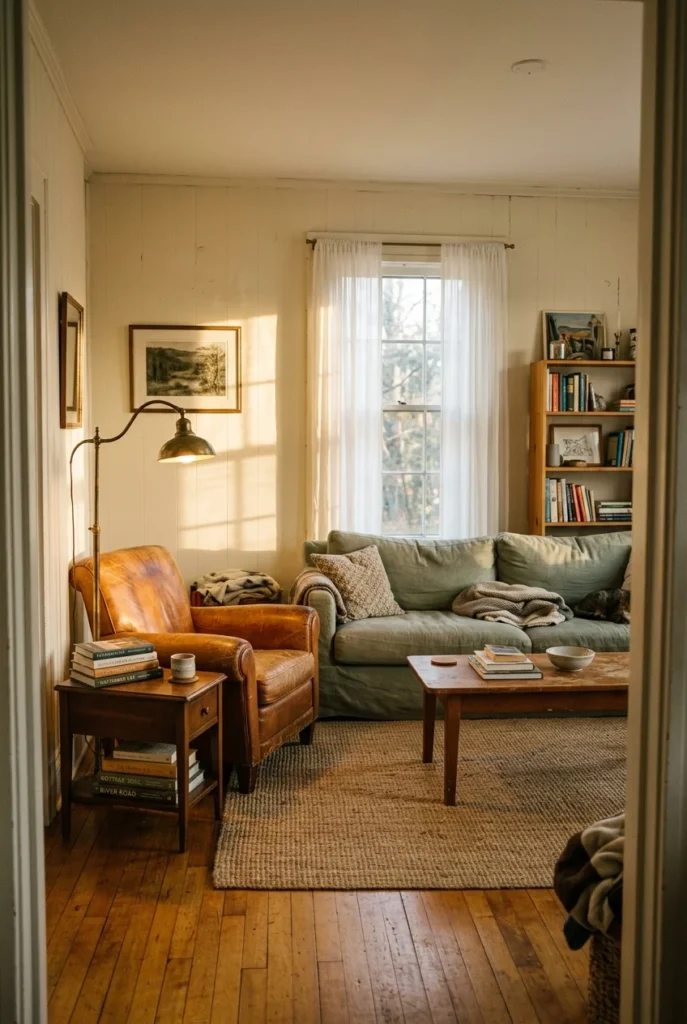
The Three-Piece Rule that makes a thrifted room look collected
Buy one wood anchor, one soft anchor, and one odd thing. In that order. Everything else in the room can be new, cheap, or inherited, and the room will still read vintage.
The wood anchor is a real piece of solid wood furniture with visible age. A round pedestal side table. A low walnut bookcase. A pine blanket chest doing coffee table duty. One piece, doing the heavy lifting.
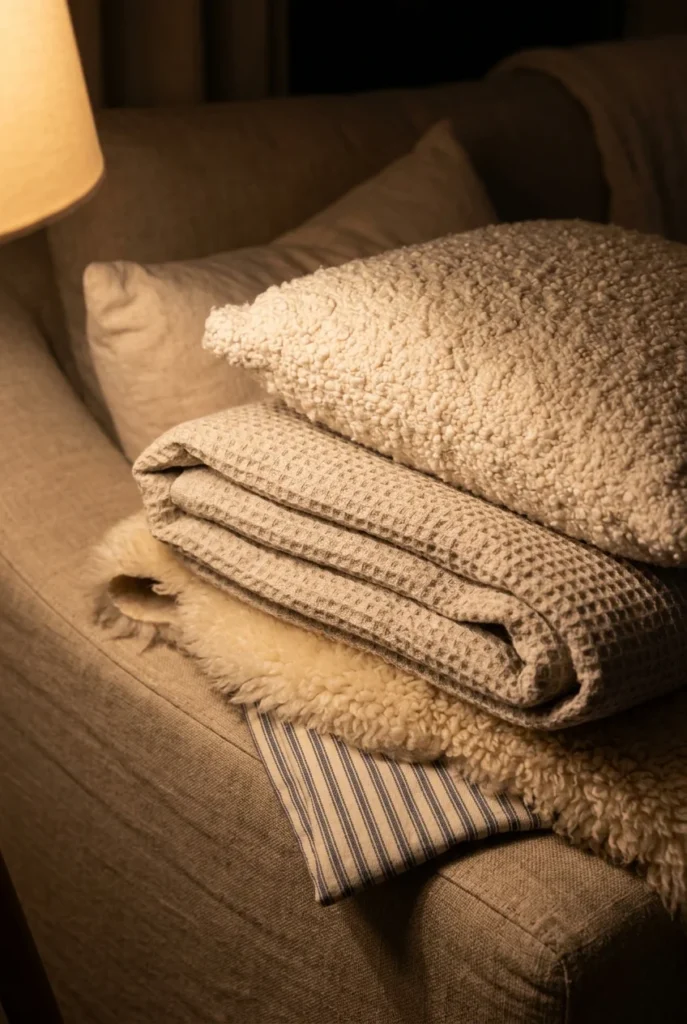
The soft anchor is a textile with genuine texture. A washed linen throw, a wool blanket with a real weave, a sheepskin over the arm of a chair. Not a smooth polyester throw. Your hand should be able to tell the difference in the dark.
The odd thing is the piece that proves a person lives here. A chipped ironstone pitcher. A brass candlestick that doesn’t match the other brass candlestick. A framed botanical print that’s foxed at the edges.
Three pieces. That’s the entire formula, and it works because vintage character comes from contrast against new things, not from volume of old things.
Failure mode: buy five wood anchors and no soft anchor, and you get a room that feels like a furniture showroom for a store that closed in 1974.
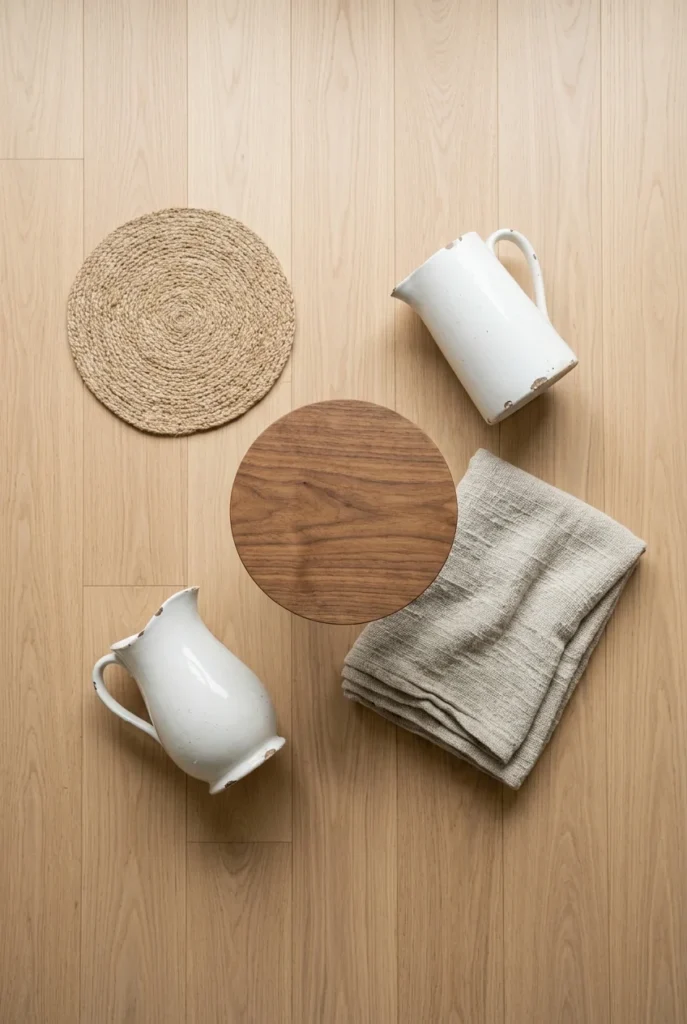
Pick one wood tone and one metal, then stop
The fastest way a thrifted room goes wrong is four wood tones arguing with each other.
Pick your dominant wood from the biggest piece you own and let everything else fall within one shade of it. Honey oak and pine live together. Walnut and dark cherry live together. Honey oak next to black-stained ash reads like two rooms shoved into one.
Same discipline on metal. Choose brass or choose black iron. Mixing is allowed once you have the room working, and the grandmillennial decor layering rules cover how to break this cleanly, but on your first pass, restraint reads more expensive than variety.
A quick way to check: stand in the doorway and squint. If your eye jumps around instead of settling, you have too many tones.
Failure mode: skip this step and you’ll blame the sofa. It’s never the sofa. It’s the fourth wood tone.
What a thrifted piece should actually cost
This is where most vintage decor advice goes quiet, so here are real numbers.
The 2026 Furniture Resale Index tracks what secondhand furniture actually sells for as a share of what it cost new. Use these as your ceiling, not your target. If a seller is asking above the top of a band, you have room to walk.
| What you’re buying | Fair secondhand range | Why the band sits there |
|---|---|---|
| Solid wood case goods (dresser, hutch, low bookcase) | 50 to 80% of a comparable new piece | Vintage hardwood holds value better than anything else in the room |
| Solid wood tables, timeless profile | 40 to 65% of original retail | Easy to refinish, easy to resell if you change your mind |
| Mid-market brand sofa, clean and odor-free | 30 to 55% of original retail | Upholstery carries the risk, so the price should reflect it |
| Flat-pack or laminate anything | 10 to 35% of original | It will not survive a second move, price it like a rental |
Context worth having: the US secondhand market reached roughly $56 billion in 2026, up from about $28 billion in 2020, according to ThredUp’s resale reporting. Sellers know what they have now. Politeness is still free, and most will take 15% off a piece that’s been sitting.
Failure mode: paying vintage-boutique prices for particleboard with a nice stain on it. Check the back panel. If it’s stapled cardboard, it’s flat-pack, and the bottom band applies no matter how good the front looks.

The 60-second inspection you run before you hand over cash
Do this every time. It takes less than a minute and it is the difference between a great find and moving someone else’s problem into your living room.
- Smell it first, before you look at it. Cigarette smoke and mildew do not come out of foam and fabric. Put your face six inches from the cushion and inhale. If you flinch, walk.
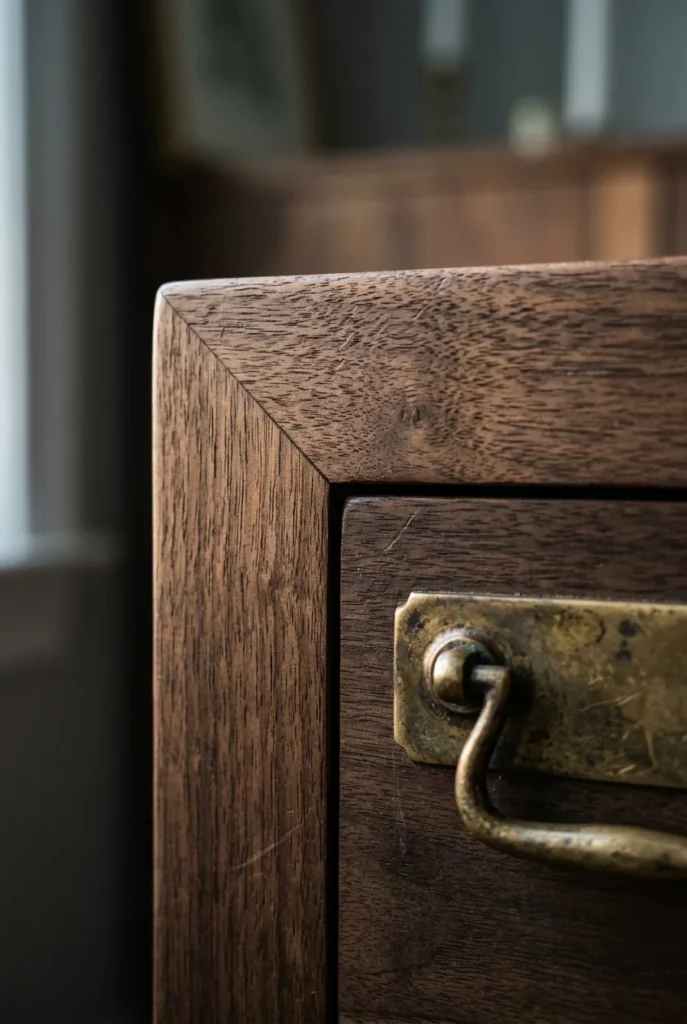
- Pull every drawer all the way out. You’re looking for two things: a manufacturer stamp inside the drawer box, which tells you what you actually have, and dovetail joints instead of staples, which tells you it was built to last.
- Lift one end two inches off the floor and set it down. Listen. A rattle means loose joinery. Fixable, but it should come off the price.
- Take the cushions out and look at the seams and welting. You’re checking for pest evidence and for chewing or burrowing in the upholstery. This is the check people skip and regret.
- Run your hand along the underside of the top. Swollen particleboard, warped wood, or a chalky feel means water damage.
- Measure your narrowest doorway before you leave the house. Write the number in your phone. A 34 inch sofa does not go through a 30 inch door, and the seller’s driveway is a bad place to learn that.
Half of those checks come straight from secondhand buying guides written by people who do this weekly. The doorway one is the one nobody tells you until it’s too late.
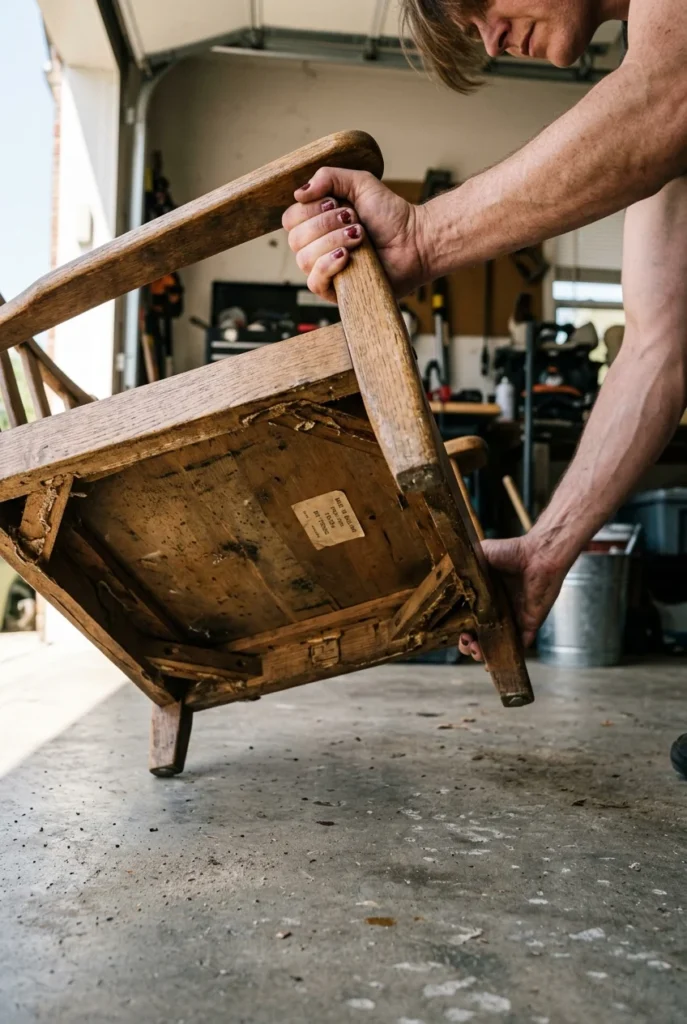
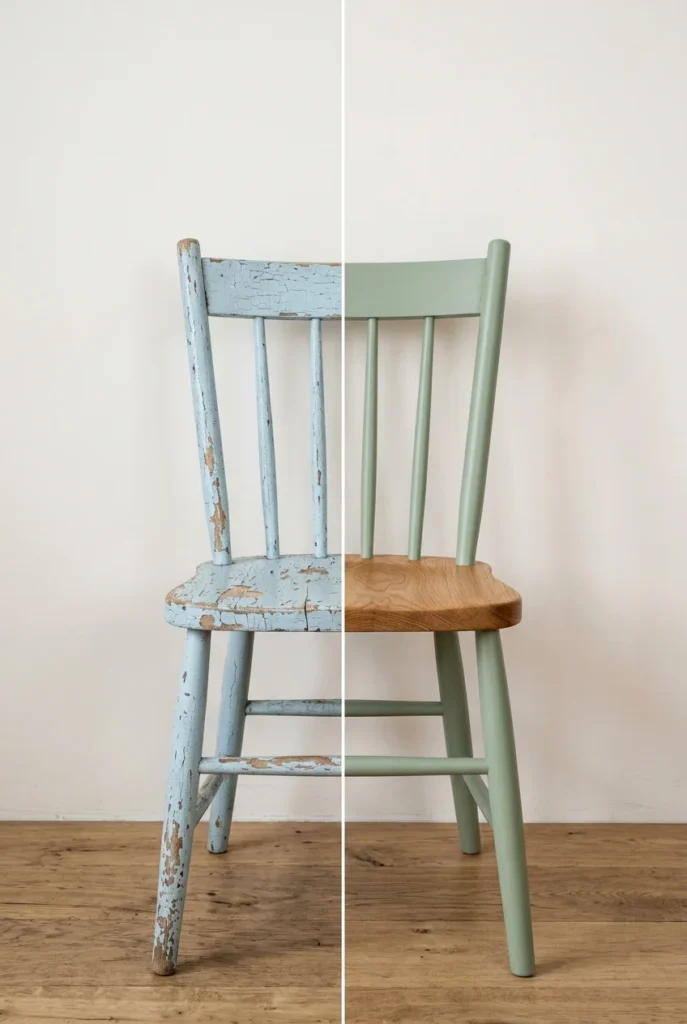
Painted pieces and the 1978 line
Here is the part that matters more than any styling tip in this article.
If a painted piece looks like it predates the late seventies, treat the paint as suspect until you know otherwise. The EPA’s position on this is plain: if your home was built before 1978, it may have lead-based paint, and the same logic applies to furniture finished in that era. Old chipping paint on a chair a toddler will chew on is a real hazard, not a patina story.
You do not have to skip the piece. You have to handle it correctly.
Never dry-sand or dry-scrape old paint. That is what turns a harmless finish into airborne dust. EPA’s lead-safe DIY renovation guidance recommends wet-dry sandpaper, misting the surface with a spray bottle or pump sprayer before you sand or scrape, chemical strippers rather than aggressive mechanical removal, and a low-temperature heat gun kept under 1,100°F if you’re using heat at all.
Cheap lead test swabs are sold at every US hardware store. Use one. Two dollars is a fair price for knowing.
This is general safety information, not a professional assessment. If you have small children, are pregnant, or plan to strip a large painted surface, talk to a certified lead-safe renovator or your local health department before you start.
Failure mode: sanding a “cute little painted stool” on the balcony on a windy Saturday, with the windows open behind you.
Soft layers that read cottage, not doily
Cottage style goes wrong in one specific way: too many small florals in too many small pieces.
The fix is scale. One large pattern, and everything else plain with texture.
Give the room one generous floral or ticking-stripe element and let it be the loudest thing. A slipcovered armchair. A pair of curtains. A large lumbar pillow. Then everything touching it goes solid: a nubby cream boucle cushion, a jute rug, a waffle-weave linen throw folded over the sofa arm.
Texture does the cottage work. Pattern just announces it.
Three textures is the working minimum for a room that feels layered: something smooth, something rough, something soft. Linen, jute, wool. Or cotton, rattan, sheepskin.
And a note nobody puts in these articles: buy the washable rug. A jute runner looks right and sheds grit into your floorboards for a year. A flatweave washable rug in a muted stripe gets you 90% of the look and goes in the machine after a spilled coffee.
Failure mode: matching floral pillows, floral curtains, and a floral rug. That’s not cottage, that’s camouflage.
Lighting is what makes vintage look expensive
You can do everything else right and lose the room to one bad bulb.
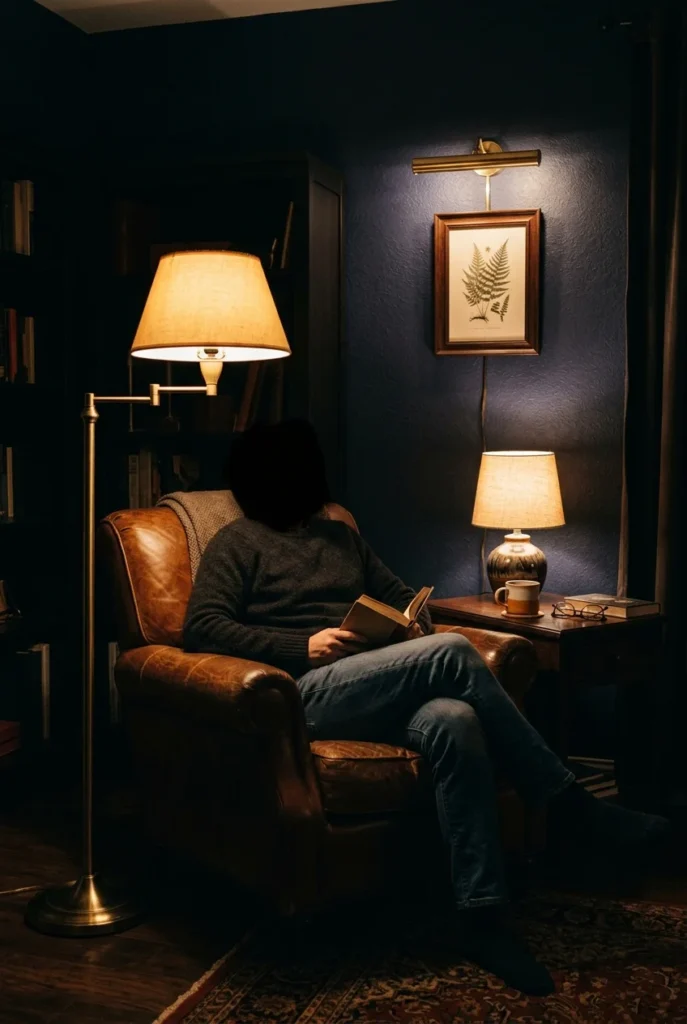
Overhead light flattens patina. It turns aged brass gray and makes old wood look tired. Vintage rooms want light at eye level and below, in pools, from at least three points.
Get the color temperature right first. ENERGY STAR classifies 2200K to 3000K as warm white and calls it ideal for most indoor applications, which is exactly the band that makes brass glow and wood look warm. Anything above 3500K will make your thrifted room look like a waiting area. ENERGY STAR’s bulb color and mood guide breaks the full scale down if you want the reasoning.
For brightness, buy lumens and ignore watts. A 60W-equivalent bulb is 800 lumens, and a 40W-equivalent is 450 lumens. Reading corner: 800. Ambient corner lamp: 450. Put both on a plug-in dimmer and the room does two completely different jobs at 4pm and 9pm.
Three light points, minimum: a floor lamp with a swing arm, a table lamp with a fabric shade, and one small thing at low level. A picture light over art, or a plug-in sconce, or a single candle. That third point is what makes a room feel like evening.
Failure mode: one bright ceiling fixture and nothing else. No amount of vintage furniture survives it.
Build the reading corner into the room, not next to it
Most vintage living rooms have a dead corner. The one behind the door, or the awkward gap beside the window that’s too small for furniture and too big to ignore.
That corner is the best thing you own.
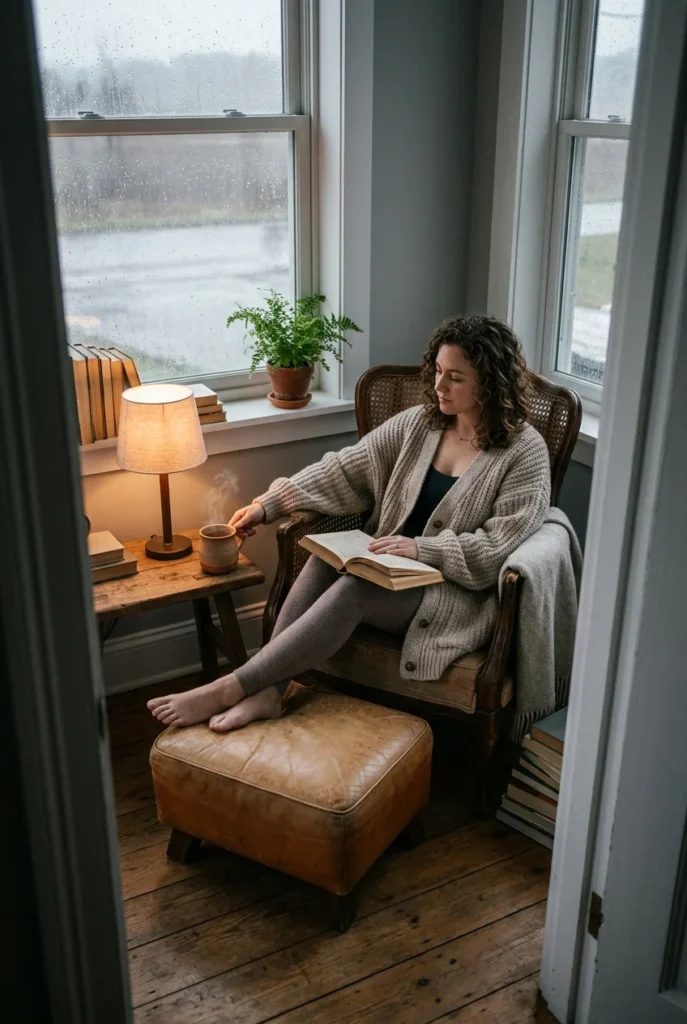
A chair angled at roughly 45 degrees into the room, a light source over your left or right shoulder, and a surface within arm’s reach. That’s it. The dead corner reading nook setup walks through the angles in detail, but the short version is: the surface has to be within about 18 inches of where your hand naturally falls, or you’ll stop using it within a week.
Thrifted vintage does this better than new furniture, because you need a chair with a real back and real arms, and those are exactly the chairs that turn up secondhand for a fraction of new. A wingback, a club chair, a caned-back armchair. Something you sink into rather than perch on.
Add a small footstool. Not for looks. Forty minutes into a book your legs will want it, and a $20 thrifted ottoman is the cheapest comfort upgrade in this entire article.
One safety note if you’re stacking a tall thrifted bookcase in that corner, especially with kids around: CPSC’s Anchor It guidance is that top-heavy furniture should be secured with inexpensive anti-tip brackets. Old case goods were built before tip-over standards existed. Two brackets and ten minutes.
Renter moves: vintage character with zero holes
Everything above works in a rental. Here’s how to get the wall-level character without the security deposit conversation.
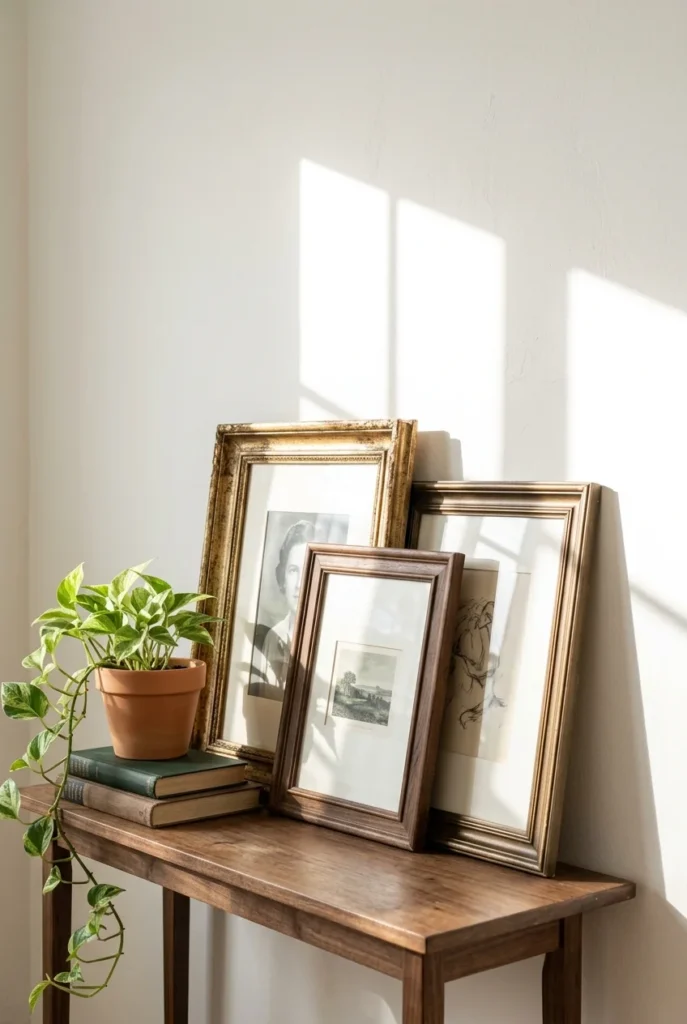
Lean, don’t hang. A large vintage mirror or an oversized framed print leaning against the wall behind a console reads more collected than the same piece hung dead center. Zero holes.
Use a picture rail or a leaning ladder shelf. Both give you vertical display without touching the wall.
Know your adhesive limits before you trust them. Command’s own published capacities are 4 pounds per set for large picture hanging strips and 3 pounds per set for medium. That’s a lightweight frame, not a vintage mirror with a plaster frame. Their heavier picture-hanging line goes higher, but check the package rating against the actual weight of the piece, on a bathroom scale, before it goes on the wall.
Change the light fixtures, keep the originals in a box. A plug-in swing-arm sconce needs no wiring and no landlord. Swapping a hardwired fixture is reversible in fifteen minutes when you move out, and it changes a room more than any other single move.
Bring in old wood at floor level instead of wall level. A vintage trunk, a low bookcase, a wooden stool used as a plant stand. Character with no installation.
The same approach applies room to room, and renter friendly vintage kitchen decor covers the version of this for a rental kitchen, where the constraints are even tighter.
The short list of things to skip
Not every old thing earns its place.
- Upholstery that smells. Already covered, still the number one regret.
- Veneer that’s lifting at the edges. Repairable in theory. In practice you’ll live with a bubble for three years.
- Anything you’d need to reupholster to like. Reupholstering a chair often costs more than the chair is worth, and quotes in most US metros start well above what people expect.
- Sets. A matching three-piece suite defeats the entire point. Buy the one good piece from the set and leave the rest.
- Sun-faded fabric. It will keep fading.
- Anything that doesn’t fit your doorway. Yes, again. It’s the most common expensive mistake in secondhand furniture.
One honest trade-off to close on: thrifted rooms take longer. You cannot order this in a weekend. The wood anchor might take three months to turn up at the right price, and the room will look unfinished while you wait. That waiting is the actual cost of this style, and it’s the thing nobody puts in the pin.
It’s also why the finished room looks like nobody else’s.
Vintage Living Room Decor Frequently asked questions
How do I make my living room look vintage? Start with one solid wood piece with visible age, one textured natural textile, and one small odd object. Match your wood tones to within one shade and pick a single metal finish. Then swap every bulb to the 2200K to 3000K warm white range. Those four moves get you most of the way before you buy anything else.
Can you mix vintage and modern furniture in a living room? Yes, and the mix is usually better than a fully vintage room. A useful ratio is roughly one-third old to two-thirds new. Keep the vintage pieces in the categories where age reads as quality, which is solid wood and metal, and let the new pieces carry comfort and upholstery.
Where do I find good vintage furniture for a living room? Estate sales price the best, thrift stores have the highest volume and the most turnover, and Facebook Marketplace and OfferUp move fastest but require the most filtering. Habitat for Humanity ReStores are underrated for solid wood case goods. Set a saved search alert with your wood tone and your size limit, and check estate sale listings on Thursday nights before the weekend crowd.
What defines vintage decor, and how is it different from antique? The common US trade convention is that antique means roughly 100 years or older, and vintage means roughly 20 to 99 years old. In practice, vintage decor is less about a date and more about visible age: patina on metal, honest wear on wood, a finish that was not made to look new.
How can I add vintage charm to a small living room? Go tall and go low, skip the middle. A tall narrow bookcase and a low wooden trunk give you character without eating floor space. Choose one large vintage piece rather than several small ones, because a room full of small old objects reads cluttered at small square footage while one large piece reads intentional.
What colors work best in a vintage living room? Warm neutrals do the heavy lifting: cream, oatmeal, putty, and warm white. Layer in muted, slightly grayed accent colors rather than saturated ones. Sage, dusty rose, faded indigo, and ochre all sit well against aged wood and brass. Cool bright whites fight patina and make old wood look dingy.
How do I use vintage pieces without overwhelming the space? Cap it. Three genuinely old pieces per room is plenty, and everything else can be new or plain. Give each vintage piece breathing room by keeping the surface around it clear. Old objects need negative space to read as special rather than as accumulation.
Where to start this weekend
Pick your wood tone. That’s the only decision that matters this week, and every purchase after it gets easier once it’s made.
Then take one photo of your dead corner, measure your narrowest doorway, and put both numbers in your phone. You now have everything you need to shop.
If that corner is the part you’re stuck on, the dead corner reading nook setup is the next thing to read.
Keep reading
More cozy nook ideas
 Living Room
Read →
Living Room
Read →
Cabin Living Room Checklist: Everything to Decide Before You Start
No log walls, no stone hearth, no lake outside the window. You can still build a cabin living room in a regular…
 Living Room
Read →
Living Room
Read →
How to Make a DIY Coffee Table That Feels Cozy, Not Cluttered
Most DIY coffee table plans hand you a cut list on line one. That is why so many finished tables end up…
 Living Room
Read →
Living Room
Read →
20 Coffee Table Ideas That Make a Small Living Room Feel Warmer
Your coffee table is probably holding two remotes, a charging cable, yesterday’s mug, and a candle nobody has lit since spring. That…