
Grandmillennial Decor: Vintage Charm Meets Modern Cozy

Seven pieces, one corner, $397 with every price checked in August 2026. That is the grandmillennial decor build waiting at the bottom of this page, and it fits in a 700 square foot rental with zero drilling and zero landlord emails.
But first, the thing nobody warns you about.
Grandmillennial goes wrong in exactly one way. You add the florals, the brass, the ruffled shade, the needlepoint pillow, and somewhere around item number six the room stops reading as collected and starts reading as untouched since 1987. There is a fix. It is a ratio, and it takes ten seconds to check.
We’ll cover the pattern rule, the bulb, the shade swap, the renter workarounds, and the exact line between charming and dated.
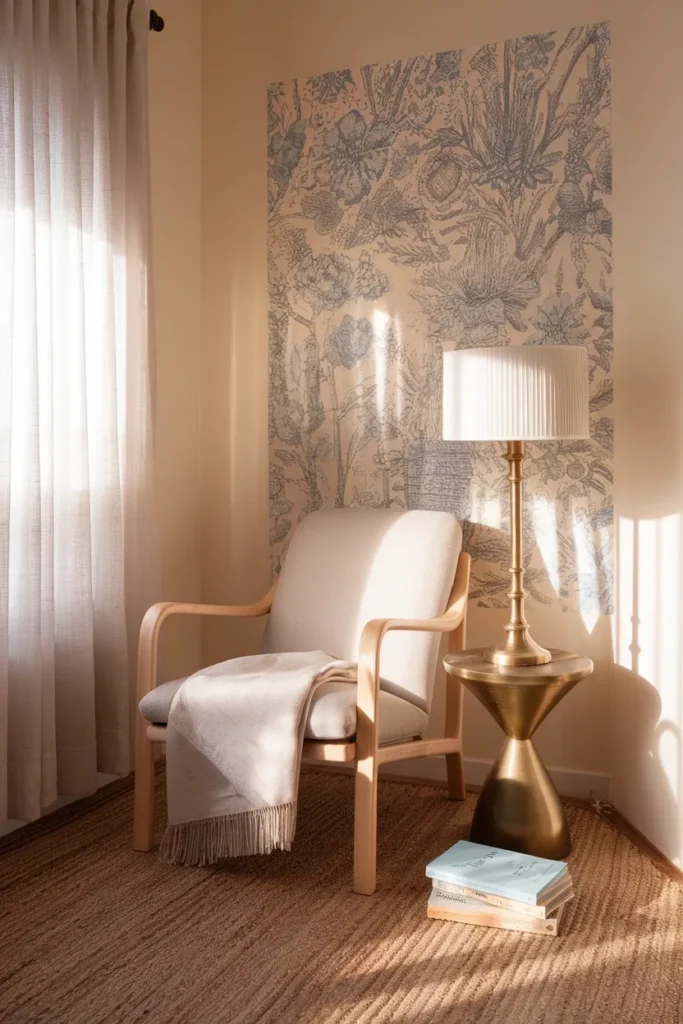
Five Things That Make a Room Read Grandmillennial
Skip everything else and copy these five. In order of how much visible difference they make per dollar:
- One large-scale floral. Wallpaper, a curtain panel, or a chair seat. Something with a repeat bigger than 8 inches so it reads as pattern from across the room, not as texture.
- A pleated or scalloped lampshade. The single fastest swap on this list. A $12 to $20 shade changes the entire character of a lamp you already own.
- Brass, unlacquered if you can get it. A picture light, a candlestick lamp, a small tray. Brass is what keeps the room from going flat.
- One genuinely old thing. Not “vintage-inspired.” Actually old, with a scratch on it.
- A 2700K bulb. Free if you already own the lamp, $2.56 if you don’t. More on why below, because this is the one people skip and then wonder why their room looks like a dentist’s office wearing a floral dress.
That is the whole aesthetic in five moves. Everything after this is refinement.
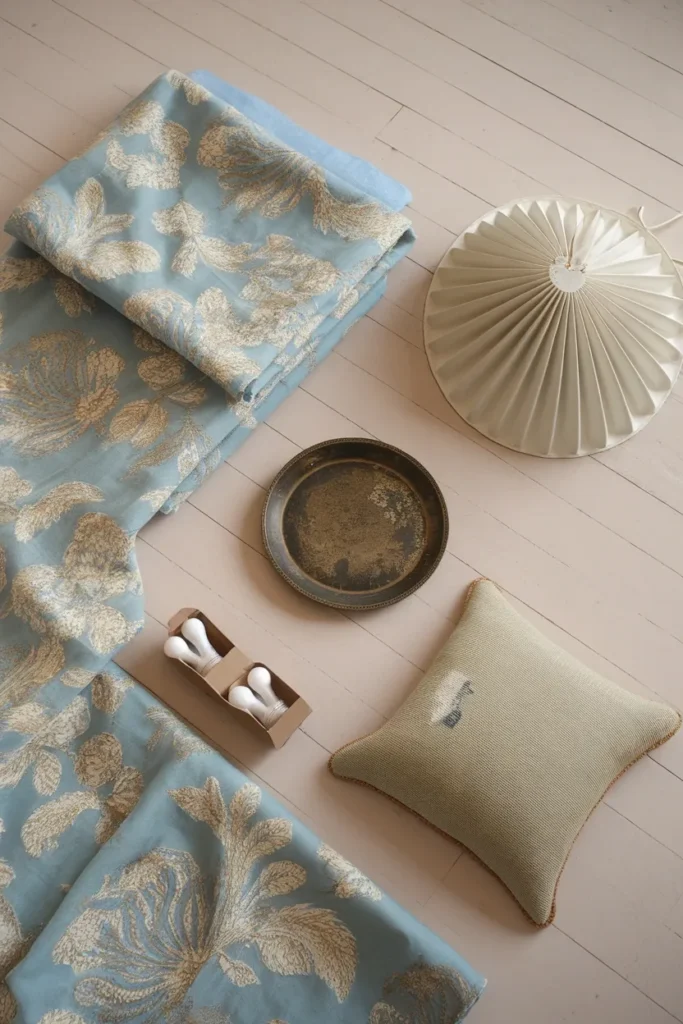
The Three-Scale Pattern Rule
Here is where most grandmillennial rooms fall apart. People mix patterns, which is correct, but they mix three patterns at the same scale, which is why the room buzzes instead of settling.
Run three patterns at three different scales, and make them share exactly one color. That is the rule. It’s the difference between a room that looks composed and a room that looks like a fabric sale.
| Scale | What it looks like | Where it goes | Share of the corner |
|---|---|---|---|
| Large | Floral, toile, or chinoiserie, repeat over 8 inches | Wallpaper, curtain panel, chair seat | ~50% |
| Medium | Check, gingham, stripe, plaid, repeat 1 to 3 inches | Lumbar pillow, lampshade, throw | ~30% |
| Small | Ditsy floral, dot, tiny geometric | Piping, trim, bolster, book jackets | ~20% |
The shared color is what does the actual work. A blue-and-cream floral, a blue gingham pillow, and a blue ticking bolster will always look intentional. Three unrelated florals never will, no matter how good each one is on its own.
If you want to see this rule doing heavy lifting in a full room instead of one corner, our floral sofa and antique hunting guide walks through the same layering at living-room scale, with a totaled thrift plan.
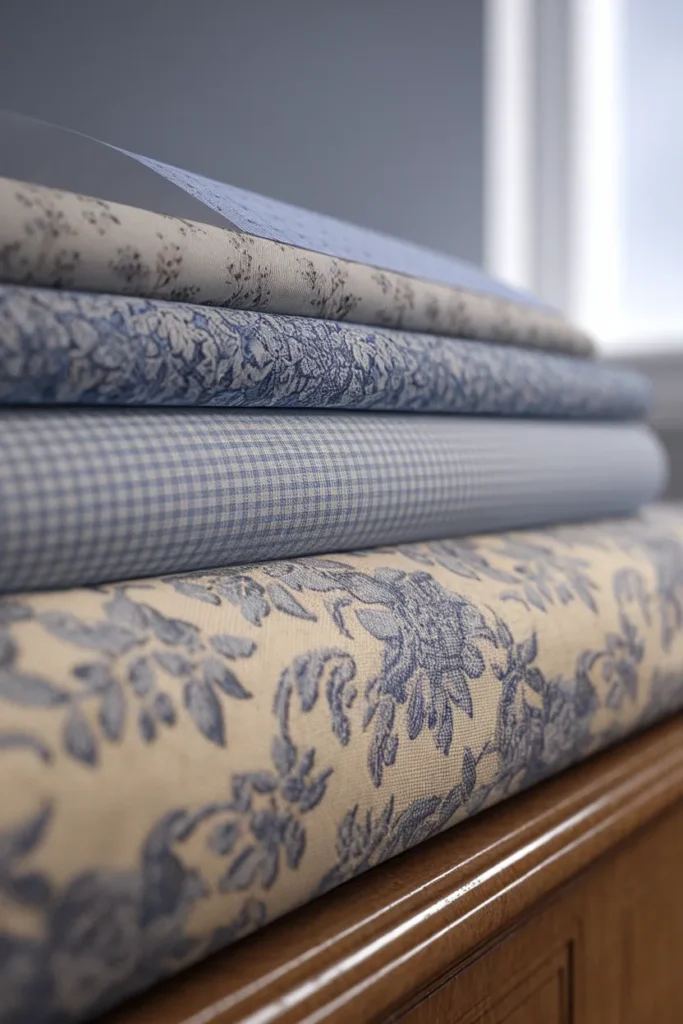
Where the Color Actually Lives
Blue and white is not a suggestion in this style. It is the spine.
Scroll the top-performing grandmillennial pins on Pinterest right now and blue-and-white shows up as an explicit phrase in more pin titles than every other palette combined. Green runs a clear second. Faded rose and cream carry the softer version, and there’s a real minority thread of dark, moody grandmillennial rooms that skew closer to dark academia.
What makes it work is the ratio, not the hue. Roughly 70% quiet ground (cream walls, oatmeal upholstery, natural wood), 20% your signature color, 10% something that surprises you. That last 10% is where a raspberry pillow or a jade lamp base earns its place.
Warm neutrals are climbing hard in 2026, so if blue and white feels overdone to you, run the same three-scale rule in mushroom, khaki, and faded terracotta. The structure holds. Only the palette changes.
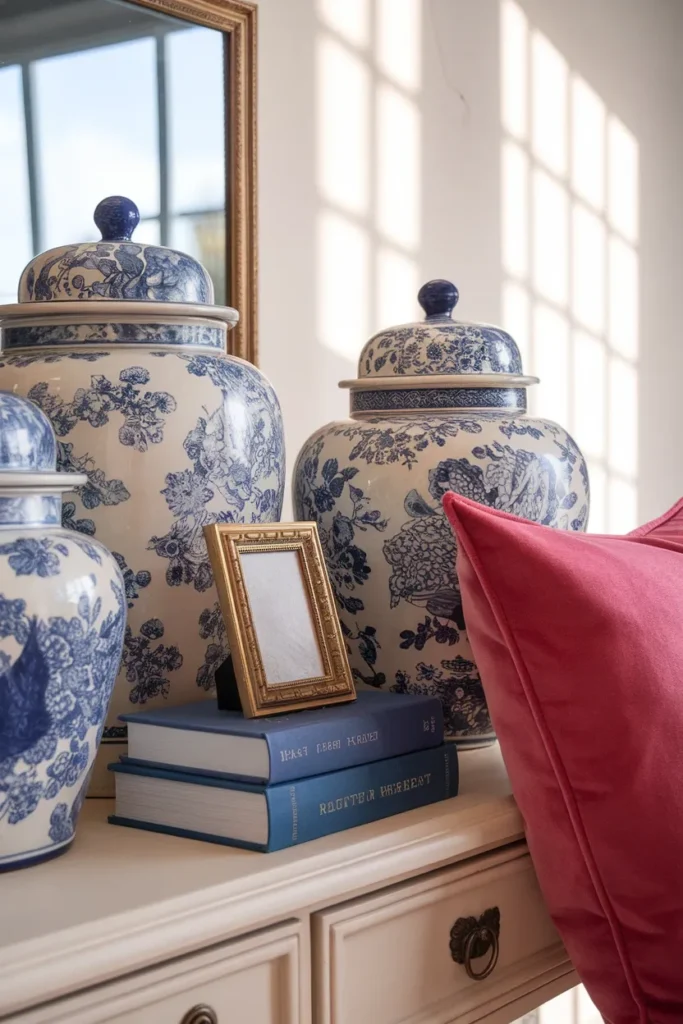
Light It Warm, Or None of It Works
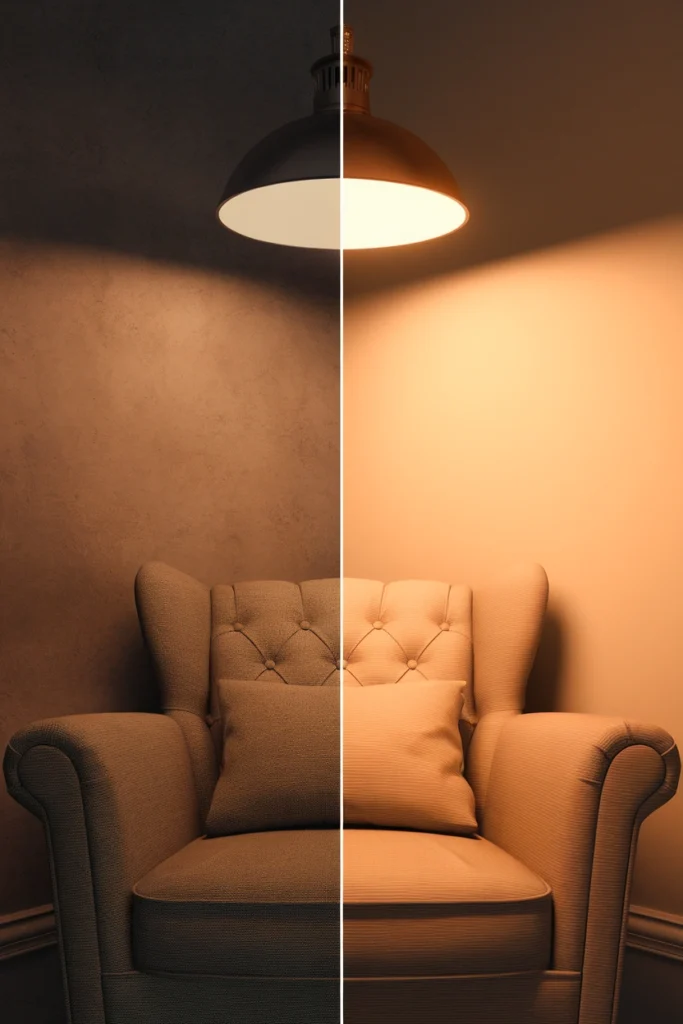
You can do everything else right and still end up with a room that feels wrong, and nine times out of ten it’s the bulb.
Grandmillennial is a candlelit-era style rendered in modern lighting. Chintz under 5000K daylight LEDs looks washed out and slightly clinical. The same chintz under 2700K looks like it has been in the family. According to the Department of Energy’s guidance on LED color, warm white sits at roughly 2700K, and that is the number to buy. A GE 8-pack of 60W-equivalent 2700K bulbs runs $20.46 at Home Depot as of this week, which works out to $2.56 per bulb to fix an entire apartment.
Then layer. One overhead source is a lighting plan the way one saltine is a meal. You want three points of light in the room at different heights: something at eye level, something low, and something washing a wall or a picture.
A plug-in brass picture light is the sleeper pick here. The Maxxima 14-inch antique brass LED picture light is $29.99 at Home Depot with an 8-foot cord, no wiring, no electrician. Clip it over a bookcase or a framed botanical print and the whole corner gains about a decade of age.
One honest correction: that particular fixture is 3000K, not 2700K. Slightly cooler than the bulbs above. In practice it reads fine as an accent because it’s washing a wall rather than lighting your face, but if you’re a stickler, buy a 2700K picture light instead.
The Pleated Shade Swap
If you only do one thing from this entire page, do this one.
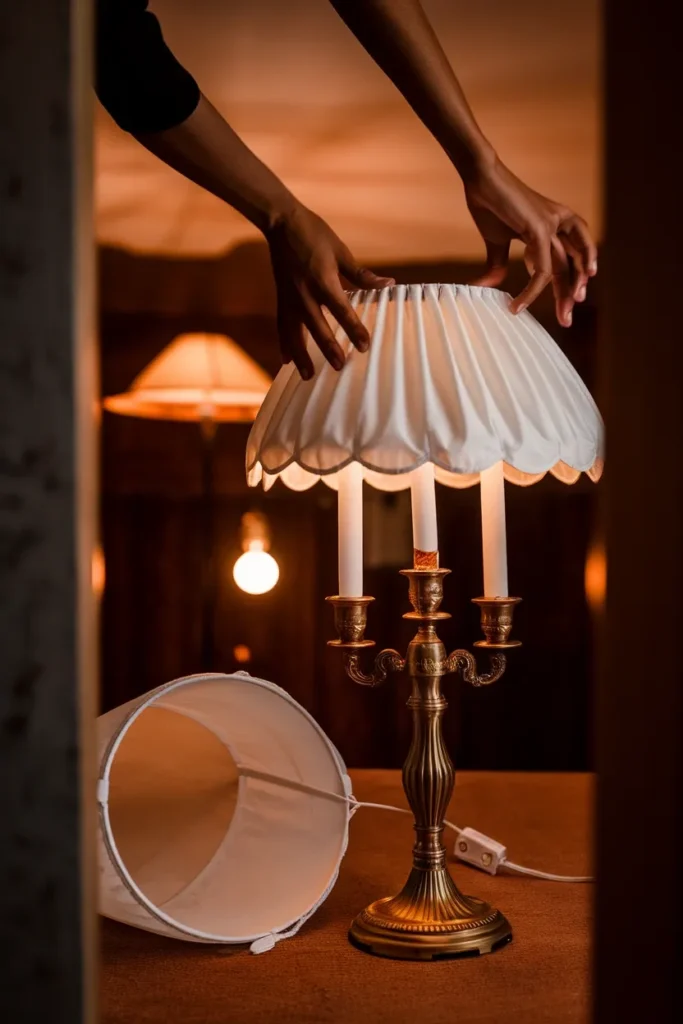
The gathered, pleated, or box-pleat fabric lampshade is the most recognizable grandmillennial signal there is, and it costs less than lunch. Target’s Threshold small pleated shade is $12.00. The Studio McGee scallop pleated version is $20.00. Both fit standard harp lamps you already own.
Here’s the trade-off nobody mentions: pleated shades throw less light downward than a plain drum shade, because the pleats absorb at the edges. Charming on an accent lamp. Frustrating if that lamp is your actual reading light. Put the pleated shade on the decorative lamp and keep a clean-lined shade or a swing-arm on the one you read by.
The rest of the lighting logic (how many sources, what height, which ones renters can set up in an evening) is covered properly in our layered warm lighting setup for renters, including the dim-to-warm trick that designers lean on.
Chintz Without the Museum Vibe
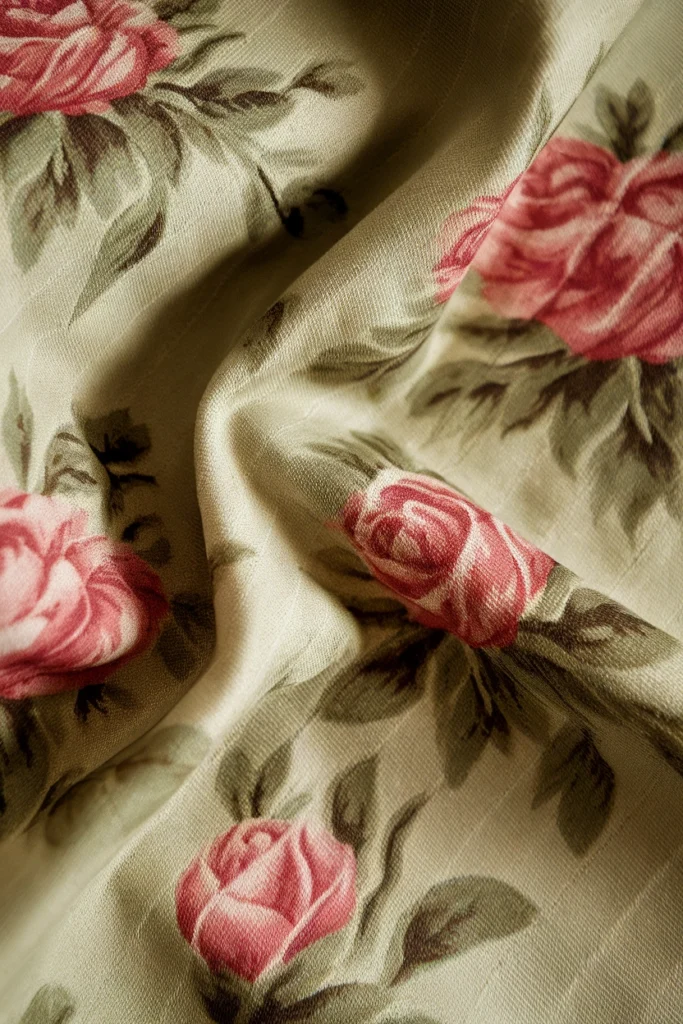
Chintz is the load-bearing fabric of this whole style, and almost nobody knows what it actually is.
It’s glazed printed cotton, and it came to Europe and America through the Indian textile trade. The word itself made the crossing with the cloth. The Met’s essay on Indian textile trade and production notes that calico, gingham, khaki and chintz all entered English the same way. Knowing that is the difference between decorating with chintz and decorating with a Laura Ashley memory.
Real vintage yardage is more affordable than people assume. On Etsy right now, vintage chintz by the yard runs from about $6 for basic 1980s florals up to $110 a yard for named designer prints like a 1984 Cowtan & Tout. The sweet spot for a pillow front or a small cushion sits around $20 to $40 a yard, and one yard covers a standard 18-inch pillow with seam allowance to spare.
Vintage needlepoint pillows follow the same pattern. Etsy listings cluster between $48 and $99. Chairish, for visually comparable pieces, clusters between $150 and $395. Same look, roughly a third of the price, if you’re willing to scroll.
One care note that no other guide on this topic bothers with: light destroys old textiles, and it does it permanently. The National Park Service’s own textile conservation handbook puts it flatly, that light damage to dyes is cumulative and irreversible. So do not hang your best piece of vintage chintz in the south-facing window. Put the reproduction there and keep the real one on the shaded side of the room.
Renter-Safe Grandmillennial
No drilling, no paint, no deposit at risk. Every item here comes back off the wall.
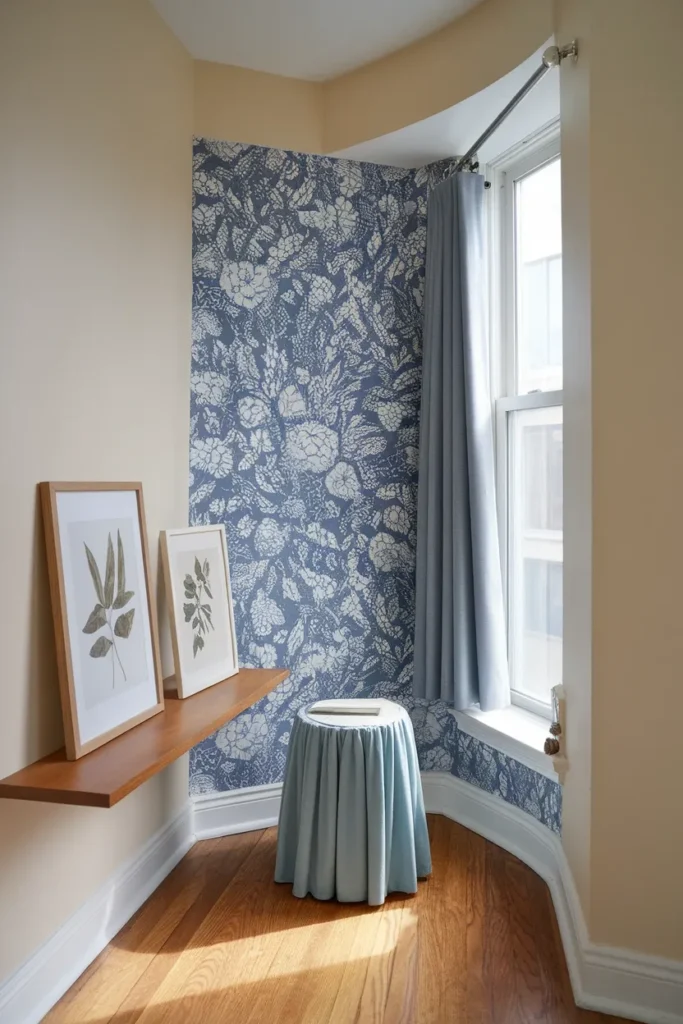
Peel-and-stick the alcove, not the room. A full accent wall is expensive and, in a rental, slightly unhinged. A single 3-to-4-foot patch behind a chair does 80% of the visual work. RoomMates Perennial Blooms peel-and-stick is $33.99 at Target and each roll covers 28.18 square feet at 20.5 inches wide by 16.5 feet long. Here’s how that maps to a real nook wall, with 15% added for pattern repeat waste:
| Nook wall (8 ft ceiling) | Square feet | With 15% waste | Rolls to buy | Cost |
|---|---|---|---|---|
| 3 ft wide | 24 sq ft | 27.6 | 1 (tight) | $33.99 |
| 4 ft wide | 32 sq ft | 36.8 | 2 | $67.98 |
| 5 ft wide | 40 sq ft | 46.0 | 2 | $67.98 |
| 6 ft wide | 48 sq ft | 55.2 | 3 (buy the third) | $101.97 |
Tension rods do skirts. A skirted table is peak grandmillennial and requires no carpentry at all. A round side table, a fabric circle, and a length of trim. If you can’t sew, iron-on hem tape holds a table skirt fine.
Cafe curtains over blinds. Two clip rings and a tension rod inside the window frame. Zero holes, and it softens the hard rectangle that makes rentals feel like rentals.
Lean the art, don’t hang it. A picture rail made from a $12 floating shelf holds framed botanicals, small plates, and a brass candlestick, and it comes down with four screws instead of forty nail holes.
The 1-in-3 Rule (Where Charming Turns Dated)
This is the rule I wish someone had handed me before I bought the third ruffled thing.
For every three traditional or vintage elements in a sightline, one object has to be clean-lined and unmistakably current. Not “antiqued.” Not distressed-to-look-old. Actually modern.
A simple matte black floor lamp. A plain linen roman shade. A boucle ottoman with no skirt. A single piece of abstract art among the botanical prints. That one modern object is doing something specific: it tells the eye that every other choice in the room was deliberate. Without it, the room reads as a space that was decorated once and then abandoned.
Test it in ten seconds. Stand in the doorway, count the traditional elements you can see at once, divide by three, and that’s how many modern anchors the view needs. Four florals and a brass lamp and a needlepoint pillow and a fringed ottoman? That’s six. You need two modern things in that view and you probably have zero.
The failure mode if you skip this: the room photographs beautifully and feels oddly heavy to sit in. Every surface is asking for attention and nothing is giving your eye a place to rest.
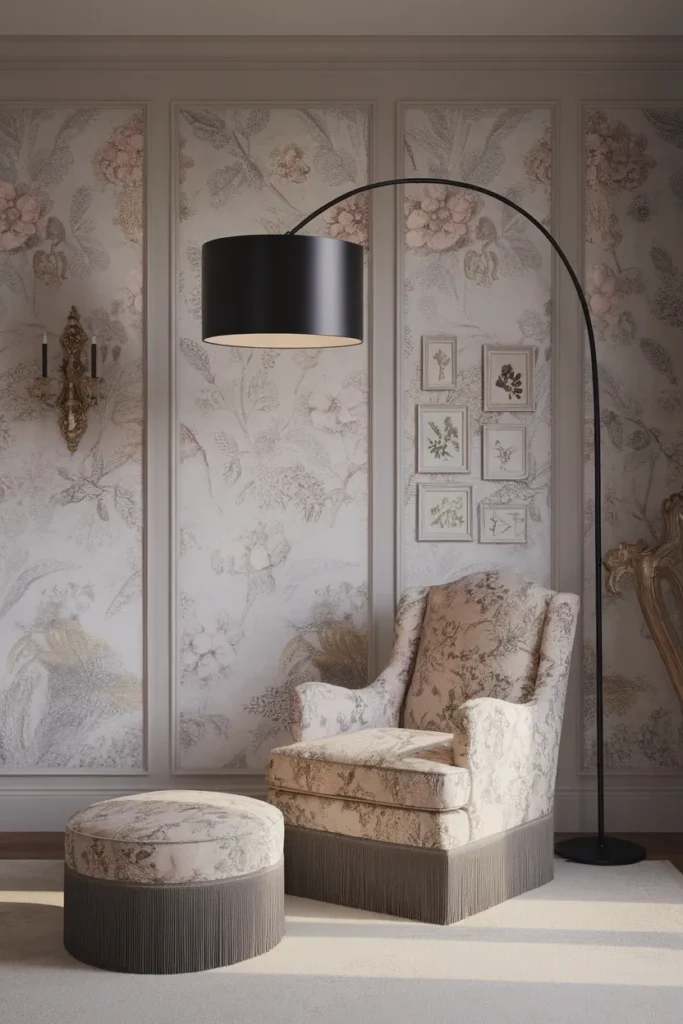
The $397 Grandmillennial Reading Corner
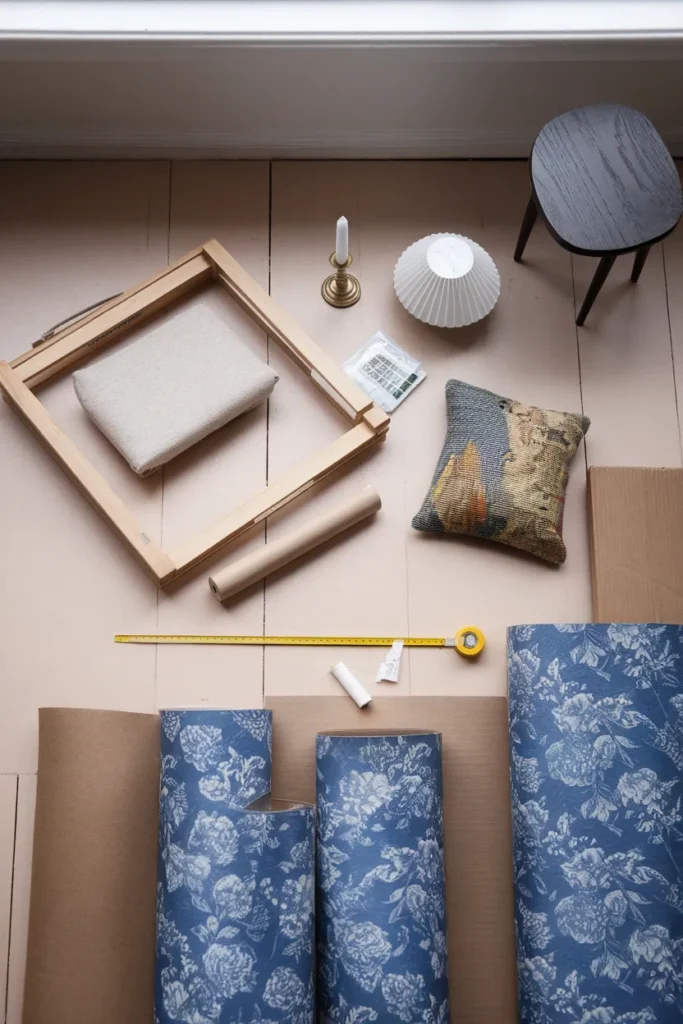
Here is the build, with every price checked at a named US retailer in August 2026. This is a 4-foot corner, no drilling, assembled in an afternoon.
| Item | Retailer | Price |
|---|---|---|
| POÄNG armchair frame, birch veneer | IKEA | $105.00 |
| POÄNG chair cushion, Knisa light beige | IKEA | $44.00 |
| Fluted Brass Table Lamp, Threshold x Studio McGee | Target | $55.00 |
| Scallop Pleated Lamp Shade, Threshold x Studio McGee | Target | $20.00 |
| GE 60W-equivalent 2700K soft white LED, 8-pack | Home Depot | $20.46 |
| Vintage needlepoint pillow | Etsy | $55.00 |
| Vintage wood side table, local pickup | OfferUp | $30.00 |
| RoomMates Perennial Blooms peel-and-stick, 2 rolls | Target | $67.98 |
| Total | $397.44 |
Skip the wallpaper and it’s $329.46. Already own a lamp? Swap in just the $20 shade and the bulbs and you’re at $294.46.
Two notes on the numbers. The IKEA BILLY bookcase, if you want one flanking the chair, is $69.00 right now on a sale that IKEA’s product page says runs through September 7, 2026, and $89.00 after. And the OfferUp side table price is a real local-pickup range I verified from live listings ($20 to $40 for a small end table); a shipped vintage wood side table on eBay runs $40 to $150 instead, so buy local if you can.
Now the placement, because a corner with the right objects in the wrong positions still doesn’t work.
The 18-inch reach rule. Your side table top should sit within 2 inches of your chair’s arm height, and its front edge within 18 inches of where your elbow naturally lands. Further than that and you lean, you spill, and within a week you’re setting your mug on the floor and the corner quietly stops getting used.
If your corner happens to have a window in it, you have better options than a freestanding chair, and our window seat reading nook ideas with storage covers the dimensions to get right before you build anything.
One more thing about the chair. Floor cushions photograph wonderfully in this style and they show up on half the grandmillennial pins you’ll scroll. Forty minutes into a real reading session your lower back files a formal complaint. Buy the chair. Keep a floor cushion for the ottoman.
Grandmillennial Decor FAQs
What is grandmillennial style? It’s traditional decorating (chintz, toile, needlepoint, brass, skirted furniture, blue and white china) adopted by younger homeowners and renters and mixed with clean modern pieces so it reads current rather than inherited. The label is generally credited to House Beautiful, which put a name to the look in 2019.
What age is a grandmillennial? It describes taste, not a birth year. That said, the term was built around millennials, who by the standard definition were born between 1981 and 1996, putting them roughly 30 to 45 years old in 2026. Plenty of Gen Z decorators run the same aesthetic.
Is grandmillennial style outdated in 2026? Depends who you ask, and the honest answer is worth more than a yes. Designers interviewed by Homes & Gardens argue the style never really left, with one noting it has “never not been on trend, especially in the south.” Forbes still lists it among 2026 summer design trends. Meanwhile, Homes & Gardens’ own trend coverage now frames “grandma chic” and “nostalgia-core” as the 2026 evolution and describes grandmillennial as having peaked a few years back. Notably, Pinterest Predicts 2026 doesn’t name grandmillennial at all. The practical read: the name is cooling, the elements are not. Build the room, don’t chase the label.
What’s the difference between cottagecore and grandmillennial? Cottagecore is rural, handmade, faded, and a little rustic: wildflowers, unpainted wood, linen that’s been washed forty times. Grandmillennial is town-house traditional: tailored, trimmed, skirted, chinoiserie, blue and white porcelain. Cottagecore wants to look like a farmhouse. Grandmillennial wants to look like a well-kept apartment with a good eye and an inherited lamp.
What colors are common in grandmillennial style? Blue and white leads by a wide margin, based on how often it appears in top-performing pin titles. Green is second. Then faded rose, cream, and buttery yellow. A moody minority version leans burgundy, forest, and dark wood. Warm browns and khakis are gaining ground in 2026.
Is grandmillennial preppy? There’s overlap but they aren’t the same thing. Preppy grandmillennial is a real subset (Pinterest maintains it as its own topic) with the ginghams, the scallops, the ribbon trim. But a dark, layered, antique-heavy grandmillennial room is not preppy in any sense.
Can you do grandmillennial style on a budget? Yes, and it’s one of the few styles where thrifting genuinely improves the result rather than compromising it. The $397 corner above proves the point. The two biggest budget levers: buy vintage needlepoint on Etsy rather than Chairish (roughly a third of the price for comparable pieces), and swap lampshades instead of lamps.
Start With One Corner
You don’t need a grandmillennial house. You need a grandmillennial corner, and you can have one by Sunday.
Pick the chair. Swap the shade. Buy the 2700K bulbs. Count your traditional elements and add one modern anchor. That’s four moves and roughly $300, and it’s enough to give your TBR pile somewhere to actually live.
When that corner is working, the next question is usually lighting, because it always is. That’s the thing that separates a corner you photograph from a corner you sit in every night.
Keep reading
More cozy nook ideas
 Boho
Read →
Boho
Read →
Boho Bathroom Checklist: Everything to Decide Before You Start
No gut job, no new tile, no landlord permission slip. A boho bathroom mostly comes down to eight decisions made in the…
 Cozy Home
Read →
Cozy Home
Read →
25 Cozy Bedding Ideas for a Cozier Home
If your bed right now is one flat comforter, two pillows that fold in half, and a throw that ends up on…
 Farmhouse & Country
Read →
Farmhouse & Country
Read →
Modern Farmhouse Bedroom Checklist: Everything to Decide Before You Start
Ten decisions, made in the right order, and a modern farmhouse bedroom stops being a pile of saved pins and starts being…