
Mid-Century Modern Reading Nook: Walnut, Warm, and Quietly Bold

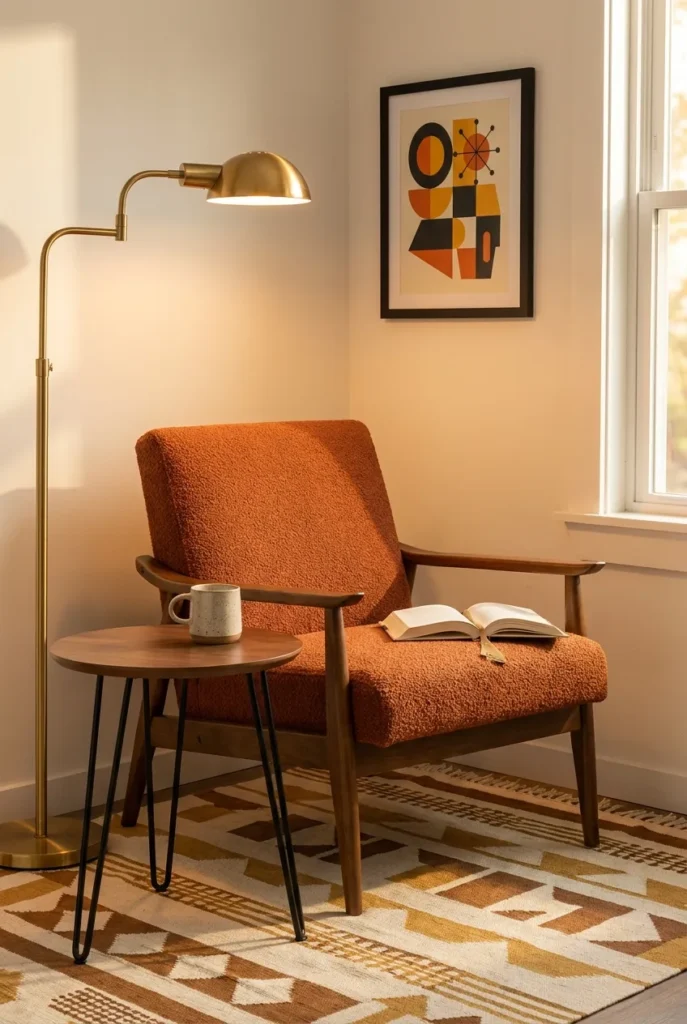
Picture this: 4 pm light across a walnut armchair, a brass swing-arm lamp turned down to 2700K amber, a jute rug underfoot that smells faintly of dry grass. That’s the mid-century modern reading nook we’re building here. You don’t need a dedicated room, a renovation budget, or a landlord who likes power tools. You need the right chair, two confident supporting pieces, and one editing rule that every other guide skips entirely. We’re covering all of it.
What Makes a Reading Nook Genuinely Mid-Century Modern
Most guides start by listing furniture. But if you buy the furniture before you understand the feeling, you’ll end up with a corner that has tapered legs and nothing else.
So here’s the feeling first.
A real mid century modern reading nook has three qualities: warmth, restraint, and quiet confidence. Warmth comes from wood, specifically walnut or teak with that orange-brown depth that catches afternoon light differently at every hour. Restraint means every single piece earns its spot in the room. No spare bolster folded on the armrest, no small decorative tray that exists only for the photo. Quiet confidence means the chair holds the corner without announcing itself. Clean lines. An organic silhouette. Designed, not accumulated.
Mid-century modern as a movement ran roughly from 1945 to 1969. Designers like Charles and Ray Eames were solving a very specific postwar problem: how do you make furniture that’s genuinely comfortable, visually elegant, and manufacturable for a mass market that had never owned anything like it? Their answer was honest materials (walnut, molded plywood, leather, woven fabric), functional forms, and zero applied ornament. The mid-century modern design collection at the Cooper Hewitt Smithsonian Design Museum documents the full arc of how those principles evolved from architecture into the domestic furniture that still shapes reading corners today.
For a reading nook, those same principles land clearly. The chair is honest about what it is. The lamp is honest about its job. Nothing is purely decorative.
The Five Rules of a Mid-Century Modern Reading Nook
Here’s the framework that separates a nook that feels genuinely MCM from one that just borrows the look. Get these five rules locked before you buy a single piece and the rest of the decisions become easy.
Rule 1: One wood tone. Choose walnut, teak, or light ash. Use that tone across every wooden piece in the nook: the chair legs, the side table, any visible shelf edge. Two different wood tones argue with each other. One says, “I did this on purpose.”
Rule 2: Brass or black, never both. Pick one metal for the lamp base, side table legs, and any frame detail. Brass reads warmer and more period-accurate to the era. Matte black reads contemporary MCM. Either works. Mixed metals read confused.
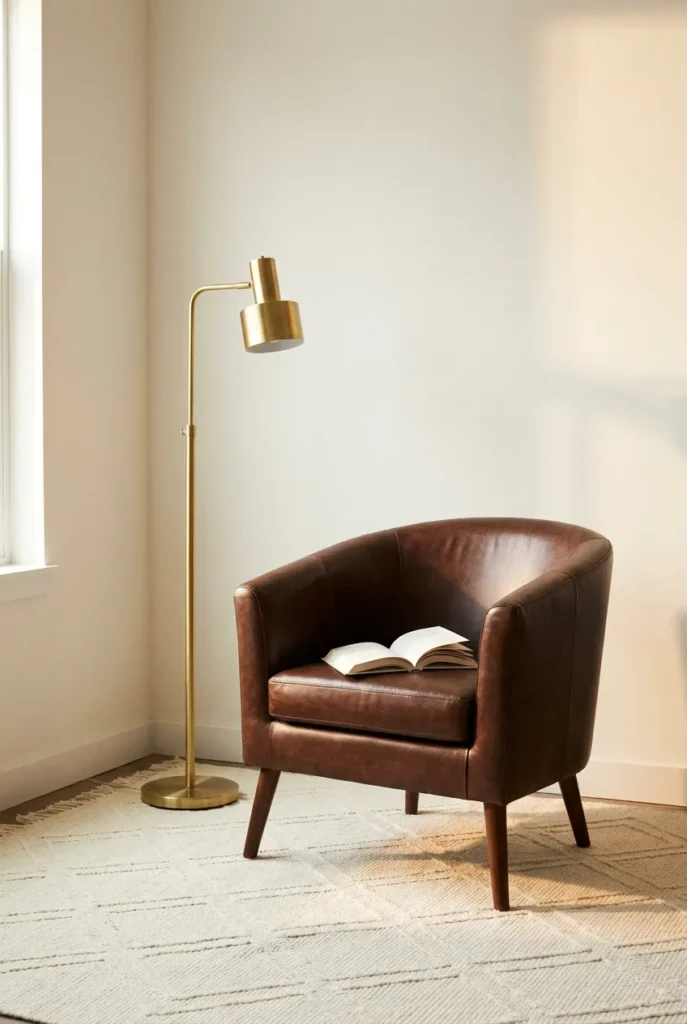
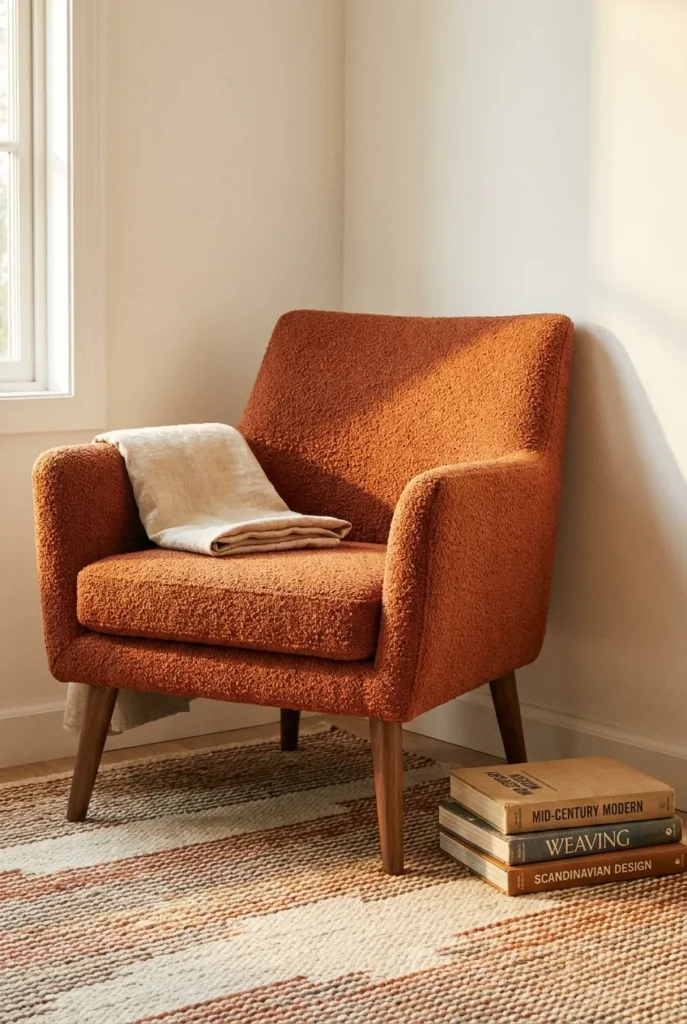
Rule 3: The chair is the highest-contrast piece. Everything else supports it. A burnt orange leather chair against an oatmeal rug reads perfectly. A burnt orange chair against a rust rug loses the chair entirely. One thing pops. Everything else holds.
Rule 4: Maximum three textiles. One throw. One lumbar pillow. One rug. I added a fourth bolster to an otherwise clean MCM corner once, because it looked so small on its own. The whole corner collapsed from sanctuary into storage. Three textiles. That’s the ceiling.
Rule 5: The light must be directional. MCM style is not about ambient glow. It’s about one source, aimed at your book, warm enough to feel like late afternoon sun through glass. A ceiling fixture with no dimmer fails this requirement regardless of bulb temperature.
The Chair Is the Whole Argument
The mid century modern reading nook lives or dies with the chair. Get it right and everything else organizes itself. Get it wrong and no amount of walnut side tables fixes the problem.
Two silhouettes work best for reading. The barrel armchair, with its rounded back that wraps slightly forward, gives you a cocooned, contained feeling that’s ideal for a long evening with a hardcover. The egg-adjacent accent chair, with its taller organic back and slight recline, gives you more visual presence in the room. For smaller spaces, a low-profile MCM accent chair with a 17-inch seat height and open tapered legs reads clearly modern without consuming visual space.
Seat depth matters more than most guides admit. Aim for 19-21 inches of seat depth. Shallower than that and you’re perched, not settled. Deeper and you lose lumbar support after 40 minutes unless you add a bolster. The back angle should be at least 5 degrees reclined from vertical. A perfectly upright chair looks correct in a furniture showroom and feels wrong by chapter three.
Here’s the honest trade-off: classic MCM chairs prioritize form. Some shell-style accent chairs are more beautiful in photographs than they are for a two-hour reading session. Check the depth and back angle measurements before ordering online. A 19-inch seat depth and a 7-degree back angle are your two non-negotiables.
Price reality for 2025-2026: a genuinely solid MCM-style accent chair costs $180-$420 at Target, West Elm, or Article. Pieces closer to the original shell silhouette run $550-$800. Herman Miller’s original Eames lounge chair sits at $5,500-$6,500 new. It is a spectacular, museum-quality object. It is not a reading chair budget decision for most of us.
Rental note: the chair is freestanding. No drilling, no anchoring, no landlord conversation needed. A renter builds a complete mid-century modern reading nook around any MCM accent chair without touching a single wall.
Lighting That Does the Heavy Lifting
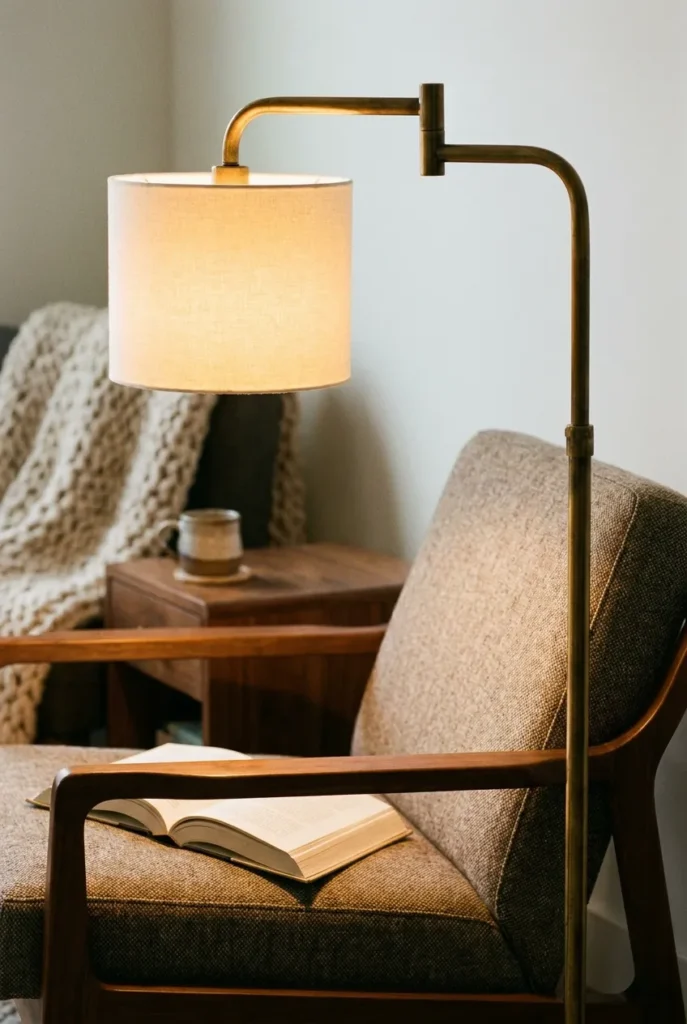
MCM reading nook lighting comes down to one sentence: a swing-arm brass lamp or a plug-in wall sconce, aimed at your book, burning a 2700K bulb at around 800 lumens. That’s the full answer.
The swing-arm floor lamp is the most flexible option. It stands behind or to the side of the chair. The arm positions over your reading shoulder. The light falls on the page, not on your face. The classic MCM floor lamp profile has a tripod or cross base, a slim column, and either a drum or cone shade no wider than 12 inches. Wider than 12 inches and you’ve crossed from modern into traditional without noticing.
For a wall-mounted look without an electrician, a battery-operated or plug-in swing-arm sconce is one of the smartest additions to any reading corner. The cord drops straight down to a floor outlet, and a paintable PVC cord cover (about $8 at Home Depot) makes it look fully intentional rather than rigged. If you want the best specific plug-in models for a 2026 reading corner, our guide to plug-in wall sconces that nail the MCM swing-arm look covers every tier without requiring a single wire in the wall.
One failure mode worth naming: skip the dimmer on your floor lamp and your 2700K bulb still reads like a dental office at 10 pm. Bulb temperature and output level work together. A lamp with an inline dimmer switch, or a smart bulb with a dimmer function, is the difference between a reading retreat and a reminder that your ceiling light exists.
The Side Table and the 18-Inch Reach Rule
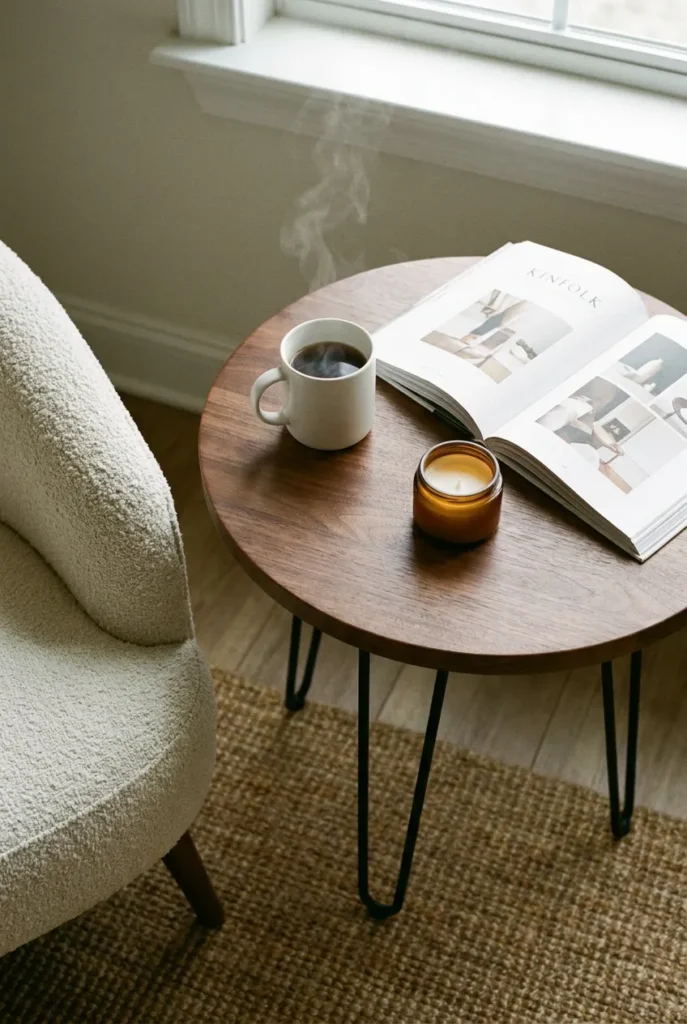
The 18-inch reach rule: measure from the outside edge of your chair arm to the near edge of the side table. Keep it at 18 inches or less. At 24 inches, you’re placing your mug rather than resting it. At 30 inches, the table is furniture for the room, not furniture for the nook.
For an MCM reading corner, the ideal side table is a round walnut-finish piece, 20-24 inches in diameter, standing 24-28 inches tall (roughly level with, or just below, the chair arm). A table on hairpin legs hits all three MCM requirements at once: warmth from the walnut surface, honest structure from the exposed metal, and enough open negative space underneath that the corner doesn’t feel blocked.
The archetype that works in almost every setup: any 22-inch round side table with hairpin or tapered legs in a medium walnut veneer finish, priced $60-$180 at Target, HomeGoods, or Amazon. The lamp sits on it. The mug sits on it. A small TBR pile lives under it. That is the full job description.
For a complete breakdown of proportions, specific model archetypes at each price point, and which tables survive the 18-inch test across different chair heights, the walnut reading nook side table sizes and finishes that match MCM proportions guide covers every option.
Color, Texture, and the Walnut-Warm-Bold Palette
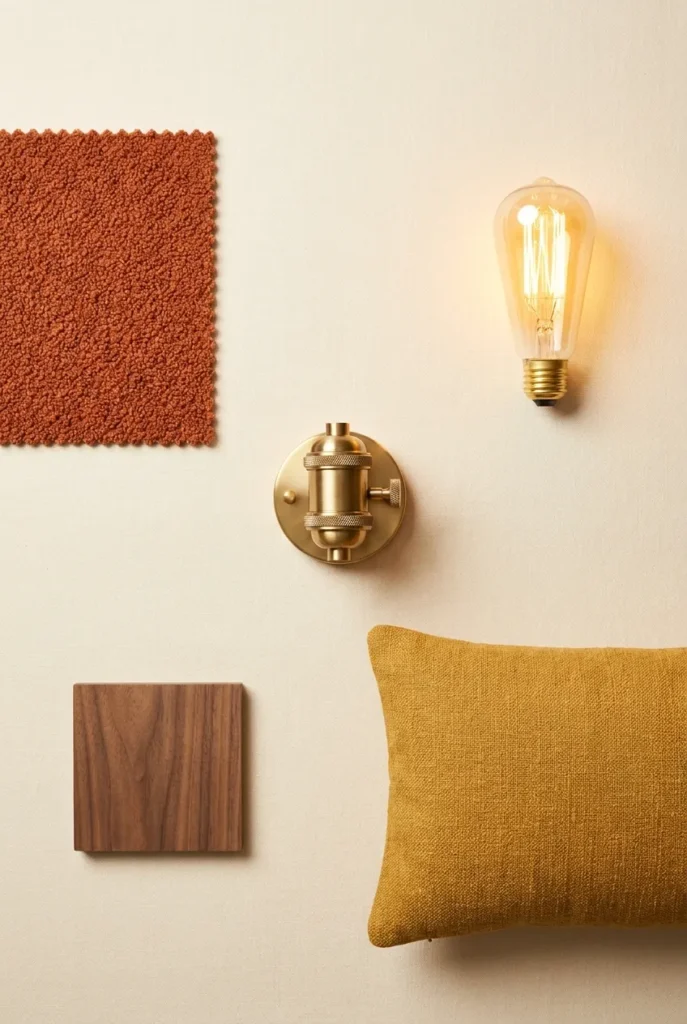
Mid-century modern does not mean beige. It means warm, and in MCM terms warm covers a very specific range: burnt orange, avocado green, mustard yellow, chocolate brown, deep rust, and the occasional punchy turquoise used with full commitment.
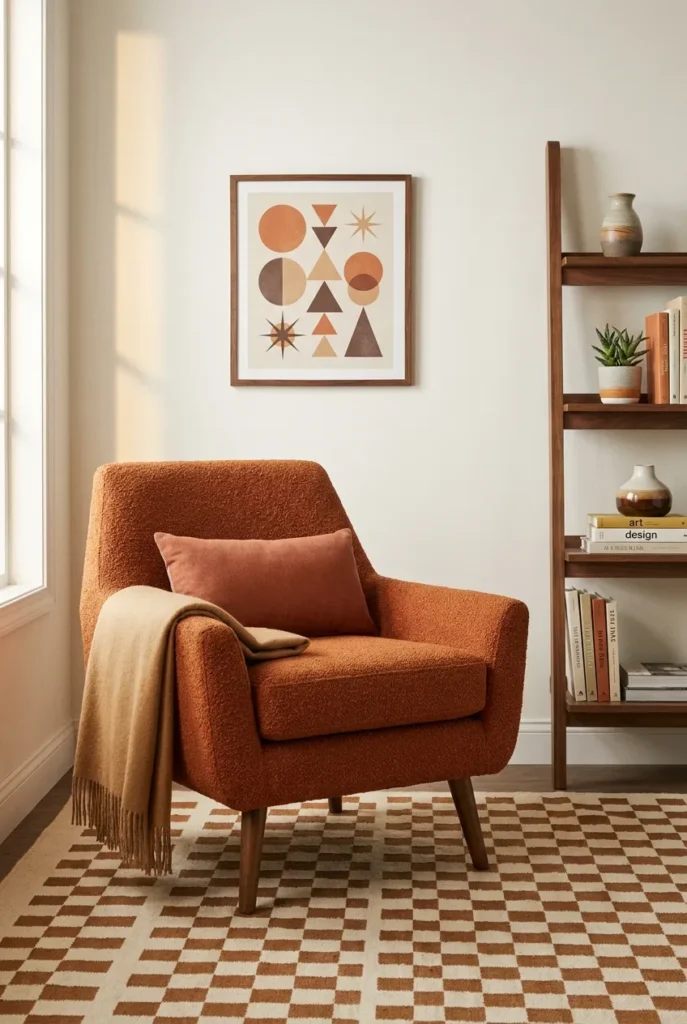
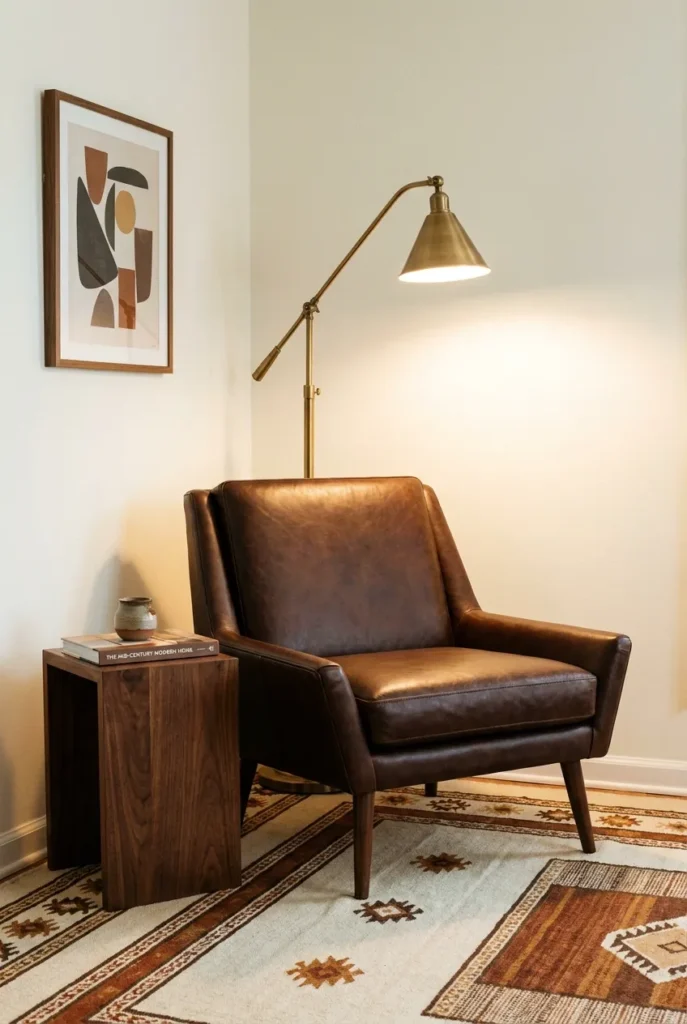
For a reading nook, the palette works in layers. The wall behind the nook, or the large-format rug, acts as the quiet ground. Warm white, off-white, or a muted tone like Benjamin Moore Pale Oak (OC-20) or Sherwin-Williams Accessible Beige (SW 7036) both work. Against that ground, the chair carries the accent. A terracotta boucle or burnt orange leather chair against an off-white wall is the entire MCM reading nook color story in one sentence.
The texture layer adds softness without visual noise. A low-pile jute rug or a flat-weave geometric rug in cream and tobacco anchors the floor. A wool throw in oatmeal or camel drapes across the chair arm. One lumbar pillow in warm rust or muted olive. Those three textiles and nothing more complete the picture.
For art, stick to one framed print at eye level: an atomic-era geometric, a vintage botanical, or a Danish mid-century abstract in two or three of your palette colors. The frame should be thin walnut or natural wood. Nothing ornate.
Here’s the sensory detail no other guide mentions: a real MCM nook at 7 pm has a specific dry warmth to it. Jute underfoot, wool across your lap, a 2700K brass lamp overhead. Those materials together produce a texture and a temperature that’s genuinely different from either a cool white Scandi corner or a soft cottagecore pile. It smells like wood and dry fiber. It feels like the decade it came from.
Three Complete MCM Reading Nook Builds
Here are three fully specified builds at three price points. Every item listed is a real 2025-2026 product archetype available at the named retailer.
| Build | Chair | Lamp | Side Table | Rug | Throw + Lumbar | Est. Total |
|---|---|---|---|---|---|---|
| Budget | Target Threshold MCM accent chair, tapered legs, cream boucle (~$180) | Threshold swing-arm floor lamp, brass base (~$65) | 20-inch round walnut table, hairpin legs, HomeGoods (~$55) | Jute rug 5×7, Target (~$75) | TJ Maxx wool throw + lumbar pillow (~$40) | ~$415 |
| Mid-Range | Article Sven junior armchair, low-profile, solid fabric (~$420) | West Elm arc floor lamp, brass finish (~$220) | West Elm round side table, walnut (~$150) | Ruggable low-pile geometric rug 5×8 (~$189) | West Elm boucle throw + lumbar set (~$95) | ~$1,074 |
| Investment | CB2 Parallel armchair or Article Ceni (~$680) | Rejuvenation swing-arm floor lamp, antique brass (~$380) | Crate and Barrel solid walnut side table (~$290) | Pottery Barn wool flat-weave rug 6×9 (~$380) | Cashmere throw, Nordstrom (~$160) | ~$1,890 |
The budget build works in any corner under 30 square feet. The Target Threshold boucle chair is a recurring surprise in this category: in cream or oatmeal, the profile reads genuinely close to a shell-style accent chair, and it photographs well. The firmness is a step down from the Article, but at $180 it’s the most credible MCM entry point available right now.
The mid-range build is the sweet spot for most people reading this. The Article Sven junior has a 20-inch seat depth and a 7-degree back angle, which means it actually works for a long reading session, not just for a photo. The West Elm arc lamp gives you the scale of a floor lamp with better arm positioning than a standard floor lamp.
The investment build crosses into genuinely heirloom territory. The Rejuvenation lamp alone is worth calling out: the brass patina is the real thing, not a spray finish, and it doesn’t look like an accent lamp after two years of daily use.
If your corner is under 6 feet wide, the budget build can scale down even further. Our renter-safe nook builds for spaces under one square meter walks through exactly how to make the budget chair and lamp work in the tightest corners without the space reading as overwhelmed.
Your MCM Reading Nook in the Bedroom
This is the build that almost nobody covers, and the spatial logic is genuinely different from a living room application.
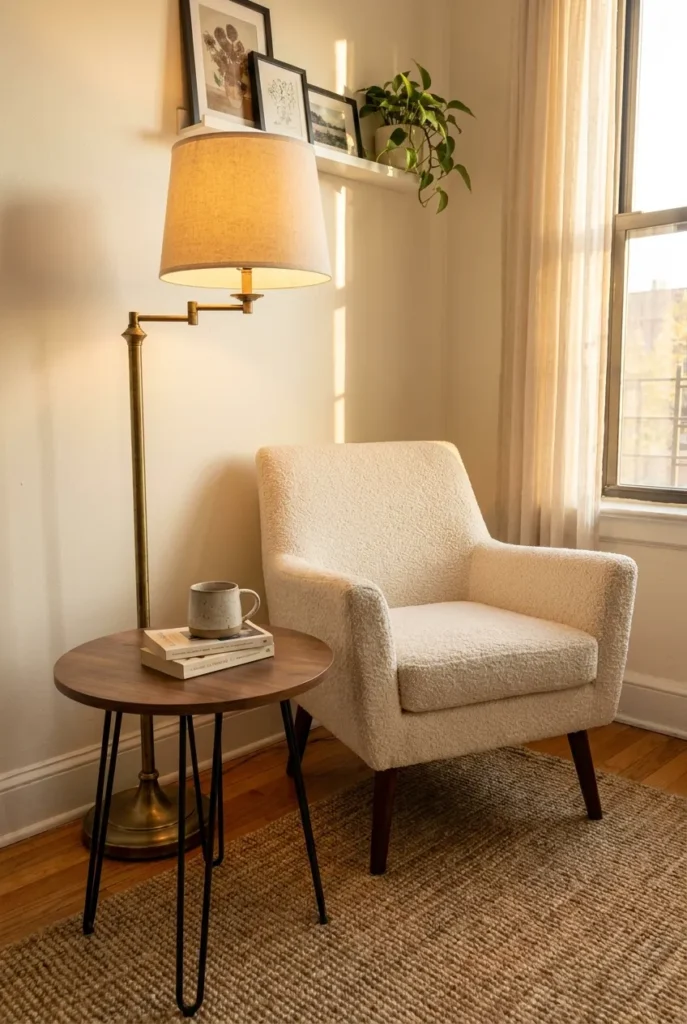
A bedroom MCM reading nook typically claims the corner diagonally opposite the bed, a space that’s often 6-8 feet from the foot of the mattress. The bed as a dominant visual anchor and the typical 8-9 foot bedroom ceiling change several decisions that you’d make differently in a living room.
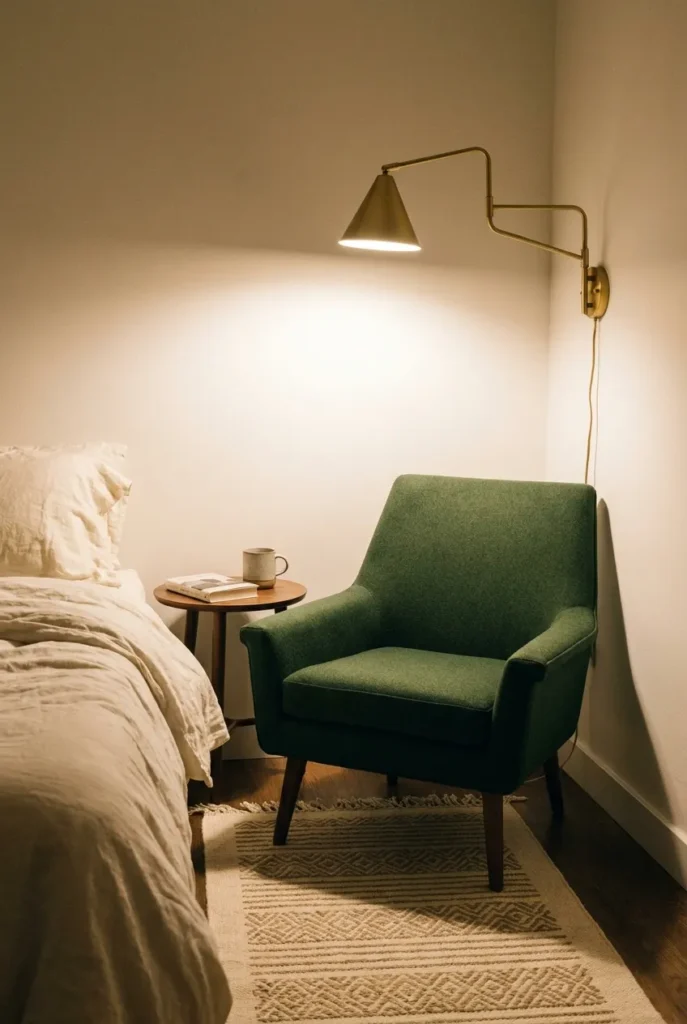
First: use a plug-in wall sconce instead of a floor lamp. A floor lamp arm positioned at chair height works fine in a living room where it competes with nothing but open space above. In a bedroom, that same lamp head can throw light upward and toward the bed, disrupting sleep ambiance. A plug-in sconce arm positioned at 55 inches from the floor, directly over your reading shoulder, keeps the light tight, directional, and entirely away from the sleeping zone.
Second: choose a chair no taller than 30-32 inches overall. In a bedroom, a visually tall chair competes with the headboard for weight and authority. A lower-profile MCM armchair recedes correctly and the corner reads as intentional rather than crowded.
Third: in a bedroom with existing carpet, skip the full 5×7 rug under the chair. A flat-weave wool runner, 24 x 60 inches, placed under the front chair legs creates the zone and signals the nook without overlapping the bedroom rug territory. Two rugs fighting for floor space is worse than one.
The bedroom also opens a color story that runs more personal than the living room palette. Dusty rose and warm camel works here better than the classic burnt orange. A forest green MCM accent chair against a warm white bedroom wall is one of the most underrated mid century modern reading nook ideas I’ve seen in actual rooms, and the color is consistent with the era in a way that feels considered rather than trendy.
FAQ
What is the best chair for a mid-century modern reading nook?
Look for a low-profile armchair with a seat height of 17-18 inches, a seat depth of 19-21 inches, a back angle of at least 5 degrees reclined from vertical, and exposed tapered or hairpin legs in walnut or teak finish. The Article Sven junior and the Target Threshold barrel chair are the two most consistently solid archetypes at mid and budget tiers. At the investment level, the Article Ceni or CB2 Parallel armchair are worth the price difference.
Can I build a mid-century modern reading nook in a small space?
Yes, and MCM actually benefits small spaces. The design rules enforce restraint, which means the setup is inherently compact: one chair, one lamp, one side table, one rug, two textiles. That combination fits in a 5×5 foot corner and looks intentional rather than squeezed. The MCM preference for exposed legs and open negative space keeps small corners from reading as cluttered.
What colors work best for a mid-century modern reading nook?
Start with a warm white or off-white wall. Benjamin Moore Pale Oak (OC-20) and Sherwin-Williams Accessible Beige (SW 7036) both work. Add a burnt orange, terracotta, mustard yellow, or forest green chair as the single accent color. Keep the rug in cream, tobacco, or a low-contrast geometric pattern. Maximum two colors in the textile layer, and they should be within one tonal family of each other.
Can renters build a mid-century modern reading nook without drilling?
Every element of the standard MCM reading nook setup (chair, floor lamp, side table, rug, throw, lumbar pillow) is completely freestanding. The only borderline item is a plug-in wall sconce, and even that requires no drilling if you use a removable adhesive wall mount rated for the fixture weight. Full MCM reading nook, zero holes in the wall.
What’s the difference between a mid-century modern and a Japandi reading nook?
Both value restraint and natural materials, but they run in opposite directions. MCM runs warm: walnut, brass, burnt orange or terracotta accent color, geometric patterns, and a quiet boldness that lets one piece make a statement. Japandi runs cooler and quieter: ash, linen, stone, muted olive, no strong accent color, and an even deeper commitment to visual silence. MCM has personality. Japandi has stillness. They share a bone structure but live in different moods.
What bulb temperature is right for a mid-century modern reading nook lamp?
2700K is the standard. It produces warm amber-white light that reads naturally, complements walnut and brass tones, and doesn’t fight the evening mood. Anything above 3000K starts edging clinical. Anything above 4000K (cool white or daylight range) will actively conflict with a warm MCM palette. Pair your 2700K bulb with a dimmer for full control.
How do I stop my MCM reading nook from looking like a retro display case?
Follow the Five Rules above, specifically Rules 1 and 4. One wood tone across every wooden piece. Maximum three textiles. The most common drift happens when small objects accumulate: a ceramic figurine here, a decorative tray there, a second plant added because the first one looked lonely. Each item seems harmless individually. Together they convert a reading retreat into a shelf display. Subtract until the corner feels quiet, then stop.
Conclusion
A mid century modern reading nook is one of the few interior projects where doing less is the right call, not a compromise. One chair. One lamp. One side table. Three textiles. The restraint isn’t a budget constraint. It’s the style itself. And once you’ve sat in a properly built MCM corner at 8 pm with a brass swing-arm lamp over your shoulder and a hardcover in your lap, the 1957 designers who figured this out start to make a lot of sense.
If you’re starting from zero, spend the most on the chair. Everything else, including the lamp, side table, and rug, can come from Target, HomeGoods, or TJ Maxx and still read correctly if the chair is right. The chair is the whole argument.
What does your corner look like right now? Drop your space dimensions and budget in the comments and we’ll help you figure out which of the three builds fits.
Keep reading
More cozy nook ideas
 Boho
Read →
Boho
Read →
Boho Bathroom Checklist: Everything to Decide Before You Start
No gut job, no new tile, no landlord permission slip. A boho bathroom mostly comes down to eight decisions made in the…
 Cozy Home
Read →
Cozy Home
Read →
25 Cozy Bedding Ideas for a Cozier Home
If your bed right now is one flat comforter, two pillows that fold in half, and a throw that ends up on…
 Farmhouse & Country
Read →
Farmhouse & Country
Read →
Modern Farmhouse Bedroom Checklist: Everything to Decide Before You Start
Ten decisions, made in the right order, and a modern farmhouse bedroom stops being a pile of saved pins and starts being…