
8 Montessori Playroom Mistakes to Avoid (and What to Do Instead)

If your Montessori playroom looks calm for about an hour after you set it up, and then every basket ends up dumped on the rug, the problem usually isn’t you. Most of the trouble comes from 8 Montessori playroom mistakes that look harmless on Pinterest, and each one has a simple fix.
Maybe you rent and have one free corner. Maybe your toddler climbs anything with an edge. Maybe you already bought the expensive shelf. That’s fine. Nothing here needs a renovation or a classroom budget.
Below you’ll find each mistake, why it backfires, and what to do instead. You’ll also get shelf heights by age, a toy count rule you can screenshot, and a starter setup totaled at under $165 with real IKEA prices.
Start with the quick list. Then read the mistakes that sound like your house.
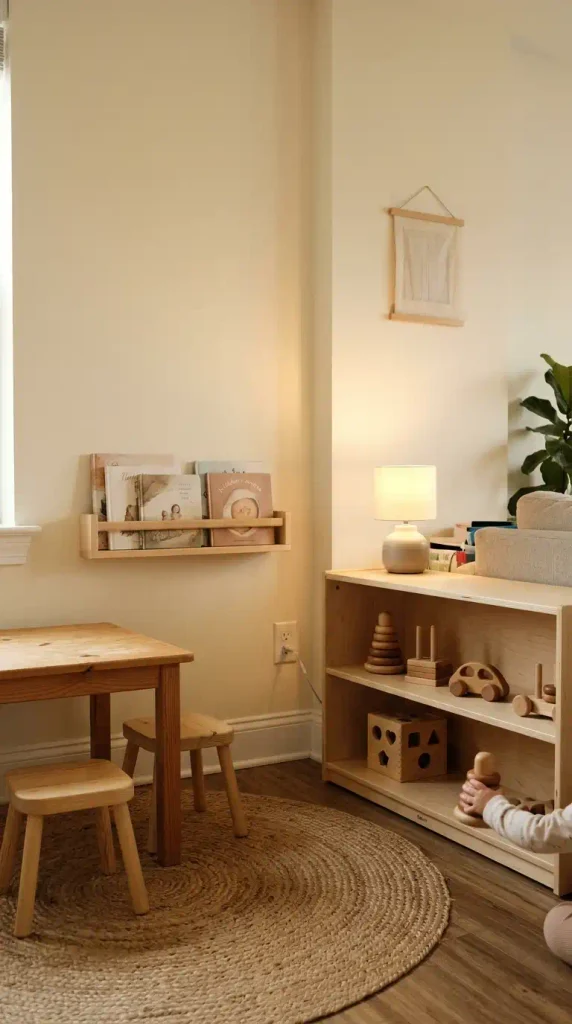
All 8 Montessori Playroom Mistakes at a Glance
Save this one. Each card names a mistake, and the line under it is the fix.
Mistake 1: Shopping Before You Watch Your Child
Montessori starts with watching, not buying. The American Montessori Society’s guide to Montessori at home tells parents to observe their child without stepping in, notice how materials actually get used, and then adjust the space.
Skip that step and you end up furnishing a room for an imaginary kid. It’s easy to buy a climbing triangle for a child who only wants to pour water, or a puzzle rack for one who spends the whole morning at the window watching trucks.
So give it one week. Notice what your child repeats, where they carry things, and where they sit down on their own. Shop for those three things first.
📌 Good To Know
Keep a note on your phone for 7 days with three headings: repeats, carries, sits. Whatever shows up most often earns the first spot on the shelf.
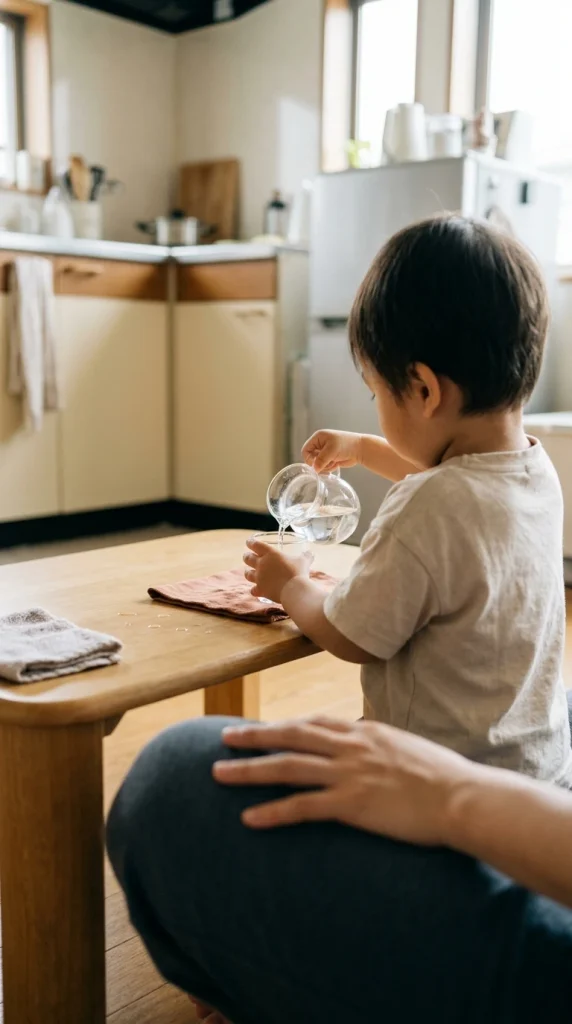
Mistake 2: A Montessori Shelf Built for Grown-Ups
Get down on your knees for a second. That’s roughly your toddler’s view of the room, and most adult furniture is a wall of things they can’t reach.
A good Montessori shelf sits low enough that your child can see everything on top and lift it off without stretching. Unfnshed puts the test simply: if your child has to reach up and over, the shelf is too tall.
Here’s how heights usually scale with age, based on Sprout Kids’ shelf chart.
| Age | Shelf height | Layout |
|---|---|---|
| 👶 6 to 18 months | About 13 in. | Top surface and floor shelf only |
| 🚶 1 to 3 years | About 20 in. | One middle shelf added |
| 🧒 3 to 5 years | About 24 in. | One middle shelf, more space between |
| 🎒 4 to 9 years | About 30 in. | One middle shelf, tallest gap |
Watch out for one popular pick. The IKEA KALLAX 2×2 stands 30 1/8 inches tall, which lands in the 4 to 9 row. For a young toddler, keep their things in the bottom two cubes and save the top for books or a plant.
It’s a solid shelf. It just isn’t a first shelf.
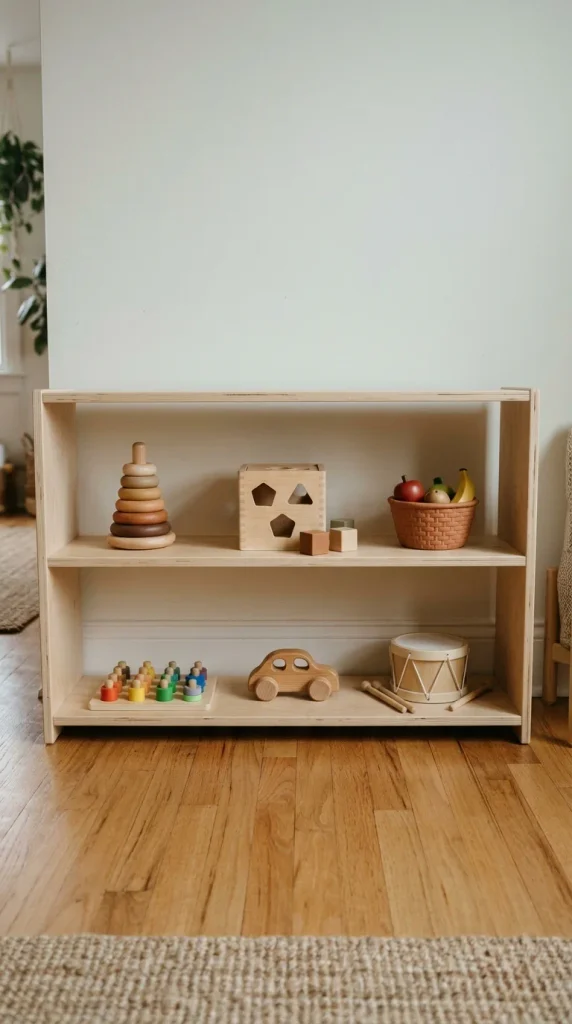
Mistake 3: Skipping the Anchor Kit
Safety note: anchor tall furniture to the wall, keep candles and cords away from fabric, and use a licensed electrician or contractor for hardwired lighting, ceiling mounts, or anything structural.
A low shelf feels too short to tip. Kids climb it anyway, because a shelf at chest height is basically a step.
CPSC’s furniture tip-over report estimated that about 22,500 Americans a year needed emergency room care for tip-over injuries in 2018 to 2020, and nearly 44% of them were children. Of the 581 tip-over deaths recorded since 2000, 472 were children. CPSC has also said most anti-tip kits cost less than $20 and install in under 20 minutes.
Sprout Kids, a Montessori furniture maker, recommends anchoring anything 20 inches tall or more. That covers most toddler and preschool shelves.
Renting? Most straps need one small screw in the wall, and spackle fills that hole when you move out. Check your lease first. If it truly forbids holes, pick a shelf under 20 inches until the climbing phase passes.
Strap every shelf 20 inches or taller to a wall stud or a proper wall anchor.
Keep heavy things like books and block sets on the bottom shelf.
Trusting that a shelf is “only 24 inches” and too low to matter.
Drawers or open doors your child can use as a ladder.

Mistake 4: Skipping Toy Rotation and Putting Everything Out
Ask five Montessori sources how many toys to put out, and you’ll get five answers:
- A Montessori educator interviewed by Nestig suggests about five to seven for a young child.
- ParentMap says about six.
- Unfnshed says 8 to 10.
- Lovevery designs its shelf around 9 to 12.
They agree more than it looks. Every one says fewer than you own, and every one says rotate.
Your child gives you the real signal. Greenspring Montessori’s family guide notes that trouble cleaning up often means too many choices. Older kids can even help decide how many toys come out.
So here’s a starting rule that blends those ranges by age. Begin at the low number and add one toy at a time.
Store the out-of-rotation toys in a lidded bin in a closet, grouped by type. Then the next swap takes a minute instead of an evening.

Mistake 5: Deep Toy Bins Instead of Trays and Baskets
Deep bins invite one move: dump. Your child tips the whole thing over to find one car, and now everything is on the rug.
Montessori rooms skip the big bin. Motherly points out that you’ll see small baskets instead, and every item gets its own spot.
A tray does something a bin can’t. It shows where one activity starts and stops. The puzzle lives on the tray, and the tray lives on the shelf, so cleanup becomes one trip instead of a search.
You can hear the difference, too. Wooden blocks set into a shallow basket make a soft knock. A plastic bin poured onto hardwood sounds like someone dropped the silverware drawer.
One deep bin holds blocks, cars, and puzzle pieces all mixed together. Your child dumps it to find a single thing, and nobody knows where anything goes back.
Three shallow baskets and one tray, each holding one activity. Your child can see what’s inside without digging and carry it back alone.
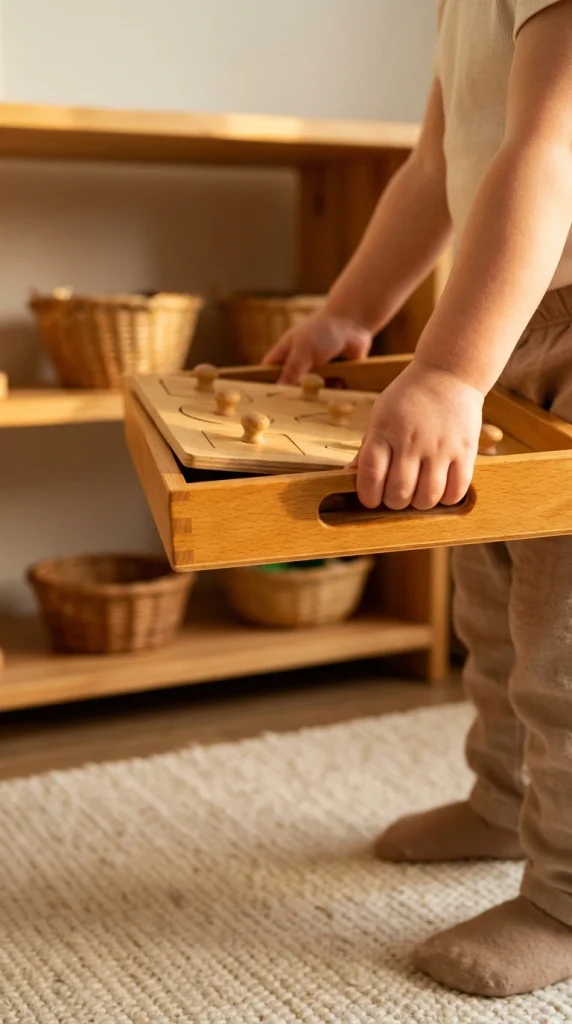
Mistake 6: No Open Floor in a Small Space
Kids under five learn with their whole bodies. Motherly and Unfnshed both treat open space and movement as core parts of a Montessori room, not extras.
The usual slip is filling every foot of floor because the room feels small. A small Montessori playroom needs empty floor even more, since there’s nowhere else to roll, crawl, or dance.
Three moves, no tools:
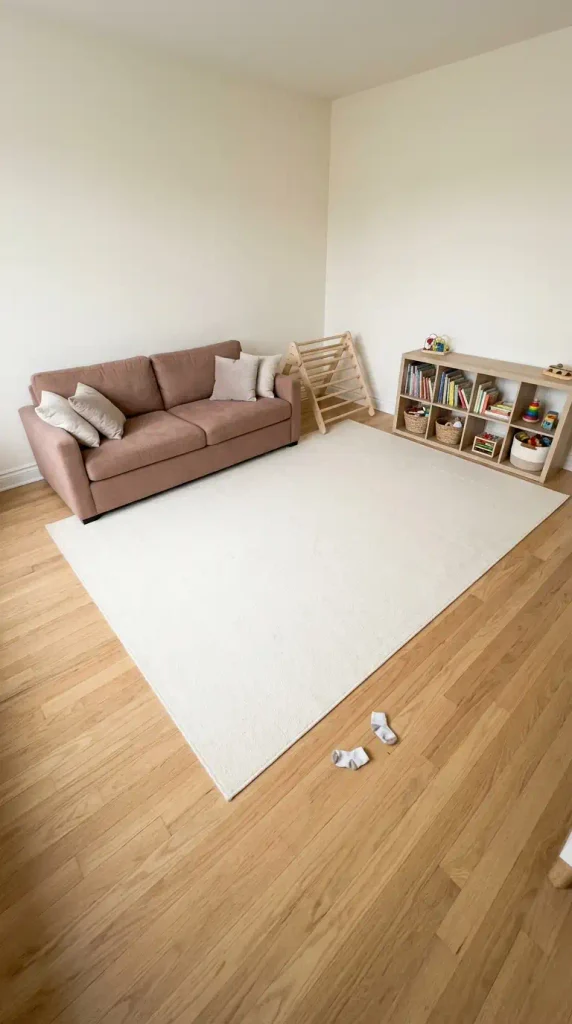
Push every piece of furniture against a wall, the shelf included.
Lay one washable rug in the middle to mark the play square.
Leave the rug empty except for one movement piece: a floor cushion for crawlers, or a wooden climbing triangle for steady walkers.
When the rug starts collecting toys again, take that as your cue to rotate. Buying another bin won’t fix it.
Mistake 7: Decorating the Walls for the Camera
Rainbow decals look great in a photo. In real life they compete with the toys for your child’s attention.
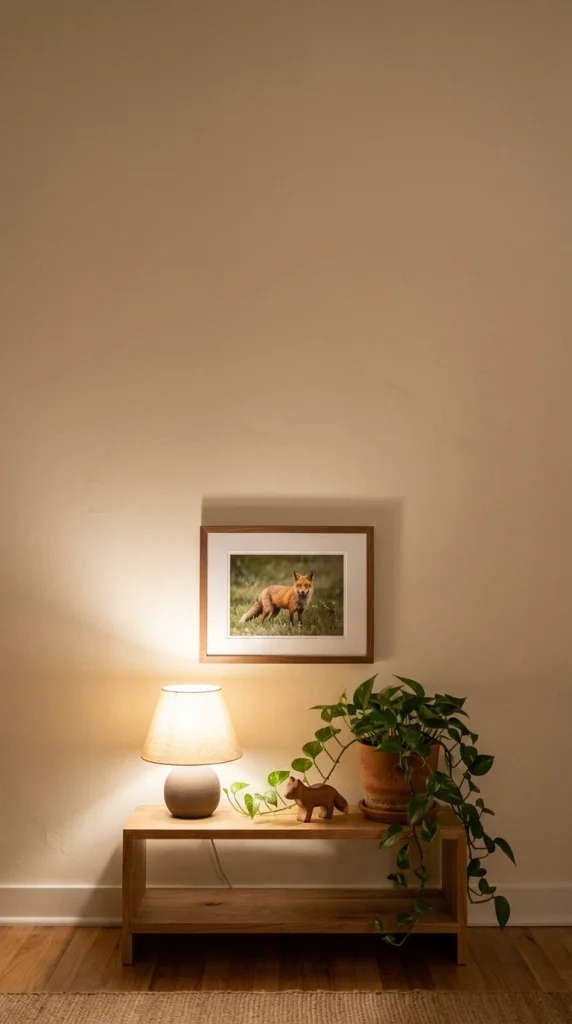
Greenspring’s guide says Montessori spaces use more neutral colors and keep very little on the walls. Unfnshed adds that Montessori rooms favor real images over cartoon posters, so a photo of an actual fox beats a smiling cartoon one.
Hang art where your child’s eyes are, not yours. Removable picture strips work if you rent. If you love that calm look and want to see how far neutrals and one plant can go, a calm Japandi corner on a budget shows the same idea for grown-up spaces.
Mistake 8: Leaving Out a Reading Corner
Books often show up in Montessori playroom guides as one more shelf item. That’s a miss, because the reading spot is where the quiet half of the room happens.
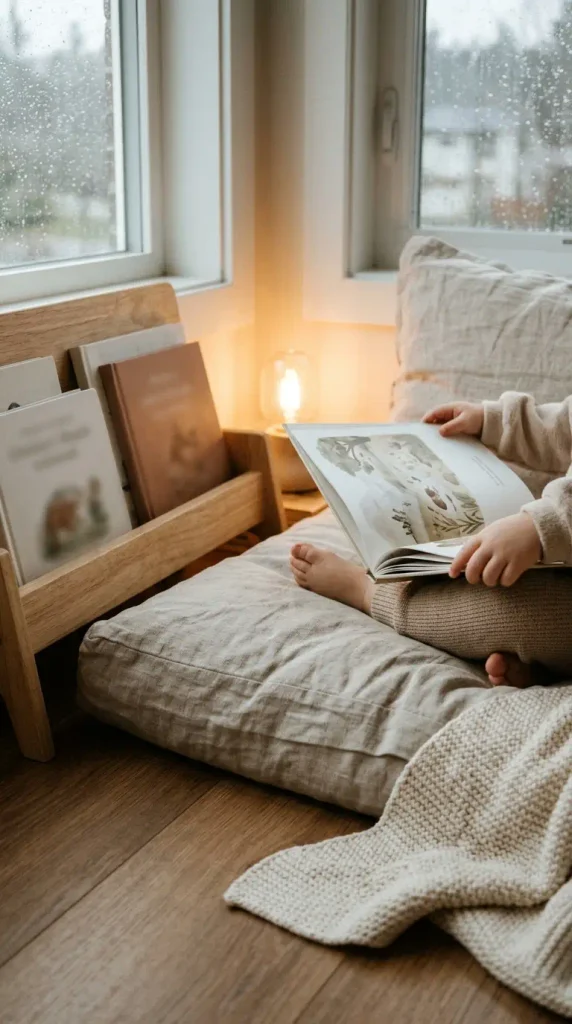
Turn the covers out. Unfnshed explains that forward-facing shelves let toddlers recognize favorites by the cover and put them back alone. It suggests the top shelf sit about 24 to 36 inches off the floor for kids around 1 to 4. Ariro recommends rotating 4 to 6 books at a time, just like toys.
Add a floor cushion and one lamp with a warm 2700K bulb, and the late-afternoon light finally has somewhere to land. Keep the lamp cord behind furniture where small hands can’t tug it. For more layouts built around this idea, browse our Montessori reading nook setups.
Build the book corner
What a Montessori Playroom Costs Without the Mistakes
$400 buys one very nice shelf. That’s the price Mother magazine listed for the Lovevery Montessori Playshelf, and it’s well made. You just don’t need it to start.
Here’s a starter Montessori playroom IKEA setup, priced from ikea.com US listings at the time of writing. If you want flat-pack pieces to look less flat-pack, see IKEA furniture ideas that look custom.
| Piece | Archetype | Price |
|---|---|---|
| 🪑 Table | IKEA FLISAT children’s table, 18 7/8 in. tall | $99.99 |
| 📦 Shelf | IKEA KALLAX 2×2 shelf unit, 30 1/8 in. tall | $44.99 |
| ⚓ Safety | Anti-tip strap kit | Under $20 |
| Total | Under $165 |
One honest trade-off: an IKEA reviewer noted the FLISAT lids are particleboard, and scratches plus moisture can wear them down. Wipe spills fast, or set an old baking sheet on top for water play.
And remember the KALLAX height from Mistake 2. Toddlers get the bottom cubes, and the shelf grows into the rest.

FAQ
How many toys should be in a Montessori playroom?
Published advice runs about five to twelve toys out at once. A Montessori educator interviewed by Nestig suggests five to seven for a young child, while Lovevery designs its shelf for nine to twelve. Start low for babies and young toddlers, add slowly for preschoolers, and watch cleanup. If your child can’t put things back alone, there’s too much out.
How often should you rotate Montessori toys?
Many parents rotate about once a week, but your child is the better clock. When a toy sits untouched for several days, swap it out. If your child is still deep into something, leave it on the shelf. Changing one or two pieces at a time keeps the shelf familiar while still giving them something new to find.
What age can you start a Montessori playroom?
You can start once your baby begins to crawl. Infant shelves are often about 13 inches tall with only a top and bottom surface, low enough to reach and to pull up on. As your child grows, raise the shelf height and add a few more choices. Toddlers usually do well with a shelf around 20 to 24 inches tall.
What furniture do you need for a Montessori playroom?
Three pieces cover most of it: a low open shelf, a child-sized table with a chair or stool, and a rug that marks the play area. Add a forward-facing book ledge for reading. Anchor anything 20 inches or taller to the wall. Skip toy chests and deep bins, since they hide toys and encourage dumping.
Can you make a Montessori playroom in a small apartment?
Yes, and you don’t need a whole room. One low shelf and a small rug in a living room corner can define the space. Keep the toy count low, push furniture against the walls, and leave some floor empty for movement. Small spaces gain the most from rotation, because fewer toys out makes the corner feel calmer.
Do Montessori toys have to be wooden?
No. Montessori-friendly toys lean toward natural materials like wood, metal, clay, and glass when possible, and they usually skip batteries and screens. A sturdy toy that does one clear thing can still earn a shelf spot. What matters more is that each toy has a purpose, fits your child’s stage, and has its own home on the shelf.
Your Next Step
A Montessori playroom doesn’t need more stuff. It needs fewer things, placed lower, with a little patience while you watch what your child actually reaches for.
Pick one mistake and fix it this weekend. Lower the shelf. Pull half the toys. Strap the shelf to the wall. Each change is small, and together they turn a cluttered corner into a space your child can run without calling you over every five minutes.
Save the Start-Low Toy Ladder and the shelf height chart to your Montessori playroom board, so they’re handy on your next rotation day.
Keep reading
More cozy nook ideas
 Nursery & Teen Rooms
Read →
25 Teen Boy Bedroom Ideas That Feel Grown-Up, Not Childish
If his room still has the race car lamp and the glow-in-the-dark stars, and the door has started staying shut, he’s telling…
 Nursery & Teen Rooms
Read →
10 Toddler Bed Ideas That Grow With Your Child
A toddler bed has a short shelf life. The federal definition covers kids who weigh no more than 50 pounds, and a…