
9 English Cottage Mistakes That Flatten the Look, and What to Do Instead

You bought the floral armchair, the ditsy print pillows, and a jug of dried eucalyptus. The corner still looks like a store display instead of a sitting room in the Cotswolds. That gap has a cause, and it usually isn’t your budget.
Most English cottage rooms fall flat because of a few small, fixable mistakes. Almost none of them need a renovation, and most of the fixes work in a rental where the lease says no paint and no nails.

Below are nine of them, roughly in the order they tend to show up, with the fix right under each one. You’ll get a pattern rule worth screenshotting, a lamp setup that warms a dark corner after sunset, and curtain math that makes a small window look taller.
Start with the audit table. If a row makes you wince, skip straight to it.
The 9 English Cottage Mistakes at a Glance
Scan the left column first. Most rooms that miss the mark have two or three of these at once, and fixing one usually makes the others easier to spot.
| ⚠️ The mistake | ✅ Do this instead |
|---|---|
| 1. Buying the whole look new in one weekend | Put one aged piece in every grouping |
| 2. One floral on everything | Climb the Pattern Ladder: large, medium, small |
| 3. A cool ceiling light doing all the work | Three warm 2700K lamps at three heights |
| 4. Short curtains hung at the frame | Rod high and wide, panels that touch the floor |
| 5. Foam beams and fake brick | Paneling, a printed shelf back, matte paint |
| 6. A chair with nowhere to set a mug | Chair, table at arm height, lamp, footstool, throw |
| 7. Shiny synthetics | Linen, wool, jute, rattan, worn wood |
| 8. A bookcase styled like a store shelf | Mixed stacks, one jug or plate, anchored to the wall |
| 9. Turning the room into a theme set | One collection, empty surfaces, two weeks before buying more |
Mistake 1: Buying the Whole Look New in One Weekend
Real English cottages were furnished over decades. A chest from a grandmother, a chair from a village sale, a lamp that has moved house three times. Buy everything from one store in one weekend and the room reads as a catalog page, however many florals you add.
The fix is a pairing habit: put at least one aged piece in every grouping. Next to a new armchair, a thrifted pine stool. Under a new lamp, a scuffed wooden box. In the US, thrift stores, estate sales, Facebook Marketplace, and Habitat for Humanity ReStore locations are the usual hunting grounds for English cottage style on a real budget.
A matching armchair, side table, and lamp from one store. Every finish is fresh, every edge is sharp, and nothing has a story.
The same new armchair beside a thrifted pine stool, a secondhand brass lamp base, and a quilt with one faded corner. One old piece per grouping.

Wood, metal, ceramic, and glass are the easy secondhand wins. Upholstery is riskier. Smell the cushions, check the seams for pests, and plan for a slipcover or a professional clean before anything soft comes into your living room.
Mistake 2: One Floral Print on Everything
Floral is the first thing most people reach for, and it’s the right instinct. Trouble starts when the same rose print lands on the curtains, the chair, the pillows, and the lampshade. One pattern at one scale turns a room into wallpaper.
English cottage rooms stack two or three patterns at different sizes, held together by one shared color. Here’s that rule, built so you can screenshot it.
🪜 The Cottage Pattern Ladder

Shopping it goes faster in this order:
- Choose the large print first, because it sets the colors for everything else.
- Pull one color out of it and find a check or stripe in that color.
- Finish with the smallest print in a softer version of the same color.
Squint at all three swatches side by side. If one jumps forward and the others vanish, the scales are too close together.
Mistake 3: Letting a Cool Ceiling Light Do All the Work
Small windows are the reason English cottages feel the way they do. Thick walls, low ceilings, and little glass mean the room runs on lamplight by late afternoon. A single overhead fixture with a cool white bulb flattens all of that into an office.
The Department of Energy explains how warm and cool color temperatures are rated: lower Kelvin numbers, around 2700K to 3000K, read warm, while 3600K to 5500K reads cool. For a cottage corner, put 2700K bulbs in every lamp and leave the ceiling light off after dark.
Three lamps at three heights do what one bright fixture can’t:
- A reading lamp beside the chair, with the shade bottom near your shoulder when you sit.
- A low lamp on a shelf or table across the room, so the corner isn’t the only bright spot.
- A small glow up high, from a picture light over a print or a corded wall sconce.

Shades matter as much as bulbs. A pleated or gathered fabric shade softens the light, while a bare bulb or a chrome dome sharpens it. For renters, a corded sconce with a cord cover painted to match the wall gives the look without wiring. Owners who want hardwired fixtures should hire out the electrical work.
Safety note: anchor tall furniture to the wall, keep candles and cords away from fabric, and use a licensed electrician or contractor for hardwired lighting, ceiling mounts, or anything structural.
Mistake 4: Short Curtains Hung Right at the Window Frame
Hang the rod at the top of the frame and buy panels that stop at the sill, and a small window looks smaller still. Cottage windows tend to be tiny, so the curtains do the work of making them read taller and wider.
Four moves fix it:
Mount the rod about 4 to 6 inches above the window frame, higher if the ceiling allows.
Run it several inches past each side so open panels stack on the wall, not over the glass.
Buy panels whose combined width is about twice the window width, so they gather instead of stretching flat.
Let the hem just kiss the floor, or break by about an inch for a softer English look.

Renters have no drill options. Brackets that hook onto the window trim hold a rod without screws, and a tension rod inside the window recess carries a cafe curtain across the bottom half for privacy. That cafe curtain, in a small check or gingham, is one of the most English details you can add for very little money.
One honest catch: trim brackets and adhesive hooks handle light, unlined linen well and heavy lined velvet badly. Check the weight limit on the package first. In a kids’ room, pick cordless shades so no loop hangs within reach.
Mistake 5: Faking Old Architecture With Foam Beams and Brick Panels
Foam beams glued to a flat 8 foot drywall ceiling rarely fool anyone. Neither do plastic brick panels across a whole wall. Real cottage character comes from walls that look handled: paneling, a rail, a soft matte color, a little pattern tucked where you don’t expect it.
Renting: keep it removable. Peel and stick beadboard below chair rail height, roughly 32 to 36 inches off the floor, gives the look of old wainscot and comes off at move out. Lining the back of a bookcase with small print wallpaper is even simpler, and it’s the fastest way to make IKEA furniture look custom, since a printed back and a strip of trim hide the flat pack giveaway.
Owning: real beadboard or a picture rail, painted in a matte sage, putty, warm white, or faded blue, carries the look for years.
Beadboard or peel and stick paneling up to about 32 to 36 inches.
Small print wallpaper inside a bookcase or cupboard.
Matte paint in sage, putty, warm white, or faded blue.
Foam beams on a flat, low drywall ceiling.
Faux brick panels covering a whole wall.
Stark white walls with high gloss trim.

Mistake 6: A Reading Chair With Nowhere to Set Your Tea
The best English cottage sitting rooms have one chair that clearly belongs to someone. It has a lamp at its shoulder, a table at its elbow, and a book face down on the arm. A lone armchair pushed against a wall to face the TV never gets that look.
An English cottage reading nook takes five pieces, and the measurements matter more than the brand.
Build the corner
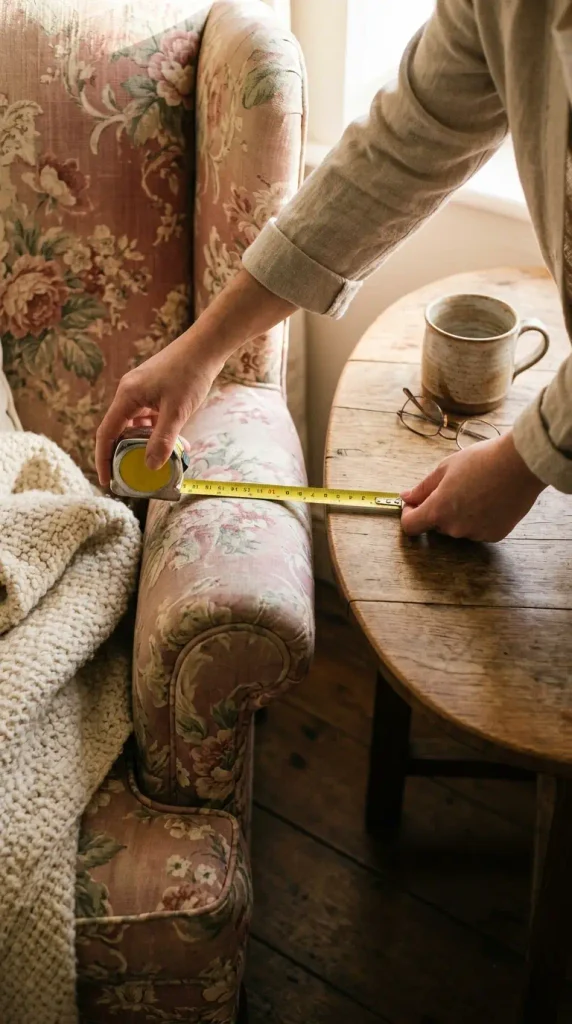
The height match is the detail people skip. A side table far below the chair arm means leaning over every time you reach for your mug, and the corner quietly stops getting used. Measure the arm first, then shop.
For the chair, a roll arm or wingback shape does the work; the IKEA Strandmon is one widely sold wingback that fits small rooms. Add the footstool and it becomes a place you stay for a whole chapter.
Mistake 7: Shiny Synthetics Where Natural Fibers Belong
Polyester velvet catches light in a way linen never does. Glossy laminate, plastic storage bins, and faux fur throws all carry the same sheen, and sheen is the quickest giveaway that a room is brand new.
Swap by material, one category at a time:
- Throws: wool or cotton waffle instead of fleece.
- Pillows: linen or cotton covers instead of satin finish polyester.
- Rugs: jute, wool, or a faded vintage style washable rug.
- Baskets: rattan, wicker, or seagrass instead of plastic.
- Surfaces: worn wood, terracotta, and stoneware.
Natural fibers wrinkle, fade, and soften with use. That wear is exactly what makes a room look lived in instead of bought.

Natural fibers have quirks. Linen wrinkles the minute you sit on it, and jute feels scratchy under bare feet and sheds a little at first. In a home with pets or small kids, a washable cotton rug is the easier pick.
What you get back is texture you can feel in the dark: the weight of a wool throw on your knees, the dry rasp of linen, the faint honey smell of beeswax polish on an old table.
One living thing finishes the corner. A jug of garden stems does more than any faux arrangement, and if you have even a patch of soil, these small backyard cottage garden ideas are a good place to start growing your own.
Mistake 8: Styling the Bookcase Like a Store Shelf
Books are half the decor in an English cottage. That’s why a bookcase styled like a retail display looks off, whether it’s rows of identical spines sorted by color or three shelves holding nothing but one vase each.
Mix it up instead. Stand most books upright, lay a few stacks flat, and use those stacks as risers for a small jug, a plate on a stand, or a framed print leaning against the back. Leave a little gap on every shelf. Keep the heaviest hardcovers on the bottom shelves, which also happens to be the safer setup.
Federal safety regulators are blunt about tall furniture. The CPSC guidance on anchoring bookcases and dressers credits its Anchor It campaign with a nearly 50 percent drop in tip over injuries and deaths in the US, and the advice is simple: secure bookcases and dressers to the wall.
⚠️ Watch Out
An adhesive hook is not an anchor. Anti tip straps need a screw into a stud or a proper wall anchor to hold. Renting? Ask your landlord first, since one small screw hole is usually an easy patch at move out. If drilling is off the table, choose a low, wide bookcase instead of a tall one.

Mistake 9: Turning English Cottage Decor Into a Theme Set
Teacups on every surface, a rooster on the windowsill, a sign that says Tea Time, a Union Jack pillow. Each piece is fine alone. Together they turn English cottage decor into a costume.
Part of the mix-up is cottagecore. The two looks overlap, and Book Riot has noted that cottagecore grew out of English countryside cottage style. Cottagecore leans into whimsy, with mushrooms, fairy lights, and a storybook mood. English cottage is quieter and more practical, built on worn furniture, mixed pattern, and things people actually use. If the storybook side is what you love, our cottagecore reading nook ideas go all the way there.
For the English version, run the edit test:
- ▸Pick one collection (teacups, jugs, or plates) and keep it to one shelf.
- ▸Leave about a third of every surface empty.
- ▸Keep one wall quiet, with plain paint and no gallery.
- ▸Remove anything with words printed on it.
- ▸Live with the room for two weeks before buying the next piece.

Restraint is what makes that one teacup shelf look like a choice.
FAQ
What makes a room look like an English cottage?
A mix of old and new furniture, two or three patterns at different scales, and natural materials like linen and wool. Add warm lamplight instead of overhead light, and walls with some texture or paneling. The look depends less on any single item than on the sense that the room was put together slowly and gets used every day.
What colors are used in English cottage style?
Soft, muted colors borrowed from the countryside: sage green, faded blue, putty, warm white, dusty rose, and buttery yellow. Matte paint finishes help, since gloss reads modern. Deeper accents like oxblood, forest green, or navy show up in smaller doses, often on a painted cupboard, a lampshade, or a single upholstered chair.
What is the difference between English cottage and cottagecore?
English cottage is an interior style rooted in real rural homes in England, with practical furniture, mixed pattern, and pieces collected over time. Cottagecore is a newer online mood that borrows from it and adds whimsy like mushrooms, fairy lights, and storybook romance. You can blend them, but English cottage usually looks calmer and more lived in.
Can you get English cottage style in a rental?
Yes. Most of the look is movable:
- a secondhand armchair
- layered pattern
- linen curtains on no drill trim brackets
- warm 2700K bulbs
- peel and stick beadboard or wallpaper inside a bookcase
Skip permanent changes like faux beams. Ask your landlord before anchoring furniture, since a single screw hole is usually easy to patch at move out.
How do you make a modern house feel like an English cottage?
Start with the fastest changes: swap cool bulbs for warm ones, add fabric lampshades, and bring in one old wooden piece per room. Then layer pattern on curtains and pillows and hang curtains high and wide. Add paneling or a picture rail if you own. Leave some surfaces empty so the room feels lived in, not staged.
Is English cottage style still popular in 2026?
Yes. Plenty of 2026 decor coverage names modern cottage, a lighter take on English cottage style, as one of the year’s leading looks. The appeal is practical. It welcomes secondhand furniture, forgives wear, and works in small homes, which makes it easier to live with than trends built on one exact color or finish.
Your Next Step
An English cottage room is mostly about what you stop doing. Stop buying everything new at once, stop matching every print, stop trusting the ceiling light. Keep the warm lamps, the old stool, the linen that wrinkles, and the shelf with room to breathe.
Pick one mistake from the table and fix it this weekend. The bulb swap takes minutes and changes the room the most after dark. Let the next fix wait until you’ve lived with the first.
Save this list to your reading nook board so the Pattern Ladder and the curtain math are there when you go shopping.
Keep reading
More cozy nook ideas
 Cottage Garden & Balcony
Read →
25 Small Backyard Ideas for a Dreamy Cottage Garden
Four plants, one 6-foot obelisk, a $99.99 folding bistro set, and a strand of warm solar lights. That’s $271.03 at this month’s…
 Cottage Garden & Balcony
Read →
20 Backyard Oasis Ideas on a Budget, Starting With a $152 Corner
Two folding chairs, a small outdoor rug, 24 battery globe lights, and two planters. At IKEA this October, that adds up to…