
16 Fall Planter Ideas for Sweater-Weather Evenings

Six o’clock, 54°F, a mug going cold on the porch step, and one pot of white mums still holding the last of the light. That’s the hour these 16 fall planters are built for: the stretch after work when you pull on a sweater and stay outside a little longer.
Most fall planter ideas are designed for a sunny Saturday photo. These are designed for dusk. You’ll find pots that glow when the porch light comes on, grasses that rustle when the wind picks up, and plants that look better after the first frost instead of worse.
Renting? Half of these never need a drill, a yard, or a landlord’s blessing. A railing, a stoop, or a 3 foot square of balcony is plenty.
Every idea leans on what actually holds up in a cold snap, with real planting distances, frost behavior pulled from university extension guides, and the small swaps that keep a pot going into winter. Start with the one that fits the spot by your favorite chair, then build out.
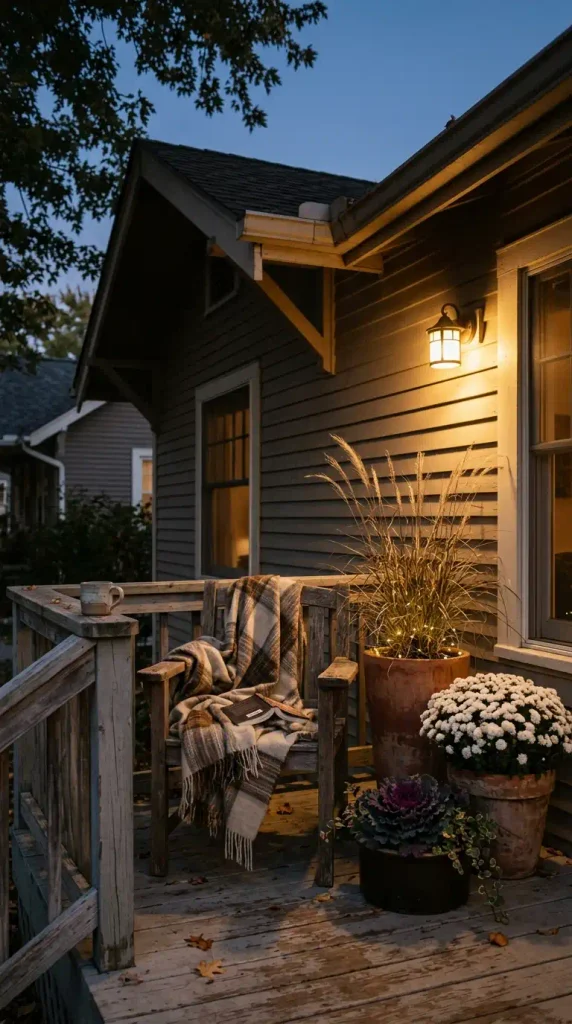
1. A White Mum Planter That Glows at Dusk Beside Your Chair
White flowers are the last thing your eyes lose when the light goes. That’s why the first planter on this list skips orange entirely.
- Thriller: a white or silver ornamental kale, set at the back
- Fillers: two white garden mums, bought mostly in bud so they open on your porch, not the store’s
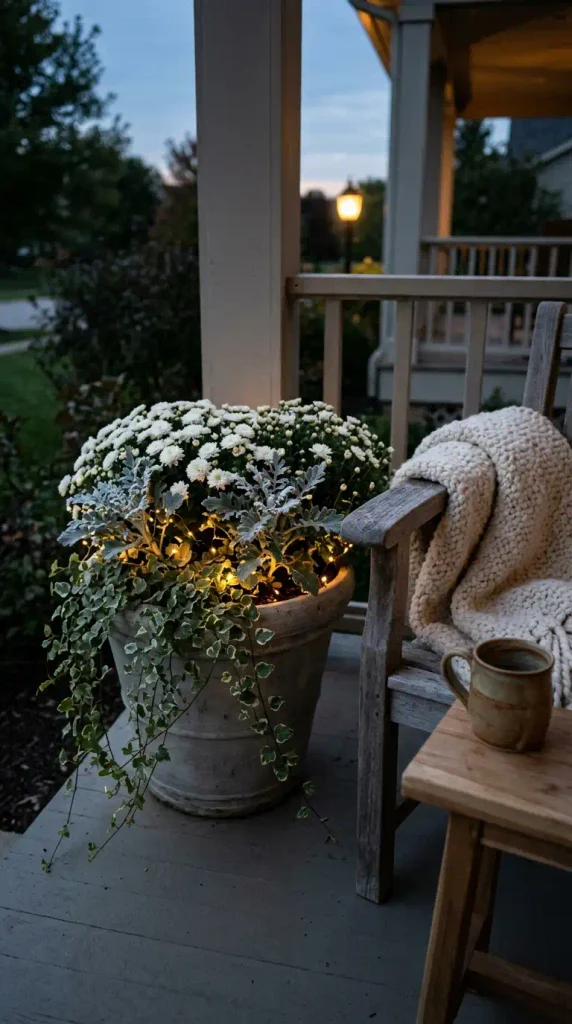
- Spillers: dusty miller and trailing ivy over the front rim
- Glow: one strand of battery fairy lights on a six hour timer, tucked low between the stems
Set the pot within arm’s reach of where you sit, on the side away from the throw you keep out there. Warm white bulbs around 2700K match a porch light, so the pot reads as part of the evening. For more ways to layer low light around a seat, browse our warm lighting ideas for small corners.
Safety note: anchor tall furniture to the wall, keep candles and cords away from fabric, and use a licensed electrician or contractor for hardwired lighting, ceiling mounts, or anything structural.
2. The 1-3-2 Fall Pot Rule for Full, Packed Planters
Fall pots don’t grow in. Summer pots do.
In May you leave gaps because plants double by July. In October growth nearly stops, so a pot planted with gaps keeps those gaps until frost. Washington State University Extension’s fall container advice puts it plainly: stuff the pot as full as you want the finished look to be.
Garden beds work the opposite way. The UMass Extension fall flower planting guide spaces mums and grasses 18 to 24 inches apart in the ground. In a pot, ignore that and plant shoulder to shoulder.
THE 1-3-2 FALL POT RULE
Fill potting mix to about 2 inches below the rim, never garden soil, and set the pot on pot feet so it drains.
Six plants, no gaps, and the pot looks finished the day you plant it.
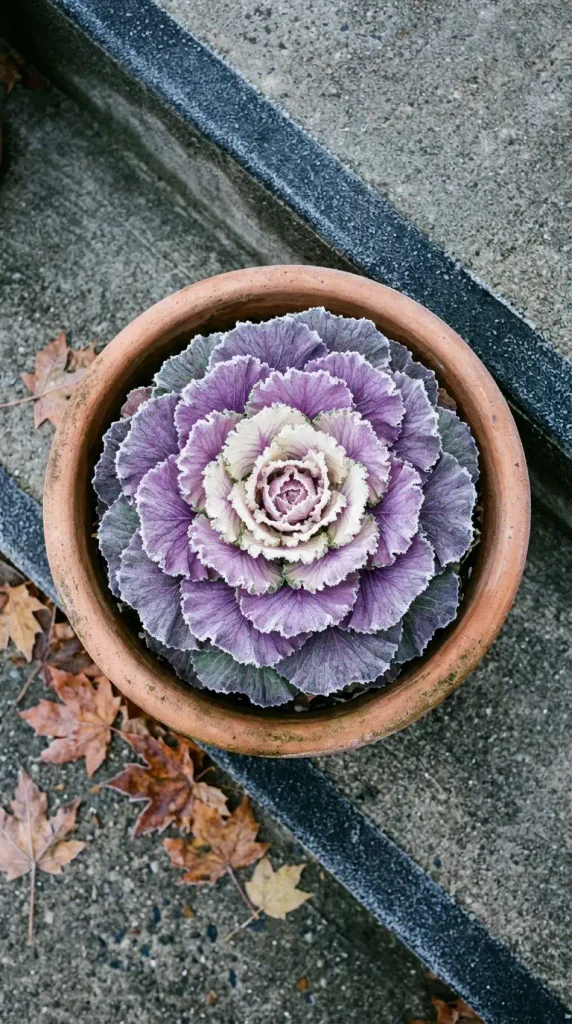
3. Ornamental Kale, Planted After the First Frost
With kale, timing matters more than variety. Penn State Extension’s Lehigh County master gardeners note that kale planted in early September tends to stretch, go leggy, and stay pale. Planted later, it colors up and dodges most of the cabbage loopers, which fade once frost arrives.
So the back half of October is the sweet spot. Cold nights deepen the purple, pink, and cream centers. A light frost leaves the leaves rimmed in white by morning, and the plant shrugs it off.
| Planted early September | Planted mid to late October |
|---|---|
| Stretches and turns leggy | Stays tight and compact |
| Pale, slow to color | Color deepens with cold nights |
| Cabbage loopers still feeding | Mostly pest free after frost |
One kale, one 12 inch bowl, done.
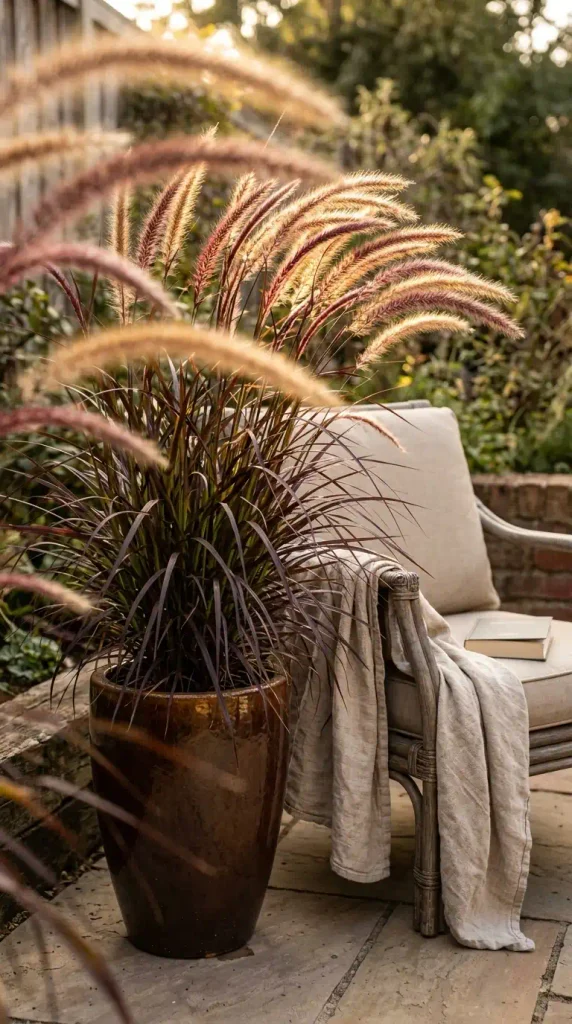
4. A Tall Grass Pot That Rustles Beside Your Reading Spot
Put a pot of grass a few feet from where you sit and the wind becomes part of the evening. Fountain grass and millet make a dry, papery whisper. Carex sits lower and stays quieter.
💡 Quick Tip
Skip the saucer under a tall grass pot on an open porch. Rain pools, roots sit cold and wet, and the pot turns top heavy. Pot feet lift it an inch and let it drain.
Choose by your winters. Purple fountain grass is grown as an annual across most of the US and fades to tan after frost, which still looks warm beside a lantern. Evergreen carex holds its color all winter. A pot about 16 inches tall lifts the seed heads close to seat height, so you hear them as much as see them.
5. No-Drill Railing Planters for a Balcony or Stoop
The common mistake is hanging the heaviest box on the street side of the rail.
Over-the-rail planters hook on with a saddle bracket, so nothing gets screwed into a railing you don’t own. Hang them on the inside. A box on the outside can drip water or drop soil on whoever is below, and plenty of leases and HOAs ban exactly that.
Fill with lightweight potting mix and keep plants low: violas, sweet alyssum, and trailing ivy. Alyssum earns its spot alone. It smells like honey on a still evening and keeps flowering through light frosts. Our balcony reading nook ideas show how to fit a chair and a planter into the same few square feet.
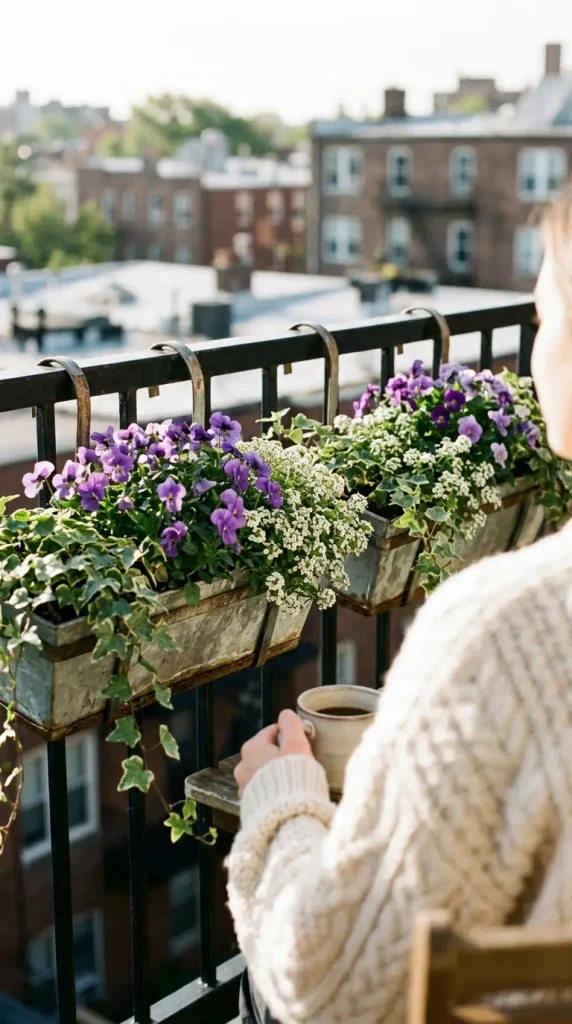
Hang boxes on the inside of the rail.
Use light potting mix and low plants.
Check your lease or HOA rules first.
Screws or clamps that mark the rail.
Garden soil, which packs down and turns heavy.
Tall grasses that catch wind up high.
6. Fall Planters With Pumpkins as the Pot
A carved pumpkin starts going soft within days. A whole one can sit on the steps for weeks. So the longest-lasting pumpkin planter never gets carved at all.
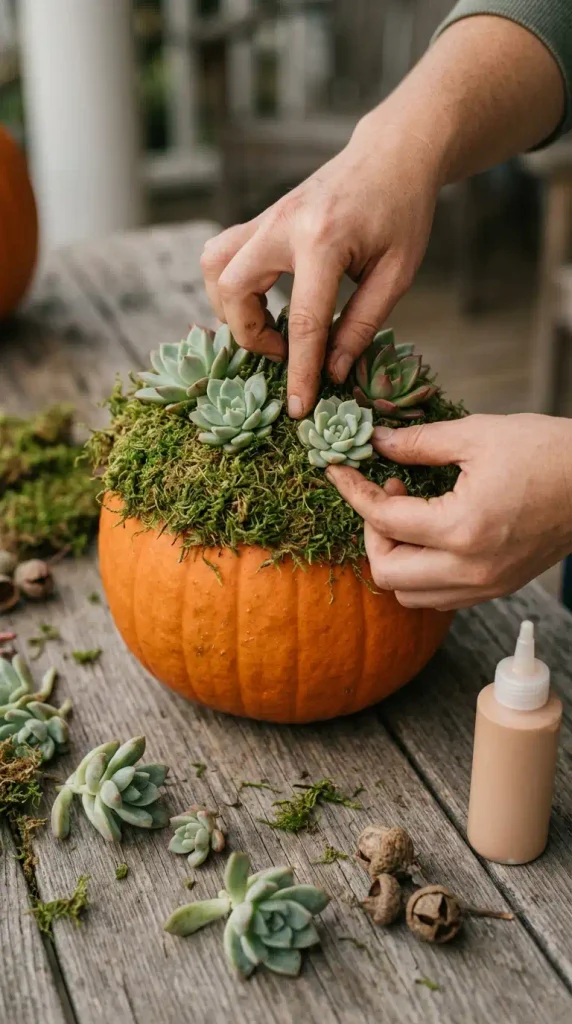
Pick a squat pumpkin with a flat top so the moss sits level.
Spread tacky craft glue over the top and press on a layer of sheet moss.
Glue small succulents and dried seed pods into the moss. No soil needed.
Keep it in shade and out of the rain. Both slow the rot.
Mist the succulents once a week. When the pumpkin finally softens, peel them off and pot them up for a sunny windowsill.
7. An Edible Fall Pot by the Kitchen Door
Clemson’s Home & Garden Information Center shows a container that mixes Swiss chard, ornamental kale, mustard, red-veined sorrel, violas, and snapdragons. It holds color for months, and you can cut dinner from it.
‘Bright Lights’ chard is the reason to try it. Red, gold, and pink stems catch porch light like colored glass, and violas are edible too, a peppery garnish for a fall salad.
Plant this pot
Ornamental kale is technically edible but tough and bitter. Save your scissors for the chard.
8. A Fall Planter That Keeps Going Until Spring
Most fall planters hit the compost bin by Thanksgiving. Layered right, this one doesn’t.
Plant it like lasagna. Spring bulbs go on the bottom, about 6 inches down: crocus, muscari, and small daffodils. Cover them with potting mix. Pansies and violas go on top, with one hellebore as the centerpiece.
Hellebores can bloom November into early spring in milder areas. Cold-tolerant pansy hybrids can overwinter in USDA zones 6 and 7. Come March, the bulbs push up right through them.
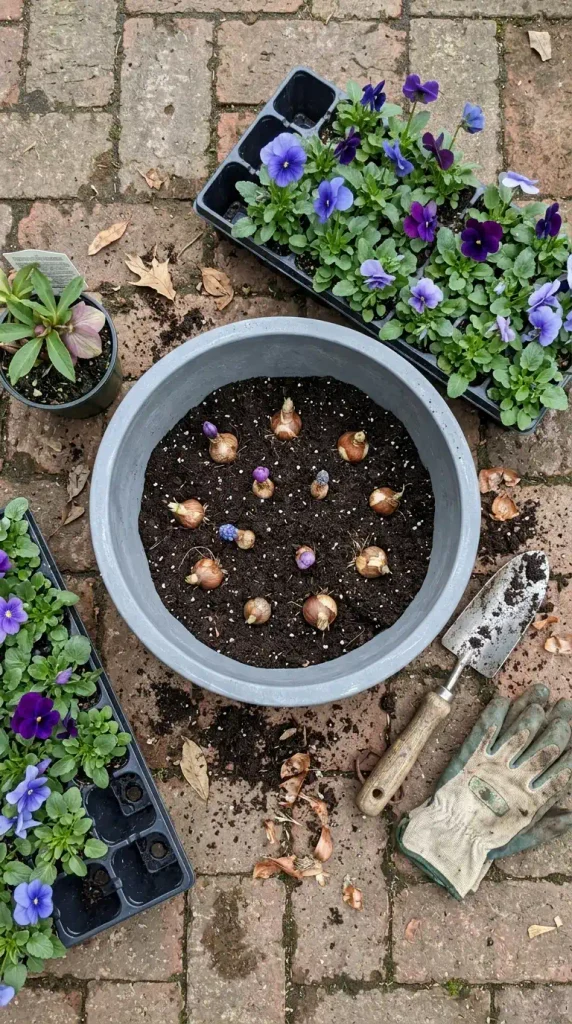
Pansies and violas in bloom, a hellebore in leaf, and bulbs hidden 6 inches down.
Crocus and muscari push up through the pansies, which wake up and bloom again.
One honest catch: UMass Extension notes that plants in containers generally won’t overwinter in cold regions, because roots in a pot get far colder than roots in the ground. In zone 5 and colder, roll this pot into an unheated garage after the hard freeze and bring it back out in March.
9. Garden Mums, Not Florist Mums, for Planters That Last
Check the tag before you fall for the color. Florist mums are bred for a big indoor display, and Penn State Extension notes their blooms die with the first frost. Garden mums are hardy to zone 5 and keep flowering through a few light freezes.
Your zone may have changed since you last looked. The USDA plant hardiness zone map finds it by zip code, and its 2023 update moved about half the country into the next warmer half zone.
| Garden mum | Florist mum |
|---|---|
| Keeps blooming after light freezes | Blooms die at the first frost |
| Hardy to zone 5 | Treat it as a short display |
| Best for: outdoor planters | Best for: indoors or a covered spot |
Handle the stems gently when you pot them. Mum stems are brittle and snap at the base.
10. A Dried Arrangement Planter for a Covered Porch
Zero watering, zero frost damage, and it looks the same on November 30 as on day one.
Fill a tall urn with dry floral foam, then build by height:
- Tall: dried wheat stalks or pampas plumes, about twice the height of the pot
- Middle: dried hydrangea heads and bunny tail grass
- Low: a few faux mini pumpkins and dried orange slices at the rim
Keep it under a roof. Homes & Gardens points out that dried planters only work when they’re out of the rain, because wet dried flowers go limp and brown. Wind is the other problem, so drop a brick into the urn before the foam goes in.
Dried stems don’t mind cold. They mind water. Give them a roof and they outlast every live plant on the porch.
11. A Small Indoor Planter Next to Your Reading Chair
Fall planters don’t have to live outside. A low stoneware bowl of coral bells on your side table brings the same burgundy and amber tones indoors, right where you read.
Heuchera works because its leaves carry the color, so no petals drop onto your book. The ASPCA lists coral bells as non-toxic to cats and dogs, which matters for a plant at lap height.
Pair it with a lit branch or a small tree for evening glow. Our fall tree ideas for sweater-weather evenings cover the lighting half of that corner.
📌 Good To Know
Indoor heat dries a small bowl fast. Water when the top inch of mix feels dry, and plant the heuchera outside in spring. It’s a perennial and comes back.
12. A Moody Black Planter for a Dark Front Door
Orange is everywhere in October. A black pot planted in near-black foliage stands out precisely because it skips it.
Lamp light is where this pot wins. The dark leaves turn glossy, the peppers shine, and a single white pumpkin at the base glows next to the door.
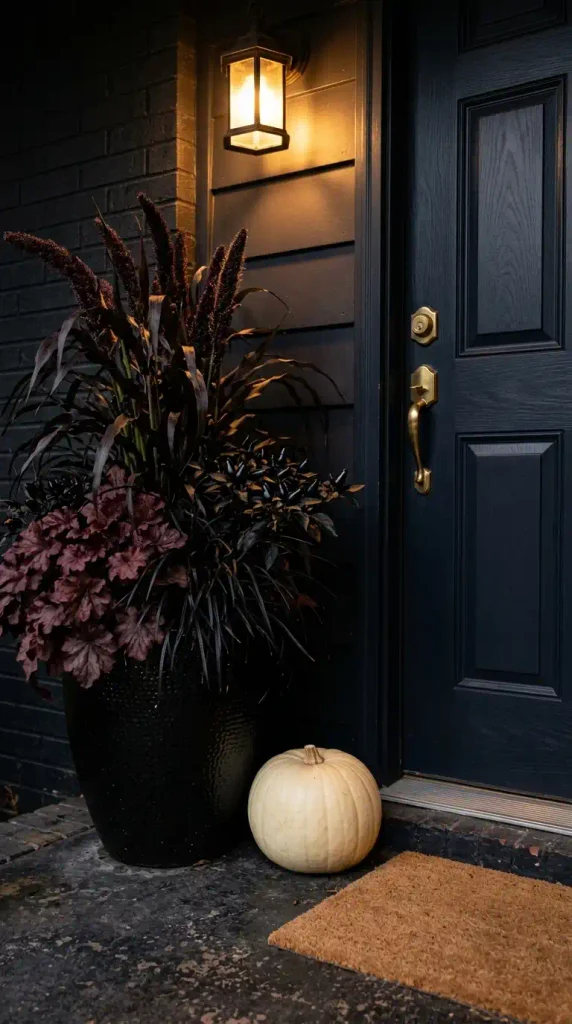
Ornamental peppers quit at the first frost. Pull them then and slide in a second heuchera.
13. A Fall Herb Pot You Brush Past on the Way In
Scent does the work here. Every time your sleeve catches the rosemary on the way to the door, you get a hit of pine and resin.
- ▸Sage: silver leaves that shrug off light frost.
- ▸Thyme: a low spiller that stays green deep into fall.
- ▸Parsley: keeps producing after a light frost.
- ▸Rosemary: the scent plant, and the tender one in cold zones.
Set the pot right beside the step you use most, so brushing it is unavoidable. Rosemary, sage, and thyme are also on VCA’s list of pet-friendly garden plants. In zone 6 and colder, move the rosemary to a sunny window before the hard freeze.
14. Three Fall Porch Planters Grouped at Staggered Heights
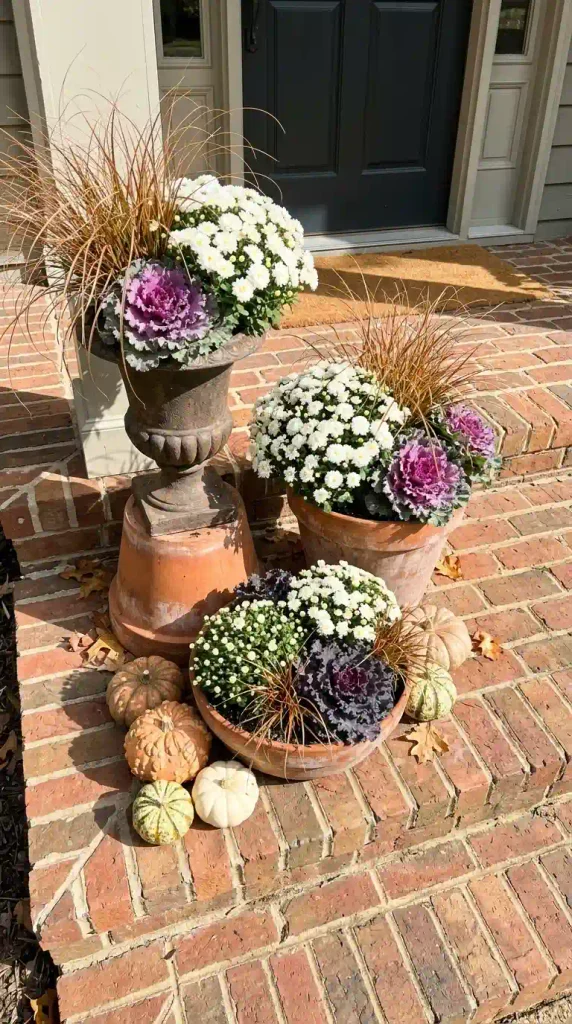
Three same-size pots lined up along the step, each planted with something different.
Tall, medium and low pots in a loose triangle, with one plant repeated across all three.
Three pots in a row look like a store shelf. Three pots at different heights look planned.
Use one tall pot (an urn, or a pot on a stand), one medium, and one low bowl. Set them in a loose triangle on the top step or beside the door. Repeat one plant across all three, like white mums or a single kale color, so they read as a set.
Short on plant stands? An upside-down terracotta pot or a wooden crate does the job. Planters themselves run roughly $20 to $200 each, and many sets of two or three sell for $40 or less.
15. A 20 Minute Window Box Swap That Keeps Your Summer Spiller
Summer window boxes rarely die all at once. Usually the center gives out while the trailing plants are still going strong, so fall window boxes can start with what’s already there.
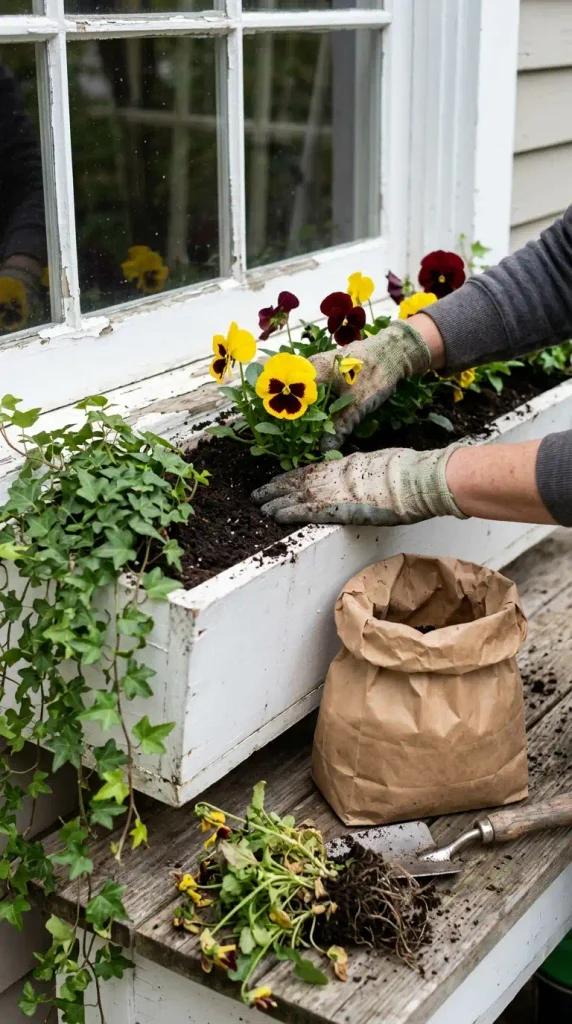
Pull the tired center plants. Keep anything still trailing well, like ivy or creeping jenny.
Loosen the old mix and top it up with fresh potting mix.
Water the new plants half an hour before planting so they slide out of their pots.
Set pansies or small mums into the gaps with root balls touching.
One warning: sweet potato vine looks great right up until the first frost, then collapses overnight. Pull it during the swap.
16. A Pet-Safe Fall Planter for Homes With Cats and Dogs
Mums are the default fall planter flower, and they’re on the ASPCA’s list of plants toxic to cats and dogs. If your cat chews anything green on the porch, plant around them.
Snapdragons as the cool-season flower.
Coral bells for burgundy foliage.
Sweet alyssum, rosemary and thyme at the edges.
Chrysanthemums of any kind.
The daffodil and tulip bulb layer in idea 8.
Lilies in any mixed arrangement if you have cats.
Snapdragons are the pleasant surprise: cold-tolerant, upright, and listed as non-toxic to cats, dogs, and horses. If your pet does eat something it shouldn’t, call your vet or the ASPCA Animal Poison Control Center at 888-426-4435 (a fee applies).
Fall Planter FAQ
What can you plant in a fall planter?
Choose cool-season plants that handle frost: garden mums, pansies, violas, ornamental kale and cabbage, heuchera, ornamental grasses, and snapdragons. Edibles like Swiss chard, mustard, parsley, sage, and thyme work too. Mix one tall plant, a few bushy ones, and a couple that trail over the rim, then pack them tightly, since fall pots barely grow after planting.
When should you plant fall planters?
Most of the US plants fall containers in September and October. UMass Extension suggests using a cooler stretch in late August or early September for mums and annuals. Ornamental kale is the exception. Penn State Extension notes it colors up better and has fewer pests when it goes in later, closer to the first frost.
How long do fall planters last?
Plan on at least six weeks, depending on your weather. Annual flowers usually bloom through October, while ornamental kale, pansies, and perennials like heuchera keep going past the first frost. Florist mums fade fastest, since their blooms die at the first frost. A layered pot with spring bulbs underneath can carry color into the following spring.
Do fall planters need to be watered?
Yes, just less often than in summer. Check the top inch of mix every few days and water when it feels dry, especially for pots in full sun or on a covered porch that rain never reaches. Water well during the first week while new plants settle in. Skip extra fertilizer, which pushes tender growth that frost damages.
Can fall planters survive frost?
A light frost, yes, with the right plants. Garden mums, ornamental kale, pansies, and heuchera all handle cold nights. Tender plants like sweet potato vine, ornamental peppers, and florist mums collapse at the first frost. Before a hard freeze, raise pots on pot feet, group them against the house, and move small containers into a garage.
Are mums safe for cats and dogs?
No. The ASPCA lists chrysanthemums as toxic to cats and dogs, and chewing them can cause vomiting, drooling, and diarrhea. For a pet-safe pot, plant snapdragons, coral bells, sweet alyssum, rosemary, and thyme instead. If your pet eats a plant and seems unwell, call your vet or the ASPCA Animal Poison Control Center right away.
Make One Pot, Then Sit Next to It
Fall planters earn their keep in the short stretch between work and dark, when the porch light clicks on and the air smells like wet leaves. Start with one pot beside the spot where you actually sit. Pack it full, choose plants that can take a frost, and give it a little light of its own.
Then add a second pot when the first one keeps you outside longer than you planned.
Save this list to your fall porch board so it’s handy when the garden center restocks kale, and check back in March to see how the layered pot from idea 8 came through the winter.
Keep reading
More cozy nook ideas
 Fall Decor
Read →
Holiday Decor on a Budget: Where to Spend and Where to Save
If last December’s holiday decor money went to plastic picks, a glitter sign, and a box of red balls you were tired…
 Fall Decor
Read →
21 Vintage Pumpkin Ideas for Small Apartments, No Porch or Nails Needed
No porch, no mantel, and a lease that frowns on nail holes. You still get a fall corner. You need one shelf,…
 Fall Decor
Read →
14 Witchy Backyard Ideas for a Whimsical, Storybook Halloween
No old oak grove, no permission to dig, no money for a garden cottage. A witchy backyard still fits. You need one…
One Comment