
10 Japandi Interior Ideas on a Budget, Starting With a $127.47 Corner

Three IKEA parts, one jute rug, $127.47. That’s the opening move for every Japandi interior idea below, and it works in a rental with zero drilling, zero paint, and one free afternoon.
If your living room right now is a gray sofa, a TV, and a corner that collects laundry, this list was built for you. Japandi borrows the calm of Japanese rooms and the warmth of Scandinavian ones. On paper it looks expensive: oak, linen, handmade ceramics, a lot of empty floor.
In practice, the look comes from a few rules, not a big spend.
So every idea here carries a real number or a real spec. Prices are the ones listed on IKEA’s US site this October, totaled where it matters. Light gets measured in Kelvin, not adjectives. And where an idea would normally need a hole in the wall, you’ll get the renter version first.
Start with the $127.47 corner. Then add the other nine ideas in whatever order your paycheck allows.

1. Start With a $127.47 Japandi Corner, Prices Totaled
Most Japandi rooms on Pinterest carry a designer price tag. This corner doesn’t. Every number below is the listed price on IKEA’s US site in October 2026.
| Piece | Archetype | Price |
|---|---|---|
| 🏮 Shade | GULLSUDARE rice-paper pendant shade, 17 ¾ in | $4.99 |
| 🔌 Cord | HAVSRIS plug-in cord set with switch, 15 ft 5 in | $20.00 |
| 💡 Bulbs | SOLHETTA LED E26, 450 lumens, warm white, 2-pack | $2.49 |
| 🧶 Rug | LOHALS flatwoven jute rug, 4 ft 4 in by 6 ft 5 in | $99.99 |
| Total | $127.47 |
Listed prices on IKEA’s US site, October 2026. Tax and delivery not included.
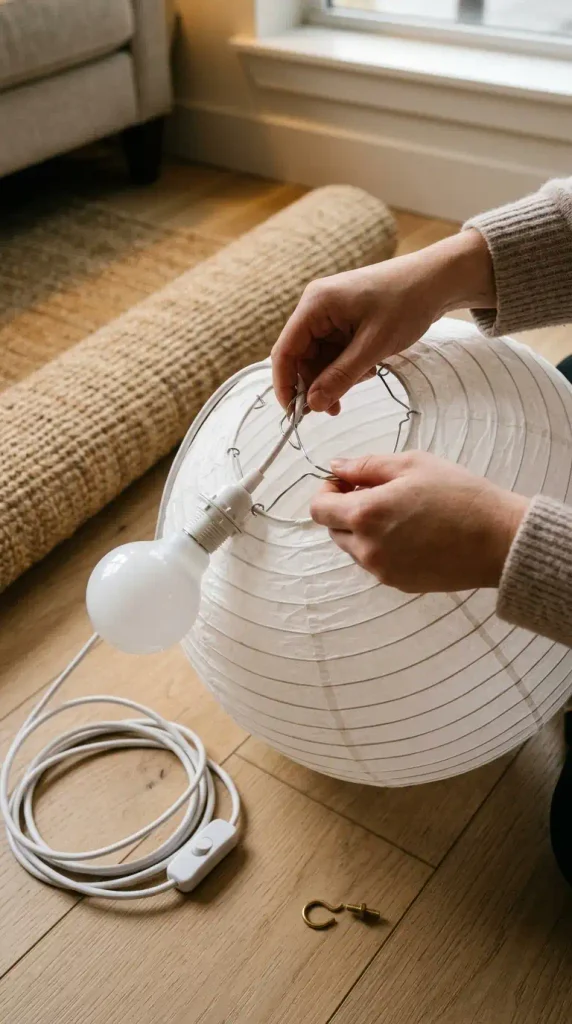
The paper globe does the heavy lifting. A 17¾-inch handmade rice-paper shade throws soft light in every direction, so the corner glows instead of glaring.
The plug-in cord set runs 15 feet 5 inches with a switch on the cord. Hang it from one small ceiling hook and run the cord down the wall to the nearest outlet. No electrician, no junction box.
Renters, skip the HEMMA cord set. It’s the hardwired version, and US reviewers on IKEA’s own page report that its plate needed modifying to fit American ceiling boxes.
Safety note: anchor tall furniture to the wall, keep candles and cords away from fabric, and use a licensed electrician or contractor for hardwired lighting, ceiling mounts, or anything structural. Inside a paper shade, use LED bulbs only.
2. Switch Every Bulb to 2700K Before You Buy Decor
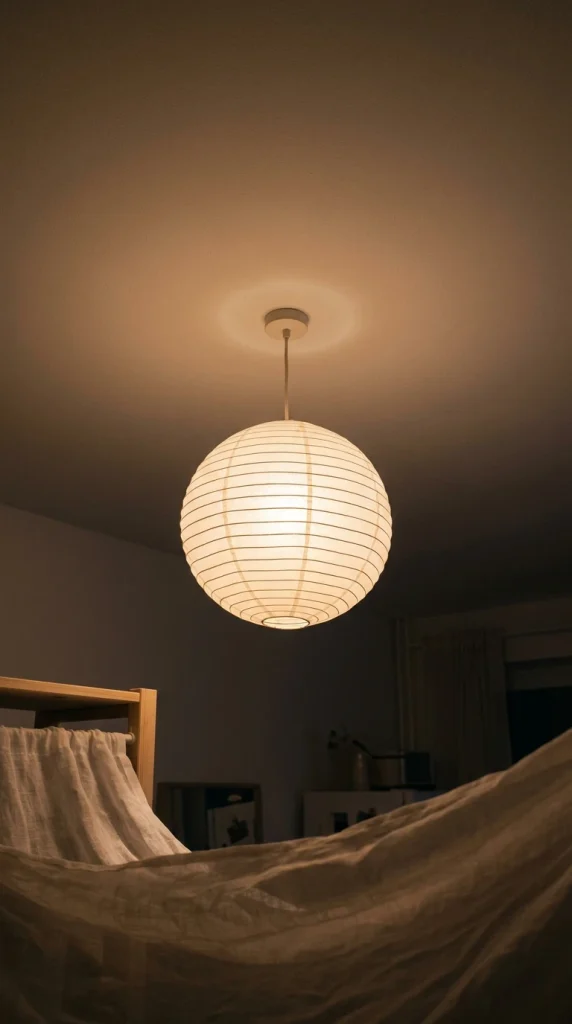
Cool bulbs wreck warm rooms. A Japandi interior leans on oak, linen, and clay tones, and bluish light turns all three gray.
The Department of Energy lighting terms guide puts warm light at 2700 to 3000K and cool light at 3600K and up. For this look, stay at the bottom of that warm range.
- Check the Lighting Facts label on the box. “Light appearance” should sit at the warm end of the scale.
- Match every bulb in the room. One daylight bulb in a 2700K room shows up like a stain.
- For a paper pendant, 450 lumens is plenty. IKEA rates its 450-lumen bulb as equal to an old 40-watt incandescent.
Fix the bulbs first, and every later purchase looks closer to the photos that sold you on Japandi.
3. Build a Five-Color Japandi Color Palette Without Painting
Paint is the slow, landlord-dependent way to get this palette. Textiles are the fast way.
Paint route: a gallon, a weekend, a lease clause, and a repaint when you move out.
Textile route: a throw, two cushion covers, and one curtain panel in the same five colors. They move with you.
Keep walls, rug, and large pieces in oat and mushroom. Let sage and clay show up only in small textiles, and use charcoal once or twice for edges.
For more rooms built on this exact palette, browse our Japandi reading nook ideas.
Rule of thumb: if a color isn’t on the card, it waits for another room.
4. Sit Lower With Floor Cushions and a Short Table
Tall furniture is what makes small rooms feel crowded. Dropping the seat height opens the top half of the room, and that empty upper space is where traditional Japanese rooms get their calm.
The fix: two or three floor cushions around a low table, with nothing standing taller than your shoulder when you sit.
Here’s the honest catch. Sitting on the floor with nothing behind you gets uncomfortable well before the chapter ends. Set the main cushion against a wall and add a firm bolster behind your lower back.
Lean the main cushion against a wall for back support.
Stack two cushions if your knees complain.
Keep the table clear except for one tray.
Cushions floating mid-room with nothing to lean on.
Deep shag rugs under floor seating. Crumbs vanish into them.
The payoff: the room reads more open, and nothing heavy had to move.

5. Follow the 3-2-1 Rule for Materials
Matching everything is the quickest way to make Japandi look like a furniture showroom. Contrast keeps it warm.
Use this count for any single room or corner:
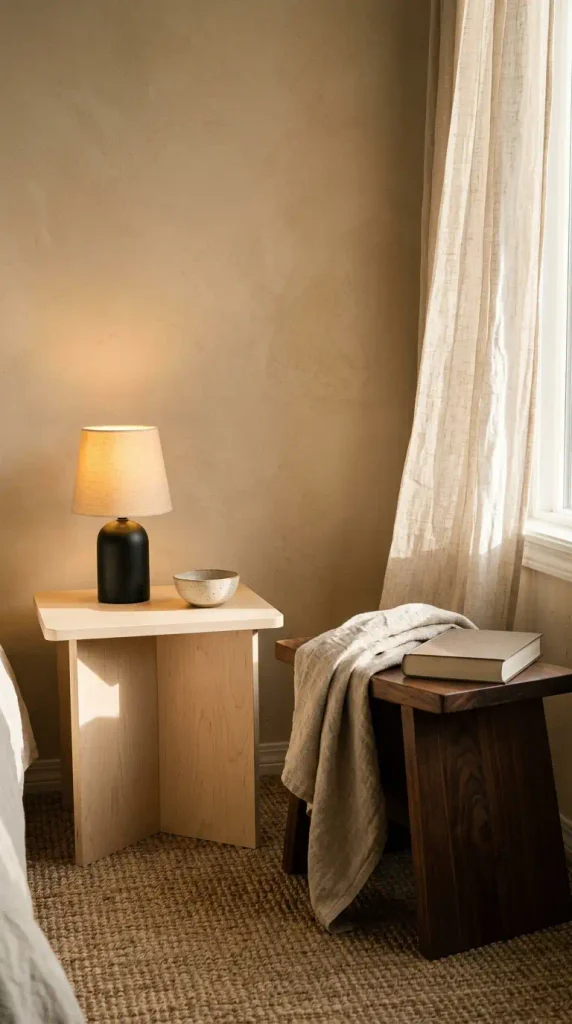
- Three natural textures. Jute underfoot, linen on the seat, stoneware on the table.
- Two wood tones. One pale, like birch or light oak, and one darker, like walnut or a stained piece, so the eye has somewhere to rest.
- One black accent. A lamp base, a picture frame, or a matte vase. Just one.
Three natural textures, two wood tones, one black accent. Count them before you buy anything new.
Count before you shop. If the room already has three textures, the next purchase should be a wood tone or nothing at all.
6. Let One Branch Replace a Shelf of Knickknacks
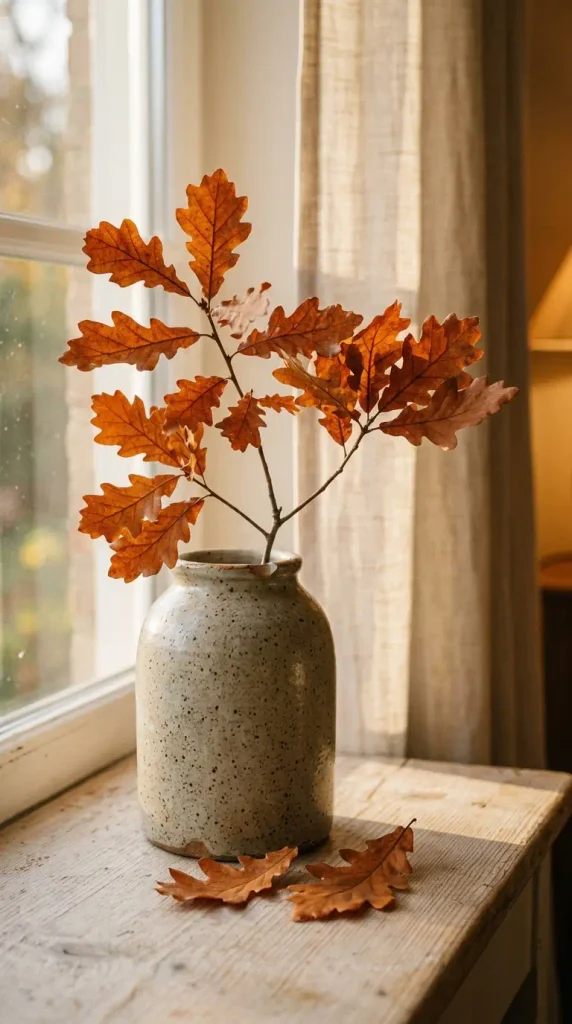
A single branch in a heavy vase does more for this style than a shelf full of small objects. Japanese arranging traditions favor one strong line with plenty of empty space around it.
Look in your own yard, a friend’s, or a pile of storm-fallen limbs. In October, oak and maple branches still hold their color, and dry leaves rustle softly when the heat kicks on.
💡 Quick Tip
Strip any leaves below the waterline, recut the stem at an angle, and change the water every few days. A bare, dry branch needs no water at all and lasts for months.
Then hit the thrift store’s ceramics shelf for the vase. An uneven glaze or a small chip is a plus here. That’s wabi-sabi, the Japanese idea that worn and imperfect things carry their own kind of beauty.
One branch, one vase, done.
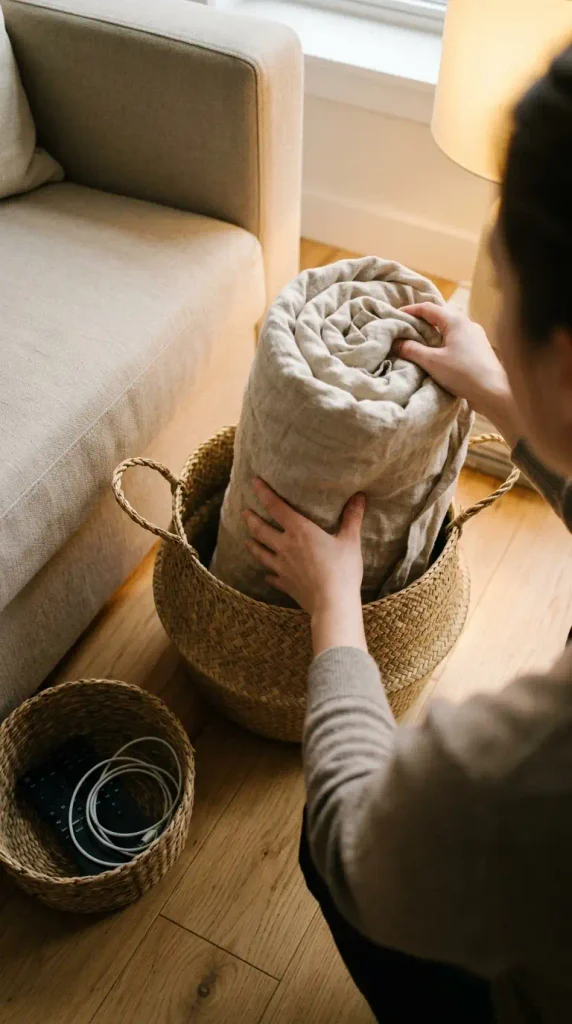
7. Hide Everyday Clutter in Seagrass Baskets
Clutter undoes this look faster than anything else.
IKEA’s FLÅDIS seagrass basket makes a good template. It’s about 10 inches across and 12½ inches tall, handwoven, with handles you flip up to hide what’s inside or fold down to show it. IKEA also says it isn’t meant for bathrooms or other humid spots, so keep it in dry rooms.
One basket, one job
Give each basket exactly one job and a fixed home. For more ways to style them in tight rooms, see these fall basket ideas for small spaces.
Watch out: an open basket that collects “everything” is just clutter with a handle.
8. Divide a Japandi Living Room With a Tension Rod and Sheer Linen
Studio apartments have a sightline problem. The bed, the desk, and the sofa all show up at once.
Shoji screens solve that in Japanese homes by filtering light through paper instead of blocking it. A sheer linen panel on a tension rod does a similar job with zero holes in the wall. Set the rod between two facing walls, inside an alcove, or across a wide doorway, then hang one or two panels that just touch the floor.
One open room where the bed, desk, and sofa all compete for attention the moment you walk in.
A soft linen screen that hides the bed, keeps the daylight, and comes down in minutes on moving day.
Read the rod’s package before you buy. Tension rods list a width range and a weight limit, and heavy blackout panels drag them down. Stick to sheer or lightweight linen.
The bed disappears. The daylight doesn’t.

9. Keep Storage Low and Anchor Anything Tall
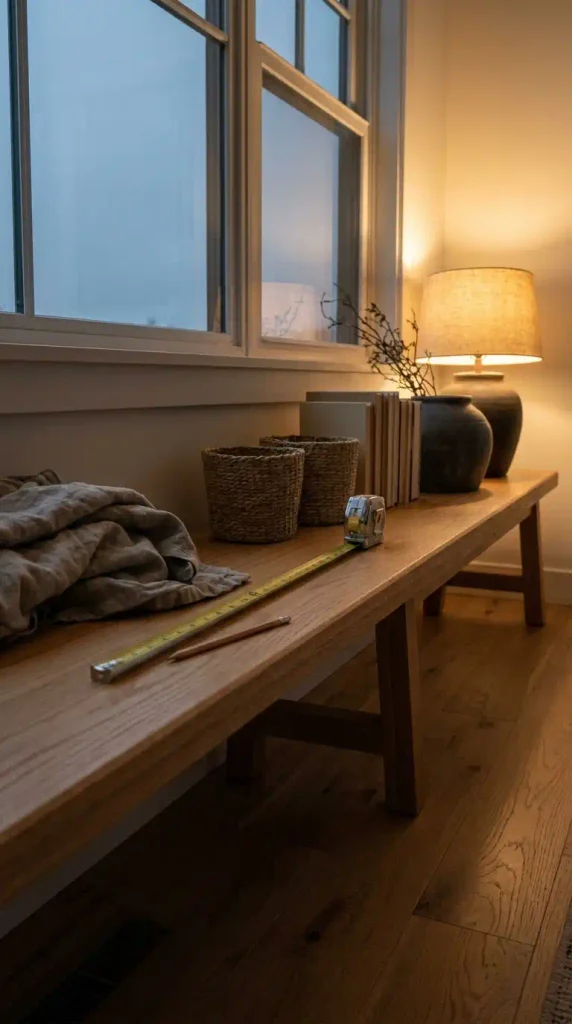
Low furniture is half of the Japandi look. Keep storage below the windowsill, and the top half of every wall stays empty. That empty band is what reads as calm.
Compare the two usual choices:
| Low bench or sideboard | Tall bookcase |
|---|---|
| Keeps the upper walls clear. | Fills the wall toward the ceiling. |
| Lower tip risk; follow the maker’s guidance. | Anchor it, especially with kids or pets. |
| Strong Japandi fit: low and grounded. | Works if you style it sparsely. |
| Best under a window or in small rooms. | Best for big book collections. |
If a tall bookcase has to stay, strap it to the wall. The CPSC’s Anchor It furniture tip-over campaign urges anchoring bookcases and dressers, and an anti-tip strap usually means one small screw hole.
Ask your landlord first, and say it’s a safety fix. Most leases treat a small anchor hole very differently from a paint job.
10. Build a Japandi Reading Corner in One Afternoon
The chair that anchors this corner has a Japanese designer behind it. IKEA credits Noboru Nakamura with the POÄNG, a bentwood armchair that’s been in its range for decades. In birch with a light beige cushion, it lists at $149, or $99 in-store for IKEA Family members through December 24, 2026.
Add it to the starter corner from idea 1 and the total lands at $276.47, or $226.47 with the member price.
Angle the chair toward the window so daylight falls over your shoulder, not into your eyes.
Hang the paper pendant behind and to one side of the chair, with a 2700K bulb.
Set a stool or small table within arm’s reach for a mug and the next book.
Keep three books on the stool, one basket for the throw, and stop there.
Want shelves too? These corner bookshelf ideas on a budget fit the same footprint.
One honest note from IKEA’s own reviews: the light frame can scoot on bare floors. Keep it on the jute rug.

Reorder note
No reorder suggested. Entry 1 already cashes the pin promise ($127.47, totaled), and entries 1 to 10 stand as delivered.
Frequently Asked Questions
What are the basic rules of Japandi interior design?
Keep it low, natural, and edited. Choose furniture with clean lines and a clear job, use real materials like wood, jute, linen, and stoneware, and stick to a muted palette. Leave empty space on purpose, especially on the upper half of the walls. Mix two wood tones so the room doesn’t look flat, add one black accent for definition, and welcome imperfect, handmade pieces.
What colors are in a Japandi color palette?
Warm neutrals do most of the work: oat, cream, mushroom, and stone. Muted sage, clay, and soft brown add life in small doses, and charcoal or matte black gives the room its edges. Skip bright primaries and stark, cool white. In a rental, carry the palette in textiles like throws, cushion covers, and curtains so you never have to paint.
What’s the difference between Japandi and Scandinavian style?
Both are minimal and practical, but Scandinavian rooms usually lean brighter, with crisp white walls and pale wood throughout. Japandi adds Japanese restraint, so it runs warmer and earthier, mixes light and dark woods, sits lower to the ground, and welcomes handmade, imperfect objects. Think of Japandi as Scandinavian comfort with more depth and fewer things in the room.
Is Japandi the same as wabi-sabi?
No. Wabi-sabi is a Japanese philosophy that finds beauty in imperfect, aged, and impermanent things, like a chipped bowl or weathered wood. Japandi is a decorating style that borrows that idea and pairs it with Scandinavian function and comfort. A Japandi room usually includes a few wabi-sabi pieces, but it stays more streamlined and organized than a purely wabi-sabi space.
Can you do Japandi in a small apartment or rental?
Yes, and small rooms often suit it best, because the style rewards owning less. Use renter-safe moves: a plug-in pendant cord set instead of a hardwired fixture, a tension rod and sheer linen instead of a built-in screen, and textiles instead of paint. Keep furniture low, give every basket one job, and anchor any tall bookcase after checking with your landlord.
Is Japandi still in style in 2026?
It’s holding steady. A recent Pinterest fall trend report listed Japanese-inspired rooms among its most-searched home styles, though Japandi wasn’t one of the bolder Pinterest Predicts 2026 home trends. That’s usually a good sign for a style built on low furniture, natural materials, and calm color, since those choices tend to age slowly instead of dating fast.
Conclusion
Start small. Change the bulbs, hang the $4.99 paper globe, and lay down the jute rug, and a Japandi interior starts showing up before you’ve bought a single chair. Then add one idea at a time: a branch in a thrifted vase, a basket with one job, a linen panel where the room needs privacy.
None of it asks for a drill, a paint roller, or a designer’s fee. It asks for restraint, and restraint is free.
Save this list to your Japandi or small-space board so the $127.47 starter corner is waiting the next time you’re at IKEA, and come back for the reading corner when you’re ready for the chair.

2 Comments