
21 Cozy Minimalist Decor Ideas for Renters Who Can’t Drill

Minimalism gets a bad reputation in rentals, and the reason is simple: most of the advice assumes you can paint the walls, swap the light fixtures, and hang a floating shelf wherever you like. You can’t. So you strip things back, the room goes echoey and cold, and you end up buying a throw pillow to fix a lighting problem.
A cozy minimalist home in a rental is a different craft. It’s about warmth landing in the right three places, not about owning less for its own sake. Everything below works with a lease, comes off the wall clean, and moves to the next apartment in the trunk of a car.
Prices here were checked in September 2026 at IKEA and Target, so the numbers are real rather than rounded guesses. The first idea fixes the single ugliest thing in most rentals, and it takes about four minutes and zero tools.
1. Start With the Ceiling Light You Didn’t Choose
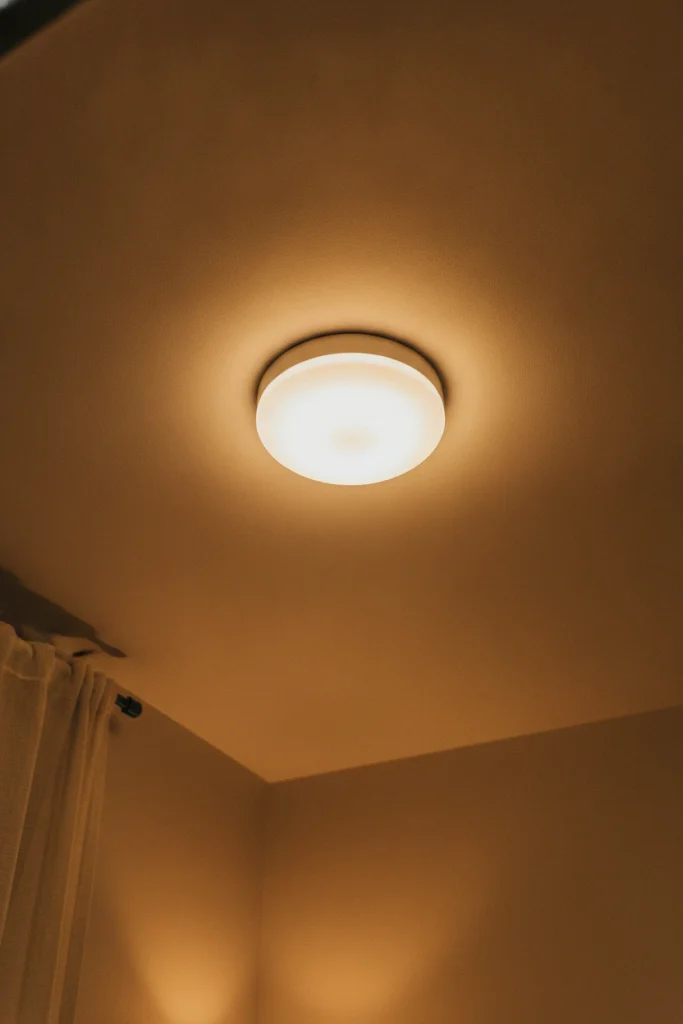
Your landlord picked that flush-mount fixture for $12, and it’s doing more damage to the room than the beige walls are. A bare downward-facing dome throws hard light straight onto the tops of heads and furniture, which flattens texture and kills every warm thing you own.
You can’t rewire it. You don’t need to. Swap the bulb for a 2700K warm-white LED (the box states the Kelvin number), and stop using the switch as your main light after dark. Treat the ceiling fixture as a daytime utility light and let lamps do the evening.
Zero tools. Zero holes. It is the highest-leverage four minutes in this whole list.
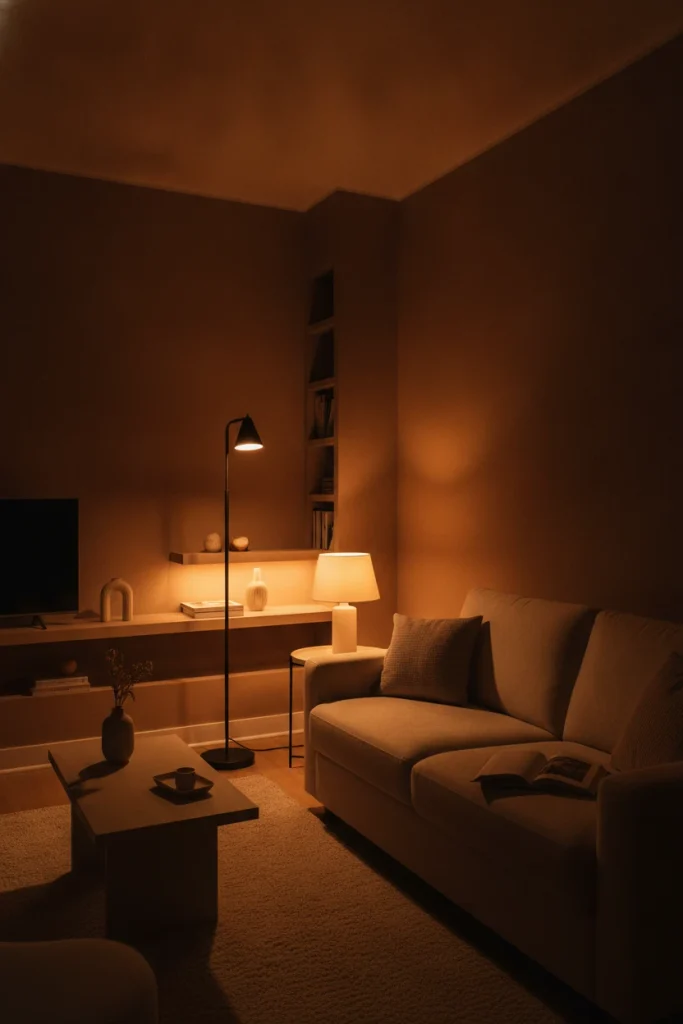
Overhead light shows you a room. Side light at sitting height makes you want to stay in it. Same furniture, completely different evening.
2. Layer Three Textures on One Chair Before Buying Anything Else
Texture does the work that color isn’t allowed to do in a rental. Pick your main seat and give it exactly three touchable materials, no more: a woven or boucle base, a knit or chenille throw, and one linen or cotton lumbar pillow.
Three is the number because two reads unfinished and four starts to look like a display. The materials have to feel different from each other, not just look different. A chenille blanket over a chenille chair is one texture pretending to be two.
- Base layer: the chair’s own upholstery or a fitted cover
- Middle layer: the throw, folded in thirds over one arm
- Top layer: one pillow, in the smallest of the three sizes
The failure mode is buying all three in the same oatmeal shade and wondering why the corner still looks flat.
Recreate this look
3. Swap Vertical Blinds for a Tension-Rod Curtain in Ten Minutes
Vertical blinds are the loudest signal in any rental that the space isn’t yours. They clatter, they yellow, and they cut the window into stripes.
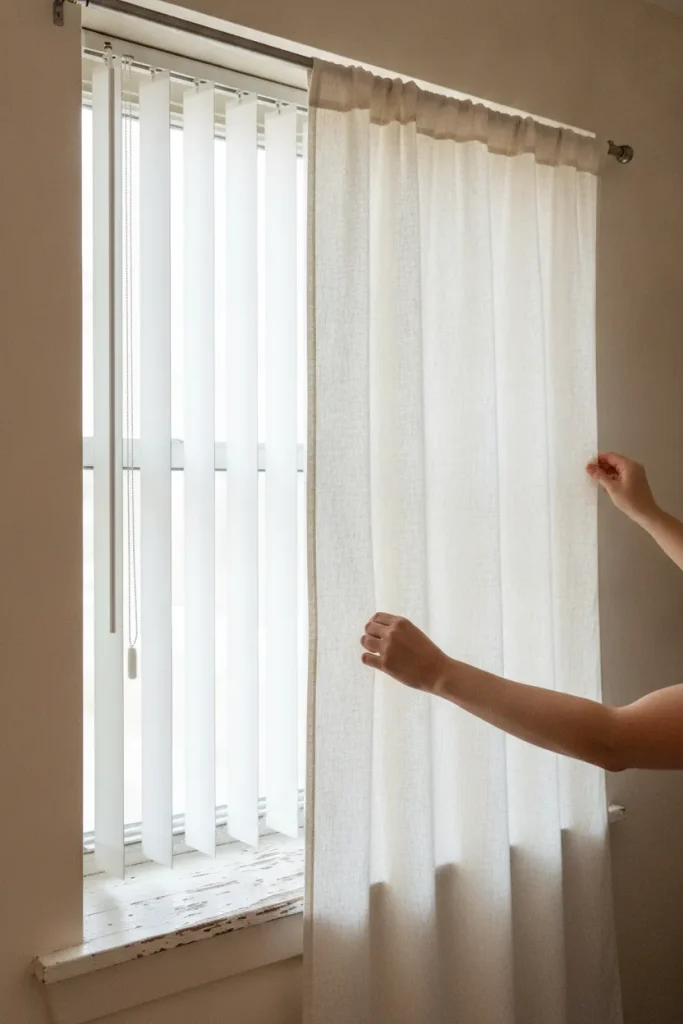
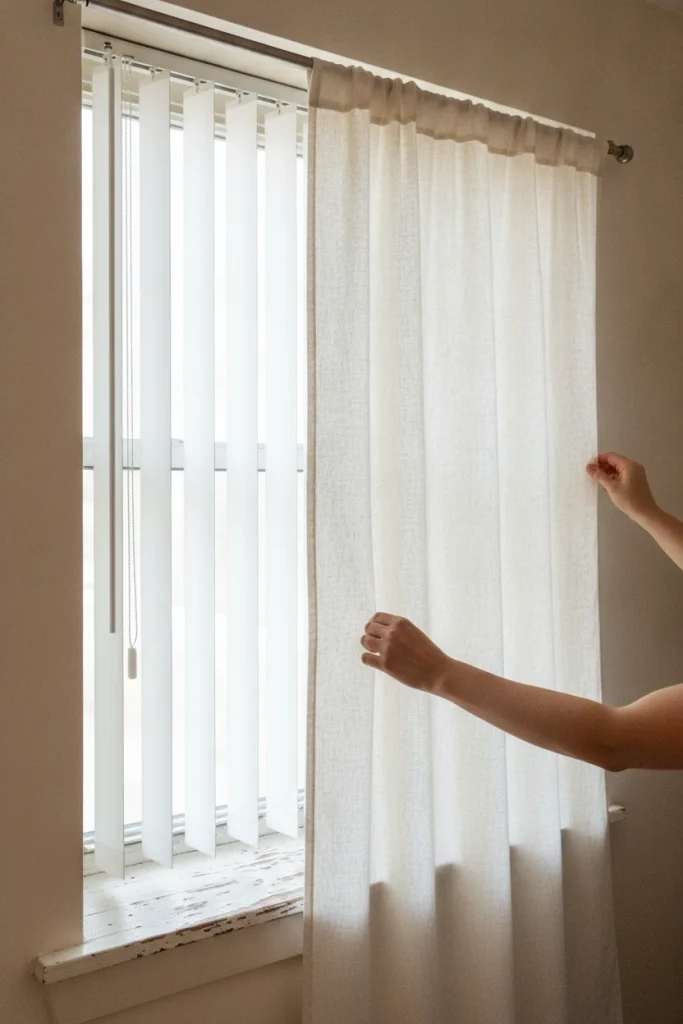
Here’s the thing most renters don’t realize: you don’t have to remove them to hide them. A tension rod inside the window recess holds a curtain panel with no brackets and no screws, and the blinds stay behind it, intact, ready to go back to their normal miserable state on move-out day.
Measure the inside width of the window recess, then buy a tension rod whose range sits in the middle of that number, not at its limit.
Pull the blinds fully to one side and tie them back so the fabric hangs flat.
Thread one linen or cotton panel, set the rod high in the recess, and twist until it bites.
Let the hem break on the sill, not the floor, since recess-mounted panels that puddle look like a mistake.
One warning: tension rods fail under weight. A heavy blackout panel will slide down the wall at 2am. Keep it light.
4. Give Every Room One Warm Pool of Light at Sitting Height
Overhead light flattens a room. Light at the height of your shoulder while you’re seated does the opposite: it carves out a pocket of warmth and tells your eye where the comfortable spot is.
The measurement that matters is roughly 40 to 50 inches off the floor for the bottom of the shade, which puts the glow at face level for someone sitting rather than standing. IKEA’s LERSTA floor reading lamp runs $22.99 and does this job without a single screw. The TÄRNABY dimmable table lamp at $34.99 does it on a side table.
If the reading corner is where you want this to land hardest, these twelve lighting setups for a reading corner go deeper on placement and bulb choice than I can here.
5. Build the Whole Corner for Under $256
Here’s the entire starter set, totaled, with prices I pulled in September 2026 rather than estimated. Five pieces, one corner, nothing drilled.
| Piece | What it is | Price |
|---|---|---|
| 🪑 Seat | IKEA POÄNG armchair, 26 3/4″ wide | $149.00 |
| 💡 Light | IKEA LERSTA floor reading lamp | $22.99 |
| 🧶 Soft layer | Target Threshold Cozy Chenille blanket, from | $40.00 |
| 📚 Storage | IKEA BILLY, 15 3/4 x 11 x 41 3/4″ | $39.00 |
| 🌿 Green | IKEA FEJKA artificial plant, 3 1/2″ pot | $4.99 |
| Total | prices checked September 2026, before tax | $255.98 |
Worth knowing: IKEA is running an in-store IKEA Family price of $65.00 on the tall 31 1/2 x 11 x 79 1/2″ BILLY (normally $79.00) from September 8 through December 24, 2026. If you want the full-height bookcase instead of the short one, that window is the cheapest it gets.
6. Cover Builder Beige With a Leaning Panel, Not Paint
Beige walls aren’t your fault and repainting them usually isn’t worth the deposit risk or the move-out repaint clause. The workaround is to stop treating the wall as the surface and start treating it as the background.
A large panel leaned against the wall (a framed canvas, a woven hanging mounted to a lightweight board, a slab of plywood wrapped in linen) covers three or four square feet of beige with something you chose. It rests on the floor, touches nothing, and leaves no mark.
Lean it behind the sofa or beside a bookcase so the bottom edge is partly hidden. A panel leaning in open floor space looks like something you haven’t hung yet.
Four feet of flat builder beige behind the sofa, catching the overhead light and showing every roller mark.
A linen-wrapped panel leaning behind the sofa, bottom edge tucked, beige reduced to a border nobody looks at.
7. Put the Rug Under the Front Legs, Not Floating in the Middle
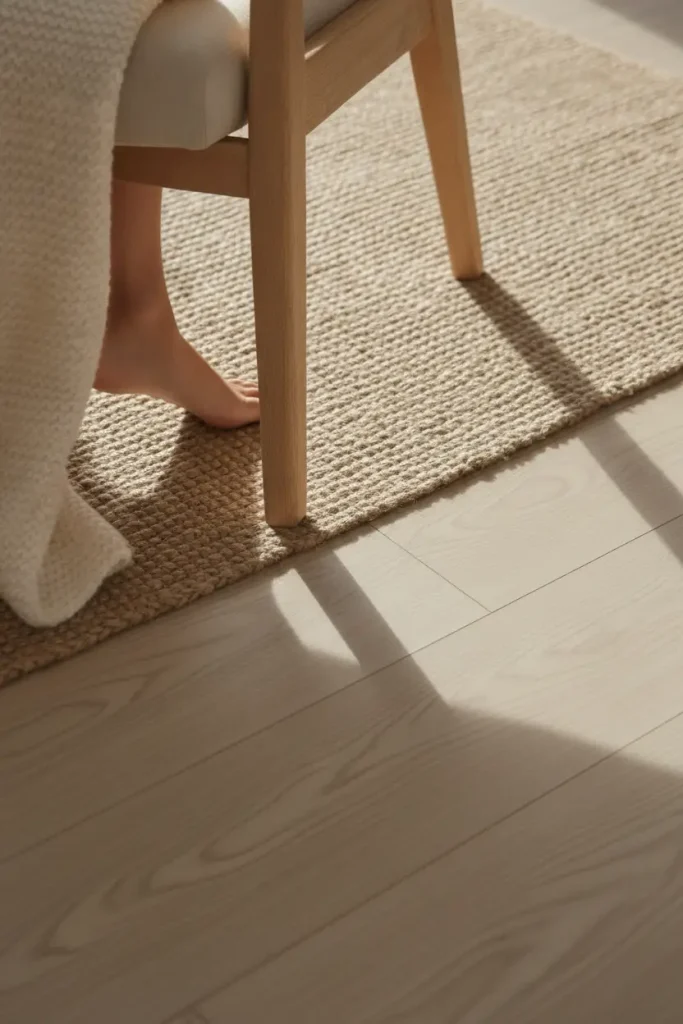
Rugs fail in rentals for one reason: people buy the small one. A 5×7 floating in the center of a room with all the furniture standing off it reads as a bath mat that got lost.
The fix costs nothing. Slide the rug until the front legs of every major seat sit on it. That single move connects the furniture into one group and makes the rug look intentional rather than undersized.
If the rug genuinely can’t reach, pull the furniture inward instead of pushing the rug outward. Most renters shove seating against the walls out of habit, and a six-inch pull away from the wall does more for a room than another purchase would.
- ▸Front legs on the rug, back legs off, for every seat in the group.
- ▸Leave 8 to 12 inches of bare floor between the rug edge and the wall.
- ▸Use a rug pad on vinyl plank, which is slick and shows rug creep fast.
- ▸Skip the rug entirely over wall-to-wall carpet unless the texture genuinely differs.
8. Cut Surface Clutter by Naming One Landing Zone
Clutter in a small rental isn’t a volume problem, it’s a routing problem. Keys, mail, chargers, and receipts land wherever you happen to stop walking, which in most apartments is three or four different flat surfaces.
Name one. A single tray, bowl, or 12-inch shelf that everything arriving with you goes into, every time, without a decision. The other surfaces then get to hold one deliberate object each instead of whatever you were carrying.
The reason this belongs in a minimalism list rather than an organizing list: the empty surfaces are the whole visual payoff. You aren’t storing better, you’re protecting the negative space that makes the room read calm.
9. Put Five Objects on a Shelf and the Rest in a Box
Shelves get crowded because an empty shelf feels like a failure. It isn’t. Five objects per shelf, roughly, with at least one gap wide enough to see the back panel through, is the line where a bookcase stops reading as storage and starts reading as decor.
Everything else goes in a labeled box in the closet for ninety days. If you don’t go looking for it in ninety days, it isn’t earning shelf space in a home this size.
Safety note: anchor tall furniture to the wall, keep candles and cords away from fabric, and use a licensed electrician or contractor for hardwired lighting, ceiling mounts, or anything structural.
That note matters more than it sounds. According to the CPSC’s furniture tip-over campaign data, an estimated 11,300 children were treated in US emergency rooms each year between 2017 and 2019 for furniture, TV, and appliance tip-overs, and 50 percent of child tip-over fatalities happened in bedrooms. If there’s a child in the apartment, a tall bookcase gets a strap. Anchor straps leave a hole roughly the size of a picture nail, which is a far easier conversation with a landlord than the alternative.
⚠️ Watch Out
Weight goes low. Books on the bottom two shelves, light objects up top. A top-heavy bookcase on rental carpet is far easier to tip than the same unit on hard flooring.
10. Trade One Bright Ceiling for Three Low Lamps
Brightness and warmth are not the same variable, and rentals usually max out the first while ignoring the second. One 1,600-lumen ceiling fixture and three 450-lumen lamps can put similar total light into a room, but they produce completely different rooms.
| One overhead fixture | Three low lamps |
|---|---|
| Light falls straight down, flattening texture on rugs, throws, and wood. | Light crosses the room sideways, so every texture casts a small shadow and reads as itself. |
| One switch, one mood, all or nothing. | Three switches, so you can run one lamp on a slow night and all three when people are over. |
| Shadows land under eyes and cabinets. | Shadows land behind objects, which is where you want them. |
| Belongs to the landlord. | Goes in the car on move-out day. |
Three lamps at IKEA prices (LERSTA at $22.99, TERTIAL at $19.99, TÄRNABY at $34.99) lands under $80 before bulbs.
11. Keep Candles Twelve Inches From Anything Soft
Candlelight sells the whole warm minimalist look better than any purchase on this list, and it’s the one idea here with a real risk attached. Rentals make it worse: small rooms, more fabric per square foot, and usually a smoke alarm you share with neighbors.
The number to hold onto comes from the U.S. Fire Administration’s candle safety guidance, which puts it plainly: keep candles at least 12 inches away from anything that burns. The same page notes that on average, 20 home candle fires are reported each day in the US.
Twelve inches is further than it looks on a styled shelf. Measure it once with your hand span and you’ll stop guessing.
⚠️ Watch Out
Never leave a candle burning in a room you’ve left, and keep flames out of bedrooms entirely. Battery flameless candles give you the same low flicker on a nightstand with none of the risk, and they’re the honest answer for anyone with pets, kids, or a landlord’s no-flame clause.
12. Stand a Short Bookcase Sideways to Split a Studio
Studios have no walls, which is exactly why a minimalist rental apartment needs one soft division rather than none. A low bookcase turned perpendicular to the wall creates a threshold without building anything.
Keep it short. The 41 3/4″ BILLY at $39.00 sits just below eye level for most standing adults, so the room still reads as one connected space instead of two cramped ones. A 79 1/2″ unit in the same position turns a studio into a corridor.
Face the open back toward the smaller zone and put a leaning panel or fabric against it, so the “back” of the divider is a finished surface rather than raw board.
If you’re carving out a reading corner specifically, these reading nook ideas that fit a real apartment work through the same problem at several different square footages.
13. Hang Art at Seated Eye Level, Not Standing
Bare walls read as temporary, and most renters overcorrect by hanging one picture too high. Gallery convention puts the center of a piece around 57 to 60 inches off the floor, which suits a hallway you walk through.
In a room you sit in, drop it. Center the piece closer to 48 to 52 inches so it lands in your sightline from the sofa rather than above it. The room feels lower, closer, and more settled, which is most of what “warm” means in practice.
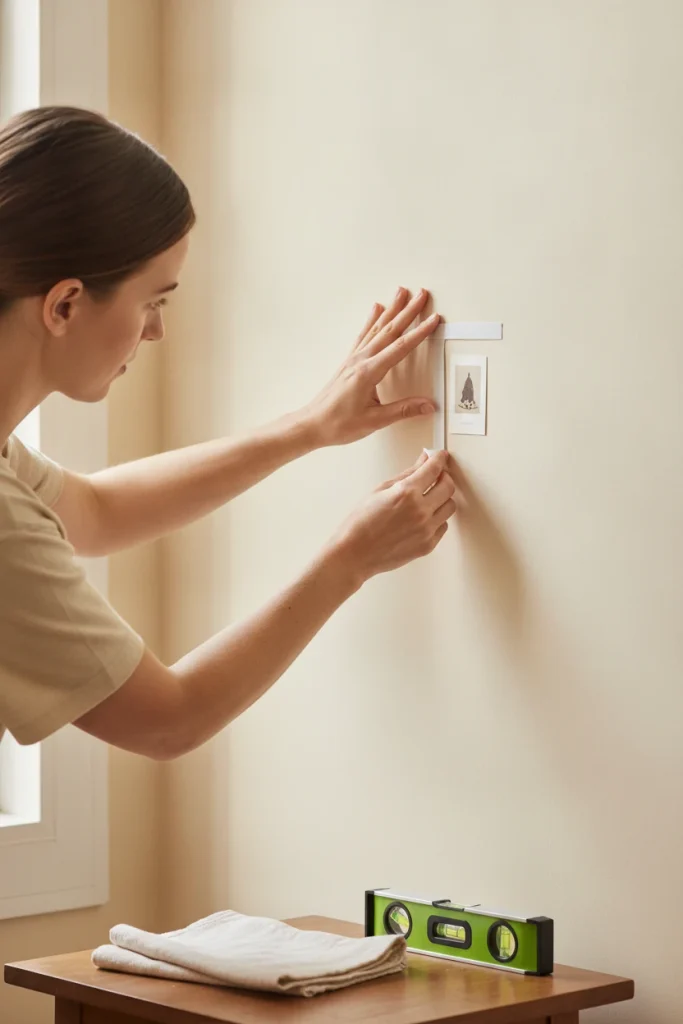
Damage-free hanging, in order
Adhesive strips do fail on textured or freshly painted walls. Test one low on the wall behind furniture before you trust it with glass.
14. The Three-Surface Rule
Warmth has to land in three places or the room stays cold, and this is the single idea that explains why some minimalist spaces feel like homes and others feel like waiting areas. It isn’t about quantity. A room with one blanket in the right place beats a room with four in the wrong ones.
Most rentals fail on overhead specifically, because the fixture belongs to the landlord and the bulb never gets changed. The other two are cheap to fix. On brightness, the ENERGY STAR brightness chart is the reference worth bookmarking: 800 lumens replaces the old 60W bulb, 1,100 replaces 75W, and 1,600 replaces 100W. Lower lumens in lamps, warmer color on the box, and the room changes character for about six dollars.
A cozy minimalist home needs warmth underfoot, overhead, and at hand. Miss one and the room reads cold no matter how much you add.
Underfoot: a rug, a runner, or one soft thing where your feet land. Overhead: a warm bulb and a lamp you actually use after dark. At hand: something you can reach without standing up, with a texture worth touching.
15. Warm a Cold Rental Bathroom With Two Swaps
Bathrooms are where rentals feel most institutional: hard surfaces, one harsh light, and a builder-grade mirror. You can’t change any of it, and you don’t need to.
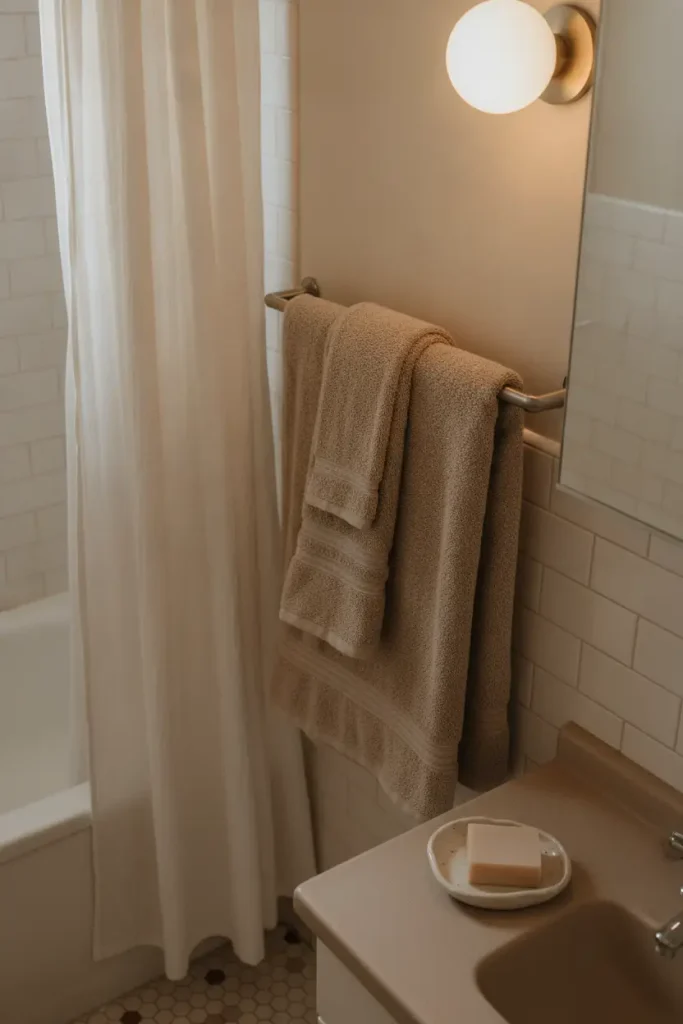
Replace the vanity bulbs with warm 2700K LEDs. Bathroom fixtures usually take standard screw-in bulbs, which makes this the one lighting change a renter can always make.
Put every towel in one color and hang a fabric shower curtain over the plastic liner. Matching towels do more visual work in a small bathroom than in any other room, because there are so few soft surfaces competing.
The trade-off nobody mentions: a fabric curtain over a liner needs the liner tucked inside the tub every single time, or you’ll be mopping. Worth it, but it’s a habit, not a one-time fix.
16. Run the Move-Out Test Before Buying More Storage
Before another bin goes in the cart, ask the only question that matters in a rental: does this leave with me?
Storage is where renters accidentally spend money on the landlord’s apartment. A wall-mounted system, a custom closet insert, a shelf cut to fit one specific alcove: all of it improves a space you will hand back. The money is gone and the improvement stays behind.
Freestanding shelving in standard sizes that fit more than one wall.
Baskets, trays, and boxes that work in any room.
Tension rods, over-door hooks, and anything that grips rather than screws.
Anything cut or built to one alcove’s exact measurements.
Wall-mounted rail systems with a dozen anchor points.
Peel-and-stick anything on a wall you haven’t tested first.
Spend the saved money on the seat and the light instead. If you want that worked all the way down to a number, here’s a full reading corner built under $100.
17. Add One Living Thing, or Fake It Convincingly
Green breaks up a neutral room better than another beige object ever will, and a real plant is the cheapest texture in this entire list. Rentals complicate it: north-facing windows, inherited blinds, and six-month leases don’t suit fussy plants.
Fake it if you have to, but fake it at the right scale. IKEA’s FEJKA range runs $4.99 for a 3 1/2 inch pot up to $89.99 for a 9 inch floor-sized tree, and the small ones are convincing while the mid-size ones are where artificial plants start looking artificial. There’s also a wall-mounted artificial moss panel at 9 3/4 x 9 3/4 inches for $8.00, which sits flat and needs no light at all.
📌 Good To Know
The inch measurement in an artificial plant listing is usually the pot diameter, not the plant height. A “3 1/2 inch” plant is tabletop sized and an “8 1/4 inch” one is a floor tree, which is why the prices jump so sharply between them.
18. Make the Bed the Softest Thing in the Room
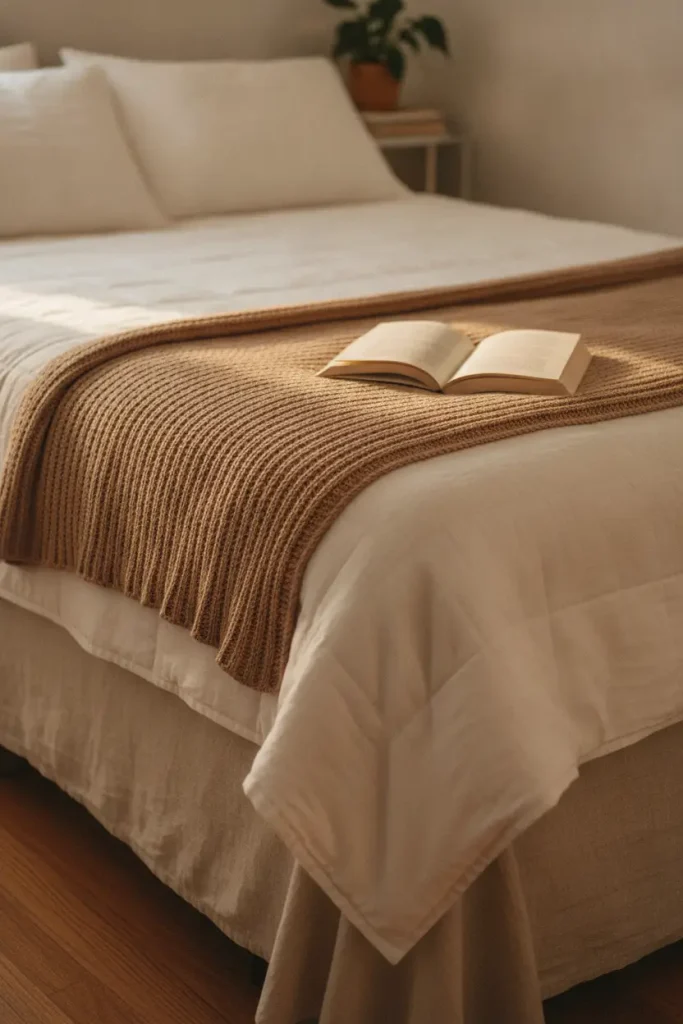
Beds carry more softness per square foot than any other object you own, which makes the cozy minimalist bedroom the easiest room on this list to get right. The catch is that most people add more layers instead of better ones.
Three layers, finishing with texture rather than pattern, does it. Target’s Threshold Bubble Fur blanket runs $75.00 at 80 by 60 inches, which covers a queen crosswise with overhang; the Cozy Chenille line starts around $40.00 if you want the same effect for less.
19. Choose Warm Metals Over Chrome in the Rooms You Can’t Change
Chrome reads cold under warm light, which is a problem because kitchens and bathrooms are the two rooms full of chrome that renters can’t replace.
You can’t swap the faucet. You can control every other metal in the room, and metals are one of the few things that genuinely look better mismatched-but-deliberate than matched-by-accident.
| Leave it | Bring it |
|---|---|
| Chrome faucet and shower head | Brass or aged-bronze accessories nearby to pull the eye |
| Builder-grade cabinet pulls | Replacement pulls in warm metal, with the originals kept in a labeled bag |
| Nickel light fixture you can’t reach | Warm-metal lamp bases at eye level, where you actually look |
Cabinet pulls are the sleeper move here. They’re usually a single screw each, cost less than a throw pillow, and every original goes back on in an hour before your final walkthrough.
20. Fix a Dark Entryway Without Touching the Wiring
Entryways set the temperature of a whole apartment in about two seconds, and rental entries are almost always the worst-lit square footage in the place. Usually there’s no outlet near the door either, which is why most renters give up on it.
The workaround is a mirror plus borrowed light. A leaning mirror on the floor beside the door catches whatever light exists further inside the apartment and doubles it back at the entry, with no wiring, no drilling, and no outlet required.
A dim three-foot stretch of hallway, shoes against the baseboard, and the only light coming from a room you can’t see into.
A leaning mirror bouncing the living room’s lamplight back down the hall, one basket for shoes, and a tray on a narrow console for keys.
Lean the mirror against a wall the door doesn’t swing toward, and put a felt pad under the bottom edge so it doesn’t walk on hard flooring.
21. Leave One Corner Deliberately Empty
Empty space is a design choice, and it’s the one that separates a cozy minimalist home from a room that simply hasn’t been filled yet. The difference is intention, and intention is visible.
Pick a corner and commit to it being empty. No console, no plant, no basket of blankets you might get to later. Bare floor, bare wall, the baseboard visible all the way into the join.
What this buys you is contrast. Every warm, layered, textured thing you built in the other twenty ideas only reads as warm because there’s something quieter beside it for your eye to rest against.
Before you call the room finished
Frequently Asked Questions
What’s the difference between cozy minimalism and regular minimalism?
Regular minimalism asks how little you can live with. Cozy minimalism asks which few things make the room feel good, then removes everything else to let them show. In practice that means the same low object count but a much higher standard for texture, light, and comfort. A cozy minimalist room has fewer things in it than an average room, and every one of them is either soft, warm, or useful every single day.
How do I make a minimalist space feel warm instead of cold?
Warmth comes from three places, not from quantity. Put something soft where your feet land, get a warm-toned bulb into a lamp at sitting height rather than relying on the ceiling fixture, and keep one texture within arm’s reach of where you sit. Rooms read cold when all three are missing and someone tries to compensate by adding more objects at eye level, which just makes the space busy and still cold.
Can I do this in a rental without losing my deposit?
Yes, and most of this list is built for exactly that. Tension rods, leaning panels and mirrors, freestanding furniture, plug-in lamps, and adhesive strips all come off clean. The two things worth testing first are adhesive strips on textured or recently painted walls, and any peel-and-stick product, which can pull paint. Test low on a wall behind furniture before committing, and always check your lease for clauses about paint and fixtures.
Do I have to get rid of everything to start?
No. Start by moving things rather than removing them. Name one landing zone for keys and mail, put five objects on a shelf and the rest in a labeled box for ninety days, and change one bulb. Those three moves cost almost nothing and change how the room reads immediately. Whatever you genuinely miss from the box after ninety days comes back out. The rest answers the question for you.
Can I use color, or does minimalist mean beige?
Color is fine, and a single saturated tone actually works better against a restrained background than it does in a busy room. Keep it to one color family across the space and let texture carry the rest. The reason these rooms trend neutral isn’t a rule, it’s that renters can’t repaint and beige walls are the most common starting point. If your walls are already white, you have more room to play than most.
How much does a cozy minimalist corner actually cost?
A working corner with a real chair, a lamp, a blanket, a small bookcase, and a plant came to $255.98 at September 2026 prices using IKEA and Target basics. You can go considerably lower by changing only the bulb, adding a blanket you own, and rearranging what’s already in the room, which costs under $20. The chair is the item worth spending on, since it’s the one thing you’ll sit in daily and the one thing that moves with you.
Is this doable with kids in the apartment?
It is, with two adjustments. Anchor anything tall, since tip-over data shows bedrooms are where the majority of child fatalities occur, and skip open flames entirely in favor of battery candles. Beyond that, kids actually suit this approach: fewer objects on surfaces means less to knock over, and washable textures do the warmth work that fragile decor would otherwise be doing.
Conclusion
Renting doesn’t put a cozy minimalist home out of reach. It just means the warmth has to come from things you can carry: light at the right height, three textures on one chair, a corner you left empty on purpose.
Start with the bulb. It costs a few dollars, takes four minutes, and it’s the change most people feel before they can explain it. Then work down the list in whatever order your apartment demands, because your worst room is probably not the same as anyone else’s.
Save this one to your board before your next trip to the store, since the prices and measurements are the part you’ll want on your phone in the aisle.
💡 Quick Tip
If you only do one thing this week, change the bulb in the lamp you use after dark to a warm 2700K LED. It costs less than a coffee and it resets how every texture in the room looks at night.
