
Cozy Entryway Decor Ideas That Work When You Don’t Have an Entryway

No foyer. No coat closet. No drill, and no conversation with your landlord about drilling.
That is the honest starting point for most cozy entryway decor ideas, because most US rentals do not come with an entry at all. You get a door that opens straight into the living room, and a pile of shoes that grows sideways along the baseboard.
Three pieces fix it. A landing surface, something vertical, and one warm light. Real prices below, checked in August 2026, plus the one measurement almost nobody takes before buying a bench. Skip it and your bench blocks your own front door.
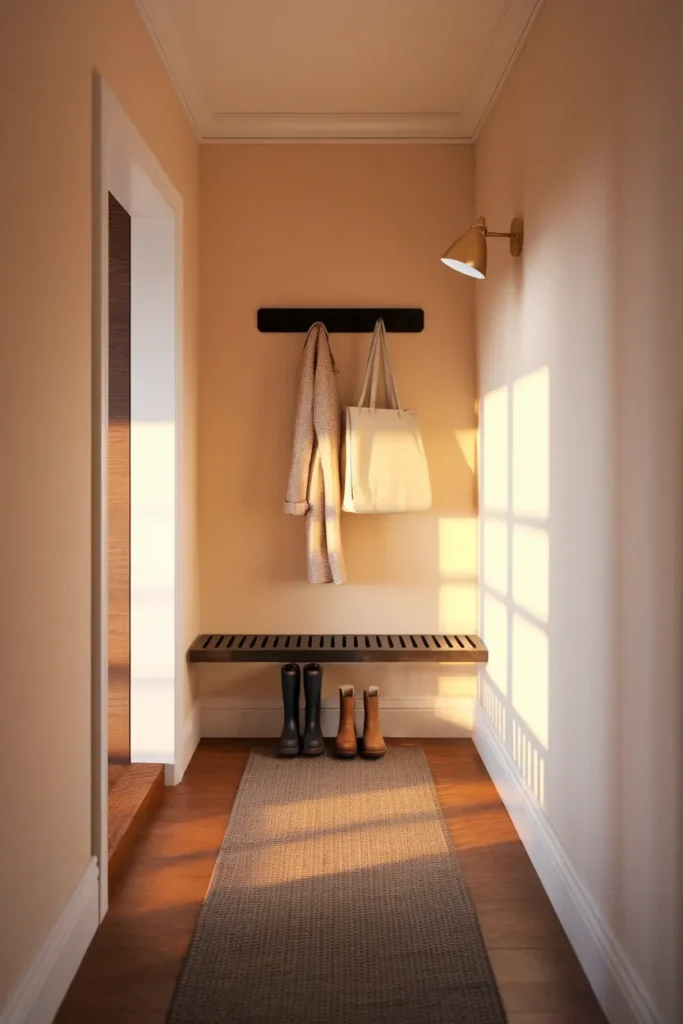
Start With Three Pieces, Not Thirty
Every entry that actually works covers the same three jobs, whether it is a grand foyer or eighteen inches of wall beside a rental door. Call it the Three-Piece Rule:
- A landing surface so keys, mail, and bags stop landing on the floor.
- A vertical (hooks or a knob rack) so coats get off the landing surface.
- One warm light at or below eye level so the space reads as arrival instead of hallway.
Cover all three and the corner looks intentional. Cover two and it looks unfinished. Cover one and it is a shelf.
Here is what the first two cost in real money, verified on IKEA’s US site in August 2026:
- IKEA TJUSIG bench with shoe storage, black, 42 1/2 inches wide by 13 3/8 inches deep by 19 5/8 inches tall: $69.99
- IKEA TJUSIG wall/door rack with knobs, black, 23 1/2 inches long: $17.99
That is $87.98 for the landing surface and the vertical. Budget roughly $25 to $60 for the light, which is an estimate because plug-in sconce prices swing hard by finish. Total lands comfortably under $150.
Buy the vertical first if you can only buy one thing. A bench with no hooks above it becomes a coat pile in four days.
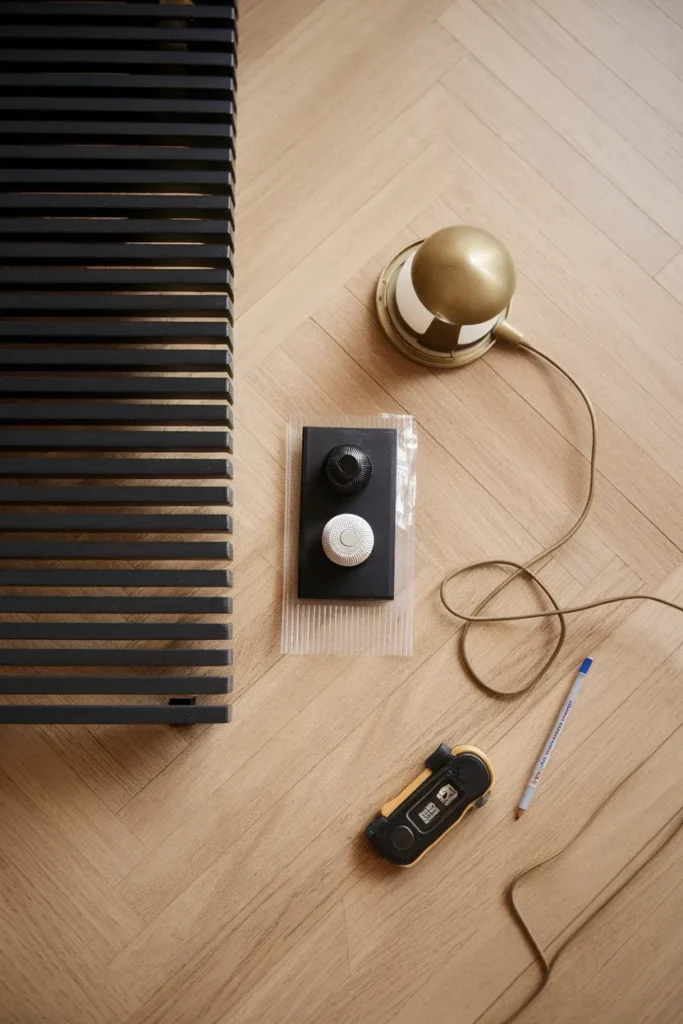
Measure the Door Arc Before You Buy Anything
This is the step every entryway roundup leaves out, and it is the reason so many benches get returned.
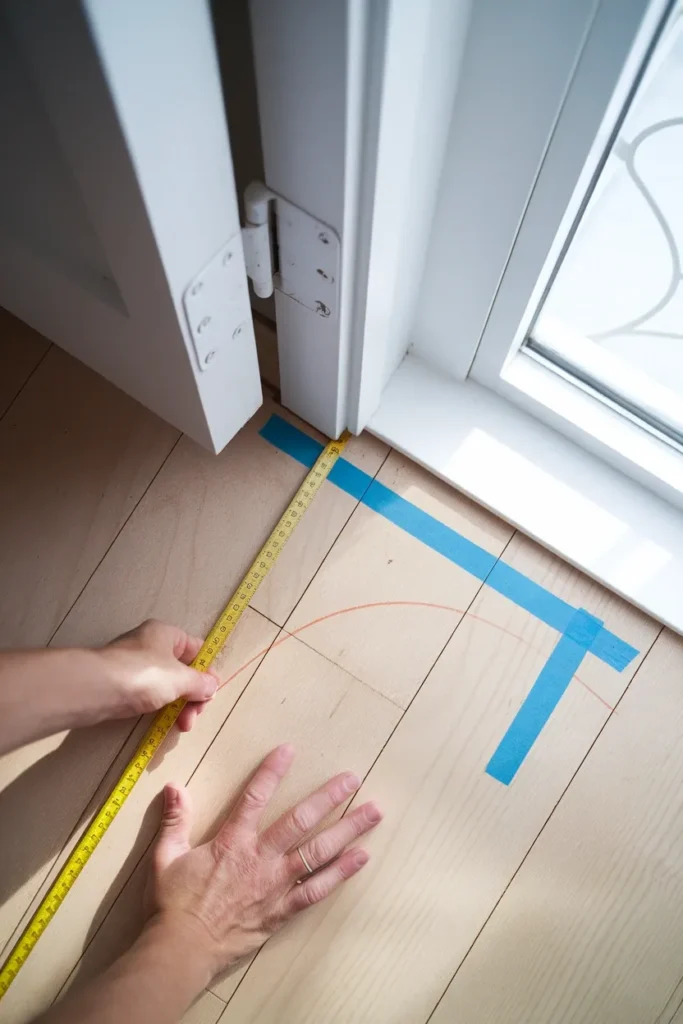
Your door sweeps an arc equal to its own width. A 32-inch door needs a full 32 inches of clear floor measured out from the hinge side. Everything inside that quarter circle is unfurnishable, no matter how good it would look there.
Take two minutes and do this before you open a single shopping tab:
- Measure the door leaf itself, hinge edge to latch edge.
- Stand at the hinge and measure that same distance straight out along the wall the door swings toward.
- Mark the spot with painter’s tape. That tape is your buy line.
- Measure the remaining wall run. That number, not the number in your head, is the widest piece you can fit.
Now check your options against real dimensions instead of product photos:
| Piece | Width | Depth | Height | Price (Aug 2026) |
|---|---|---|---|---|
| TJUSIG bench with shoe storage | 42 1/2 in | 13 3/8 in | 19 5/8 in | $69.99 |
| TJUSIG shoe rack | 31 1/8 in | 12 5/8 in | 14 5/8 in | $29.99 |
| HEMNES bench with shoe storage | 33 1/2 in | 12 5/8 in | 25 5/8 in | $99.99 |
| KALLSO bench with shoe storage | 31 1/2 in | 14 3/4 in | 21 7/8 in | $99.99 |
| TJUSIG wall/door rack with knobs | 23 1/2 in | 1 1/2 in | 3 1/4 in | $17.99 |
Depth is the number that decides whether you like the room. Put a 14 3/4 inch deep bench in a 36-inch hallway and you have left 21 1/4 inches of walkway. Two people cannot pass. You will resent it by Thursday.
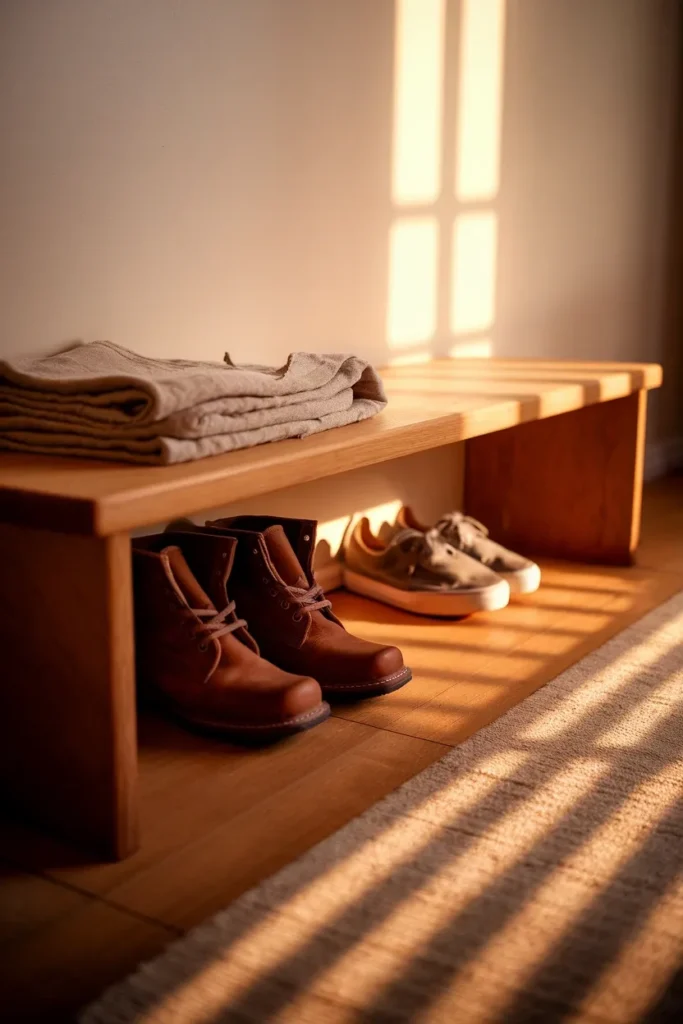
Pick a Landing Surface Under 14 Inches Deep
Width gets all the attention. Depth is what you feel every day.
Under 14 inches keeps a standard 36-inch hallway walkable for two people. Over 15 inches and one of you turns sideways every single time. That is the whole rule.
Four options that respect it:
- A bench with open shoe storage. Best pick if shoes are your actual problem. Boots go under, nobody has to bend.
- A narrow console or a single floating shelf mounted at 30 to 32 inches. This is the move when you have literally zero floor to spare. It gives you a landing surface with a zero-inch footprint.
- An ottoman or pouf that tucks fully under the shelf. No install, no hardware, moves in ten seconds when you vacuum.
- A slim ladder shelf if your wall is tall and narrow rather than wide.
The trade-off nobody mentions: a padded bench top looks softer in photos and is worse at its job, because wet boots and damp bags sit on fabric. A hard top with a linen throw folded over one end gives you the same softness and wipes clean.
There is a sound difference too. Keys hitting a bare wood shelf clack. Keys dropping into a shallow ceramic bowl on a linen runner just land. You notice it every evening for a week and then you stop noticing, which is exactly when it has worked.
Fix the Bulb Before You Buy the Lamp
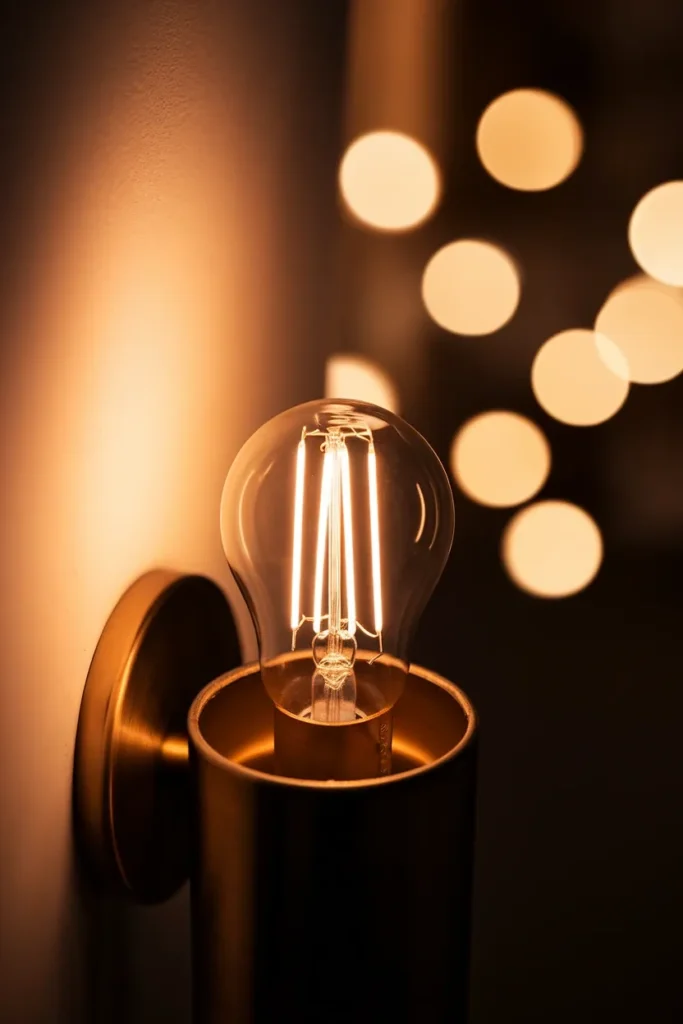
Most entries are lit by one cold ceiling fixture that was installed by a builder who never stood under it at 6 p.m. Change the bulb before you spend a dollar on a new fixture. It is a four-dollar fix that does more than a hundred-dollar lamp.
Aim for 2700K. The Department of Energy explains the scale plainly in its Consumer Guide to Energy-Efficient Lighting: “Higher K numbers mean the light appears cooler (or bluer) and lower K numbers mean the light is warmer.” Warmer is what you want at a threshold. You are walking in from a parking lot, not into a dentist’s office.
Product archetype: any 2700K A19 LED, dimmable if your fixture supports it. Check the Lighting Facts label on the back of the box, not the marketing word on the front. “Soft white” is usually 2700K but manufacturers use it loosely.
The failure mode is specific and instantly recognizable. A 4000K bulb turns cream walls gray, makes warm oak look orange, and makes every face in the mirror look tired. Swap it and the same room reads warm with zero decorating.
Hooks Fail Quietly, So Do the Five Pound Math
Every entryway article says “add hooks.” Not one of them tells you what a hook actually holds, which is why adhesive hooks let go at 2 a.m. and take a strip of paint with them.
Here are the manufacturer’s own published ratings for Command hooks:
- Medium hook: 3 pounds
- Large hook: 5 pounds
- Jumbo hook: 7.5 pounds
- Large picture hanging strips: 4 pounds per set
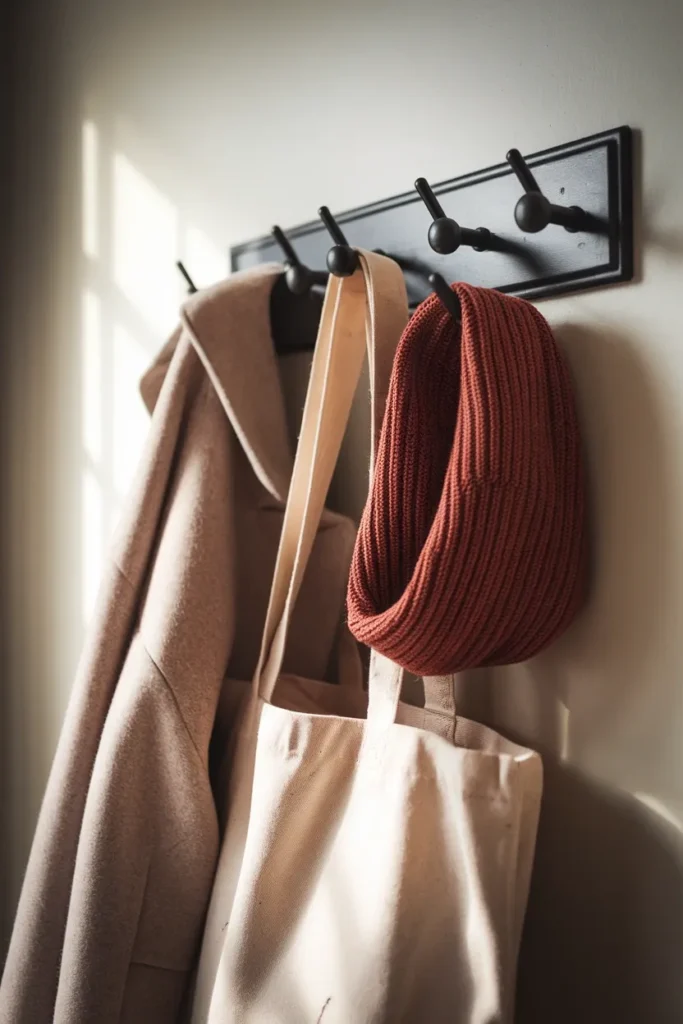
Now weigh what you are hanging. A wool peacoat, a loaded canvas tote, and a scarf on one Large hook clears 5 pounds without trying. The hook does not fail immediately. It creeps, then it goes overnight.
So do the math out loud before you stick anything to a wall:
- One hook per person, spaced 8 to 10 inches apart so coats hang instead of overlapping.
- Winter coats go on a freestanding or over-door rack, not on adhesive. A door-mounted knob rack like the TJUSIG carries the load on the door structure instead of the paint.
- Mount at 60 to 66 inches for adults, 40 to 44 inches for a kid who needs to reach her own jacket.
- Wipe the wall with isopropyl alcohol first, not a household cleaner. Residue is the number one reason adhesive strips fail early.
If nothing in your place can take a screw, the same load logic runs through every room. These no-drill decorating ideas for renters apply it to curtains, rugs, and lighting too.
Two Mats Beat One
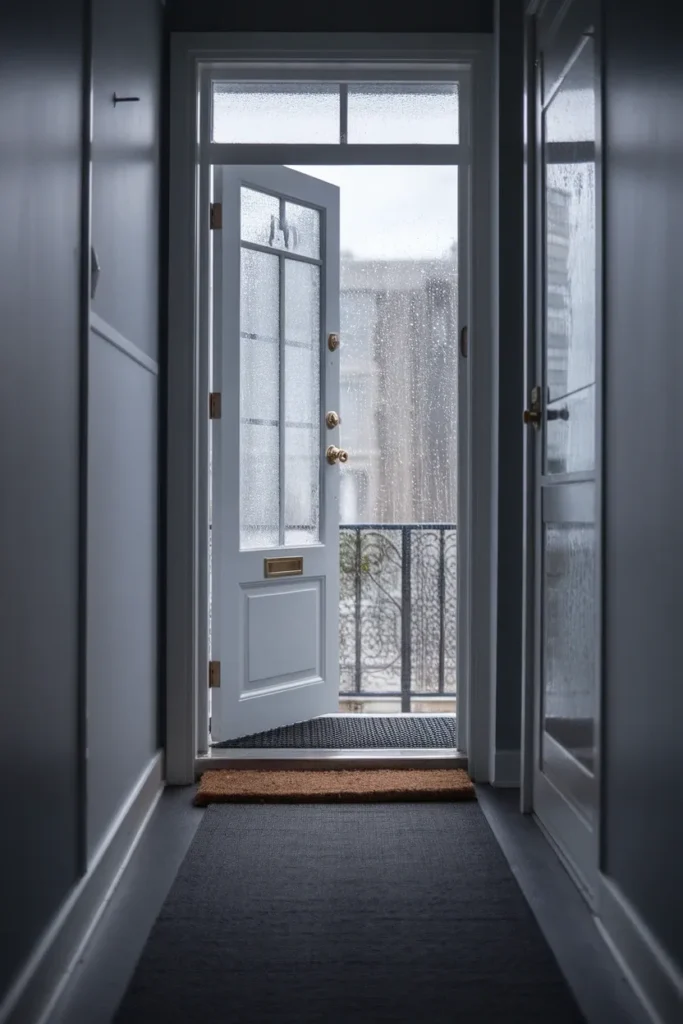
One mat inside the door is decoration. Two mats is a system, and it is the single change that keeps the rest of your entry looking clean.
Outside, you want grit control: a stiff coir or rubber scraper that grabs the chunks off your soles. Inside, you want fines: a low-pile washable flatweave that absorbs the dust and damp your shoes carry past the threshold.
That is not just a housekeeping preference. The EPA’s guidance on entry dust mats is direct about it: “Place dust mats both inside and outside your home to avoid tracking dust, which may contain lead, inside.” If your building went up before 1978, that matters more than aesthetics. General information only, not a health assessment. For lead testing or abatement in an older US home, hire a certified lead professional.
Sizing that works:
- Inside mat should be at least as wide as the door opening, so a 32-inch door wants a 36-inch minimum width.
- Long enough for three full steps. In practice that is a 2 by 3 foot mat at the absolute minimum, and a 2 by 5 or 2.5 by 7 runner if you have a hall.
- Leave 1/4 to 1/2 inch of clearance under the door swing. Measure the gap under your closed door before you buy pile height.
The trade-off, stated honestly: a jute rug photographs beautifully and traps grit in its weave where you cannot get it out. A washable flatweave looks slightly flatter in a photo and goes in your machine in March when the salt and slush arrive. Pick based on which month you care about.
Warm the Wall at Eye Level
Everything so far lives below waist height. That is why a functional entry can still feel cold. The wall above the bench is the part your eye actually reads when you walk in.
Three ways to fill it, cheapest first:
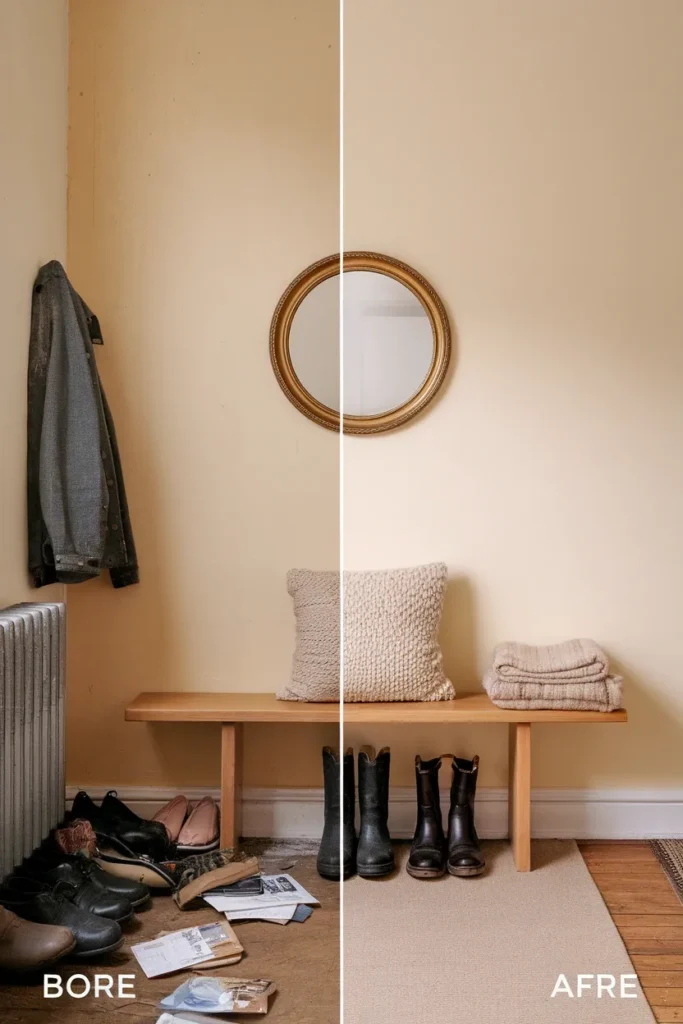
- A mirror. Hang it so the center sits at 57 to 60 inches, the standard gallery height, and place it across from or adjacent to your only light source. It borrows that light and doubles it. A round mirror softens a corner full of straight lines.
- One piece of art, not four. A gallery wall in a two-foot-wide entry reads as clutter. One larger piece reads as a decision.
- Peel-and-stick wallpaper on that one wall only. It contains the project to a single surface, costs less than paint plus primer, and comes off at move-out. A small-scale cottagecore floral or a fine stripe both work in a narrow run.
Then add the soft layer, because texture is what separates a functional entry from a cozy one. A boucle or linen lumbar cushion on the bench. A wool throw folded over one end. A sheepskin on a pouf if you have one. Three textures is plenty. Five is a pile.
Run the 8 P.M. Test
Here is a check you can run tonight. At 8 p.m., turn off the overhead fixture and look at your entry. If what remains is darkness, the space will never feel warm no matter what you put in it.
Light at 30 to 60 inches off the floor reads as warm. Light at 96 inches reads as institutional. That gap is why one small lamp on a console beats a brighter ceiling fixture every time.
Fixes in order of cost:
- A small table lamp on the landing surface, on a smart plug or an inline cord switch so you can hit it as you walk in.
- A plug-in sconce with a cord cover run down the wall. No electrician, no hole beyond two small screws or an adhesive mount.
- Battery LED puck lights under a floating shelf, which gives you a glow with literally zero wiring.
The same zoning logic scales up to the rest of the house. This breakdown of warm evening living room lighting walks through the 2700K rule across a whole room instead of one corner.
Build the Drop Zone That Survives Week Three
Every entryway you have ever pinned was photographed on day one. Nobody photographs day fourteen, which is when the real mail, the real gym bag, and the third pair of shoes show up and the bench becomes a shelf again.
The fix is a rule, not more storage: one object, one home, one size. If a daily object does not have a home sized specifically for it, it will land on the flattest available surface, which is your bench.
Assign these four before you style anything:
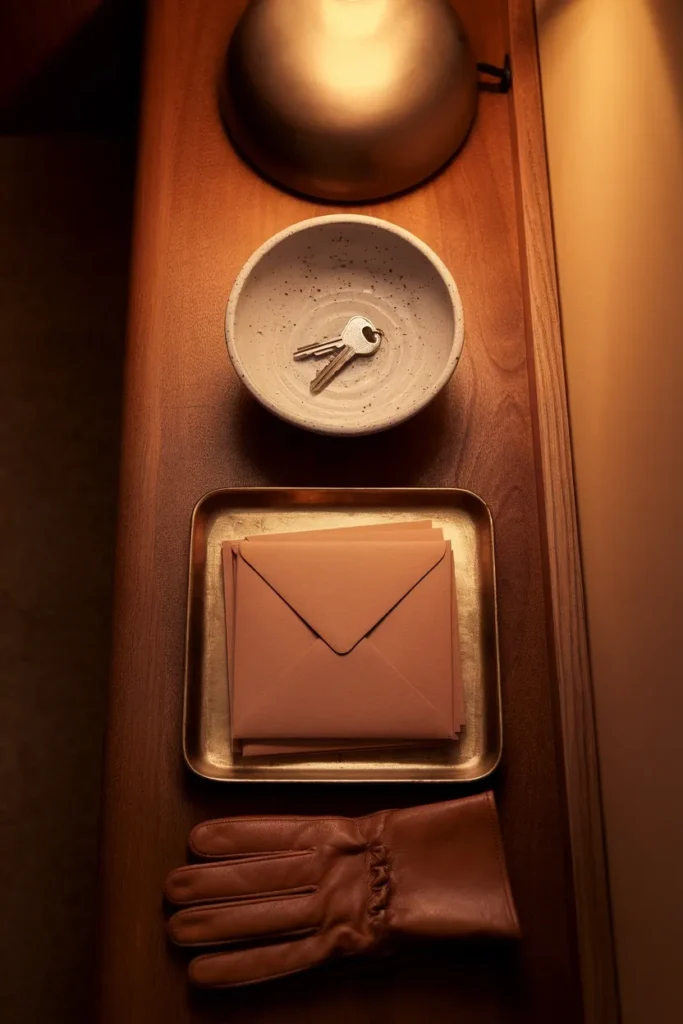
- Keys get a shallow ceramic bowl, 4 to 6 inches across. Shallow matters. Deep bowls swallow keys and collect coins.
- Mail gets one vertical file or a single tray, plus a standing Sunday rule that it empties. One tray, not a stack of trays.
- Shoes get a hard cap: one pair per person at the door, everything else lives elsewhere. The cap is the whole system.
- Bags get the hook, never the bench.
Ninety seconds a day maintains it. The reason your last entry setup failed was almost certainly that a fifth object had nowhere to go.
Borrow the Corner Beside the Door
If your front door opens straight into the living room, you do not have an entryway problem. You have a zoning problem, and zoning is easier.
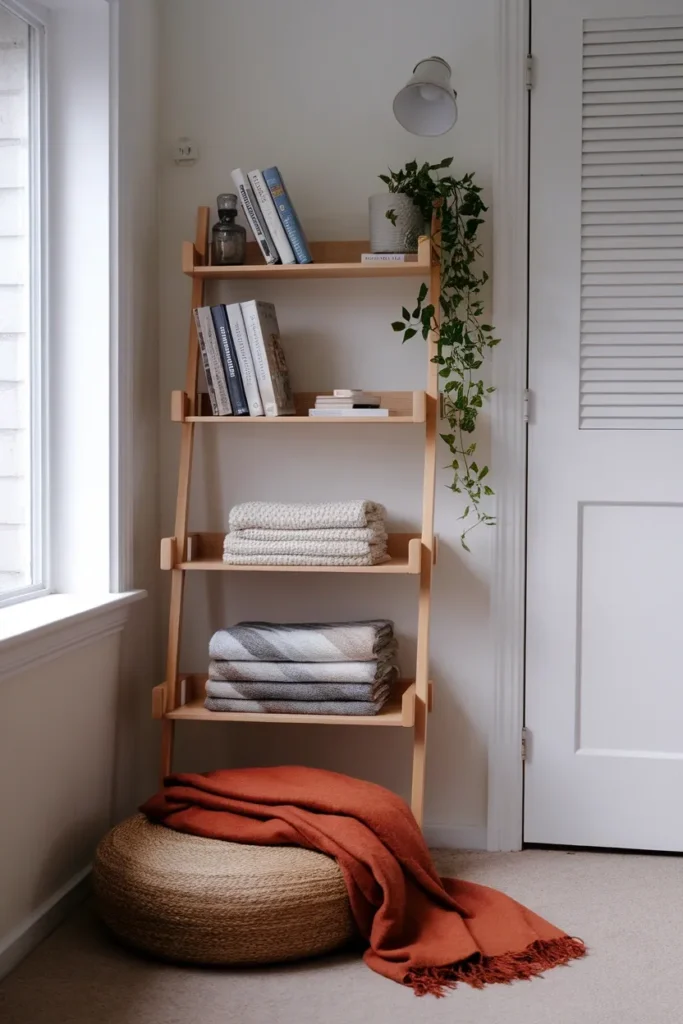
Claim the 30 inches beside the door and treat it as its own small room. A slim ladder shelf or a narrow bookcase on the hinge side works as a soft wall, marking where the entry ends and the living room begins without blocking anything. Add a floor cushion or a pouf and the same corner does double duty as a place to sit and pull boots off.
Anchor it with a rug that is a different texture from your main living room rug. That single change tells the eye it is a separate zone, even though there is no wall.
If you have more than 30 inches to work with, the corner can become something better than storage. The same measure-first approach turns up in this dead corner reading nook build, which uses a 42-inch test to check whether a chair will actually fit before anything gets bought.
Three Real Budgets, With Real Numbers
| Build | What is in it | Total |
|---|---|---|
| The $88 reset | TJUSIG bench with shoe storage ($69.99) plus TJUSIG wall/door rack with knobs ($17.99) | $87.98 verified |
| The mid build | The reset, plus a TJUSIG shoe rack ($29.99), a 2700K bulb, a washable 2 by 3 runner, and a shallow key bowl | roughly $180 to $215 (estimate) |
| The finished entry | The mid build, plus a plug-in sconce, a round mirror, one boucle cushion, and peel-and-stick paper on the bench wall | roughly $350 to $400 (estimate) |
Only the first row is a verified total. The other two are honest ranges, because runner and sconce prices move constantly and anyone quoting you an exact figure for those is guessing.
Start with the $88 reset. Live with it for two weeks. The gaps you notice in week two are the ones worth spending the next hundred dollars on, and they will not be the gaps you would have guessed today.
Cozy Entryway Decor Ideas Frequently Asked Questions
How do I make a small entryway feel cozy? Change the bulb to 2700K, add one light source below eye level, and add one soft texture at bench height. Those three moves change how a small entry feels more than any amount of decor. Warm low light plus one wool or boucle texture reads as cozy to the eye almost instantly.
What should every entryway have? A landing surface, a vertical for coats and bags, one warm light, and a mat system. That is the working minimum. Everything past those four is styling, and styling on top of a missing function is what makes an entry look nice and behave badly.
What size rug should I use in an entryway? Match or exceed the width of your door opening, so a 32-inch door wants at least a 36-inch wide mat. For length, allow three full steps: a 2 by 3 foot mat is the floor, and a 2 by 5 or 2.5 by 7 runner suits a hallway. Check the gap under your closed door before choosing pile height.
How deep should an entryway bench be? Under 14 inches for most apartments. A 13 3/8 inch deep bench in a 36-inch hallway leaves about 22 1/2 inches of walkway, which two people can share. At 14 3/4 inches deep you drop to roughly 21 1/4 inches and passing gets awkward.
How do I decorate an entryway when I do not have one? Zone it instead of building it. Claim the 30 inches beside the door with a slim vertical piece, put a rug down in a different texture from the adjacent room, and mount a floating shelf at 30 to 32 inches so you get a landing surface with no floor footprint at all.
How do I add an entryway to an apartment without drilling? Use a door-mounted knob rack for coat weight, adhesive hooks only for light items within their stated rating, a freestanding bench or pouf that needs no install, and peel-and-stick wallpaper for the wall. Rated adhesive hooks top out around 7.5 pounds, so heavy winter coats belong on the door rack or a freestanding rack.
How do I make a small entryway look bigger? Hang a mirror at 57 to 60 inches on center opposite your light source, keep everything under 14 inches deep, choose a floating or open-legged piece so you can see floor underneath it, and run a long narrow runner in the direction of travel. Visible floor is what reads as space.
Start With the Tape Measure Tonight
You do not need a foyer, a budget, or a landlord who says yes. You need a landing surface, a vertical, a warm bulb, and about an hour.
Do the door arc measurement tonight before you shop. Two minutes with a tape measure and a strip of painter’s tape tells you the exact widest piece your wall can take, and it is the difference between a bench you love and a bench you shove sideways.
Then run the 8 p.m. test on whatever you already own. Most people find their entry does not need more stuff. It needs one warm light thirty inches lower than the one they have.
If your door opens into a living room, the small spaces section of Little Nook Home has the corner-by-corner version of this same approach, including the dead-corner build and the renter lighting setups.
Keep reading
More cozy nook ideas
 Fall Decor
Read →
Fall Decor
Read →
Fall Door Decor on a Budget: Where to Spend and Where to Save
If your fall door every year is a wreath that sheds on the mat, two mums that are crispy by Halloween, and…
 Fall Decor
Read →
Fall Decor
Read →
12 Thanksgiving Tablescape Ideas for Small Spaces (That Still Leave Room for the Food)
Twenty-four inches. That’s how much table edge one person needs to eat without bumping elbows, and it’s the number most Thanksgiving tablescape…
 Fall Decor
Read →
Fall Decor
Read →
18 Fall Coffee Bar Ideas for Sweater-Weather Evenings
No counter space to spare, no espresso machine, no landlord permission needed. This fall coffee bar runs on three pieces: a slim…