
Farmhouse Kitchen Wall Decor That Survives a Real Kitchen

Most farmhouse kitchen wall decor fails for a boring reason. It got hung in the wrong three feet of the room.
Grease travels farther than you think. Steam gets into unsealed wood. That thrifted breadboard you loved in October goes faintly tacky by March, and you blame the breadboard.
So we’re doing this in a different order than everyone else. First we map your walls into three zones. Then we fill each zone with something that can actually live there. You don’t need a bay window, a renovation budget, or a landlord who returns your emails.
Twelve ideas, sorted by which wall they can survive on.
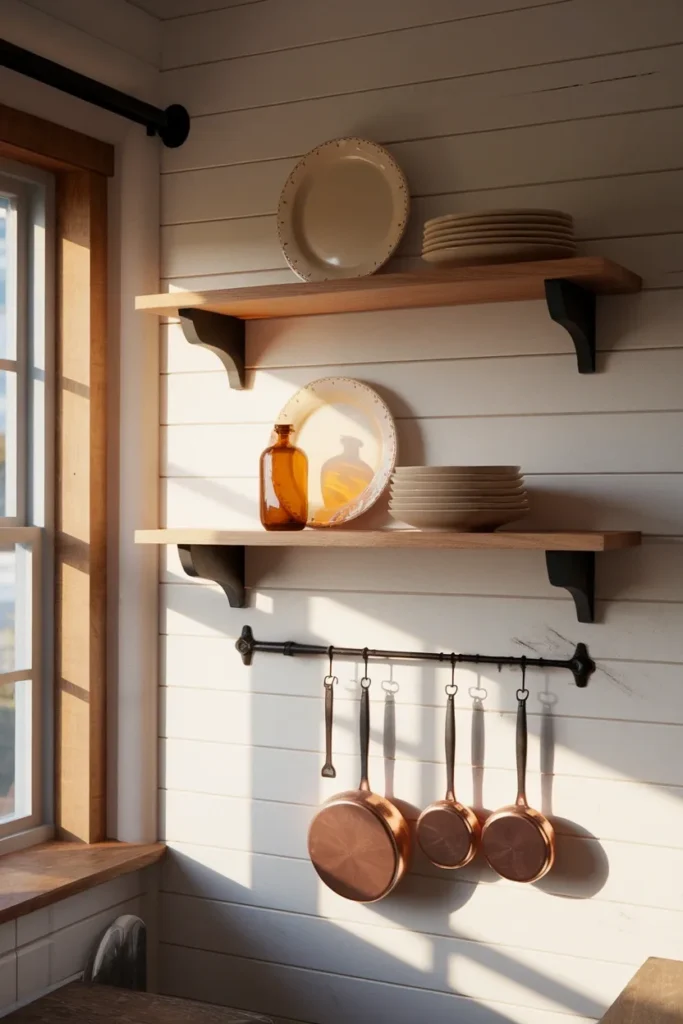
Start Here: The Three-Zone Wall Map
Before you buy anything, walk into your kitchen and find your range. Everything else is measured from there.
Kitchen walls are not one surface. They’re three, and each one destroys a different category of decor. Here’s the working rule we use, which we call the 30-inch grease line: anything within roughly 30 inches of a cooktop or a sink lives in a splash zone, because that’s the same clearance band manufacturers use for range hood mounting. It’s the air that carries oil aerosol and steam.
| Zone | Where it is | What survives there | What dies there |
|---|---|---|---|
| Zone 1: Splash | Within 30 in of the range or sink | Glazed tile, sealed metal, glass, enamel | Paper, raw wood, textile, anything matte |
| Zone 2: Working | The counter run, the 18 in gap under uppers | Wipeable and functional: rails, ledges, enamelware | Framed art, dried florals, cardboard-backed prints |
| Zone 3: Safe | Opposite wall, breakfast corner, entry side | Anything you love, including paper and fabric | Nothing, this is your free wall |
Print that. Screenshot it. It’s the whole article in nine boxes.
Old grease has a smell, by the way. Not strong, just faintly stale and sweet, and it lives permanently in unsealed wood. Once it’s in, no amount of wiping brings the piece back. That’s the failure mode you’re avoiding.
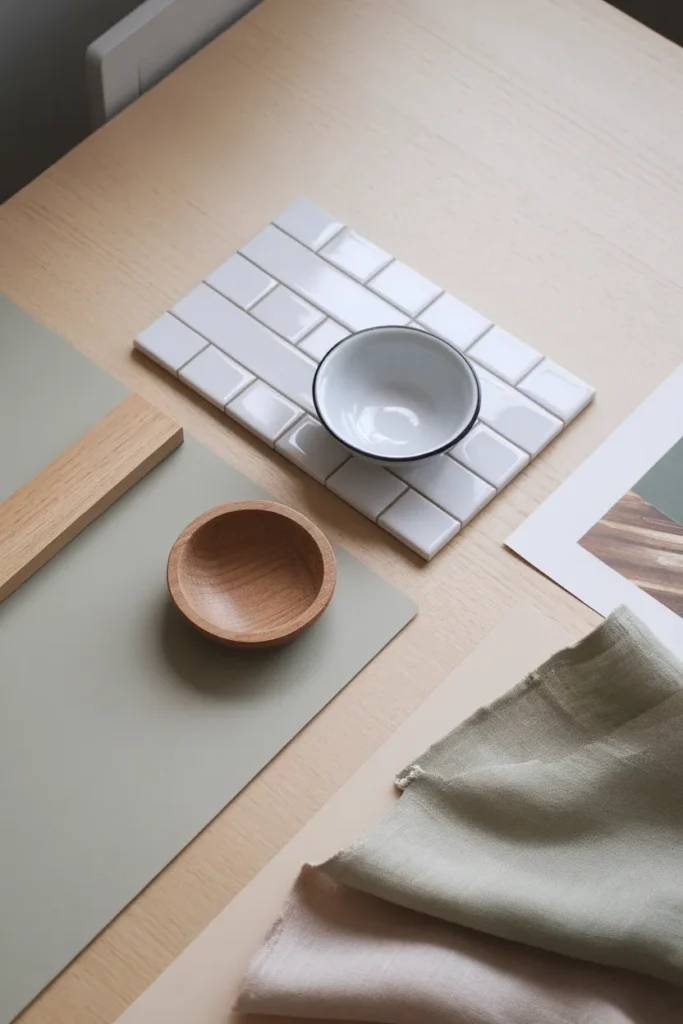
Zone 3 First: The Gallery Wall That Won’t Go Sticky
Your safe wall gets the good stuff. Start here, because it’s the fastest visible win.
Farmhouse gallery walls go wrong in one specific way: everything is the same. Same wood tone, same distressed white frame, same font on every sign. It reads like one shopping trip, because it was one shopping trip.
Mix three sources instead. One thing that’s old and actually old (a flea market seed packet, a botanical page torn from a damaged book, a small mirror with real spotting). One thing that’s flat and graphic (a black and white photo, a hand-lettered menu). One thing with dimension (a small woven trivet, a tiny cast iron trivet, a hand-thrown plate).
Hang the center of the arrangement at 57 inches from the floor. That’s the gallery standard, and it’s tuned to average standing eye level, which matters more in a kitchen than in a living room because nobody sits down in here.
Failure mode: if every frame is the same distressed white, the wall reads as a display fixture, not a collection.
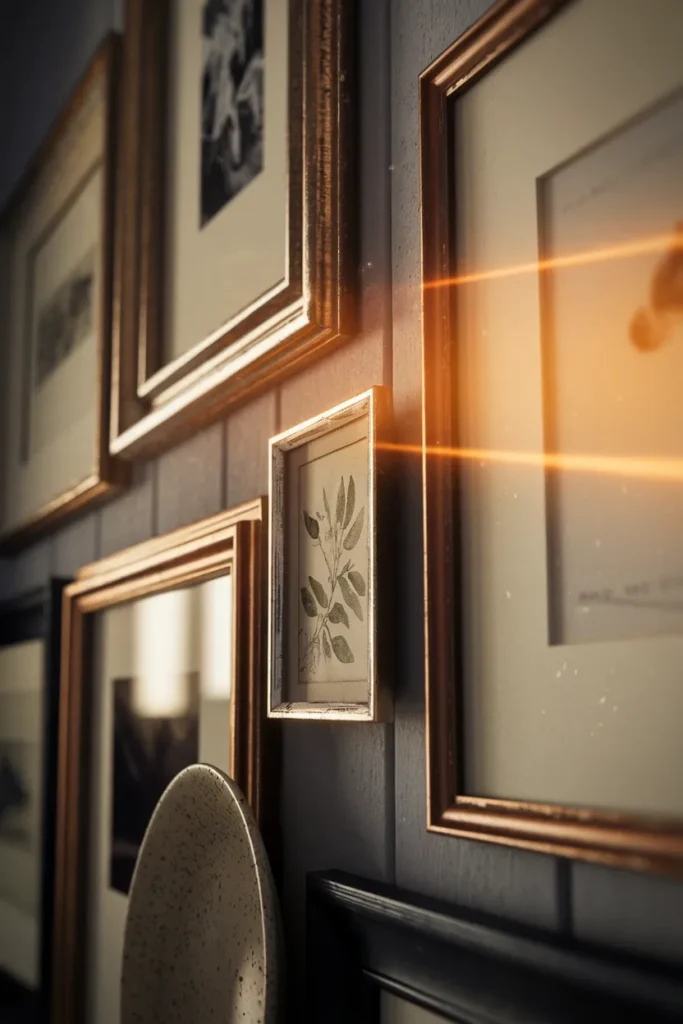
Open Shelving That Earns Its Wall
Open shelving is the single most-recommended idea in every competing article, and it’s recommended without a single caveat. Here’s the caveat.
Shelves in Zone 1 collect a film. Shelves in Zone 3 collect dust. Shelves in Zone 2, the counter run under your uppers, are the ones that work, because you’re touching and rotating that stuff daily. Items that get used don’t have time to build a coating.
Two shelves beat three. Give them 12 to 14 inches of vertical breathing room so you can actually lift a stack of bowls out without tilting. Anything tighter and you stop using the shelf, which means it starts collecting.
For the full styling ratio and the dust-map breakdown, we went deep on this in our guide to cottage kitchen open shelving styling rules, including which wall in your kitchen will betray you first.
Failure mode: shelves you don’t touch weekly become a cleaning chore you resent.
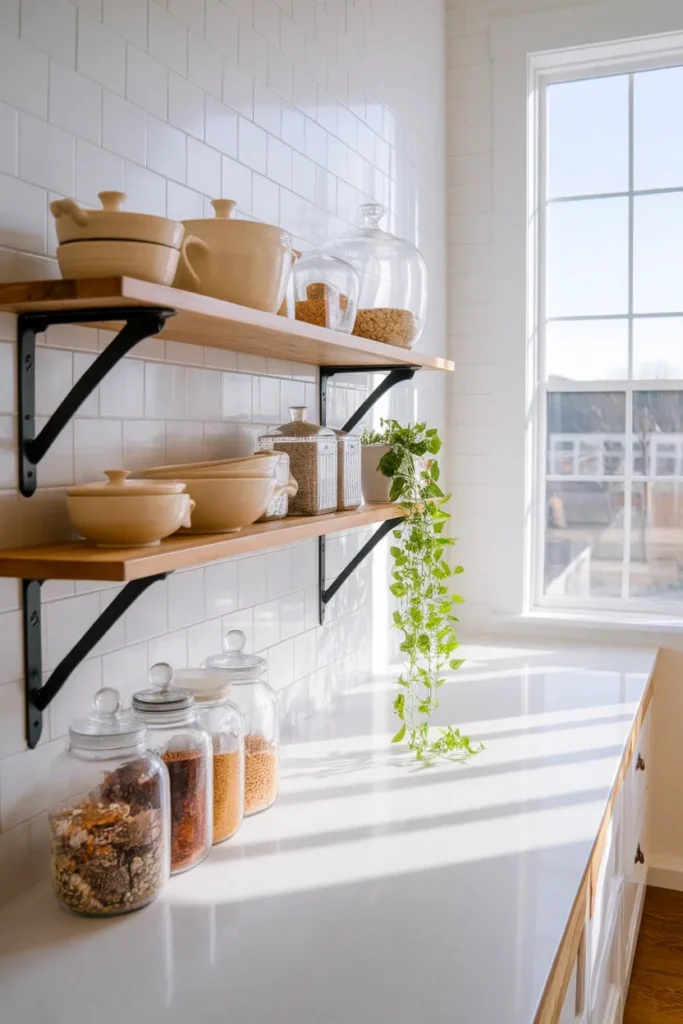
The Plate Wall, Done Without a Single Nail Hole
Hanging plates is on every competitor’s list. None of them mention that traditional plate wire hangers put constant spring tension on a glazed rim, which is exactly how vintage ironstone chips.
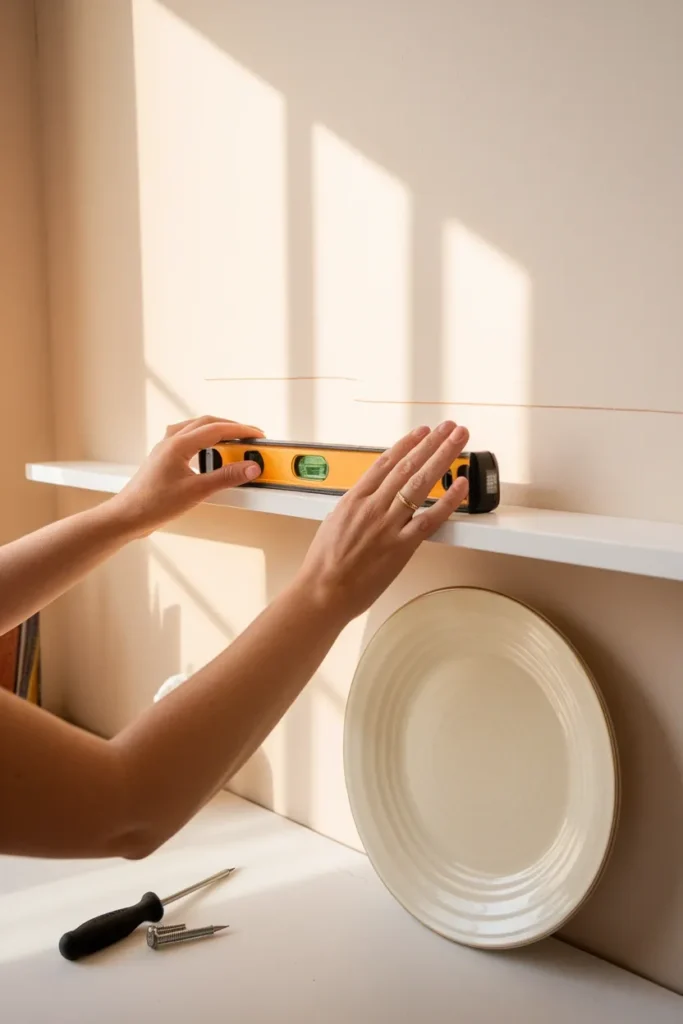
Use a picture ledge instead. The IKEA MOSSLANDA in the 45 1/4 inch length runs $19.99 as of August 2026, is 4 3/4 inches deep, and carries a stated max load of 16.53 lb. That’s plenty for eight to ten stoneware plates leaned in an overlapping row.
Leaning also means you can restyle in about forty seconds, which you will do more often than you’d admit.
If you’re mounting a ledge into drywall, use the anchors that come in the box, not just the screws. Wall anchors in standard drywall are the difference between a shelf and a sound you’ll remember.
Failure mode: wire hangers plus a slammed cabinet door equals a chipped rim you can’t replace.
Hang Light, Not Just Art
This is the highest-impact change in the entire article and it costs less than a sign.
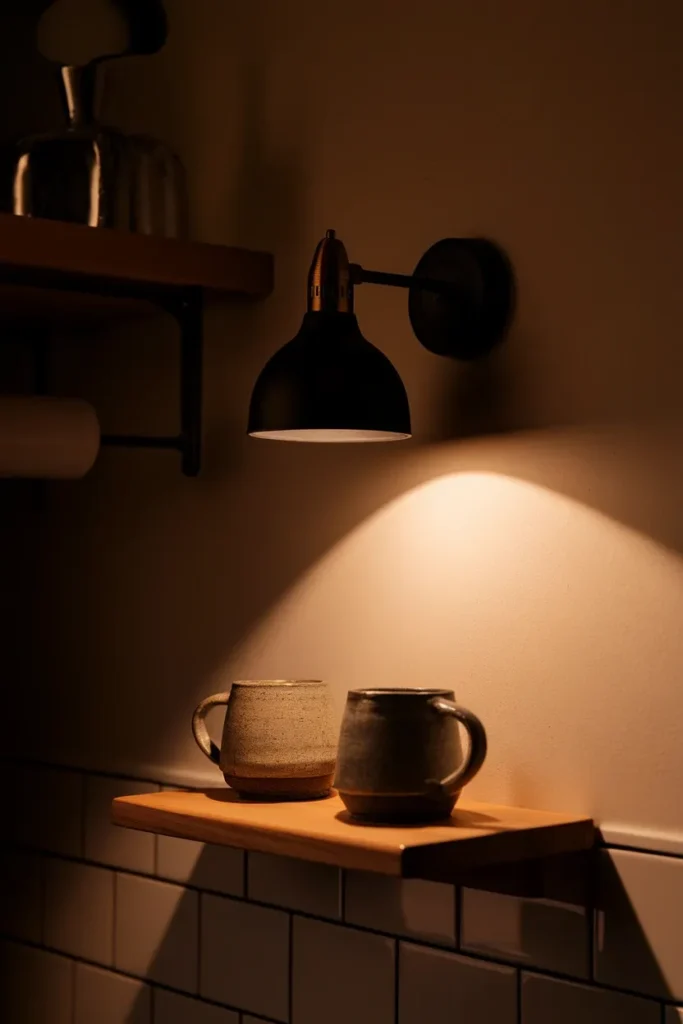
A wall sconce or a small picture light aimed at your Zone 3 arrangement does something no decor object can do on its own: it makes the wall exist after dark. Plug-in sconces with a cord cover are renter-legal and take about ten minutes.
Bulb temperature is where most farmhouse kitchens quietly go wrong. According to the ENERGY STAR light bulb purchasing guide, the 2200K to 3000K Soft White band is “ideal for most indoor applications,” while the cooler 3500K to 4100K band is what’s typically recommended for kitchens and work spaces.
Both are correct, which is the part nobody explains. Your under-cabinet task lighting can run cool so you can see what you’re chopping. Your decorative wall lighting should sit at 2700K so the wood tones stay warm instead of going gray and clinical at 8 PM.
Layer them. One switch for work, one for evening.
Failure mode: a single 4000K ceiling fixture flattens every warm material in the room.
Vintage Pieces That Belong in a Working Kitchen
Not all vintage survives a kitchen equally, and the sorting rule is simple: was this object originally built to be near heat and water?
Yes, put it up: enamelware basins and bowls, cast iron trivets, copper molds, galvanized trays, ironstone platters, wooden cutting boards that were already oiled for kitchen use, tin canisters.
No, keep it in Zone 3 or another room: paper ephemera, unframed textiles, anything with an original painted finish you care about, veneered wood.
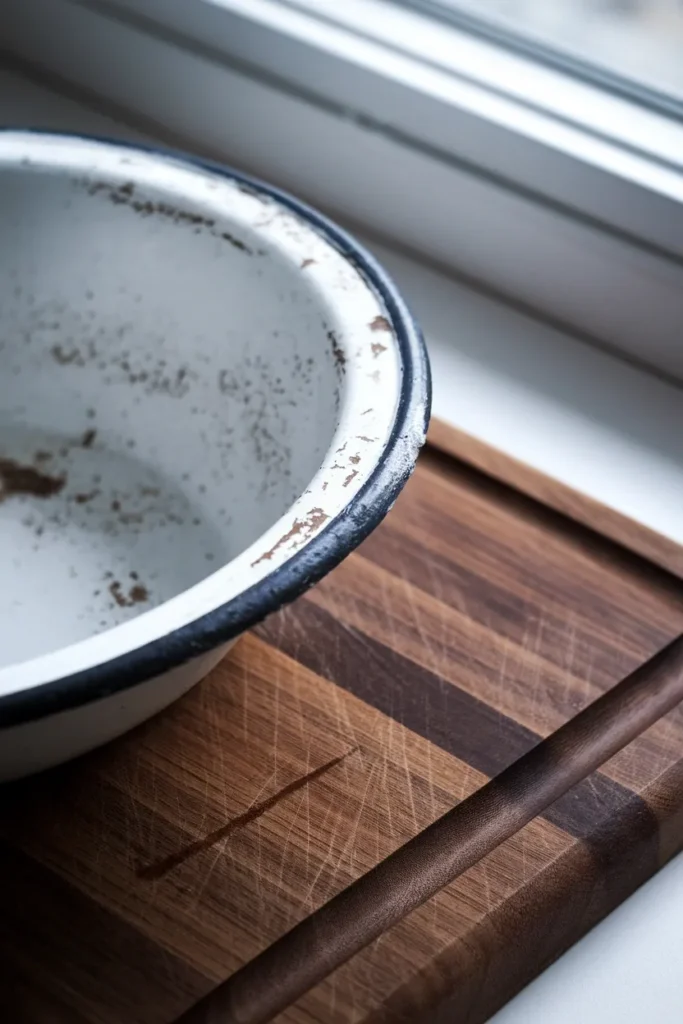
Enamelware in particular is the workhorse here. It was made for exactly this environment, it wipes clean with a damp cloth, and a chipped rim on a 1940s basin reads as character rather than damage.
We covered thrift sourcing, the lead-testing step for anything you’ll actually serve food on, and the 1978 paint cutoff in our guide to vintage kitchen decor for a rental.
Failure mode: a framed paper print hung in Zone 2 will cockle at the edges within one winter of steam.
The Three Things That Should Never Hang in a Kitchen
Every competing article is purely additive. Here’s the subtraction, which is the part that actually protects your things.
1. Original artwork or anything irreplaceable. Kitchens combine sustained light exposure with humidity swings and airborne oil. The Northeast Document Conservation Center’s guidance on protection from light damage to collections explains that light damage is cumulative and permanent, and that fading and embrittlement cannot be reversed once they occur. A sunny kitchen wall is a slow bleach. Hang a print, keep the original elsewhere.
2. Unsealed dried florals directly over a range. They collect oil aerosol, then they hold it. Within a season they go from airy to visibly heavy, and they can’t be washed.
3. Anything held by adhesive over a heat source. Adhesive tack softens with sustained warmth. The wall above a range is the one place you commit to a mechanical fastener or nothing.
None of this means your kitchen has to be sterile. It means the sentimental things go on the far wall where they’ll still be there in ten years.
That Dead Space Above Your Cabinets
This is one of the most-asked questions in the whole category, and most answers say “add greenery” and stop.
The real problem with the above-cabinet gap is scale. From standing height you’re viewing it at a steep upward angle, so anything under about 12 inches tall disappears entirely and just reads as clutter you can’t reach to dust.
Three things that actually work at that height:
- One oversized piece per cabinet run, not a row of small ones. A single large woven basket or a tall stoneware pitcher.
- A horizontal line. A row of matched crocks, or three galvanized trays leaned flat against the wall, all the same height.
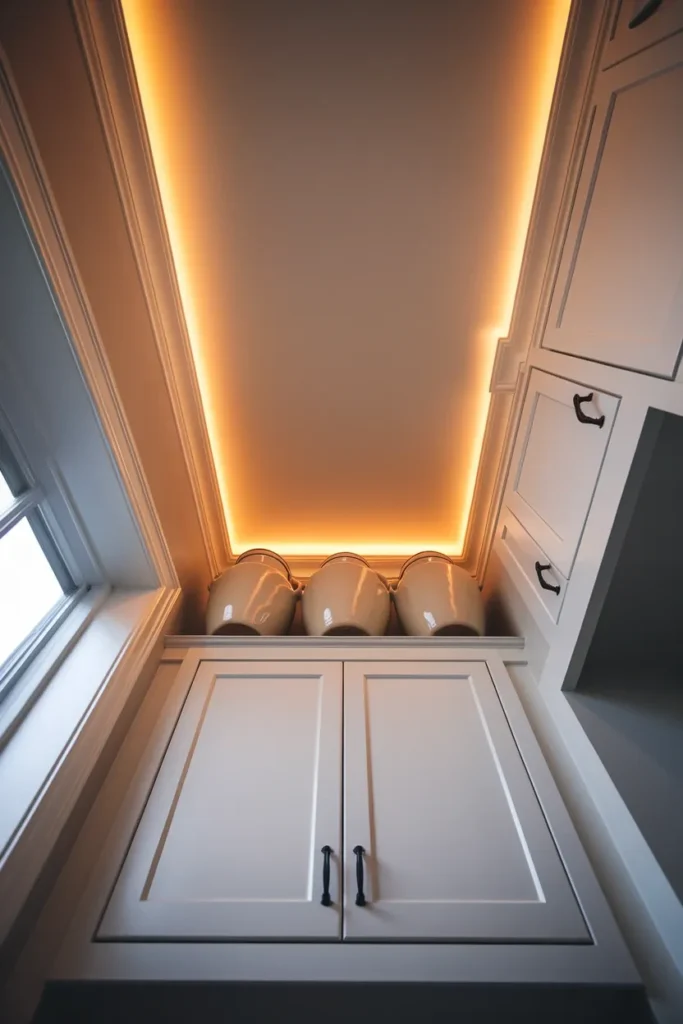
- Nothing at all, plus a light. An LED strip tucked behind the crown molding, uplighting the ceiling. It makes the ceiling feel taller and there’s nothing up there to clean.
That last one is the option nobody suggests and the one most small kitchens should pick.
Failure mode: a scattered mix of small objects up there reads as storage, not styling.
Renter-Safe Farmhouse Walls: What Actually Holds
Here are the real numbers, straight from the manufacturer, because “use Command strips” is useless advice without a load rating.
Per Command’s published weight limits: Picture Hanging Strips hold 1 lb per set in small, 3 lbs per set in medium, and 4 lbs per set in large. General purpose hooks hold 5 lbs for large and 7.5 lbs for jumbo.
Read that again, because it’s lower than most people assume. A large strip set is 4 pounds. A cast iron trivet is often heavier than that on its own.
What that means in practice:
| What you want to hang | Typical weight | Renter-safe method |
|---|---|---|
| Framed print, 8×10 in | Under 2 lb | Small or medium strip set |
| Framed print, 16×20 in | 3 to 5 lb | Two large strip sets |
| Ceramic plate, single | 1 to 2 lb | Adhesive plate disc hanger |
| Picture ledge with plates | 10 lb+ | Drywall anchors, patch on move-out |
| Cast iron or heavy metal | 5 lb+ | Lean it, don’t hang it |
The three no-drill methods that scale past 4 pounds:
Lean, don’t hang. A picture ledge is the obvious one, but so is the top of a fridge, a counter backsplash ledge, or a narrow console. Leaning has no weight limit and no wall damage.
Use the tension. A spring tension rod in a window recess or between two cabinet runs holds a small curtain, a hanging rail for utensils, or a row of S-hooks.
Go vertical with furniture. A slim leaning ladder shelf against the wall gives you four display surfaces and touches the wall only for balance.
One more thing renters forget: test any adhesive on a small hidden patch first if your walls have a matte or chalky paint finish. Cheap flat builder paint sometimes comes away with the strip, and that’s a bigger patch job than a nail hole.
Failure mode: exceeding a strip’s rating doesn’t fail slowly. It fails at 2 AM.
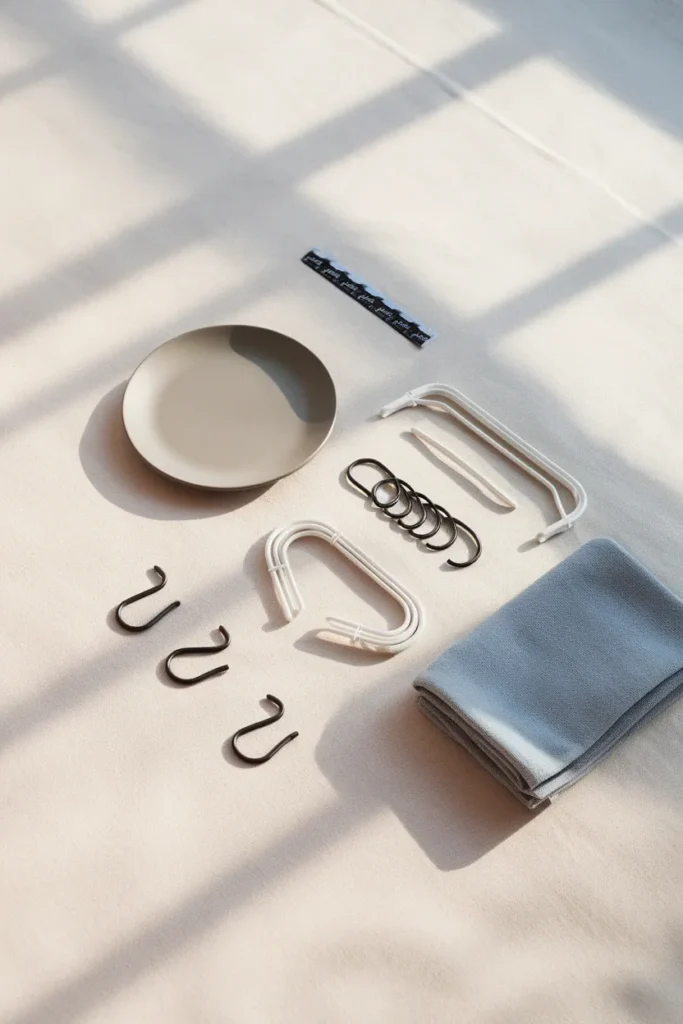
What a Full Farmhouse Wall Actually Costs
Competitors mention budget. Nobody totals it. Here’s a real Zone 3 wall, built from scratch.
| Item | Estimated cost | Note |
|---|---|---|
| Picture ledge, 45 1/4 in | $19.99 | Verified IKEA MOSSLANDA price, August 2026 |
| Second ledge, 21 3/4 in | $10 to $15 est. | Shorter size, same line |
| Plug-in wall sconce | $25 to $60 est. | Wide range by finish |
| 2700K LED bulb | $4 to $8 est. | Buy a two-pack |
| Thrifted enamelware, 2 pieces | $8 to $30 est. | Highly variable by region |
| Adhesive strips and anchors | $10 to $15 est. | One pack covers a whole wall |
| Total | roughly $80 to $150 | Within Appendix B budget band |
Only the first line is a verified live price. Everything marked “est.” is a realistic planning range, not a quote, and thrift pricing in particular swings hard by region.
The order matters more than the total. Bulb first, then light, then the ledge, then what goes on it. Most people do it backwards and wonder why the wall looks flat.
Seasonal Rotation Without Buying More Stuff
Farmhouse decor has a hoarding problem. Four bins in a closet, one per season, and a wall that looks like a store display twice a year.
Try a swap ratio instead: keep 80 percent of the wall permanent, change 20 percent. On a nine-piece gallery wall that’s two objects. Two.
What rotates well without storage cost: whatever is actually growing or in season on your counter. A branch of forsythia in March. A bowl of lemons. Bare branches in January. Wheat stems in September. These cost nothing, they go in the compost when they’re done, and they read as seasonal far more convincingly than a stored sign does.
The permanent 80 percent is what makes this work. If the base arrangement is genuinely good, small changes register clearly. If the base is weak, no amount of seasonal decor rescues it.
Our guide to cottagecore home decor for a lived-in look goes further into the collected-over-time approach if you want the whole-house version of this idea.
Failure mode: four full storage bins for a wall you change twice a year.
Five Mistakes That Make Farmhouse Walls Look Dated
Front-loaded, worst first.
- Every piece bought at once, from one store. The whole point of the look is accumulation. One shopping trip cannot fake fifteen years.
- Word signs as the primary decor. One is fine. A wall of them dates the room to a specific mid-2010s moment.
- All-gray wood tones. Weathered gray reclaimed wood peaked years ago. Warm oak, walnut and honey pine read current.
- Matching distressed frames. Distressing that’s identical across nine frames is factory distressing, and the eye catches it instantly.
- Everything at the same height. Real collected walls have vertical variation. Perfectly aligned rows read as retail.
The through-line: farmhouse style is supposed to look like time passed. Anything that reads as simultaneous purchase works against it.
Farmhouse Kitchen Wall Decor Frequently Asked Questions
What do you put on farmhouse kitchen walls? Start with a functional layer that can be wiped down (open shelving, a pot rail, a picture ledge), add one lighting element, then finish with two or three collected objects in different materials. Keep porous items like paper and textile on the wall furthest from your range.
What should I put on my kitchen walls if the wall is very large? Break it into sections rather than treating it as one canvas. A large wall handles one oversized anchor piece (a big mirror, a single large mounted board) plus a smaller cluster, better than it handles a grid of same-size frames, which tends to read as a hotel corridor.
How do you decorate above kitchen cabinets? Go tall and go few. Anything under roughly 12 inches disappears at that viewing angle. One oversized basket or three matched crocks in a line works. If the gap is under 12 inches, skip decor entirely and add hidden LED uplighting instead.
How high should I hang kitchen wall art? Center the piece or the arrangement at 57 inches from the floor, which is the standard gallery height and matches average standing eye level. Kitchens are standing rooms, so the usual advice about hanging lower to suit seated viewers doesn’t apply here.
Which colors match farmhouse style? Warm neutrals do the heavy lifting: cream, greige, soft white, unbleached linen. Add depth with matte black hardware and one warm metal (aged brass or copper). For accents, muted sage, dusty blue and terracotta all sit comfortably in the palette. Cool grays are what make a farmhouse kitchen read dated.
What materials suit farmhouse decor best in a kitchen? Materials originally made for kitchen use: enamelware, stoneware, ironstone, galvanized metal, copper, oiled hardwood, jute and linen. These were built for heat and moisture, so they age well instead of degrading.
How do you mix vintage and modern elements without it looking cluttered? Hold the modern layer to the fixed elements (cabinets, hardware, lighting) and let vintage live only in the movable objects. Cap yourself at three vintage pieces per wall. The contrast reads as intentional when modern is the background and vintage is the accent, and muddled when they’re evenly split.
Start With One Wall This Weekend
Don’t do the whole kitchen. Pick your Zone 3 wall, the one furthest from the range, and give it two hours.
Change the bulb to 2700K. Hang one ledge. Put three things on it that came from three different places. Stand back at the doorway, which is where you’ll actually see it from every day.
That’s the whole first pass. The wall closest to your stove can wait, and honestly, it should stay mostly empty anyway.
Keep reading
More cozy nook ideas
 Living Room
Read →
Living Room
Read →
Cabin Living Room Checklist: Everything to Decide Before You Start
No log walls, no stone hearth, no lake outside the window. You can still build a cabin living room in a regular…
 Bedroom
Read →
Bedroom
Read →
English Cottage Bedroom Checklist: Everything to Decide Before You Start
You saved forty pins of floral quilts and sloped ceilings, then looked up at your own bedroom: beige walls, one window, a…
 Nursery & Teen Rooms
Read →
Nursery & Teen Rooms
Read →
25 Teen Boy Bedroom Ideas That Feel Grown-Up, Not Childish
If his room still has the race car lamp and the glow-in-the-dark stars, and the door has started staying shut, he’s telling…