
Whimsical Home Decor That Reads Playful, Not Cluttered

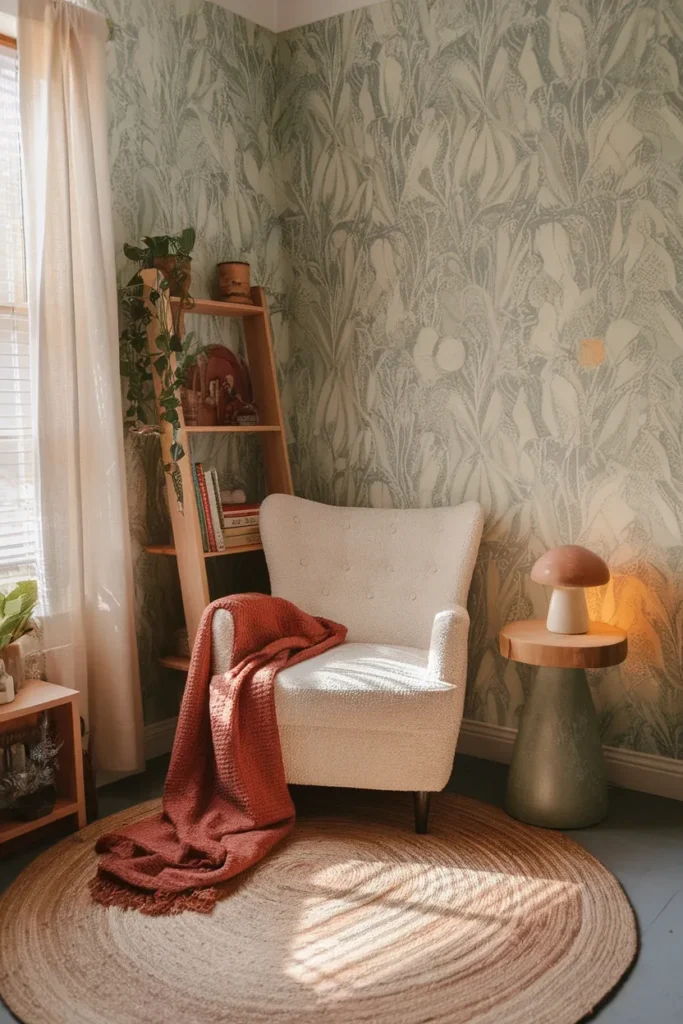
Picture 4 p.m. light on a mushroom lamp, a linen throw half falling off the arm of a chair, and one small brass rabbit sitting where nobody expects a rabbit. That is whimsical home decor working correctly. Most guides on the subject will tell you to paint your ceiling and wallpaper your stair risers, which is lovely advice if you own the building.
You probably rent. You have one awkward corner, a security deposit you would like back, and a landlord who has opinions about paint.
So here is the version that works in 700 square feet with a screwdriver you borrowed. Everything below is either removable, reversible, or under $60.
The 3-2-1 Whimsy Formula (Start Here)
Every whimsical room that fails, fails the same way. Too many competing ideas, none of them repeated, so your eye never gets to rest. Here is the fix, and it is the only rule you need before you buy anything.
The 3-2-1 Whimsy Formula
3 patterns maximum per room, at three different scales. One large (wallpaper or curtain), one medium (a cushion or rug), one small (a lampshade trim or a book spine cluster). 2 colors that repeat at least three times each across the room. Repetition is what separates “designed” from “accumulated.” 1 genuinely strange object per sightline. A brass frog. A scalloped mirror. A lamp shaped like a mushroom. One. Not four.
Test it by standing in the doorway and counting. If you find a fourth pattern, a third dominant color, or two odd objects in the same glance, remove the newest one. That is the whole self-test.
The reason this works is that whimsy needs a straight line to bounce off. A room of only strange things reads as chaos. A room with one strange thing in a calm frame reads as wit.
What Whimsical Home Decor Actually Means, and Where Cottagecore Sits
Whimsical decor is not a style so much as a permission slip. It means one deliberate departure from what the room is supposed to look like. A ruffled lampshade in an otherwise plain bedroom. A mural of ferns behind a very ordinary sofa.
Cottagecore is the softest, most mainstream dialect of it. Florals, handmade textiles, pastoral nostalgia. Whimsigoth is the same instinct in a darker key, all moons and moths and deep plum. Fairycore leans mossy and enchanted. Cluttercore says fill every surface with things that mean something.
You do not have to pick one. Most real rooms end up as cottagecore with a whimsigoth candle and a fairycore plant shelf, and that is fine.
The practical difference matters at the shopping stage, though. Cottagecore forgives a beige rental carpet. Whimsigoth does not, because dark whimsy needs dark walls to sit against, and dark walls are usually a landlord conversation. If you are building this across more than one room, our whole-house cottagecore decorating guide walks through how to keep the thread going without every room shouting.
Light Does More Work Than Any Object You Buy
You can style a room perfectly and ruin it with one bulb. This is the part nobody covers, and it is the cheapest fix on this page.
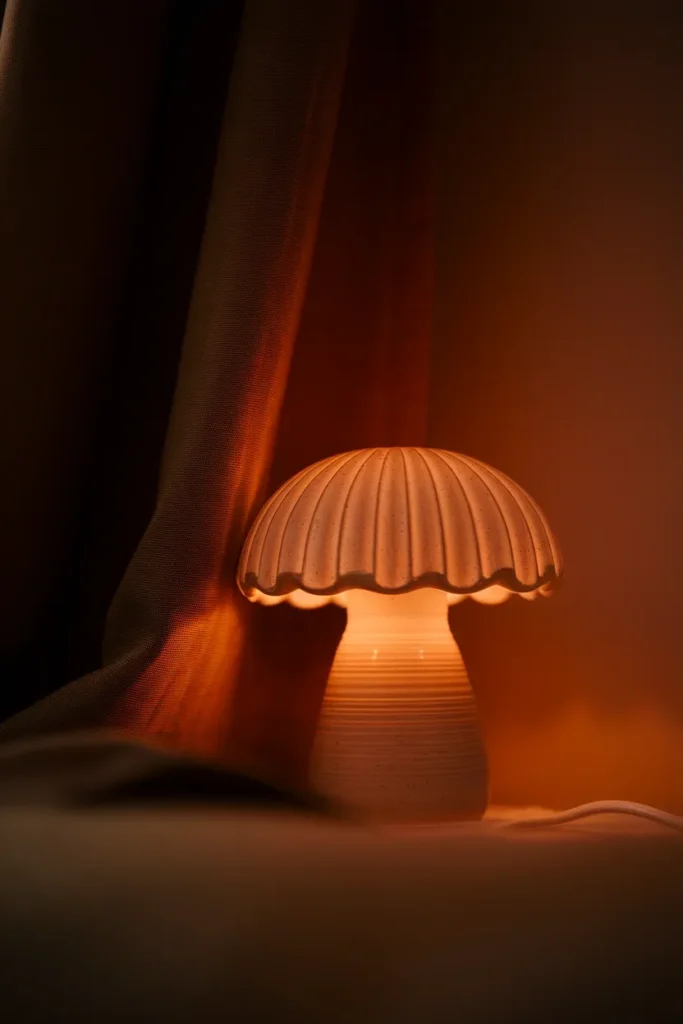
Whimsical rooms need warm light. Not “warm-ish.” Specifically 2700K to 3000K, which is what gets sold as soft white or warm white. The U.S. Department of Energy’s lighting color temperature guidance puts 2700K to 3600K as the recommended band for indoor general and task lighting, and notes that warm light is preferred in living spaces because it flatters skin and fabric. Anything above 4000K turns your sage green wallpaper gray and makes brass look like aluminum.
Brightness, using the ENERGY STAR watt-equivalent table:
| Old wattage | Lumens | Best used for |
|---|---|---|
| 40W | 450 lm | Accent lamp, shelf glow, ambient corner |
| 60W | 800 lm | General table lamp, bedside |
| 75W | 1,100 lm | Reading position, task light |
| 100W | 1,600 lm | Overhead only, and put it on a dimmer |
Three lamps at 450 to 800 lumens will always beat one ceiling fixture at 1,600. Layered low light is what makes a room feel like a room instead of a lobby.
One more thing that costs nothing: swap every bulb in the space to the same Kelvin. Mixed color temperatures are the single most common reason a carefully styled corner still photographs badly.
Pattern Mixing Without the Visual Noise
Every competing article says “mix and match patterns” and then stops, which is like being told to season to taste with no salt in the house.
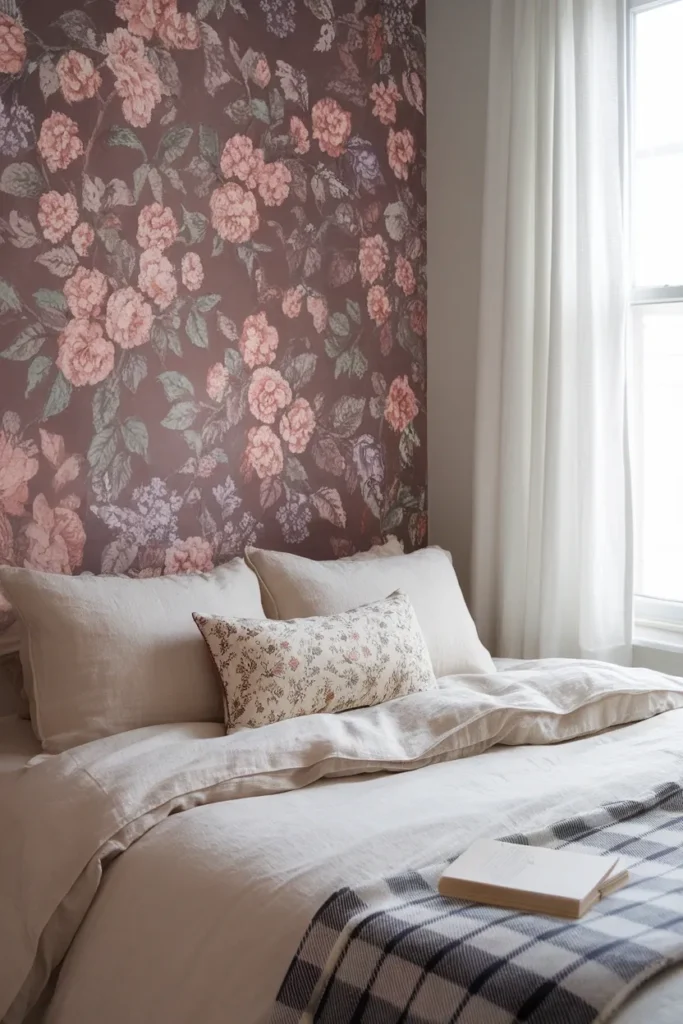
Here is the mechanic. Patterns fight when they are the same size. They cooperate when they are not. So pull one large-scale print, one medium, one small, and let each one own a different surface.
Scale in practice:
- Large is anything where a single motif is bigger than your palm. Wallpaper, a curtain print, a big botanical art piece.
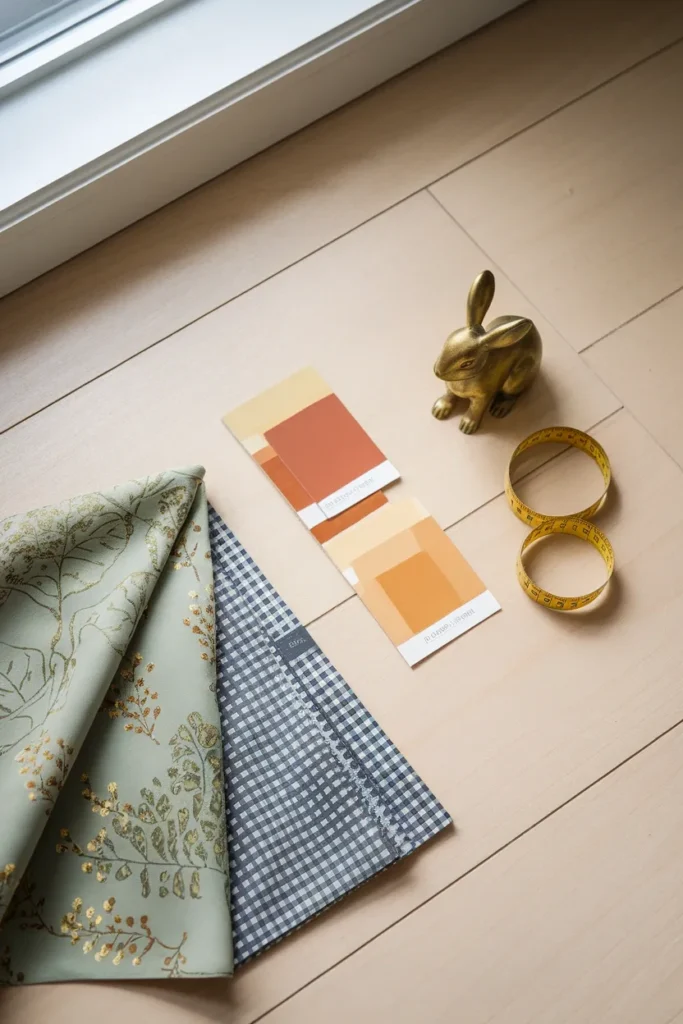
- Medium is a motif roughly the size of a coin to a palm. Gingham, buffalo check, a mid-size floral cushion.
- Small is anything you have to lean in to read. Ditsy florals, pinstripes, tiny sprigs.
Then bind them with color. If your wallpaper has a rust stem in it, your smallest pattern should carry that same rust. Two shared colors across all three patterns and the mix stops looking accidental.
Where people go wrong: matching sets. A curtain, cushion, and lampshade in the identical print reads as a hotel room, not a home. Whimsy needs a little friction.
Renter-Safe Whimsy That Leaves No Marks
This is the section the big sites skip entirely. All of it is reversible.
Peel-and-stick wallpaper, with a real warning. It works on smooth drywall painted in eggshell, satin, or semi-gloss. It does not reliably come off flat or matte paint, because the adhesive bonds to the paint film and pulls it away in sheets. Manufacturers say this outright: Tempaper lists flat and matte as not recommended, and Chasing Paper warns that matte finishes let the adhesive bond and pull. Cure times conflict by brand, so check yours. Tempaper wants 30 days after painting, Chasing Paper says four to six weeks. Budget roughly $35 to $55 per roll, which covers about 28 to 30 square feet.
Damage-free hanging. Command’s Large Picture Hanging Strips are rated so that four pairs hold 15 pounds, which covers most framed prints and small scalloped mirrors. The removal step is where deposits die. You pull the tab slowly straight down against the wall, not outward, and the strip stretches free without taking paint. 3M’s official Command strip removal instructions specify stretching at least 15 inches on the how-to page, though the 15 lb product page says 12 inches, so follow the number printed on your actual pack. Two rules from the same source that people ignore: wait seven days after painting, and never hang over a bed.
Tension rods instead of brackets. A tension rod across an alcove takes a cafe curtain, a sheer canopy, or a fabric panel that hides an ugly closet door. No drilling. Same trick works vertically in a shower corner or a window well.
Plug-in sconces. All the drama of hardwired wall lighting, none of the electrician. Expect $40 to $95 at a big-box retailer. Run the cord down behind furniture, or use adhesive cord clips and a fabric cord cover in a color that matches your wall. Mount between 60 and 72 inches from the floor, which is Kichler’s published guidance for general living-room sconce placement, then adjust down slightly if you are lighting a seated reading position.
Freestanding everything else. A ladder shelf leans, it does not anchor. A folding screen makes a corner without touching a wall. Stacked vintage suitcases are a side table that leaves no holes.
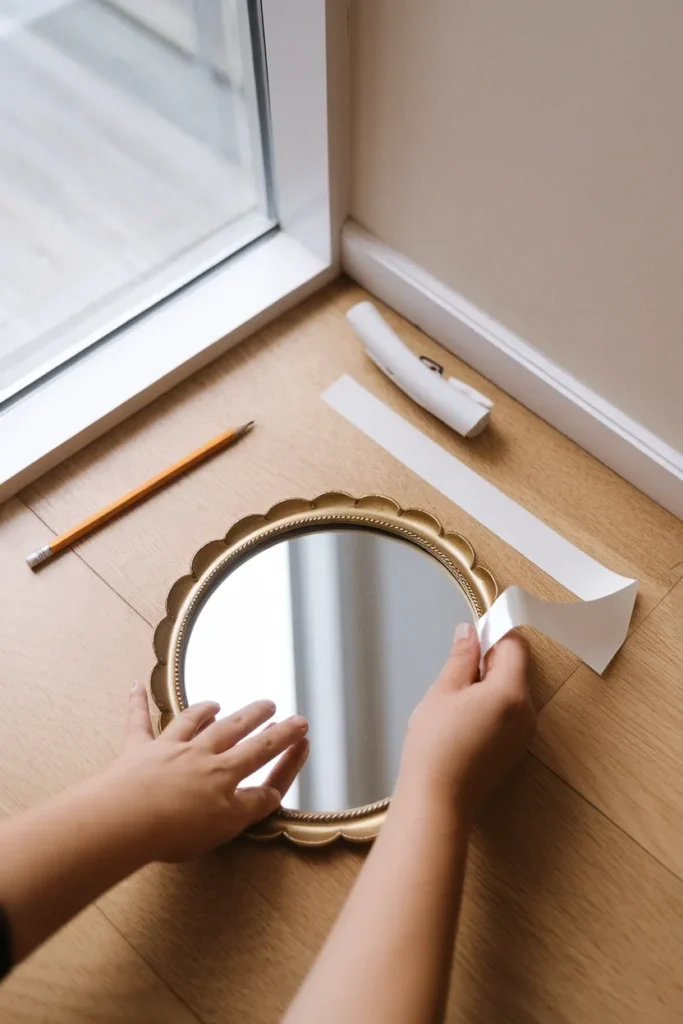
Build One Whimsical Reading Corner First
Do not try to whimsy an entire apartment at once. Pick the corner you already sit in and finish it completely, because one finished corner changes how the whole room feels and an unfinished room does not.
The anatomy is short. A chair you can actually sit in for an hour. A light at the right height. A surface for a mug. Something soft. One odd object.
Chair height matters more than chair looks. An IKEA POÄNG runs $149 to $249 depending on cushion, with a 16 1/2 inch seat height and a 19 5/8 inch seat depth, which suits most adults for a long sit. Floor cushions photograph beautifully and are a trap. Forty minutes in and your lower back will file a complaint.
Side table height follows the armrest rule: at or slightly below the arm of your chair, ideally within two inches. Most end tables land between 18 and 28 inches, and 24 is the common middle. Too tall and you knock the mug. Too short and you reach down like you are feeding a cat.
Then add sound and smell, because whimsy is not only visual. A wool throw that rustles. A beeswax candle that smells faintly of honey when the room warms. Rain on a window is free and beats any object you can buy. For a full set of storybook layouts, our storybook fairy tale reading corners breaks down twelve builds by room type.
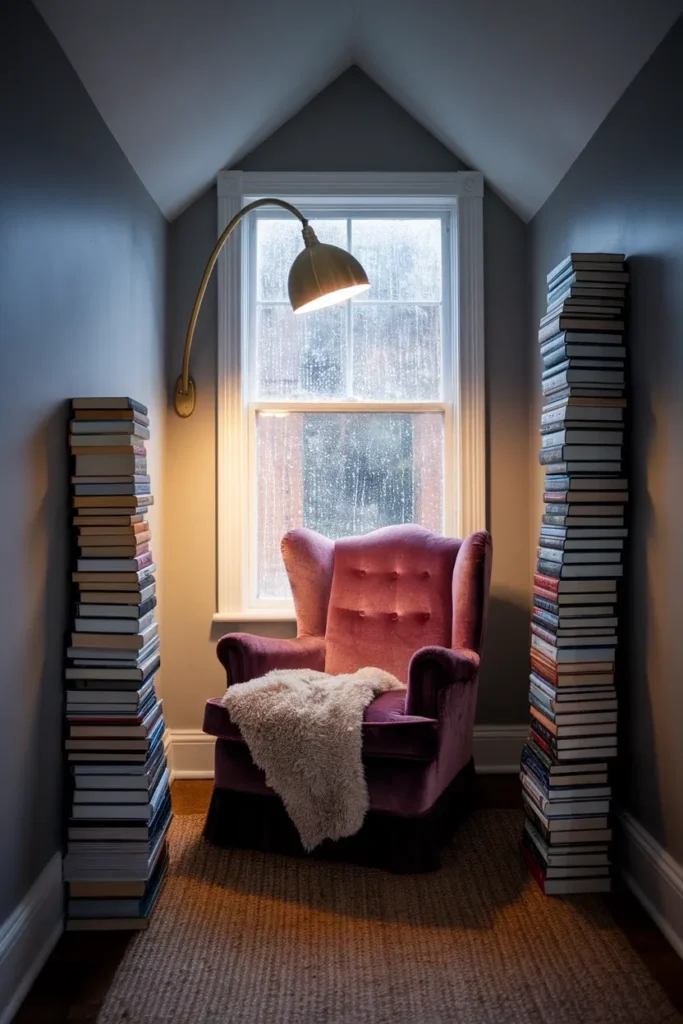
Three Shoppable Whimsical Archetypes
Pick one and commit. Mixing all three is how rooms get muddy.
Cottagecore Bloom
Sage and cream base, dusty rose accent. Large-scale botanical wallpaper on one wall, gingham cushion, ditsy floral lampshade. Brass hardware, jute rug, dried flowers in a chipped jug. Odd object: a scalloped mirror or a ceramic hen. This is the archetype that works best over a landlord-beige carpet, because sage and cream sit near beige rather than fighting it.
Dark Whimsy
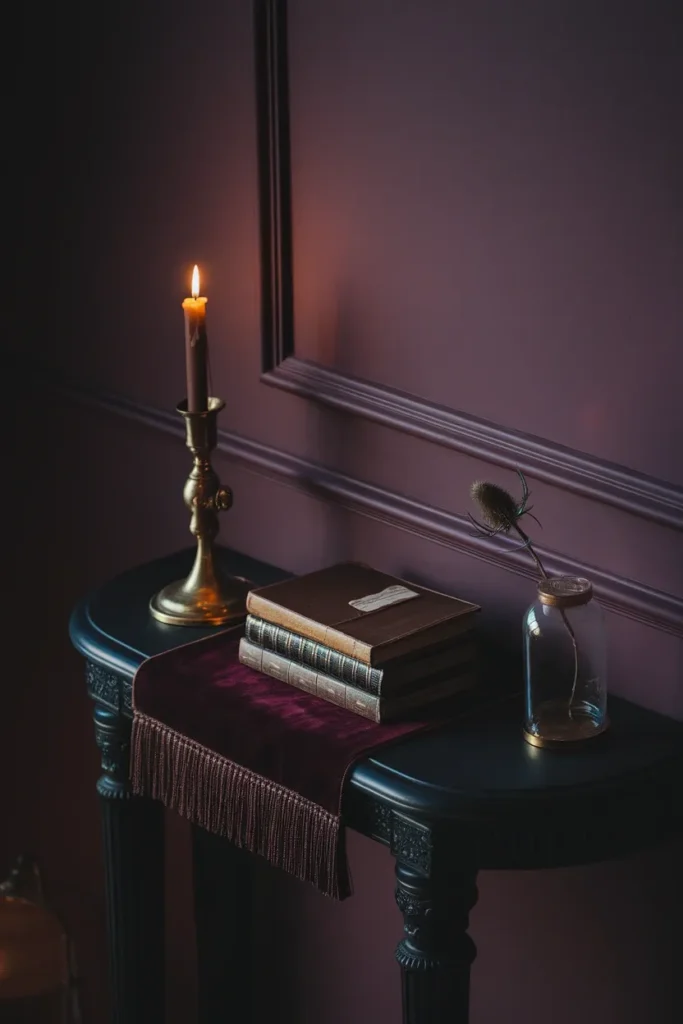
Plum, deep green, and aged gold. Works only if you can go dark on at least one wall, whether by paint or by peel-and-stick. Velvet, tasseled cushions, a moon-phase print, candle sconces. Odd object: a bell jar with something odd inside. Skip this one in a north-facing room under 500 square feet unless you are prepared to light it aggressively.
Fairycore Green
Moss, fern, and unbleached linen. Trailing plants doing most of the visual work, an arched mirror, gauzy layers, fairy lights on a warm setting rather than a blue-white one. Odd object: mushroom anything. Pothos is the workhorse here because Clemson’s extension service notes it prefers bright indirect light but tolerates low light, which describes most rental corners exactly. Worth knowing if you have pets: all parts of a pothos are mildly toxic if chewed.
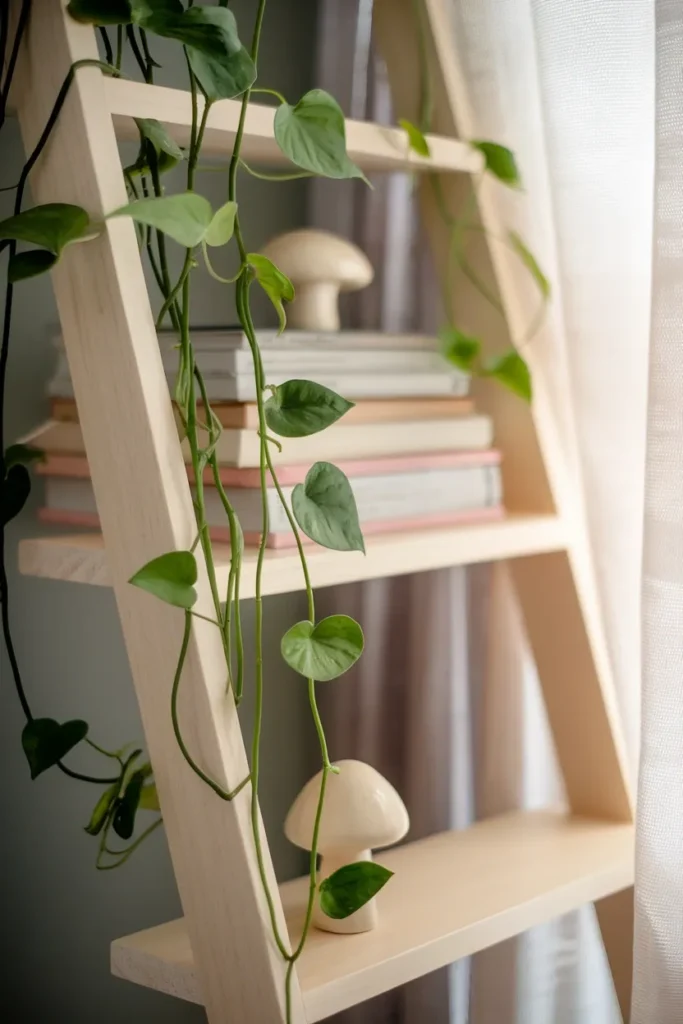
The $200 Whimsical Corner, Totaled Out
Not “affordable.” An actual list with actual August 2026 U.S. prices, verified at the retailer.
| Item | Real price band | Why it earns the spot |
|---|---|---|
| One roll peel-and-stick wallpaper (approx. 28 to 30 sq ft) | $35 to $55 | Covers the wall directly behind the chair, which is all the camera and your eye ever sees |
| Plug-in wall sconce | $40 to $95 | The single biggest upgrade per dollar, and no wiring |
| Thrifted side table | $10 to $52 | Fair-market value range published in the Salvation Army donation valuation guide |
| Thrifted lamp or odd object | $5 to $78 | Same source. Your one strange thing, per the 3-2-1 formula |
| Two warm 2700K bulbs | $8 to $16 | Fixes the light in the room in under five minutes |
Low end lands near $98. High end near $296. A realistic middle sits around $180 to $200 if you thrift the table and the odd object and buy the wallpaper and sconce new.
Two honest caveats. The Salvation Army figures are a donation valuation guide for tax purposes, not a survey of thrift shelf prices, so treat them as a fair-value reference rather than a promise of what you will pay. Retail prices move, and these were captured in August 2026.
The corner you skip in this budget is the rug, and that is deliberate. A washable 5×7 runs $50 to $160 and doubles your total. Add it in month two. For more no-damage builds at this price point, see our renter-friendly no-drill nook setups.
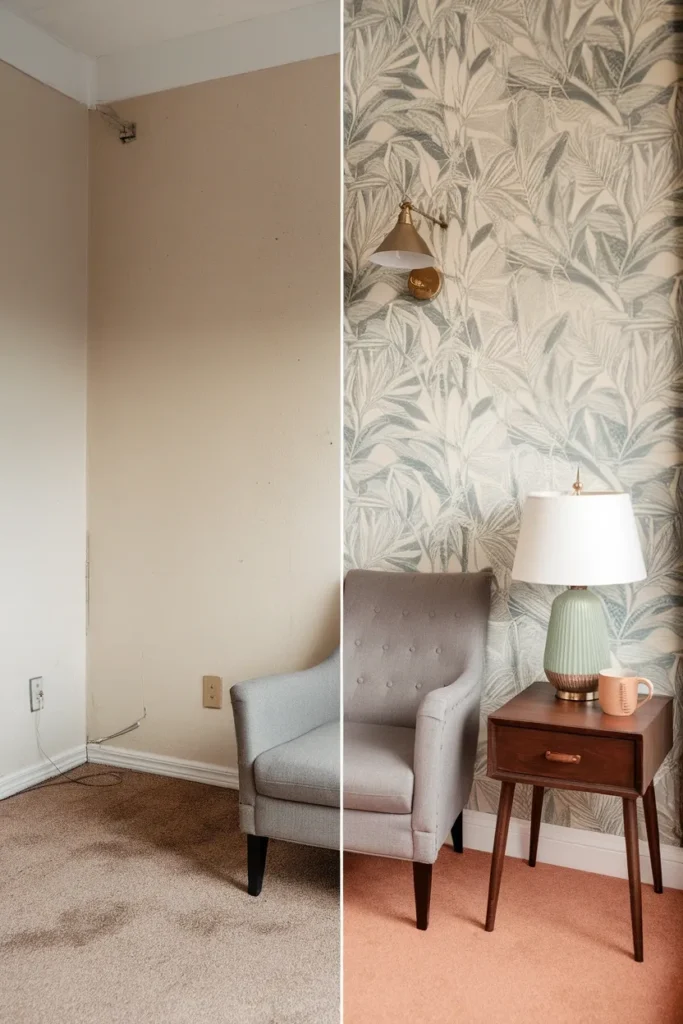
Five Ways Whimsical Decor Goes Wrong
None of the top-ranking articles will tell you this part, so here it is.
1. Everything is the same size. Three medium patterns, four medium objects, all at chest height. Vary scale or the room reads flat. Fix by adding one very large element and one very small one.
2. Cool bulbs under warm decor. You bought sage and brass and lit them at 5000K. The whole scheme goes gray. Fix costs about $8.
3. Whimsy with no calm. If every surface is doing something, nothing is doing anything. Leave at least one third of your visible surfaces empty.
4. Peel-and-stick on matte paint. The single most expensive mistake on this list. It comes off with the paint attached, and repainting a wall at move-out costs more than everything you saved. Check your paint sheen with a flashlight held at a low angle. Matte drinks light, satin bounces it.
5. Buying the theme instead of building it. A cart full of mushroom-shaped objects is a costume, not a room. One odd object per sightline. The rest should be ordinary furniture doing an ordinary job.
Is Whimsical Decor Still Worth Doing in 2026?
Short answer, yes, and the search data supports it more than the trend reports do.
Worth being precise here, because a lot of blogs are getting it wrong: Pinterest Predicts 2026, published December 9, 2025, does not contain a trend called whimsical, whimsy, cottagecore, or fairycore. What it does contain are close cousins. FunHaus covers circus-inspired decor with bold stripes and sculptural silhouettes. Mystic Outlands is described in Pinterest’s own language as whimsical and mystical, all enchanted forests and misty ruins. Vamp Romantic sits roughly where whimsigoth does.
So the honest framing is that whimsy is showing up in what people actually search rather than in the official trend taxonomy, which is usually the better signal anyway. Trade press reporting in March 2026 put “whimsy room” up sharply over a quarter, though neither outlet tied the figure to a named Pinterest report, so hold that loosely.
The colors currently pushing hardest, per 2026 palette reporting, are Plum Noir, Jade, Persimmon, Wasabi, and Cool Blue. Plum Noir and Jade slot straight into dark whimsy and fairycore respectively.

Frequently Asked Questions
What defines whimsical home decor? One deliberate, playful departure from what a room is expected to look like, held inside an otherwise calm frame. A scalloped edge, an unexpected animal, a color where a neutral belongs. The departure has to be intentional and singular. Four departures at once stops being whimsy and starts being clutter.
Can I mix whimsy with minimalism? Yes, and it is arguably the easiest version to pull off. Keep your furniture, walls, and floor plain, then place exactly one strange object per sightline. Minimalism gives the odd object the empty space it needs to land. This is often called modern whimsy.
Are there budget-friendly whimsical ideas? The cheapest high-impact changes, in order: swap every bulb to 2700K (around $8 to $16), add one thrifted odd object ($5 to $78 fair-value range), and put a single roll of peel-and-stick wallpaper on the one wall you look at most ($35 to $55). Those three under $150 shift a room more than a new sofa would.
How do I avoid a chaotic feel? Use the 3-2-1 Whimsy Formula: three patterns at three different scales, two colors that each repeat at least three times, one strange object per sightline. Then leave a third of your visible surfaces genuinely empty. Chaos is almost always a repetition problem, not a quantity problem.
Is whimsical decor suitable for every room? Bathrooms and entryways are the best places to start because they are small, low-risk, and people notice them. Kitchens take whimsy well on open shelving and hardware. The room to be careful in is a home office, where a busy pattern in your peripheral vision genuinely does compete with focus.
What’s the difference between whimsical decor and cottagecore? Whimsical is the broader instinct, which is playfulness and surprise. Cottagecore is one specific dialect of it: rural, floral, nostalgic, handmade. All cottagecore rooms are whimsical to some degree. Plenty of whimsical rooms are not remotely cottagecore, including whimsigoth and modern whimsy.
What’s the biggest mistake when designing with whimsy? Buying the theme instead of building the room. A cart full of mushroom objects reads as a costume. The strongest whimsical rooms are 90% ordinary furniture doing an ordinary job, with 10% doing something unexpected.
Start With the Bulb, Then the Wall
If you take one thing from this page, take the light. Warm 2700K bulbs across the whole room, three low lamps instead of one bright ceiling fixture, and half of the whimsical decor problem solves itself before you buy a single object.
Then pick your one corner. Wallpaper the wall behind it, hang one thing with removable strips, put one strange object where a strange object should not be, and stop there.
Next up, if you want to build the corner properly rather than just style it, our reading nook lighting guide covers sconce placement, cord management, and what to do when there is no outlet within reach.
Keep reading
More cozy nook ideas
 Boho
Read →
Boho
Read →
Boho Bathroom Checklist: Everything to Decide Before You Start
No gut job, no new tile, no landlord permission slip. A boho bathroom mostly comes down to eight decisions made in the…
 Cozy Home
Read →
Cozy Home
Read →
25 Cozy Bedding Ideas for a Cozier Home
If your bed right now is one flat comforter, two pillows that fold in half, and a throw that ends up on…
 Farmhouse & Country
Read →
Farmhouse & Country
Read →
Modern Farmhouse Bedroom Checklist: Everything to Decide Before You Start
Ten decisions, made in the right order, and a modern farmhouse bedroom stops being a pile of saved pins and starts being…