
Cottagecore Aesthetic Room Ideas for a Dreamy Space You’ll Actually Live In

No cottage. No garden. No landlord who says yes to paint. A cottagecore aesthetic room needs five decisions, one weekend, and roughly $200 if you buy in the right order.
If you’re working with 700 square feet, one awkward corner, and a lease that says “no adhesive” twice, this is written for you.
Here’s the part most guides skip: the order matters more than the budget. Almost everyone starts with the wallpaper. Wallpaper is the fourth thing, not the first, and starting there is why so many rooms end up looking like a craft store exploded near a bed.
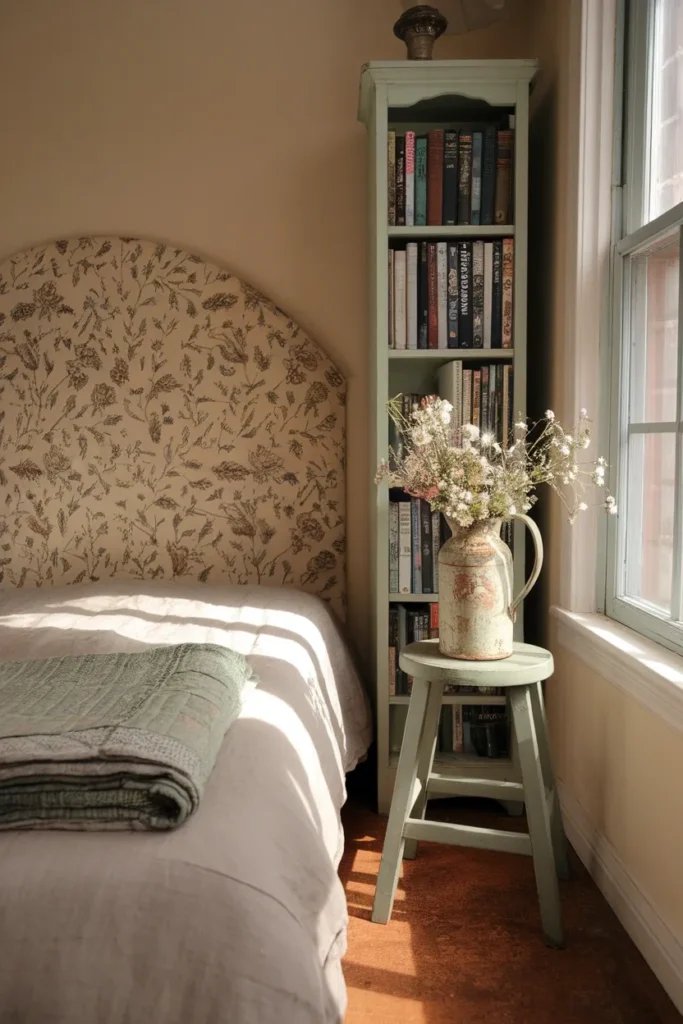
The Five Rules of a Cottagecore Aesthetic Room
This is the whole build, in order. Everything after this section is the detail work.
- Set the palette first. Three warm neutrals, two textures, one faded color. Nothing saturated. Paint and wallpaper decisions get easy once this is locked.
- Layer texture before you add another floral. A room reads cottagecore because of nubby linen, waffle cotton, and worn wood, not because of pattern count.
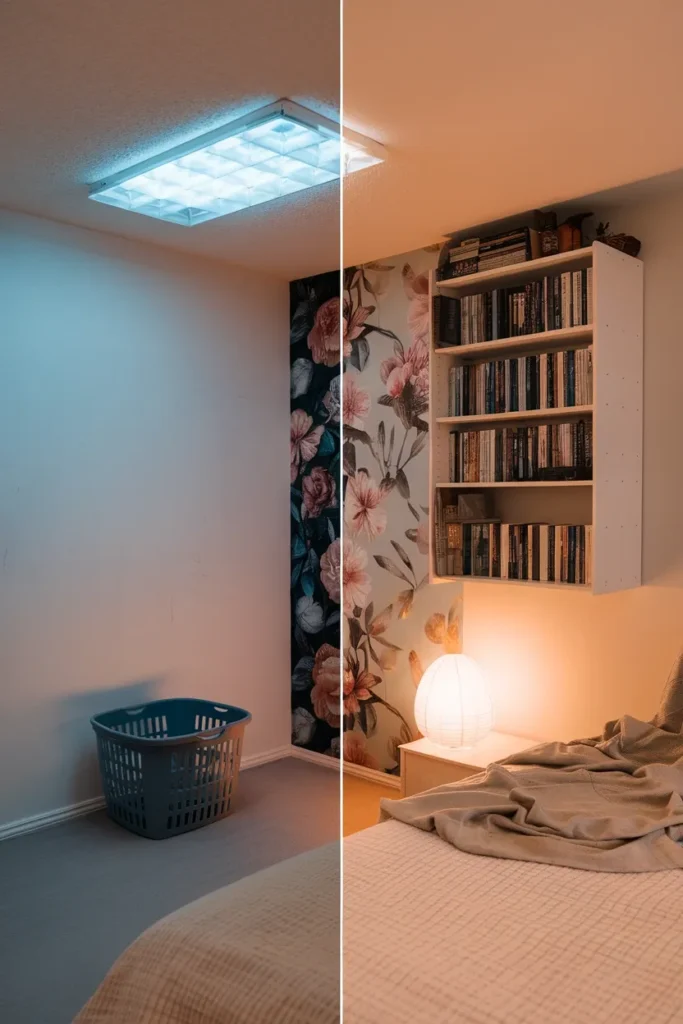
- Light it at 2700K, from two sources, never from the ceiling. This single swap does more visible work than any purchase on this list.
- Add one living thing and one dried thing. Fresh stems for the week, dried stems for the season. Two plants, not twelve.
- Give the room one job. A cottagecore room that isn’t used for something specific turns into a photo set you tiptoe through.
Do them in that order and each step makes the next one cheaper. Do them backward and you’ll buy a $34 wallpaper roll that fights a bedspread you already own.
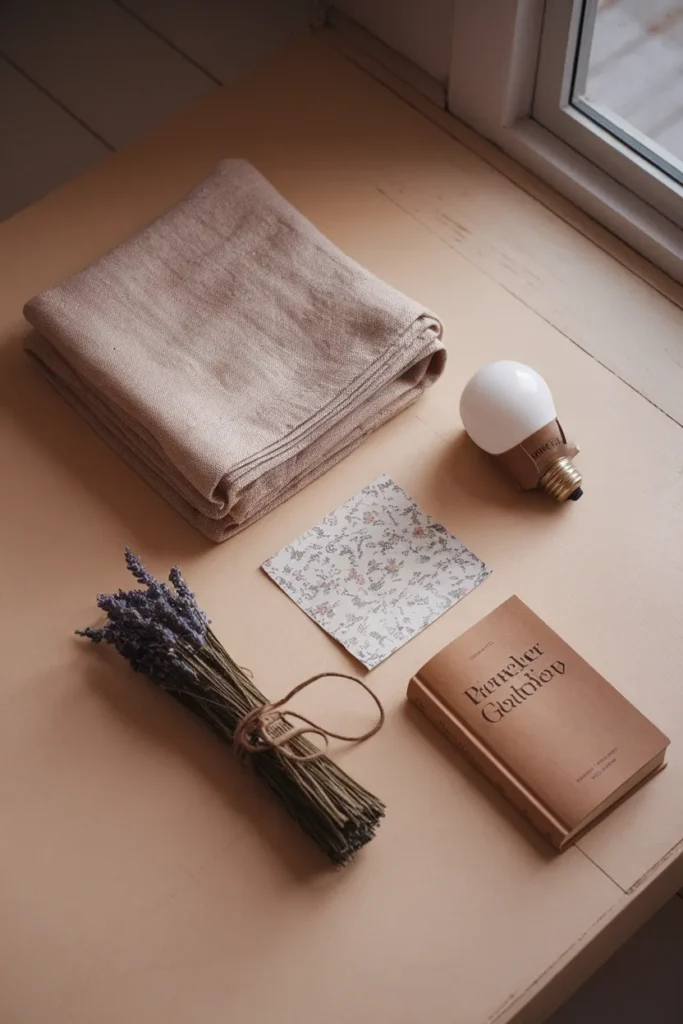
What Cottagecore Actually Means for a Room, Not a Mood Board
Cottagecore reads as rural nostalgia: hand-done things, growing things, and objects that look like they’ve been kept rather than bought. In a real room that translates to three signals. Soft light. Natural fiber you can feel from across the room. Evidence of a person, usually in the form of something slightly worn.
It is not shabby chic, which leans distressed white and sells you the furniture. It is not farmhouse, which leans black and white and shiplap. Cottagecore is warmer and messier than both, and it forgives a lot.
Worth knowing before you commit: Pinterest’s own Spring 2026 trend report shows searches for “dark cottagecore kitchen” up 915% and “grandma core kitchen” up 545% year over year, while “my room, my rules” climbed 415%. Read together, those numbers say the aesthetic is moving toward moodier, more personal, more specific rooms. The pale-cream-everything version peaked. Yours can have olive walls and a brass lamp and still be firmly cottagecore.
Rule 1: Three Warm Neutrals, One Faded Color, Nothing Saturated
Here’s the named version, because it’s easier to remember at the paint counter.
The 3-2-1 Cottagecore Palette: three warm neutrals (cream, oat, honey-toned wood), two textures (one smooth, one nubby), one faded color used three times in the room.
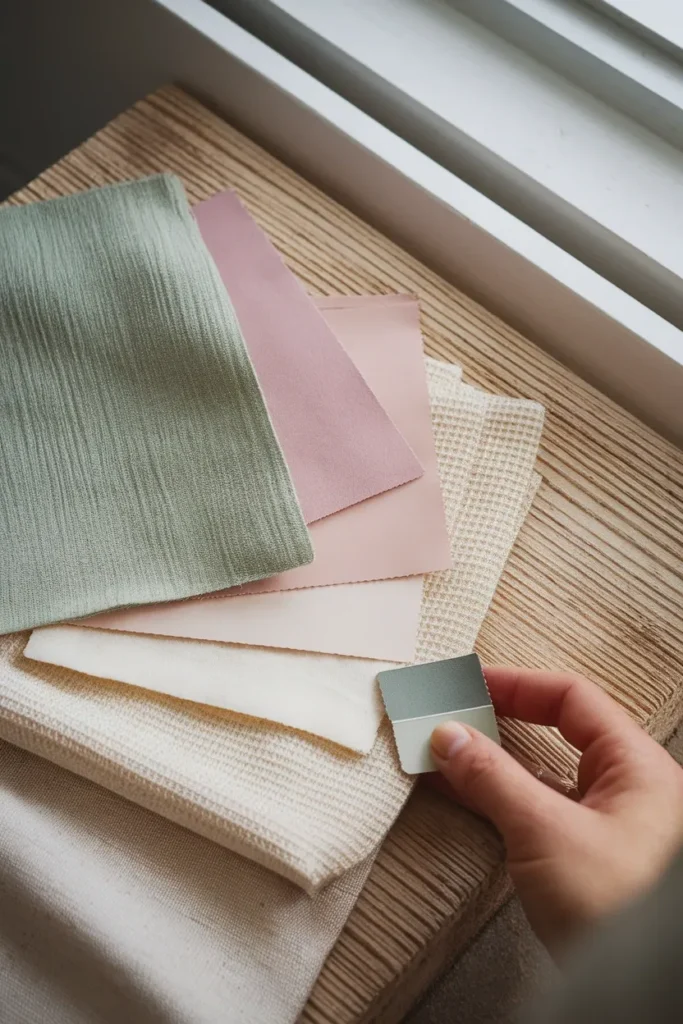
The faded color is where personality lives. Sun-bleached sage. Dusty rose. Butter yellow. Faded denim blue. Pick one, then repeat it exactly three times: a pillow, a jug, a book spine facing out. Three appearances reads intentional. Two reads accidental. Eight reads like a gift shop.
Skip anything that looks freshly mixed. Cottagecore colors should look like they’ve been in a window for six summers. If a swatch feels bright, hold it next to raw pine. Warm wood is the honest test, and most saturated colors fail it immediately.
Small room, low light? Push the neutrals lighter and put the faded color on the textiles instead of the walls. You get the palette without shrinking the space.
Rule 2: Layer Texture Before You Add Another Floral
Pattern is the loud part of cottagecore, so it gets all the attention. Texture is what actually sells it.
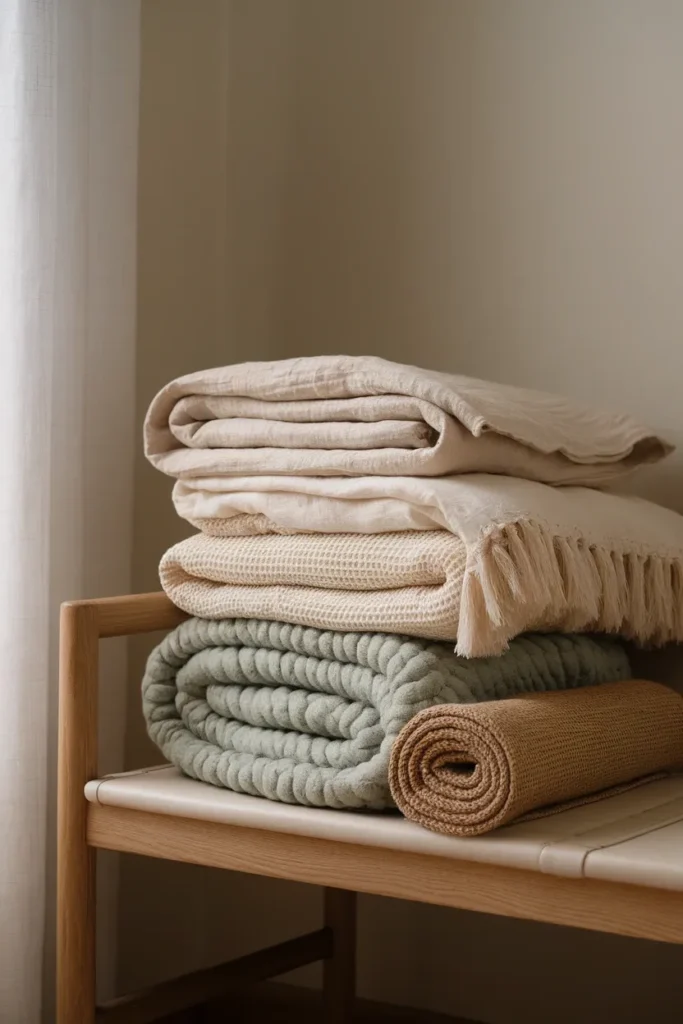
Aim for four fibers you could identify blindfolded. A washed linen duvet with visible slubs. A waffle-weave cotton blanket. One wool or boucle throw with real weight to it. A jute or seagrass rug that’s slightly scratchy underfoot. That mix looks collected even when every single item is new.
Then, and only then, add florals. One large-scale floral, one small ditsy print, one solid, one stripe or gingham. That’s the whole formula, and it keeps working no matter how small the room is.
The failure here is subtle. Two florals at the same scale will fight each other quietly, and you’ll never quite figure out why the bed looks wrong. Change the scale, not the color.
Sound matters more than people expect, too. A jute rug and a heavy curtain absorb echo, and a room that isn’t echoing feels older and more sheltered. That’s most of what “hygge” actually is: soft surfaces eating hard noise.
Rule 3: Light It at 2700K, From Two Sources, Never From the Ceiling
If you only do one thing on this page, do this one. A warm bulb costs about four dollars and changes a room more than a hundred dollars of decor.
Two specs matter. Color temperature, measured in Kelvin, controls how yellow or blue the light reads. You want 2700K, which is the warm candle-adjacent end of the scale. Brightness is separate, and it’s measured in lumens rather than watts, a distinction the ENERGY STAR brightness and lumens guide lays out with a conversion chart: an old 60-watt incandescent equals roughly 800 lumens, a 40-watt equals about 450.
Which gives you a shopping cheat sheet.
| Fixture in the room | Color temp to buy | Brightness to look for |
|---|---|---|
| Reading lamp beside the chair or bed | 2700K | 800 lumens (old 60W equivalent) |
| Wall sconce for ambient glow | 2700K | 450 lumens (old 40W equivalent) |
| Overhead, if you truly must use it | 2700K on a dimmer | 1,100 lumens max (old 75W equivalent) |
| Fairy lights and accent strings | 2700K or warmer | Decorative only, don’t count them |
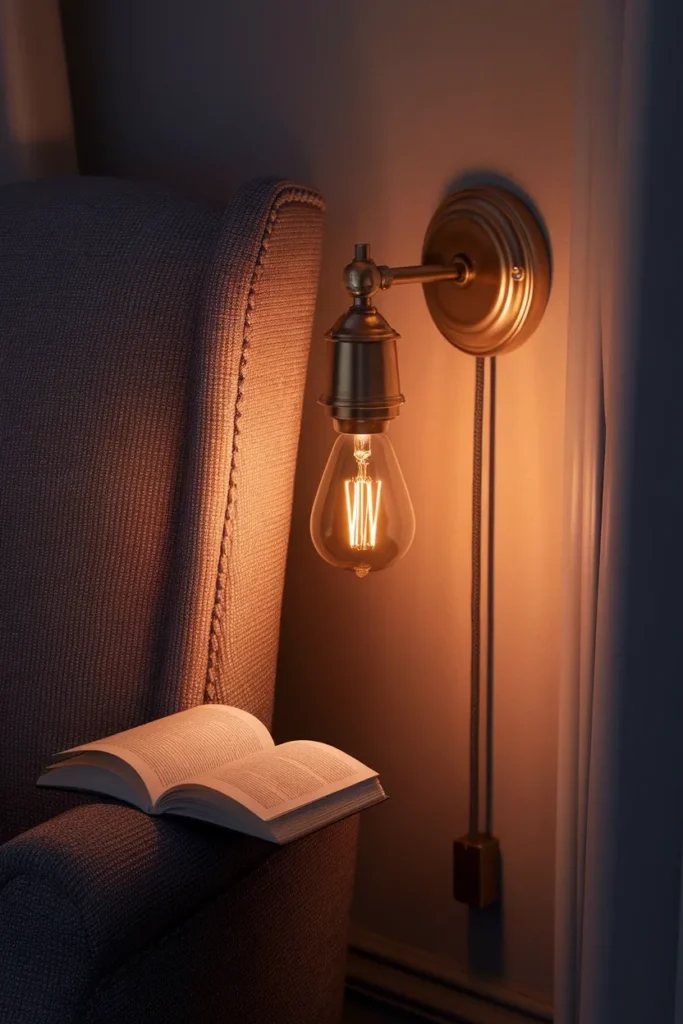
The Two-Lamp Minimum: any cottagecore room needs at least two light sources at or below eye level, and zero at ceiling level. One lamp makes a spotlight. Two lamps make a room.
Ceiling fixtures flatten texture, and texture is the entire point of rule 2. Kill the overhead, put a lamp low on one side and a plug-in sconce or picture light on the other, and the room gains depth instantly. Renters, take note: plug-in sconces exist specifically so you never have to touch a junction box.
Rule 4: One Living Thing, One Dried Thing
Two plants beat twelve, because two plants stay alive.
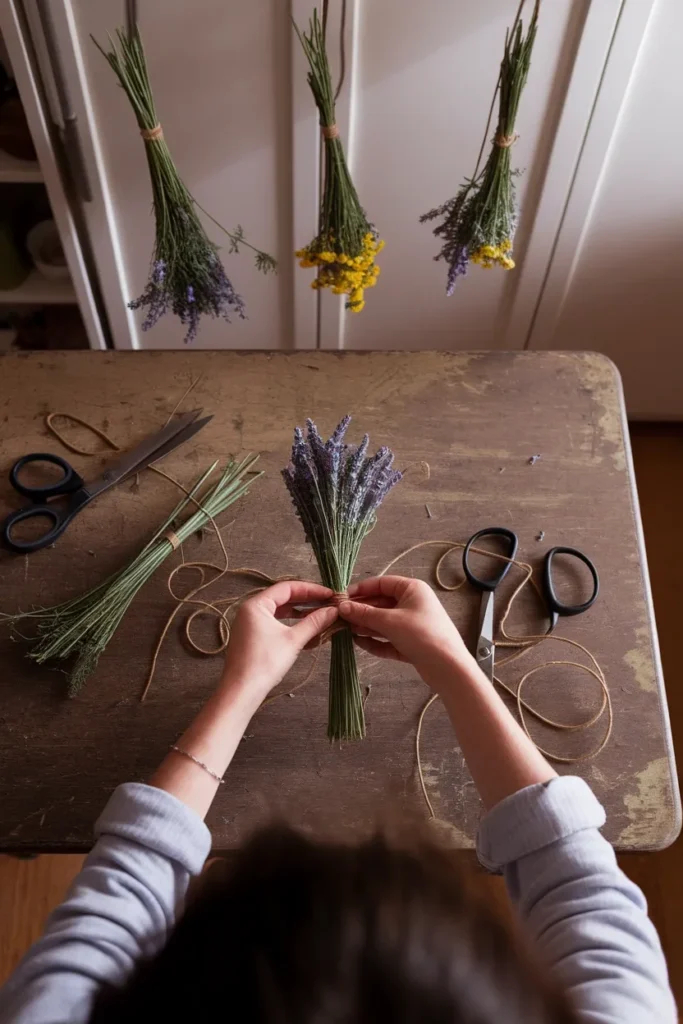
Pick one living stem situation you can actually maintain: a pothos on a shelf, a rosemary pot on the windowsill, or just grocery-store eucalyptus in a jug, swapped every couple of weeks. Then pick one dried arrangement that carries the room through the season without any attention at all.
Drying your own is the cheapest upgrade in cottagecore, and it takes almost no skill. According to a Illinois Extension flower drying guide, you hang bunches upside down in a warm, dry, dark spot with good air circulation, and the process runs two to three weeks. The same guide notes that blue and yellow flowers hold their color best through air-drying, while pinks tend to fade. That’s genuinely useful information if you were about to hang a bunch of pink peonies and expect them to stay pink.
A closet rod works fine as a drying rack. So does the back of a door.
One honest warning, since nobody else mentions it: dried arrangements collect dust and they collect it fast. Plan on a hairdryer on the cool setting, held about 12 inches away, roughly once a month. Skip that and your romantic lavender bundle becomes a gray fuzzy object by winter.
Rule 5: Give the Room One Job It Does Better Than Anywhere Else
A cottagecore room with no function becomes a room you photograph and then leave. Pick the job before you finish styling.
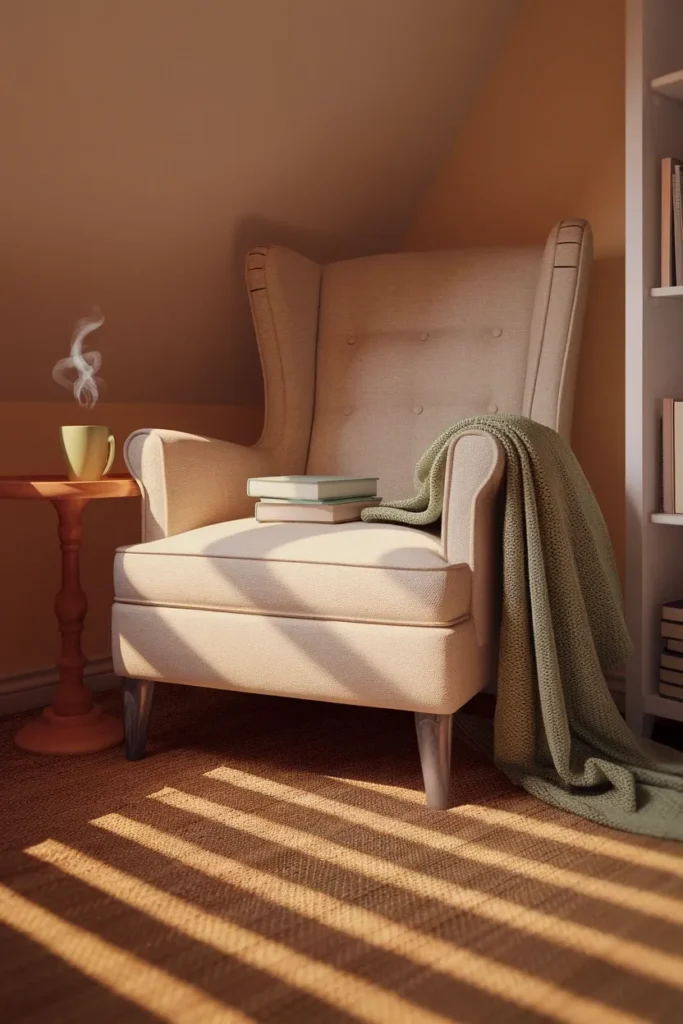
For most people the honest answer is reading, and Pinterest agrees: their Spring 2026 report clocked “reading nook ideas” up 245% and “comfy reading chair small spaces” up 455%. That second number is the useful one. People aren’t searching for grand libraries, they’re searching for one good chair in a tight space.
So build for the body, not the camera. A chair with real back support, a surface within arm’s reach for a mug, and light coming from behind your shoulder rather than over the page. Our full walkthrough of a renter-friendly floral reading corner goes through the seating and pattern-mixing decisions in more detail if that corner is your priority.
The reach rule is worth internalizing: keep the side table surface within about 18 inches of where your hand rests, and no more than 2 inches above the seat cushion height. Farther than that and you’ll set your tea on the floor. Every time.
Floor cushions deserve a fair warning too. They photograph beautifully and they cost almost nothing. Sit on one for 40 minutes and your lower back will file a complaint. Use them as secondary seating, not as the main event.
The Renter’s Version: Zero Drill Holes, Zero Deposit Risk
Almost every cottagecore guide waves at renting in a single sentence and moves on. Here are the actual numbers you need.
Adhesive load limits. 3M’s Command picture hanging strips are sold in three ratings that matter for this: 10 lb medium, 15 lb large, and 20 lb extra-large. Weigh the frame before you trust it, because these ratings assume a clean, dry, painted surface at room temperature. Textured or freshly painted walls hold considerably less, and paint needs a full week of cure time before anything sticks to it.
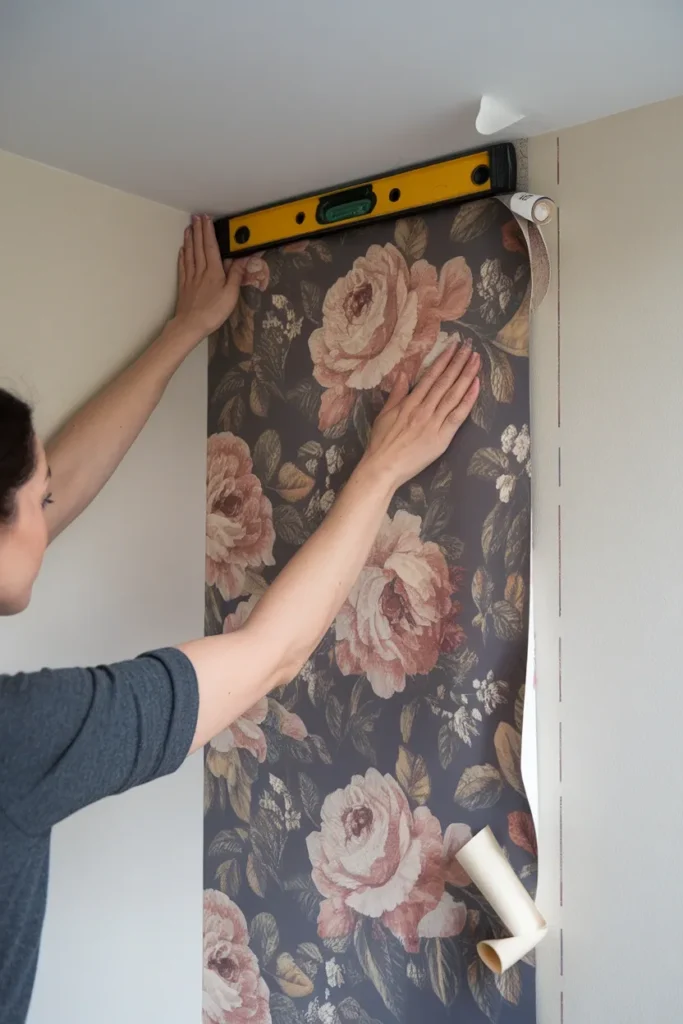
Wallpaper math. A standard peel-and-stick roll covers about 30 sq ft. As a real reference point, Home Depot’s SURFACE STYLE floral peel-and-stick roll runs $33.83 and covers 30.75 sq ft at 20.5 inches wide by 18 feet long, which is roughly one strip 4 feet wide by 7.5 feet tall. One roll does a headboard-width accent panel. It does not do a full wall, so measure before you buy one and hope.
The plumb line rule. Accent walls rarely fail because of the pattern. They fail because the first panel went up without a plumb line, and every panel after inherits the lean. Spend the three minutes with a level.
Curtains without holes. A tension rod inside a window casing carries sheer or cafe curtains fine. Save the drilled brackets for blackout panels, which are heavy enough to pull a tension rod down at 2 a.m.
Removal order. Take wallpaper down warm and slow, pulling at a low angle back against itself rather than straight out from the wall. Pull adhesive strip tabs straight down, never toward you. Our guide to no-damage rental decor ideas covers the reversible swaps in more depth, including the ones that quietly cost people their deposits.
The $198 Starter Build, With Real Prices and a Real Order
Prices below were checked in August 2026 at US retailers. They’ll drift, so treat them as a band rather than a quote.
| Buy in this order | Real example | Price |
|---|---|---|
| 1. Bulbs | Two 2700K LED bulbs, 800 lumens each | about $8 |
| 2. Soft layer | Thrifted quilt plus a secondhand linen-blend throw | about $25 |
| 3. Dried bundle and vessel | Farmers market lavender or eucalyptus, thrifted jug | about $12 |
| 4. Shelf | IKEA BILLY bookcase, 31 1/2″ W x 11″ D x 79 1/2″ H | $79 |
| 5. Light fixture | Plug-in swing-arm sconce, no wiring | about $40 |
| 6. Accent panel | One floral peel-and-stick roll, 30.75 sq ft | $34 |
| Total | about $198 |
That total assumes you already own something to sit on, which most people do. Adding a new armchair changes the math: an IKEA POÄNG runs $149 and measures 26 3/4 inches wide by 32 1/4 inches deep, bringing the build to roughly $347. Still inside a normal $80 to $400 range for a corner, just not a $200 one.
Note the order. Bulbs first, because they’re four dollars and they change your read on every color decision that follows. Wallpaper last, because by then you know exactly what it has to coexist with.
Under $60 total and no thrift store nearby? Do items 1, 2, and 3 only. Warm light, one real textile, one dried bundle. That’s a legitimately transformed corner for the price of a takeout dinner.
The Evening Layer: What the Room Should Look Like After 8 p.m.
Most cottagecore rooms are designed in daylight and then fall apart at night, which is exactly when you’re most likely to be in them.
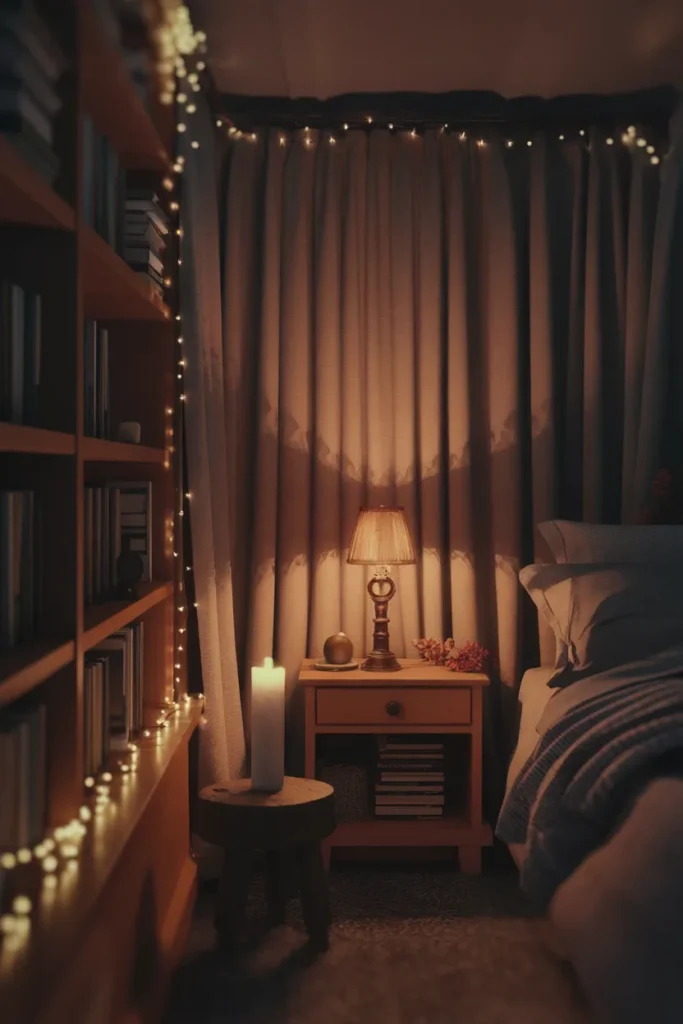
Three things fix the evening version. A dimmer, either an in-line cord dimmer or a smart bulb, so the same lamp does homework and does winding-down. One flame or faux-flame source at a lower height than every other light in the room. And one closed curtain, because a black window at night reads as a hole, while a drawn curtain reads as a wall.
Scent belongs to this layer too. Beeswax has a faint honey smell that suits the aesthetic far better than anything labeled “fresh linen,” and dried lavender releases more when you crush a bud between your fingers on the way past. Small thing. It’s the kind of detail that makes a room feel yours rather than assembled.
If overhead lighting is your main problem, warm lighting ideas for small homes walks through the bulb swaps and layering order room by room.
What Goes Wrong in Real Cottagecore Rooms, and How to Fix It
Aspirational guides skip this part. It’s the most useful section on the page.
Pattern collision. Two florals at the same scale reads as noise. Fix: keep one large-scale floral and one ditsy print, never two mediums.
Dust accumulation. Dried stems, lace, and open shelving are all dust magnets. Fix: cool hairdryer at about 12 inches, once a month, and keep dried arrangements away from radiators and vents where airflow drives grit into them.
Dim-but-unusable lighting. Warm and dim are not the same setting. Fix: 2700K for warmth, 800 lumens where you actually read. Warmth is the Kelvin number, not the dimmer position.
Clutter creep. Cottagecore rewards collecting, and collecting has no natural stopping point. Fix: one surface in the room stays completely empty. Not sparse, empty. It gives your eye somewhere to rest and it exposes creep immediately.
Fake-vintage flatness. A room of new items styled to look old reads slightly off, and it’s hard to name why. Fix: three genuinely old things, minimum. A real secondhand book with someone else’s name inside it does more work than ten distressed reproductions.
Fire and safety, briefly. Open flame near dried botanicals, lace, and sheer curtains is a real hazard, not a fussy caveat. Keep candles at least 12 inches from anything that can catch, never leave one burning in an empty room, and use LED pillars if you have pets, kids, or a habit of falling asleep mid-chapter. If you’re unsure about your setup, your local fire department will usually answer questions about candle and outlet safety at no cost.
A Cottagecore Corner for Kids and Tweens
The formula shifts in three ways for a child’s room.
Everything switches to washable. A washable flat-weave rug instead of jute, cotton instead of boucle, and a duvet cover that survives a real washing machine on warm.
Lighting drops to battery-operated and LED only. No open flame, no cords running across a floor, and a clip-on reading light rather than a lamp that can be pulled off a nightstand.
Scale comes down. A canopy hung from a single ceiling hook over a floor mattress reads magical at four feet tall and slightly claustrophobic at five and a half. Measure from their eye level, not yours, and hang the canopy so the lowest drape clears their head with a few inches to spare.
Tweens want the same thing adults want out of “my room, my rules”: authorship. Let them pick the faded color from rule 1. The other five decisions can stay yours.
Cottagecore Aesthetic Room FAQ
What is a cottagecore room? A room styled around rural nostalgia, hand-made objects, and growing things. In practice it means warm soft light, natural fibers you can feel, floral and gingham pattern in mixed scales, worn wood, and at least a few genuinely old pieces. Warmer and less polished than farmhouse, less white and distressed than shabby chic.
What should be in a cottagecore room? Six things cover it: a warm palette of three neutrals plus one faded color, four distinct fabric textures, two light sources at 2700K below eye level, one living plant and one dried arrangement, one floral pattern moment, and three secondhand objects with actual history.
How do I make my room cottagecore? In this order: swap every bulb to 2700K, add one real textile in linen or waffle cotton, put one dried bundle in a thrifted vessel, add a shelf for books, add a low light source, and only then add a floral accent panel. Lighting first is the least intuitive step and the one that changes the most.
Can I do cottagecore in a small or rented space? Yes, and small rooms often do it better because the aesthetic depends on enclosure. Stick to plug-in sconces, tension rods inside window casings, and adhesive strips rated for the weight you’re actually hanging. Nothing on the core list requires drilling, painting, or a landlord conversation.
Is cottagecore decor expensive? It’s one of the cheaper aesthetics to execute well, because secondhand and slightly worn is the goal rather than a compromise. A totaled starter build came to about $198 at US prices in August 2026, and a meaningful version of it runs about $45 if you already own a chair and a shelf.
What colors work best for cottagecore? Warm neutrals as the base (cream, oat, honey-toned wood), then one faded accent repeated three times. Sun-bleached sage, dusty rose, butter yellow, and faded denim blue all hold up. Test any swatch against raw pine, and if it looks bright next to the wood, it’s too saturated.
Is cottagecore still popular in 2026? By Pinterest’s own numbers, yes, and it’s shifting rather than fading. Their Spring 2026 trend report shows “dark cottagecore kitchen” up 915% and “grandma core kitchen” up 545% year over year. The movement is toward moodier, more personal versions rather than the pale cream look that dominated earlier.
Start With the Bulbs
Pick your faded color, order two 2700K bulbs, and do rule 3 tonight. It takes about four minutes and you’ll see the difference before the wallpaper ever arrives.
Once the light is right, the corner is the fun part. If reading is the job you picked for the room, the floral reading corner walkthrough linked above is the natural next step, and it takes the seating and pattern decisions further than we could here.
Keep reading
More cozy nook ideas
 Boho
Read →
Boho
Read →
Boho Bathroom Checklist: Everything to Decide Before You Start
No gut job, no new tile, no landlord permission slip. A boho bathroom mostly comes down to eight decisions made in the…
 Cozy Home
Read →
Cozy Home
Read →
25 Cozy Bedding Ideas for a Cozier Home
If your bed right now is one flat comforter, two pillows that fold in half, and a throw that ends up on…
 Farmhouse & Country
Read →
Farmhouse & Country
Read →
Modern Farmhouse Bedroom Checklist: Everything to Decide Before You Start
Ten decisions, made in the right order, and a modern farmhouse bedroom stops being a pile of saved pins and starts being…