
Cozy Fall Home Decor: What to Change in Every Room (and What to Skip)

Three surfaces per room. That is the entire system.
Cozy fall home decor gets sold as a whole-house overhaul, and if you rent 700 square feet with one awkward corner, that advice is useless to you. No mantel. Probably no porch. You have a couch, a lamp, and a landlord who counts nail holes.
Here is what actually changes a room in October: the seat, the light, and one surface at eye level. Everything below is organized that way, room by room, with real sizes, honest failure modes, and a teardown plan for the day you are done.
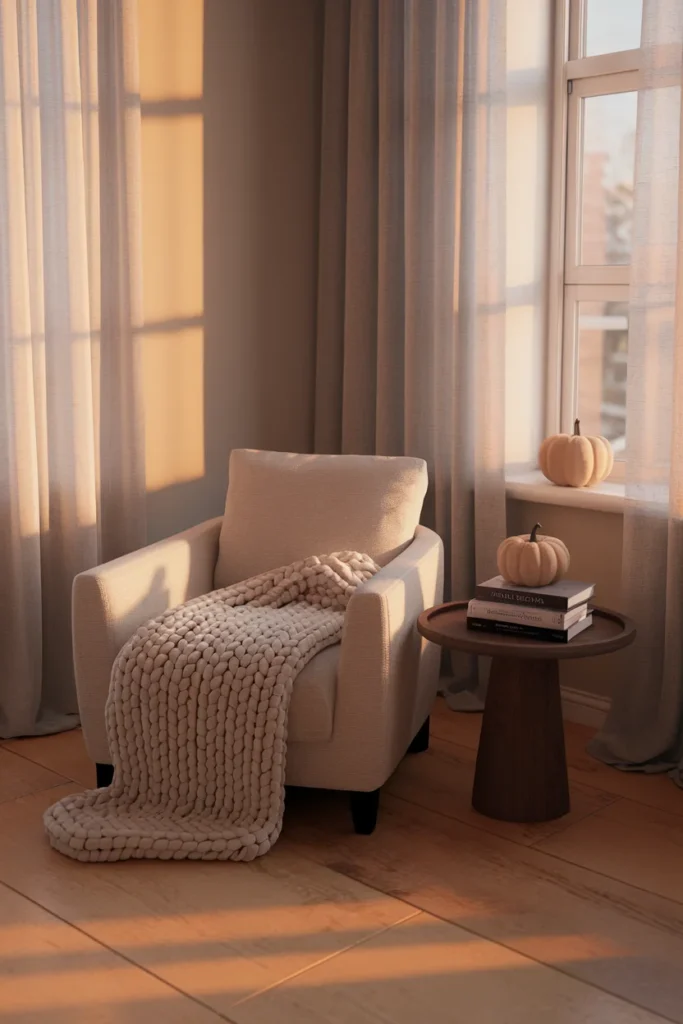
The Three-Surface Rule: Start Here, Not at the Store
Pick any room. You only need to change three things for it to read as autumn:
- The seat. Whatever you sit on gets one new soft layer. A throw, a sheepskin, a lumbar pillow. One.
- The light. Swap the bulb before you buy a lamp. It is the single biggest change you can make to a room, and it costs less than a candle.
- One surface at eye level. A shelf, a console, a windowsill, the top of a bookcase. Not the coffee table, which sits below your sightline and reads as clutter.
That is it. Three moves, roughly fifteen minutes per room once you have the parts.
The reason this works is that your eye reads a room in a Z pattern and mostly lands on vertical planes. A dozen small objects scattered across low surfaces just makes a small room feel busier, which reads as colder, not warmer.
Failure mode if you skip this: you buy nine decorative items, spread them evenly, and the apartment feels like a store display instead of a home. Concentration beats distribution every time in under 1,400 square feet.
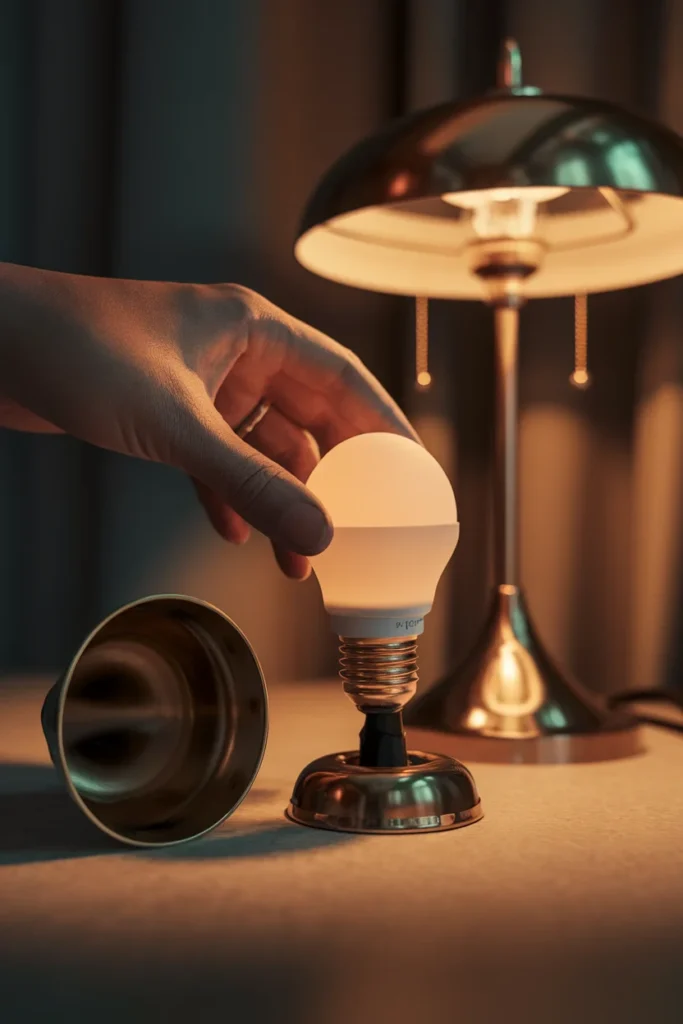
Swap Three Bulbs Before You Buy a Single Pumpkin
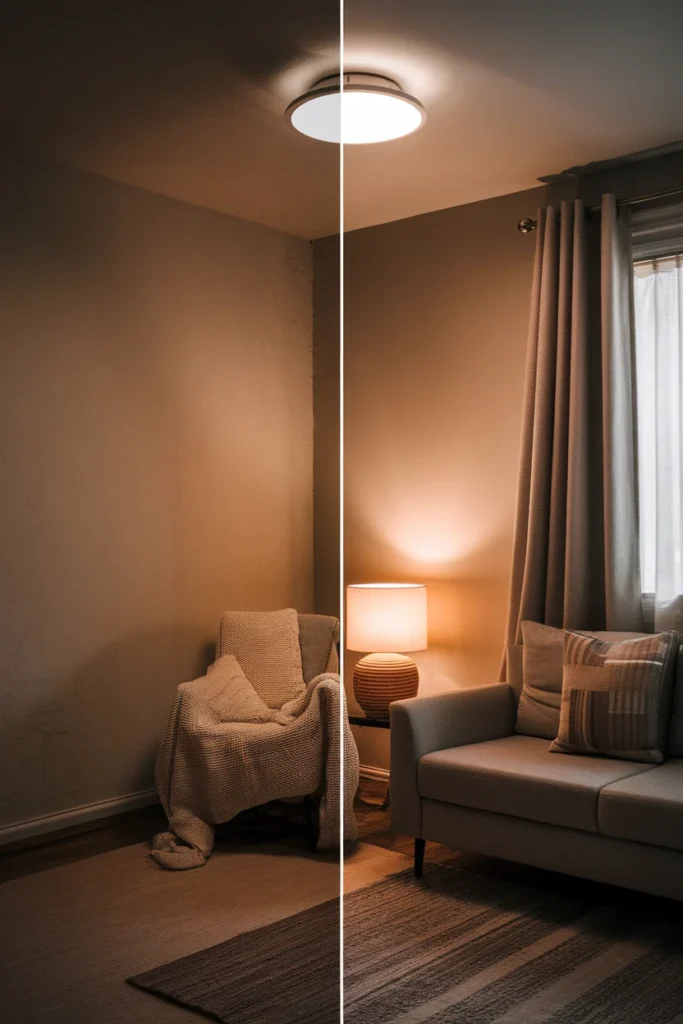
Most rentals ship with 4000K bulbs in the ceiling fixture. That is roughly the color of a dentist’s office, and no amount of plaid is going to fix it.
Buy 2700K. Warm white. Then put light at three heights instead of one blast from overhead: a floor lamp in a corner, a table lamp at seated eye level, and something low like an LED puck under a shelf.
Here is the actual spec sheet, because most articles say “warm lighting” and stop there:
| Color temp | Reads as | Use it in |
|---|---|---|
| 2200K | Candle flame, amber | Accent lamps, string lights, a shelf wash |
| 2700K | Warm white, golden | Living room, bedroom, reading corner (start here) |
| 3000K | Soft white, slightly crisp | Kitchen counters, bathroom vanity |
| 4000K+ | Daylight, clinical | Nowhere you want to relax |
Also worth switching for a reason unrelated to comfort: per the Department of Energy’s LED lighting guide, ENERGY STAR rated residential LEDs use at least 75% less energy and last up to 25 times longer than incandescent bulbs. So the bulbs you install this September are plausibly still running three autumns from now.
Budget about $10 to $15 for a three-pack at a US hardware store (that is a planning estimate, not a quoted price, so check current tags).
One trade-off, honestly: dimmable 2700K bulbs sometimes buzz faintly on older rental dimmer switches. If yours hums, the bulb is the cheap fix, not the switch.
The Living Room: Seat, Throw, One Warm Surface
The throw is where most people waste money, because they buy one that is too small and it ends up looking like a folded towel on the sofa arm.
Real dimensions, so you can measure before you order:
| Piece | Standard size | Works for |
|---|---|---|
| Throw | 50 x 60 in | One armchair, one person curled up |
| Oversized throw | 60 x 80 in | Loveseat, foot of a queen bed, two people |
| Budget fleece (IKEA POLARVIDE archetype) | 51 x 67 in | Testing a color before committing |
| Square pillow | 18 x 18 in cover, 20 x 20 in insert | Plump, not sad and flat |
| Lumbar pillow | 12 x 20 in | Actual lower back support while reading |
That pillow insert trick is the one nobody tells you. A 20 inch insert in an 18 inch cover is what makes a pillow look like the catalog instead of a deflated envelope. It is a two dollar difference and it is the entire effect.
For texture, contrast matters more than quantity. One boucle cushion against a flat linen sofa does more than four boucle cushions against a boucle sofa. Same logic as the lighting: layer different things, not more of the same thing.
If you want the whole-house version of this layering approach rather than just the seasonal one, our room-by-room hygge decor ideas covers the same principles for the other ten months of the year.
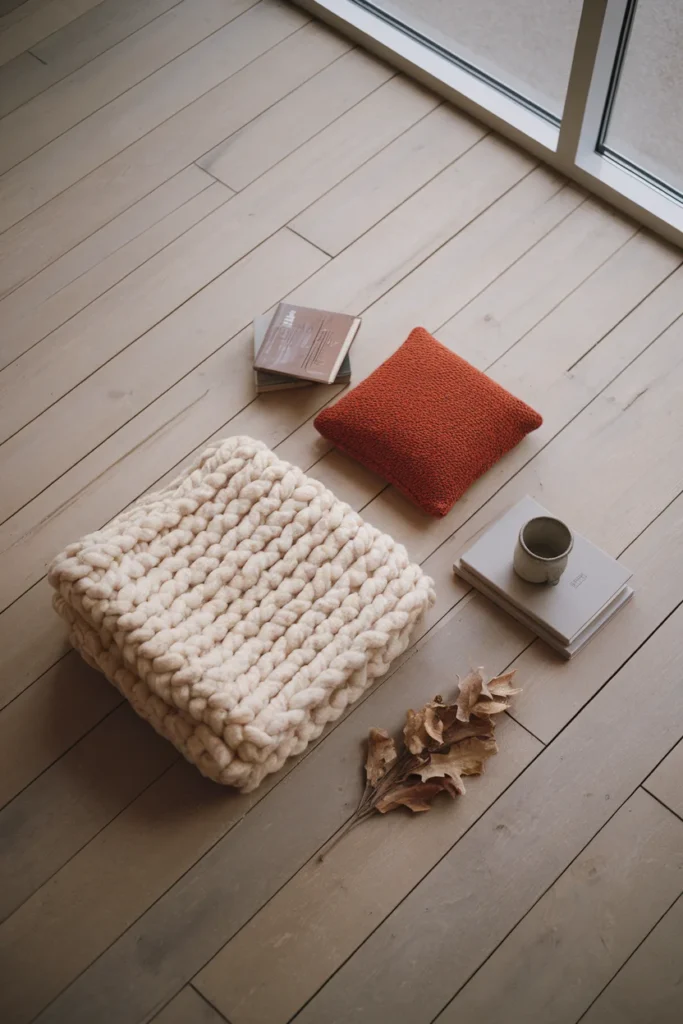
Candles Done Right, Including the 12-Inch Rule Nobody Mentions
Competing articles will tell you to use candles, candles, and more candles. None of them tell you the clearance distance, which is a strange thing to leave out of an article recommending open flame in a small apartment.
So: the U.S. Fire Administration candle safety rules say keep a lit candle at least 12 inches away from anything that burns, use stable holders placed where they cannot be knocked over, blow them out when you leave the room or go to bed, and skip them entirely in bedrooms and sleeping areas. Their guidance also flags roughly 20 home candle fires reported per day nationally.
Twelve inches is further than it sounds. Measure it once against your usual console setup and you will probably find your dried stems are sitting at four.
The practical version for a small space:
- Group three pillars on a stone, ceramic, or metal tray, never directly on wood or a runner.
- Keep the tray at least a foot clear of curtains, paper, dried florals, and pampas grass, which is essentially kindling.
- For the bedroom and for anywhere near a cat, use flameless. Battery LED pillars with a 10-key remote and a 24-hour cycling timer run on 2 AA batteries and give hundreds of hours per set, which means the light comes on at 5 p.m. without you thinking about it.
The flameless version is also the only one that survives a rental with a smoke detector directly above the console.
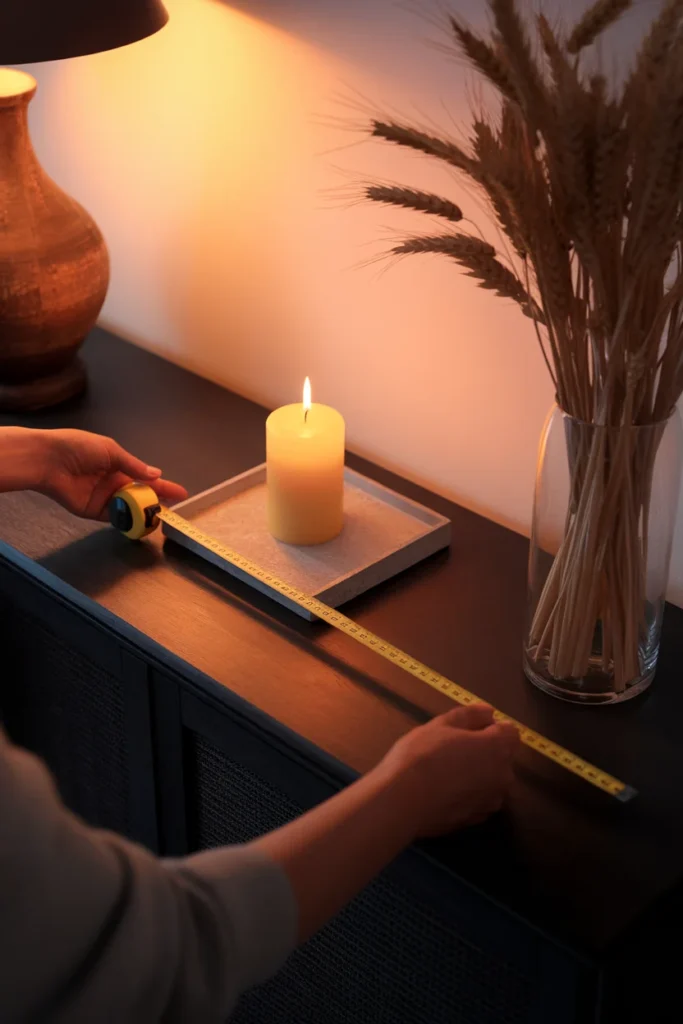
The Entryway Gets 20 Minutes and Exactly Two Objects
Small entryways fail because people try to build a vignette in a space that is 18 inches deep.
Two objects. That is the budget.
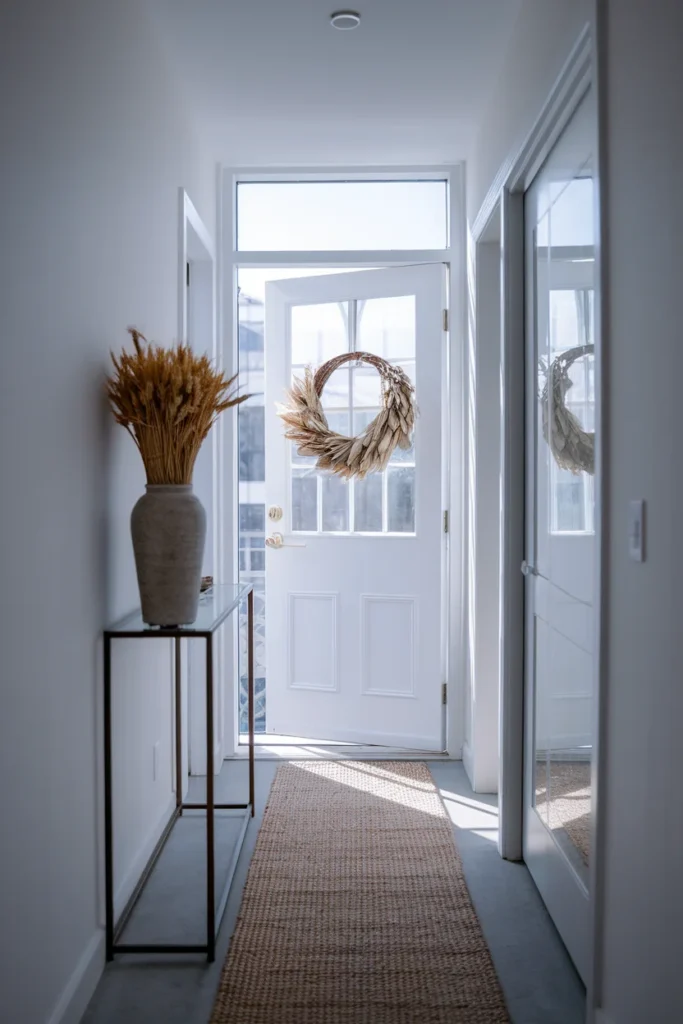
Pick one vertical and one soft: a tall vase of dried wheat or a single branch, plus a jute runner or a small washable rug. The vertical draws the eye up and makes a narrow hall feel taller. The soft one absorbs the echo, which is why builder-grade entryways feel hollow and unwelcoming in the first place.
If you have a door you are allowed to touch, a wreath still earns its keep. If you do not, hang it on the inside of the door or on the wall beside it using an adhesive hook rated well above the wreath’s actual weight. Nobody checks the inside of a door.
Failure mode: a bench you cannot walk past. Measure your hallway width first. Under 36 inches of clear floor and a bench turns your entry into an obstacle, no matter how good it looks in the photo.
Fall Decor That Does Not Cost You Your Deposit
This is where most seasonal decor advice quietly assumes you own the walls.
The no-damage version, in order of how much it changes a room:
- Tension rods. A rod inside a window frame or across an alcove holds curtains, a garland, or a hanging planter with zero holes. Sheer linen panels in warm oatmeal will change a room’s temperature more than any pumpkin.
- Adhesive hooks and strips, honestly rated. Read the weight rating, then use half of it. Adhesive fails on textured or freshly painted walls, and it fails in humidity. A ceramic wreath form on a bathroom door in October is a coin flip.
- Lean, do not hang. A framed print leaned on a console or a picture ledge reads as intentional and puts nothing in the drywall.
- Plug-in sconces. A wall sconce with a cord and a cord cover gives you the built-in look without an electrician or a landlord conversation.
- Peel-and-stick, only where you can test it. Try one panel inside a closet door before you commit to a wall.
The move-out logic matters as much as the install. Anything adhesive should be removed slowly, pulled straight down along the wall rather than out from it, in warm room temperature. Cold walls in December are when the paint comes off with the strip.
Our guide to no-damage rental decor upgrades goes deeper on the actual weight limits and the reversal order if you are working through a whole apartment rather than one seasonal refresh.
Cozy Is About 40 Percent Non-Visual
Every article about this topic treats warmth as something you look at. Most of what your body registers as warmth is not visual at all.
Scent. A simmer pot on the lowest burner: a sliced orange, two cinnamon sticks, a few whole cloves, and a splash of vanilla in about four cups of water. Top it up every hour or so. It costs roughly two dollars and outperforms most candles, with the added benefit that it makes the kitchen feel occupied.
Temperature. Set the thermostat to about 68°F and add a layer rather than pushing it to 74°F. The point is contrast. A warm blanket only reads as warm if the room around it is slightly cool. Rooms held at 74 all winter feel stuffy, not snug.
Sound. Soft surfaces kill echo, and echo is what makes an empty rental feel unwelcoming. A rug, a curtain, and a full bookcase do more for the acoustic feel of a room than anything on the walls.
Texture underfoot. This is the one people skip. Bare feet on cold laminate at 6 a.m. undoes an entire room of styling. A small washable rug on the side of the bed you actually get out of is a genuinely disproportionate upgrade.
Trade-off, honestly: a simmer pot needs supervision and a topped-up water level. Walk away for two hours and you get a scorched pan and a smell that is the opposite of autumn.

Skip the Orange: The 2026 Palette That Reads Warmer
Default pumpkin orange against a white rental wall reads as decoration rather than atmosphere. It announces the season instead of feeling like it.
Pinterest’s 2026 color forecast is a more useful starting point, and two of its five shades are built for autumn:
- Plum Noir, described as a fusion of burgundy, velvet brown, and dark violet. This is the one to steal. It reads rich against oatmeal and warm wood, and it photographs far better in low light than orange does.
- Persimmon, a red-orange blend that is warmer and less plastic than a standard pumpkin orange.
- Jade, sitting between mint and moss, which works as the unexpected third color if your base is already neutral.
Designers surveyed for the 2026 season are also pointing at velvet, burgundy and brown florals, chunky knits, and tarnished warm metals rather than shiny copper.
Pick three colors and stop. One neutral base (oatmeal, bone, warm gray), one warm mid tone (rust, camel, tobacco), one deep accent (plum, oxblood, forest). Every item you add has to belong to one of those three. That constraint is what separates a room that looks styled from a room that looks accumulated.

The Bedroom and the Reading Corner, Where Fall Actually Pays Off
The bedroom is the room where seasonal decorating stops being decorative and starts being functional, because you are the only one who sees it and you are in it when you are tired.
Three things:
Layer the bed properly. A flat quilt plus one heavier textured layer folded across the bottom third. Not a full second duvet, which just makes the bed hot and hard to make.
Fix the bedside light. One 2700K bulb in a swing-arm or a clip-on reading light, positioned so the light falls over your shoulder onto the page rather than into your face. Overhead light in a bedroom after 8 p.m. is the enemy of actually going to sleep.
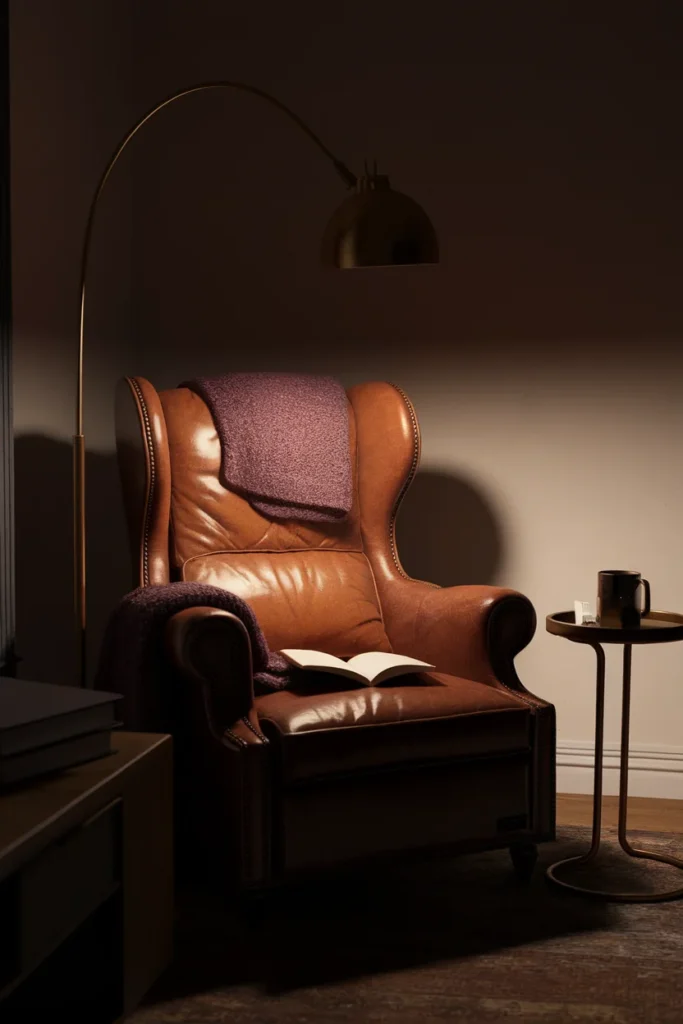
Build the corner. If there is any spare corner, that is where a reading nook goes: an armchair or a floor cushion, a light, and a surface within about 18 inches of your reaching hand. Anything further and you will put the mug on the floor, which is how mugs get kicked over.
That reach distance is worth measuring. A side table 18 inches from the arm of the chair is usable without leaning. At 30 inches you have to stand up, and a chair you have to stand up from is a chair you stop using.
For the full version of building out one corner instead of a whole room, our smart layouts for tiny apartments walks through the buy order of seat, then light, then surface.
The One-Bin Rule: What Happens on November 30
Nobody writes about this part, which is why so many people end up with four totes of seasonal decor in a closet they need for coats.
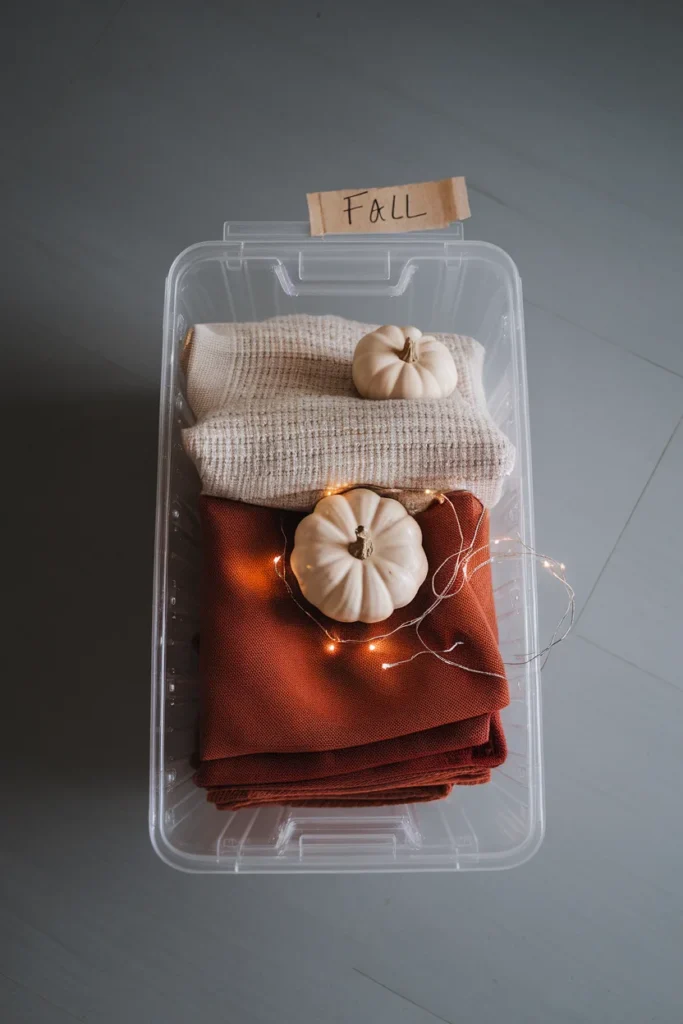
The One-Bin Rule: all of your fall decor fits in a single 27 gallon tote, or you own too much of it.
One bin is roughly the right volume for a home under 1,400 square feet. It forces the decision that makes next autumn easy: you keep the things that earned their space and you let go of the rest while you still remember which was which.
Teardown order, so it takes 25 minutes instead of an afternoon:
- Textiles first. Wash them, dry them fully, then fold. Damp anything in a sealed bin for eight months is how you get mildew.
- Naturals go in the trash, not the bin. Real gourds, foraged branches, and anything from a garden. Dried florals can stay if they are not shedding.
- Wrap ceramic and glass in the textiles you just folded. No packing paper needed and it uses volume you already committed to.
- Photograph the styled shelf before you dismantle it. Take one photo per room on your phone. Next September you will rebuild in ten minutes instead of starting from a blank surface.
- Label the bin on the short end, because that is the side you will see when it is stacked.
Anything that does not fit goes to a donation bin the same week, while the decision is still fresh. Things that go into a “maybe” pile in a closet do not come back out.
Fall Decorating Mistakes That Quietly Make a Room Feel Colder
These are the ones worth catching before you spend anything.
- Leaving the 4000K bulbs in. Every other change is fighting the ceiling fixture.
- Spreading small objects evenly. Three groups of three beat nine singles, always.
- A rug that is too small. If the front legs of the sofa do not sit on it, the rug shrinks the room instead of anchoring it. In a small living room, aim for 5 x 7 feet minimum.
- Curtains hung at the window frame. Mount the rod 4 to 6 inches above the frame and let the panels break at the floor. This costs nothing and is the closest thing to free ceiling height.
- Buying the styled photo instead of the room. The pin was probably shot in a 3,000 square foot house with nine-foot ceilings and south light. Steal the color and the texture, not the object count.
- Decorating on August 20th. By late October you will be tired of it. Most people find early-to-mid September is when it still feels earned.
Cozy Fall Home Decor FAQs
When should you start decorating for fall? Most people land on the first two weeks of September. Early enough that it still feels like a change, late enough that you are not bored of it by Halloween. If you want a non-arbitrary trigger, use the first evening you turn a lamp on before 7 p.m.
How do I make my house feel cozy for fall without buying much? Change the bulbs to 2700K, move one soft thing you already own onto the chair you actually use, and run a simmer pot. Those three cost roughly the price of a coffee and account for most of the perceived difference.
How do you decorate for fall on a budget under $100? A three-pack of 2700K bulbs, one 50 x 60 inch throw, one 18 x 18 inch pillow cover with a 20 inch insert, a jute runner, and a bundle of dried wheat will land in that range at most US retailers and covers a living room and an entryway. Prices vary by store and season, so treat that as a planning band rather than a quote.
What colors are trending for fall decor in 2026? Pinterest’s 2026 palette names Plum Noir (burgundy, velvet brown and dark violet), Persimmon, Jade, Cool Blue, and Wasabi. For autumn specifically, Plum Noir and Persimmon are the useful two. Designers are also pointing toward velvet, burgundy and brown florals, chunky knits, and tarnished rather than polished metals.
How can renters decorate for fall without damaging walls? Tension rods inside window frames, adhesive hooks used at half their rated weight, leaned frames on ledges and consoles, plug-in sconces with cord covers, and peel-and-stick tested inside a closet first. Remove adhesive slowly, straight down the wall, in a warm room.
Are candles safe in a small apartment? They can be, with clearance. The U.S. Fire Administration advises keeping lit candles at least 12 inches from anything that burns, using stable holders, never leaving them lit in an empty room, and avoiding them in bedrooms and sleeping areas. In tight spaces near curtains, dried florals, or pets, battery LED pillars on a timer are the sane choice.
How do you store fall decorations after the season? Wash and fully dry textiles first, throw out anything organic, wrap ceramics inside the folded textiles, photograph each styled surface before dismantling it, and label the bin on the short end. If it does not fit in one 27 gallon tote, donate the overflow that week.
Start With the Lamp Tonight
You do not need a shopping list to begin. Turn off the ceiling light in whatever room you are sitting in, switch on a single lamp, and notice how much of “autumn” was really just a lighting problem.
Then do the three surfaces in that one room this weekend: the seat, the light, and one thing at eye level. Once that corner works, the rest of the apartment is just repetition.
If you want to go further into the corner you sit in most, the reading nook build is the natural next step, and it is the one that keeps paying off long after the pumpkins are back in the bin.
Keep reading
More cozy nook ideas
 Fall Decor
Read →
Fall Decor
Read →
Fall Door Decor on a Budget: Where to Spend and Where to Save
If your fall door every year is a wreath that sheds on the mat, two mums that are crispy by Halloween, and…
 Fall Decor
Read →
Fall Decor
Read →
12 Thanksgiving Tablescape Ideas for Small Spaces (That Still Leave Room for the Food)
Twenty-four inches. That’s how much table edge one person needs to eat without bumping elbows, and it’s the number most Thanksgiving tablescape…
 Fall Decor
Read →
Fall Decor
Read →
18 Fall Coffee Bar Ideas for Sweater-Weather Evenings
No counter space to spare, no espresso machine, no landlord permission needed. This fall coffee bar runs on three pieces: a slim…