
Cottage Garden Flowers That Frame the Spot Where You Actually Sit

Three layers. One border. Blooms from May to hard frost.
That is the entire plan, and it fits a strip of dirt about six feet by ten, which is where mine started outside a rental with a landlord who cared a lot about the fence and not at all about what grew next to it. Most cottage garden flowers guides hand you twenty-five plant names and leave you in the nursery aisle with a cart and no order of operations.
This one gives you the order. It also gives you the part the plant lists skip: where to put the tall stuff so the border reads as a frame from your chair instead of a wall from the sidewalk.
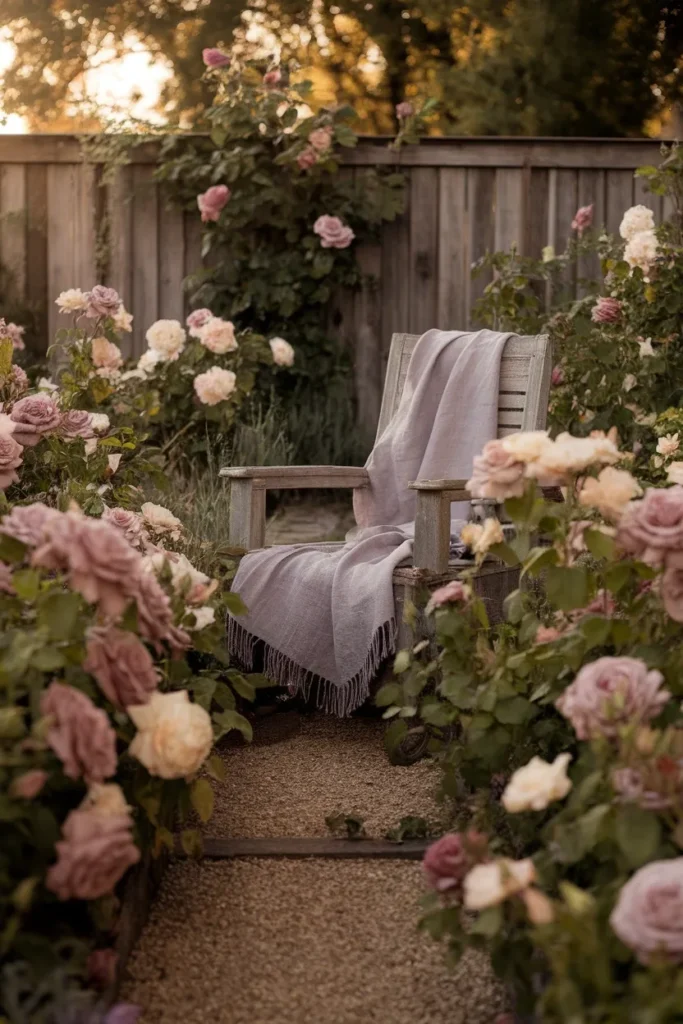
Start Here: The Three Layers and the 5-3-1 Rule
Everything below hangs off three bands of height. Learn these and the plant names stop mattering so much, because you can swap any name for another at the same height.
Back layer, 4 to 8 feet. Vertical spires that give the border its ceiling. Hollyhock, delphinium, foxglove, and a climbing rose trained on whatever is behind the bed.
Middle layer, 2 to 4 feet. Rounded, bushy, long-blooming. Coneflower, garden phlox, bee balm, Shasta daisy, peony.
Front layer, 3 inches to 2 feet. Sprawlers that flop over the edge and hide bare soil. Catmint, English lavender, sweet alyssum, lady’s mantle.
Now the ratio, which is the piece nobody hands you.
The 5-3-1 Drift Rule
For every 4 linear feet of border:
- 5 of one front-layer sprawler
- 3 of one middle-layer bloomer
- 1 single back-layer spire
Repeat that block down the bed, and change only the middle-layer plant every second repeat. Keep the front-layer plant the same the whole way along. That single repeated edge is what makes a cottage border read as intentional even though the middle looks wild.
Failure mode: buying one of everything. A border with fifteen different plants in ones and twos looks like a garden center display, not a garden. Repetition is the difference, and it costs less, because five of one thing is usually cheaper per plant than five different things.
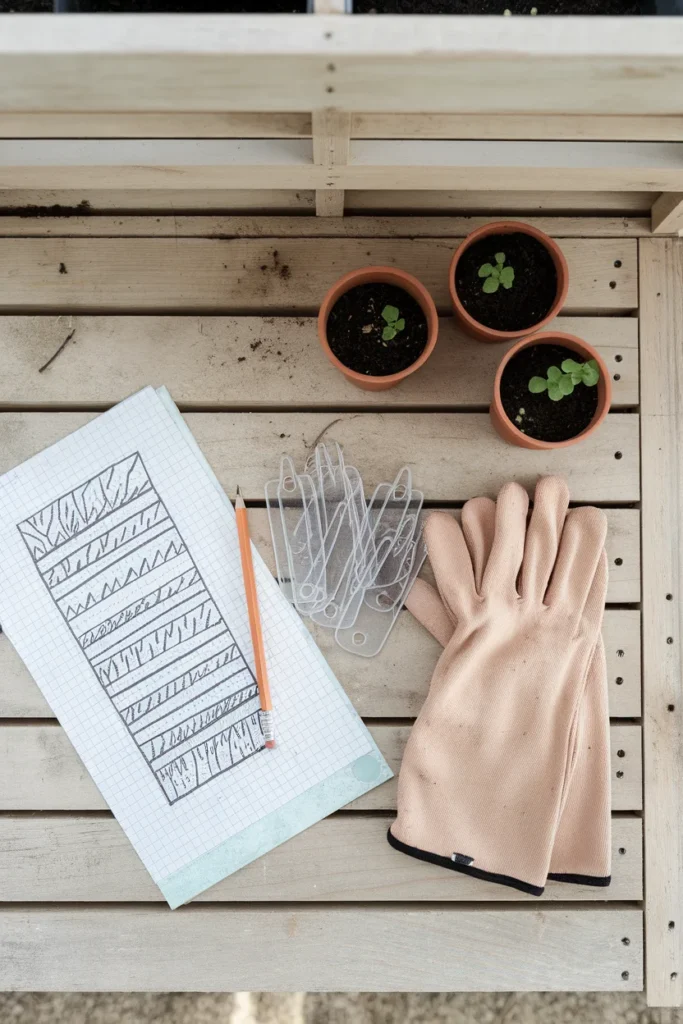
The Back Layer: Tall Spires That Do the Heavy Lifting
These are the plants people pin. They are also the ones that need the most from you.
| Plant | Mature height | Sun | USDA zones | Bloom window | Lifecycle |
|---|---|---|---|---|---|
| Hollyhock (Alcea rosea) | 5 to 8 ft | Full sun | 5 to 9 (NCSU) / 2 to 10 (MBG) | June to August | Biennial or short-lived perennial |
| Delphinium (D. elatum) | 3 to 5 ft, tall types 6 ft+ | Full sun | 3 to 7 | June to July | Short-lived perennial, roughly 3 to 5 years |
| Foxglove (Digitalis purpurea) | 2 to 5 ft | Sun to part shade | 4 to 9 (NCSU) / 4 to 8 (MBG) | May to June | Biennial |
| Climbing rose (e.g. ‘New Dawn’) | 10 to 15 ft | 6 to 8 hrs direct sun | 5 to 9 | June, then repeats into fall | Woody perennial |
Notice the two zone ranges on hollyhock and foxglove. That is not sloppiness, it is a real disagreement between N.C. Cooperative Extension and Missouri Botanical Garden, and plant tags at big-box stores tend to quote whichever range is more flattering. Look up your own zone on the 2023 USDA plant hardiness zone map before you trust a tag, especially if you are near a zone boundary. The map was redrawn in 2023 and about half of the country shifted a half zone warmer.
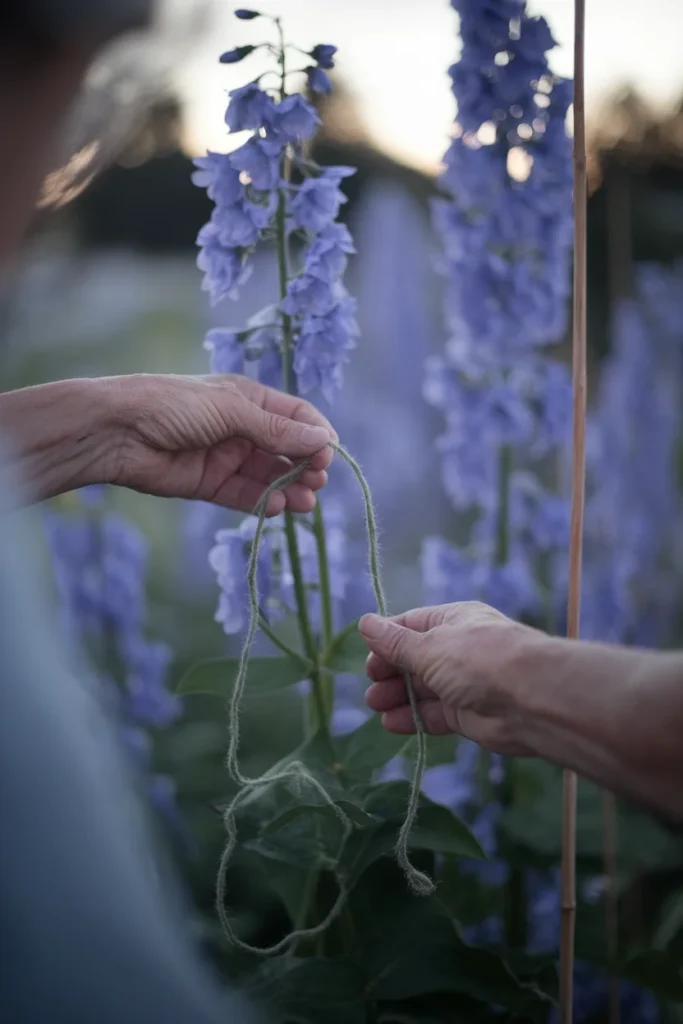
The trade-off nobody puts in the caption: delphiniums photograph better than anything else in this list and snap first in a summer storm. Stake them when the stems hit about 18 inches, not when they start leaning. Waiting until they lean means tying a bent stem upright, which looks exactly as bad as it sounds. That is a mistake I have made twice.
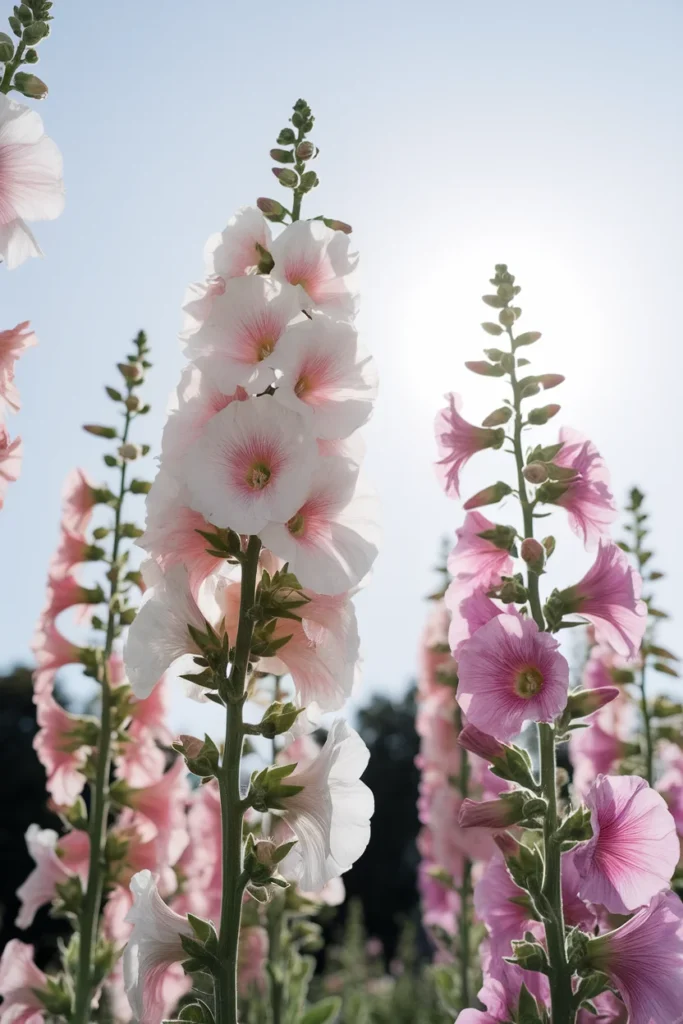
The biennial trap. Foxglove and hollyhock are biennials. Year one they make a low rosette of leaves and nothing else. Plant only biennials in your back row and your first summer has no back row at all. The fix: buy one or two already in bloom the first spring and sow seed at the same time, so the seedlings come into flower the following year and the cycle overlaps from then on.
The Middle Layer: Workhorses That Cover May Through October
Your back row gets the attention. The middle row is what keeps the border from going blank in August.
- Peony (Paeonia lactiflora), 1.5 to 3 ft, zones 3 to 8, blooms in May for about two weeks
- Purple coneflower (Echinacea purpurea), 2 to 5 ft, zones 3 to 8, June to August and longer if you deadhead
- Bee balm (Monarda didyma), 2 to 4 ft, zones 4 to 9, June to September, space plants 2 ft apart per Iowa State Extension
- Garden phlox (Phlox paniculata), 2 to 4 ft, zones 4 to 8, July to September, genuinely fragrant flowers
- Shasta daisy (Leucanthemum x superbum), 2 to 3 ft, zones 4 to 9, July to September
Chain those together and you get a relay: peony in May, coneflower and bee balm from June, phlox holding the middle of summer, and daisies running to first frost. No single plant carries the season, which is the whole point of a mixed border.
Two weeks is two weeks. Peonies bloom for roughly a fortnight in May and then spend four months being a medium-sized green shrub. Put them where that shrub shape still earns its keep, along a path edge or against a fence, not in the middle of your longest sightline where a bare patch will nag at you all July.
Buy the right black-eyed Susan. Rudbeckia hirta is sold constantly as a perennial and behaves like an annual or biennial in a lot of yards. If you want it to come back reliably, look for Rudbeckia fulgida instead, which Missouri Botanical Garden rates as a true perennial for zones 3 to 9 and which flowers July into October. The tag will say “black-eyed Susan” either way. Read the Latin.
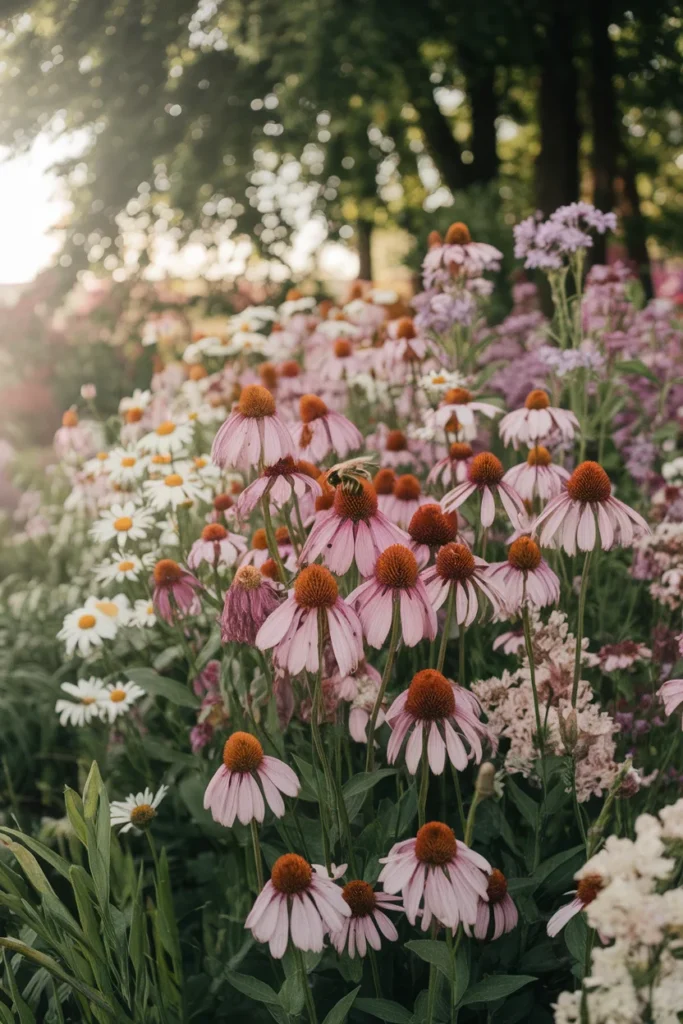
The Front Layer: Sprawlers That Hide Every Mistake
A tidy front edge buys forgiveness for everything behind it. These four do the hiding.
- Catmint (Nepeta ‘Walker’s Low’), 2 to 2.5 ft, zones 4 to 8, flowering from April or May clear through September
- English lavender (Lavandula angustifolia), 1 to 3 ft, zones 5 to 9, June to August, flowers and foliage both aromatic
- Sweet alyssum (Lobularia maritima), 3 to 10 inches, honey-scented, blooming spring into fall
- Lady’s mantle (Alchemilla mollis), 1 to 1.5 ft, zones 3 to 8, chartreuse froth in June that holds rain droplets on its leaves for hours
Here is a placement detail worth more than another plant name. Catmint’s scent lives in the leaves, not the flowers, and it only releases when something brushes against it. So catmint belongs where your leg passes it, right at the edge of the path or beside the chair, not in the middle of the bed where nothing ever touches it. Same logic for lavender. A plant whose payoff is a smell should be within arm’s reach of the place you sit.
That distinction is worth flagging because a lot of plant lists call bee balm and catmint “fragrant flowers.” Both Missouri Botanical Garden and NC State list the aroma in the foliage only. Bee balm’s bruised leaves smell distinctly of mint. Its flowers do not do much of anything.
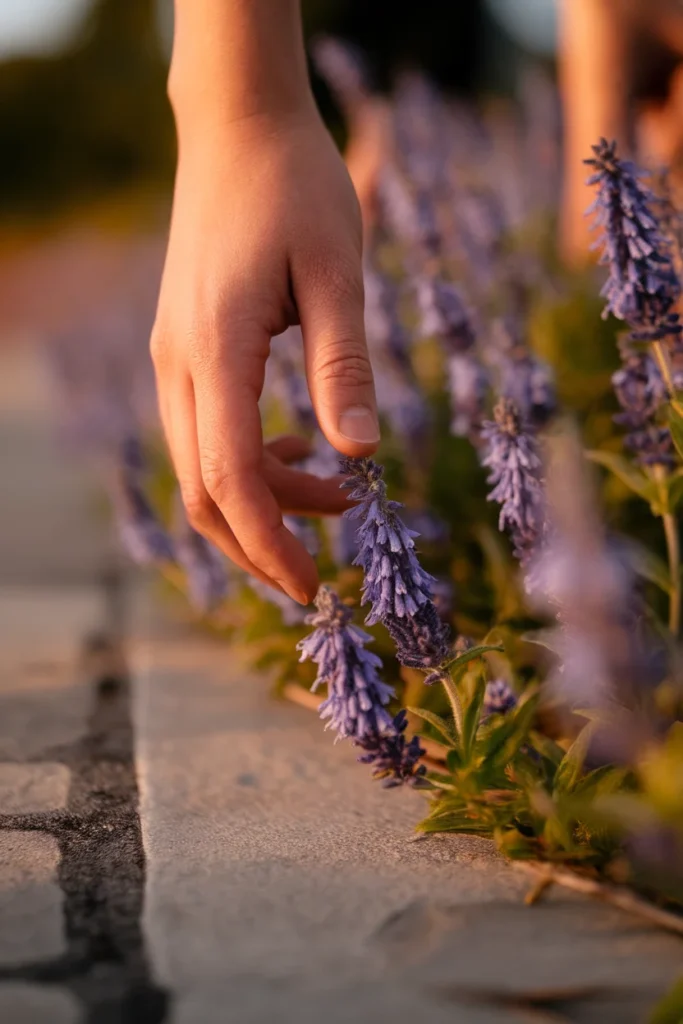
Year One Looks Thin, So Fill the Gaps With Annuals
Perennials spend their first summer building roots. Your border will look about forty percent as full as the pin that sent you here, and that is normal, not a failure. Annuals are the patch.
- Cosmos (Cosmos bipinnatus), 1 to 4 ft, blooming June until frost, sown straight into the soil
- Zinnia (Zinnia elegans), 6 inches to 3 ft depending on the variety, June to frost
- Sweet pea (Lathyrus odoratus), climbing 3 to 8 ft, May to July, and the most strongly scented thing on this whole page
One packet of cosmos seed sows more than a small border needs, which makes annuals the cheapest square footage you will buy all season. Expect roughly $3 to $5 a packet at most US garden centers.
Pick a palette before you buy, not after. Three colors plus white is the working limit. Go past four and the border stops reading as a scheme and starts reading as leftovers. Dusty pink, deep violet, and cream is the combination that shows up over and over in high-performing pins, and it happens to be the same restraint that makes indoor rooms work. If you want to see the identical logic applied to a room instead of a border, these cottagecore living room ideas run the same three-plus-white discipline across textiles.
Plant for the View From the Chair, Not the Sidewalk
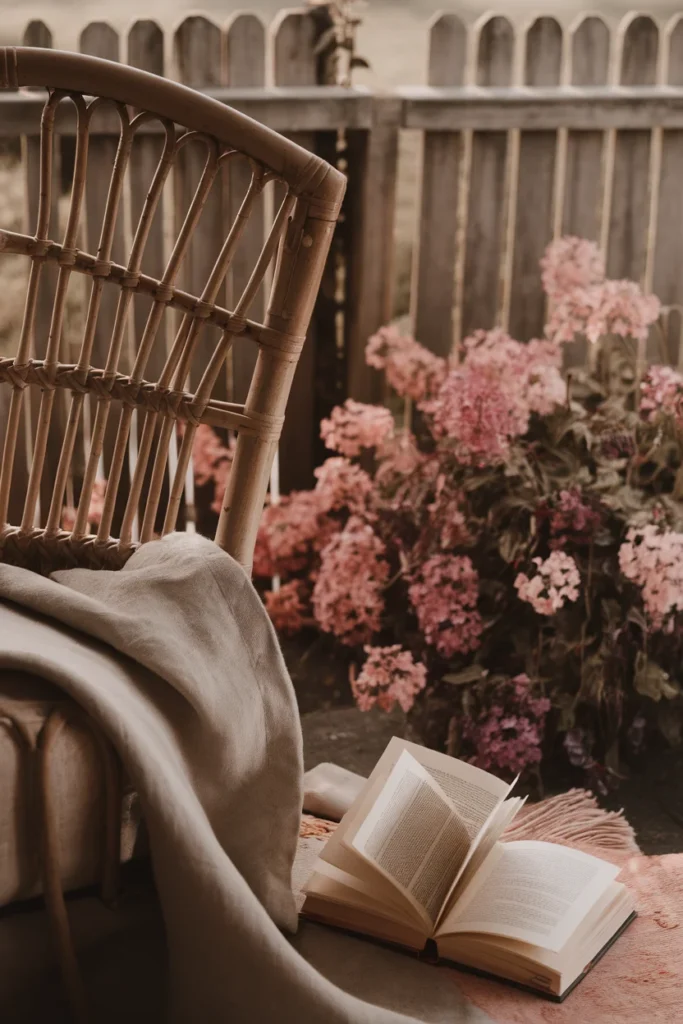
Every plant list on the internet designs this border for a stranger standing on the pavement. You are not that stranger. You are going to be sitting down, usually in the same chair, usually at the same time of day, and the geometry from a seated position is completely different.
So do this before you buy anything. Sit in the chair you actually use, at the hour you actually read, and take one photo with your phone held at your own eye level. Do not stand up to take it. Whatever the bottom edge of that photo cuts off is dead space, and anything you plant there is decoration for the neighbors.
The chair-line rule: from a low armchair or a window seat, seated eye level lands somewhere around 40 to 48 inches off the ground for most adults. Your useful bloom band starts about 18 inches up and peaks between 30 and 48 inches. That is exactly the middle layer. It is why coneflower and phlox punch so far above their weight in a small garden and why a five-inch drift of alyssum, gorgeous from above, vanishes the second you sit.
Two things follow from that. Push one middle-layer repeat closer to the chair than the plan says, so something blooms inside your near focus. And if a windowsill or a balcony railing cuts the view, measure its height and treat that number as your new zero.
The same sightline thinking is what makes an indoor corner work, and this cottagecore reading corner with florals walks through the indoor half of the equation for renters who cannot drill.
The Renter’s Version: A Whole Cottage Border in Pots
If you cannot dig, you can still do all of this. Containers change three things and nothing else.
Pot sizing. Working rule: pot diameter should be at least one third of the plant’s mature height. A 3-foot coneflower wants a 12-inch pot minimum. A 5-foot spire wants 16 to 18 inches. Undersize it and the plant either topples in wind or dries out by noon, and usually both.
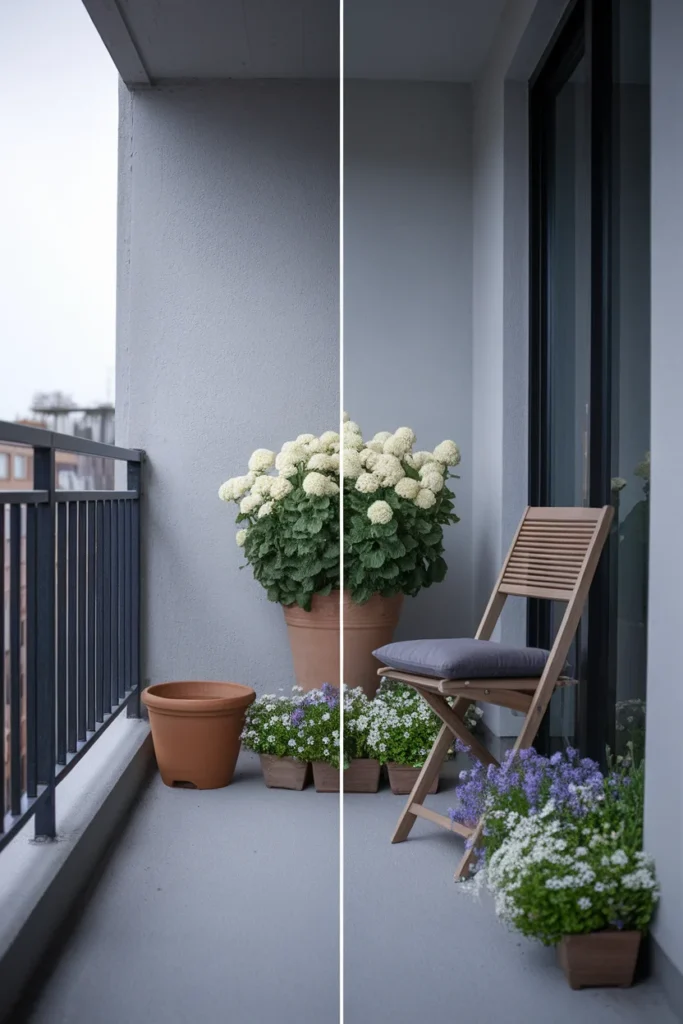
The layout translation. Back layer, one 16 to 18 inch pot per spire. Skip hollyhock in containers, because it sends down a deep taproot and sulks. Use tall flowering tobacco or a delphinium instead. Middle layer, 12 to 14 inch pots for coneflower and phlox. Front layer, 8 to 10 inch pots for catmint, lavender, and alyssum, clustered in odd-numbered groups so the 5-3-1 ratio still reads.
Watering and winter. In July I water the 10-inch pots daily and the 18-inch ones every other day, and that gap is the single biggest argument for buying fewer, larger pots. For winter, plan on a potted perennial behaving as though it lives one to two hardiness zones colder than its tag, because roots in a container have no soil mass insulating them. Zone 6 gardeners should shop as though they are in zone 4 or 5 for anything staying outdoors in a pot.
What you gain: the whole border moves with you. Mine has relocated once, in the back of a hatchback, over two trips.
The Evening Shift: What Your Border Does After Sunset
Pinterest searches for evening garden parties are up 210% this spring, and this is the part almost nobody plans for.
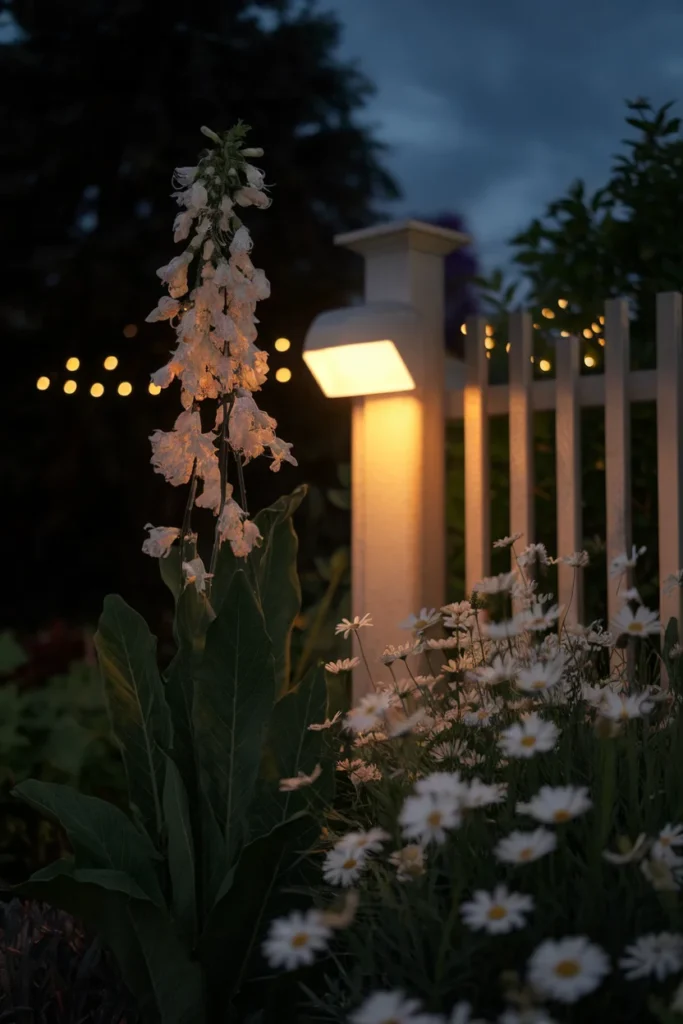
Plant for scent, not sight. Flowering tobacco (Nicotiana) is the classic, but there is a trap in it. Missouri Botanical Garden notes that the compact bedding cultivars sold in six-packs open during the day and are mostly non-fragrant. Only the tall types deliver. Look specifically for Nicotiana sylvestris, which UW-Madison Extension describes as giving off a strong, sweet, jasmine-like scent in the evening to attract sphinx moths. It grows 3 to 5 feet, so it belongs in your back layer anyway.
Plant white where you will sit. Color drains out of a garden about twenty minutes before the light does, and white is the last thing standing. White cottage garden flowers is a real search cluster on Pinterest for exactly this reason. A drift of white phlox or Shasta daisy near the chair keeps working after everything magenta has gone gray.
Get the bulb color right. A 2700K warm white bulb in a plug-in sconce or a string of fairy lights along the fence will make skin, wood, and cream petals look warm. A 4000K cool bulb turns the same border into a parking lot. This is the same rule that governs interiors, and these warm lighting ideas for a cozy home cover bulb temperature and placement in more detail than a garden post has room for.
The Foxglove Talk, and Three Other Things to Check Before You Buy
This section exists because the pretty lists leave it out.
Foxglove is highly toxic. UW-Madison Extension states plainly that all parts of the species are poisonous if eaten and that contact with the leaves can irritate sensitive skin, and Missouri Botanical Garden notes the leaves are the source of the drug digitalis. The UW-Madison Extension guide to common foxglove is worth two minutes of your time before you plant it anywhere a toddler grazes. The ASPCA also lists it as toxic to dogs, cats, and horses.
Three more that surprise people:
- Delphinium is toxic to humans and pets, and NC State notes it can cause contact dermatitis.
- Peony is listed by the ASPCA as toxic to dogs, cats, and horses.
- Lavender is also on the ASPCA toxic list for dogs, cats, and horses, which catches almost everybody off guard.
None of that means do not plant them. It means know which ones they are, keep them out of the layer a small child can reach, and skip foxglove entirely if you have a dog who eats plants.
This is general gardening information, not medical or veterinary advice. If a person or pet swallows part of any plant listed here, call the US Poison Control hotline or your veterinarian right away rather than waiting to see what happens.
What a Starter Border Actually Costs
Real numbers, with the honest caveat that nursery pricing swings hard by region and by month.
At most US garden centers you can expect roughly $8 to $16 for a one-gallon perennial, $5 to $9 for a quart pot, and $3 to $5 for a seed packet. Buying in quart size instead of gallon is the single biggest lever on this list. A quart perennial usually catches up to a gallon one by the end of its second season, and you can buy nearly twice as many.
A worked example for a border about 8 feet long, using the 5-3-1 ratio twice:
- 10 front-layer plants in quart size, at roughly $6 each: about $60
- 6 middle-layer plants in quart size, at roughly $7 each: about $42
- 2 back-layer plants in gallon size, at roughly $13 each: about $26
- 3 seed packets of annual filler: about $12
- 2 bags of compost: about $16
That lands near $155, which sits inside the $80 to $400 range most people are working with. Shop the end-of-season markdowns in late August and September and the same list drops by a third, because perennials do not care what month you plant them as long as the ground is workable.
Frequently Asked Questions
What are the easiest cottage garden flowers for a beginner? Catmint, coneflower, Shasta daisy, and cosmos. All four tolerate imperfect soil, none needs staking, and three of the four are perennials that come back. Start with those, add the temperamental spires in year two once you know how your soil drains.
What are the best low-maintenance cottage garden plants? The ones with aromatic foliage tend to be the toughest, because the same oils that make them smell good also make deer and rabbits skip them. Catmint and English lavender lead that group. Coneflower and Rudbeckia fulgida are close behind and both feed pollinators well into fall.
How do you design a cottage garden border layout? Work in three height bands and use the 5-3-1 ratio: five front-layer plants, three middle-layer, one back-layer spire per four linear feet of bed. Repeat the block down the border, keeping the front plant identical the whole way and swapping the middle plant every second repeat.
What are the most cottagecore flowers? Foxglove, hollyhock, sweet pea, peony, and old-fashioned climbing roses. The look comes from vertical spires and soft ruffled petals in a muted palette, so anything with those two qualities will read cottagecore even if it is not traditional.
What are the best tall cottage garden flowers? Hollyhock at 5 to 8 feet is the tallest reliable choice, followed by delphinium at 3 to 6 feet and foxglove at 2 to 5 feet. Climbing roses go well past all of them at 10 to 15 feet but need something to climb.
Can you grow a cottage garden in shade? Partial shade, yes. Foxglove, lady’s mantle, and garden phlox all handle part shade. Full shade is a different garden. Lavender, coneflower, and most annuals need six hours of direct sun or they stretch, flop, and stop flowering.
Can you make a cottage garden in pots? Yes, and it is the version that survives a move. Size each pot to at least one third of the plant’s mature height, group them in odd numbers to keep the ratio readable, and shop as though your zone is one to two numbers colder for anything wintering outdoors.
One Weekend Is Enough to Start
You do not need the whole border in the first season. Pick your four feet, buy five of one front plant, three of one middle plant, and one spire, and put them in the ground this weekend. That single block is a complete unit. Repeat it next month and the month after and by next summer nobody will be able to tell it went in piecemeal.
Then go sit in the chair, at four o’clock, and check what you can actually see from there. That view is the whole reason any of this is worth doing, and it will tell you exactly what to buy next.
Keep reading
More cozy nook ideas
 Cottage Garden & Balcony
Read →
Cottage Garden & Balcony
Read →
20 Backyard Oasis Ideas on a Budget, Starting With a $152 Corner
Two folding chairs, a small outdoor rug, 24 battery globe lights, and two planters. At IKEA this October, that adds up to…
 Reading Sheds
Read →
Reading Sheds
Read →
12 She Shed Ideas for Small Yards
No acre, no contractor, no giant budget. You need about 64 square feet, a flat patch of ground, and a plan for…
 Garden Nooks
Read →
Garden Nooks
Read →
Container Gardening Ideas for Small Cottage Gardens That Fit a Rental Patio
One anchor pot, two mid-size pots, three little ones. That’s the whole cottage garden, and it fits on a patio smaller than…