
18 Small Office Ideas for Tiny Apartments and Awkward Corners

No spare room, no landlord who likes drills, and a laptop that keeps wandering between the couch, the bed, and the kitchen counter. You can still have a small office that works. These 18 ideas fit tiny apartments and awkward corners: a closet with the doors off, a desk that folds flat against the wall, a $29.99 rolling cart that parks out of sight at night, and a reading chair for the work that doesn’t need a screen.
Every idea comes with a real measurement or spec, so you can hold a tape measure up to your own corner before you buy anything. Renter-safe options come first. Owner upgrades come second, and they’re labeled.
You’ll also get the 20-Inch Screen Rule, a one-minute check built on OSHA’s workstation guidance. It stops the most common small office mistake: a screen so close that you lean into it all day.
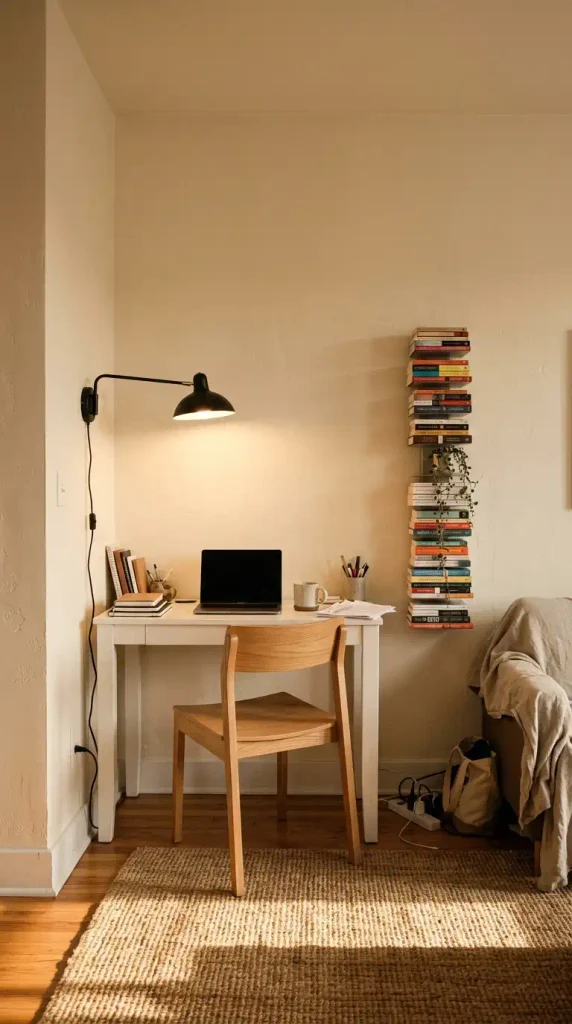
Start with idea one if all you have is a corner and an outlet.
1. Claim the Dead Corner With a 28 3/4 Inch Desk and a Plug-In Sconce
Twenty-eight and three-quarter inches. That’s the width of the small IKEA MICKE desk, and it fits the corner most of us hand over to a laundry basket.
Here’s the whole setup:
- The desk. MICKE lets you mount the legs on the left or the right, so pick the side that keeps the outlet reachable.
- A plug-in swing-arm sconce. The light lives on the wall, so the desktop stays free for your laptop and a notebook.
- An armless chair. It slides all the way under at night and gives you back the walkway.
Corners work because two walls do the storing. One wall takes a pinboard, the other takes the sconce, and no floor goes to a lamp base.
Safety note: anchor tall furniture to the wall, keep candles and cords away from fabric, and use a licensed electrician or contractor for hardwired lighting, ceiling mounts, or anything structural.
Measure the corner at floor level, not halfway up the wall. Baseboards and outlet covers steal space you won’t see at eye height.
2. Take the Closet Doors Off and Call It an Office
Take the doors off first. Everything else about a cloffice gets easier once you can actually sit in front of the opening.
Most reach-in closets run about 24 inches deep, which is roughly desk depth already. A freestanding narrow desk slides in with no cutting, and the existing closet shelf becomes your upper storage on day one. The hard part is light. Closets are dark by design, so plan a clip-on lamp or a plug-in sconce before you plan the paint.
Lift the doors off their track or hinges and store them flat under the bed.
Measure width and depth at the floor and again at 30 inches up. Door trim often narrows the opening.
Slide in a freestanding desk that is a few inches narrower than the opening, so the chair arms clear the frame.
Add a clip-on lamp and a small desk fan. A closet holds warm air from a laptop more than you’d expect.
Bag the hinges and screws, label the bag, and tape it inside the closet. Move-out day will be ten minutes instead of an hour of hunting.

3. Hang a Desk That Folds Into a Shelf at Night
Owners, this one’s yours. Renters, it’s a question for the landlord first.
IKEA’s NORBERG is sold as a wall-mounted drop-leaf dining table, but at 29 1/8 by 23 5/8 inches it’s a laptop desk in disguise. IKEA’s own mounting guide puts the top edge at about 74 cm (29 inches) for table height, which lines up with a standard desk. The best part is the hinge. The top comes in two pieces, so when you fold it down, a narrow strip stays up as a small shelf for a pen cup or a plant.
The trade-off is honest: it needs screws into studs, and you’ll be patching holes at move-out.
| Fold-down wall desk | Small freestanding desk |
|---|---|
| Folds to a narrow shelf after work | Takes its full footprint all day |
| Screws into studs, drill required | No tools beyond assembly |
| Renters: ask first, patch later | Renter-safe as is |
| Best with a laptop and short sessions | Best with a monitor and long days |
It disappears at 6 p.m. Your workday should too.
4. Run the Whole Office Off a $29.99 Rolling Cart
Your desk might be the kitchen table. That’s fine. The supplies just need a home that rolls.
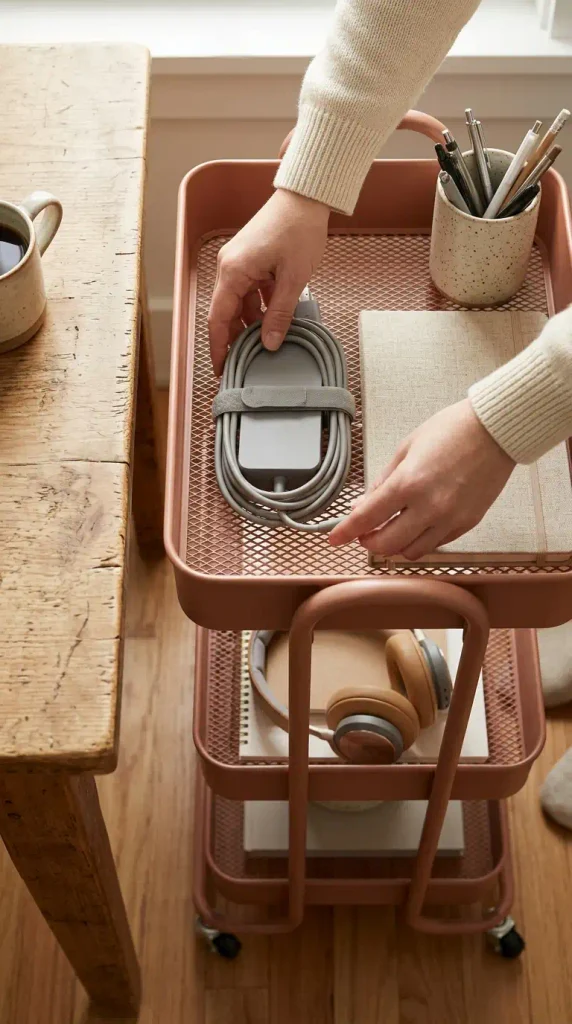
The small IKEA RÅSKOG cart measures 11 by 15 by 24 inches and was listed at $29.99 on IKEA US when this was written. It’s narrow enough to park beside a fridge, in a closet, or at the end of the couch. Three tiers is the right number for work stuff, because three forces you to choose.
Load the cart like this
Roll it into the closet at night and the kitchen table goes back to being a kitchen table.
5. Tuck a Desk Under the Stairs, Tall End for You
Most under-stair spaces are taller at one end than you think and lower at the other than you hope. Put the chair at the tall end and the storage at the short end, and the awkward slope starts working for you.
A few rules keep it comfortable:
- Sit in the spot before you buy anything. Check that your head clears the underside of the stairs when you stand up fast.
- Use the lowest, most cramped section for a basket of paper or a printer you touch once a week.
- Add a plug-in light. Under-stair corners get almost no daylight, even at noon.
⚠️ Watch Out
The wood under a staircase holds the stairs up. Don’t cut into it or open the wall without a licensed contractor. A freestanding desk needs nobody’s permission.
Footsteps overhead will be part of your workday here. A pair of over-ear headphones solves that faster than any decor choice.
6. Turn the Desk Sideways to the Window
Facing the window feels right for about ten minutes. Then the afternoon sun lands on your screen, and you spend the rest of the day squinting at a washed-out display.
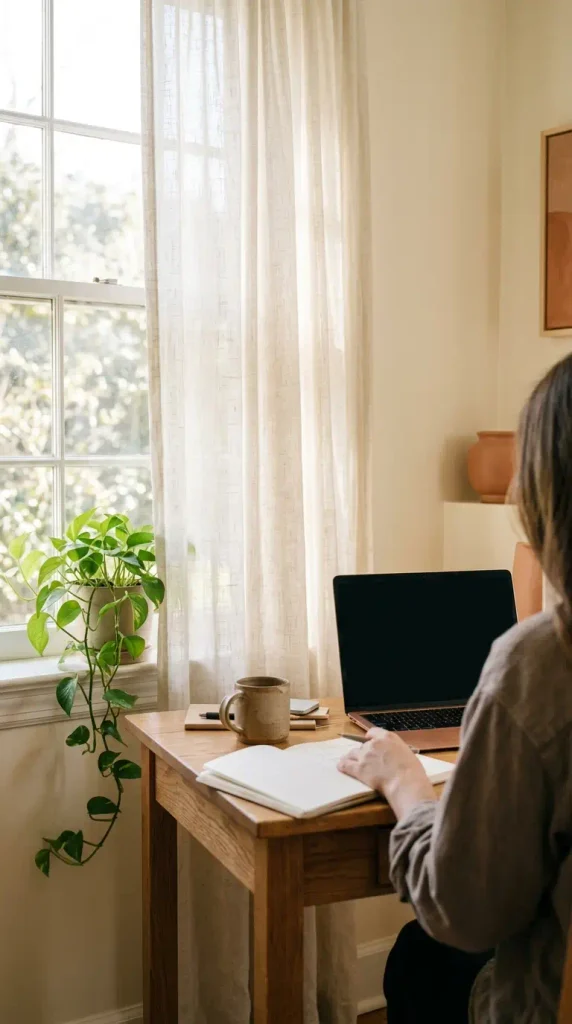
Turn the desk so the window sits to your left or right. Daylight falls across the desk instead of straight into your eyes or onto the screen.
Desk faces the glass. Bright sky behind the screen, glare by mid-afternoon, blinds shut by 3 p.m.
Desk sits at a right angle to the window. Side light on the desk, a readable screen, and the view still one head turn away.
We go deeper on this in our list of study nook mistakes that wreck your focus, including what to do when the only window is behind you. You keep the view. You just stop staring into it.
7. Split a Bedroom Office From the Bed With a Low Bookcase
Can you work six feet from your bed and still switch off at night? Yes, if the bed isn’t in your sightline all day.
Turn the desk perpendicular to the wall so your back, not your face, is toward the bed. Then set a low bookcase between the two zones. It reads as a wall without blocking light, and it gives you a place to drop work stuff that isn’t the nightstand.
Face the desk away from the bed or toward a side wall.
Use a low, open bookcase as the divider and keep heavy books on the bottom shelf.
Working from bed “just for today.” It becomes every day.
A tall unanchored shelf as the divider. Top-heavy units tip.
Close the laptop and slide it onto the bookcase shelf at night. Out of reach is out of mind.
8. Let the Entryway Console Do Double Duty
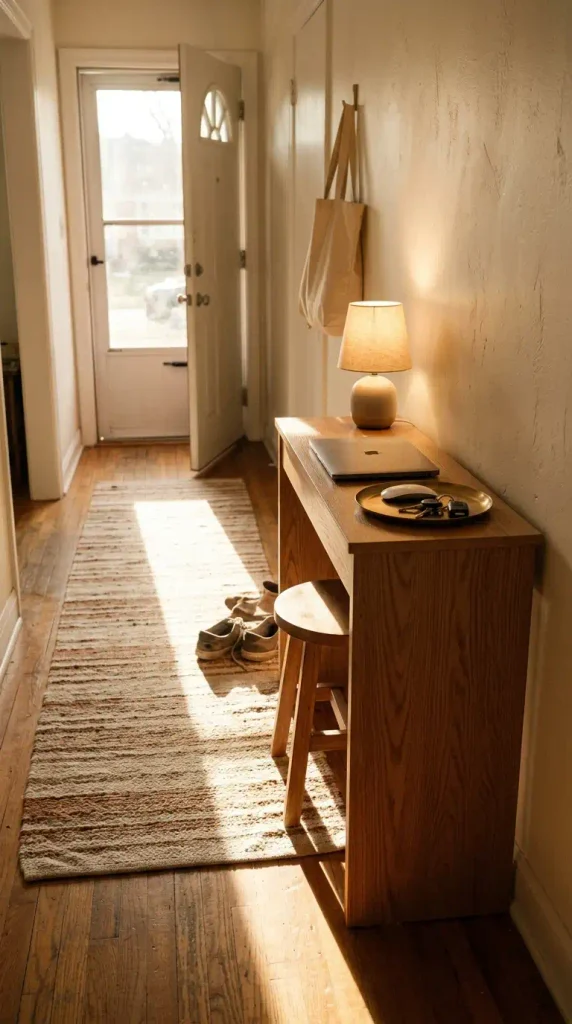
A console table is already a desk. It just hasn’t been asked.
Room & Board’s design team points out that console tables can stand in as a small desk in a narrow space, and the entryway is where most apartments hide one. Add a stool that tucks under, and the hallway you walk through twice a day becomes the spot where email gets answered.
If your entry also has to hold shoes and coats, our small entryway mudroom ideas without drilling show how to stack both jobs on one wall.
Test the depth with your laptop open before you commit. The base plus a little wrist room has to fit, or you’ll be typing with your elbows hanging off the edge.
9. Bridge a Desktop Between Two Bookcases
Two tall bookcases, a desktop bridged between them, and suddenly a blank wall reads like a built-in study. It’s the most library-looking idea on this list, and it fits a wall as narrow as two bookcases plus a chair.
The catch is height. Tall, narrow bookcases are exactly the furniture that tips.
- ▸Anchor both bookcases to the wall with the anti-tip straps that ship in the box.
- ▸Rest the desktop on cleats or shelf pins at around 29 inches, and don’t screw it to both units if the floor is uneven.
- ▸Load books bottom-up. Heavy reference books low, light decor high.
- ▸Renters: each strap leaves one small screw hole, an easy spackle job at move-out.
CPSC credits ten years of its campaign with a nearly 50 percent drop in tip-over injuries and deaths, and its Anchor It tip-over safety guidance starts with bookcases and dressers. Two straps. Ten minutes. Done.
10. Use the 20-Inch Screen Rule Before You Buy a Desk
Buy the desk for the screen, not the room.
Most small office setups go wrong in the same quiet way: the screen ends up a forearm away, and you spend the day leaning in. OSHA’s desk setup guidance for computer work says the monitor belongs directly in front of you, at least 20 inches away. In a small office, that one number decides what desk depth you can get away with.
Screenshot the card, take it shopping, and do the tape test in the store with the floor model.
11. Give the Corner Two Bulbs With Two Jobs
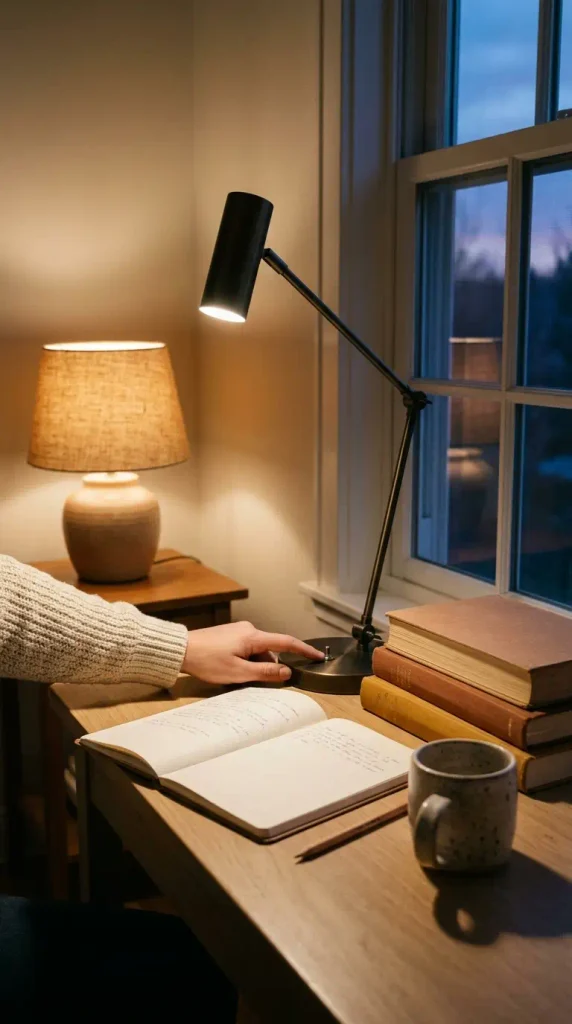
Light is where small offices fall apart after dark. One overhead fixture flattens everything, and a single dim lamp leaves your notebook in shadow.
Split the job between two lamps.
The numbers aren’t arbitrary. An LED around 800 lumens matches the brightness of an old 60-watt bulb, and bulbs in the 2700 to 3000K range give the soft, warm light incandescents used to. A cooler bulb near 3500K is the usual pick for work surfaces.
When the workday ends, click off the task lamp and leave the warm one on. The corner stops looking like a desk and starts looking like part of your home again.
12. Stack Storage Up the Wall, Then Stop
Build up, then stop. That’s the whole rule.
Vertical storage is how small offices survive, but a wall packed to the ceiling makes a 5-foot corner feel like a supply closet. Two or three shelves above the desk is plenty:
- One for daily things in a lidded box.
- One for books you actually reach for.
- One left half empty, so the wall can breathe.
Renters can skip the drill with a leaning ladder shelf or a narrow freestanding bookcase pushed against the desk’s side. Owners can float shelves straight above.
💡 Quick Tip
Hang the lowest shelf high enough that you can stand up from the chair without ducking. Sit, stand, and mark the wall where your head clears before you hang anything.
If your office lives where two walls meet, our corner bookshelf ideas on a budget cover shelves that fit the angle without wasting the inside corner.
13. Get the Cords Off the Floor in Four Moves
Cords are why a tidy small office still looks messy. On a 20-inch-deep desk, every charger cable shows.
OSHA’s desk guidance also warns against storing things like a computer tower under the desk, because it crowds your legs. The fix lifts everything off the floor.
Stick a power strip to the underside of the desktop near the back edge.
Hang a cable tray or a wire basket beneath it to hold the bricks and slack.
Bundle the desk cables with reusable hook-and-loop ties.
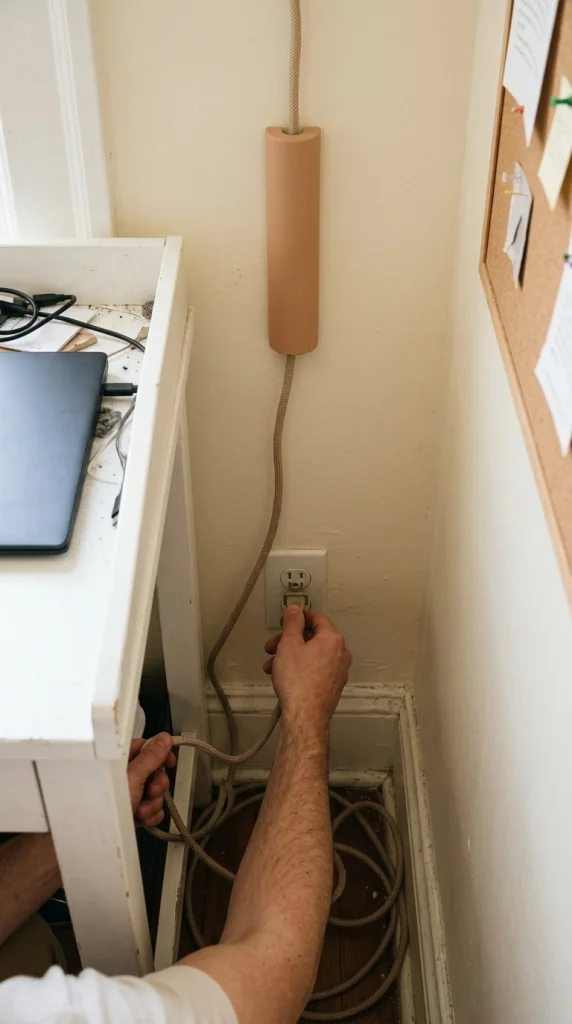
Run one single cord to the wall outlet, down a desk leg.
One cord, one outlet. The floor under the desk is clear for your feet, your vacuum, and nothing else.
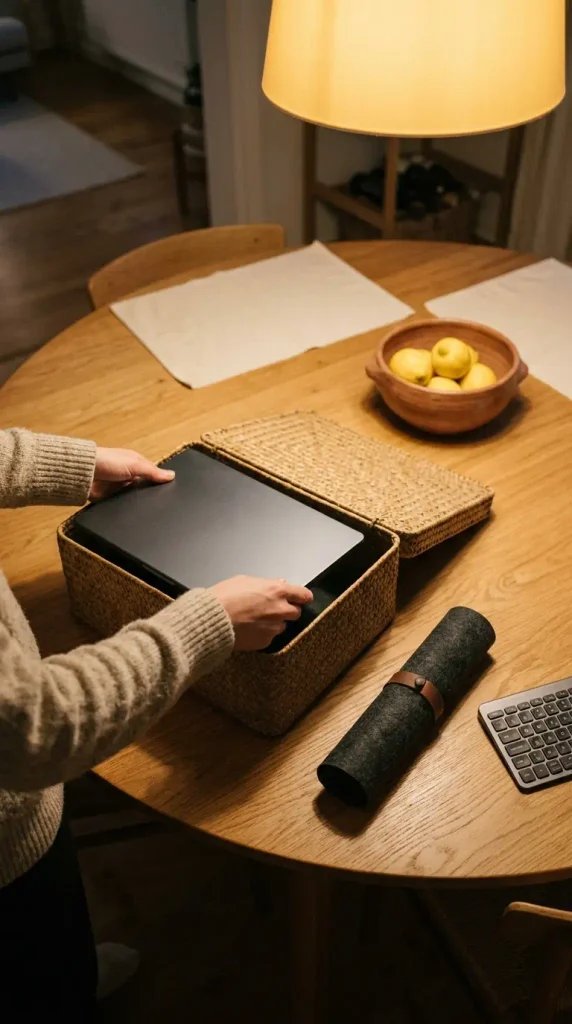
14. Pack the Office Into One Lidded Box
Not every apartment has a corner to give. Sometimes the office is the dining table from nine to five, and that’s a real setup if the packing is fast.
The trick is one container that holds everything, with a lid, so it can sit on a shelf looking like decor. A woven box with handles works, and so does a canvas bin.
What goes in the box
Set up in a few minutes, clear in two, and dinner never shares a table with your inbox.
15. Pick an Armless Chair That Disappears Under the Desk
The chair is the piece people forget to measure, and it’s often the piece that blocks the room.
Room & Board’s guidance is simple: an office chair with no arms takes up less space and can tuck fully under the desk. A comfortable dining chair can stand in too, if your workdays are short.
| Armless task chair | Dining chair |
|---|---|
| Tucks fully under most desks | Tucks under if the seat clears the apron |
| Height adjusts to your desk | Fixed height, so the desk has to match |
| Built for full workdays | Fine for an hour or two |
If your feet don’t rest flat once the seat height is set for the desk, add a footrest. A sturdy box under the desk does the job.
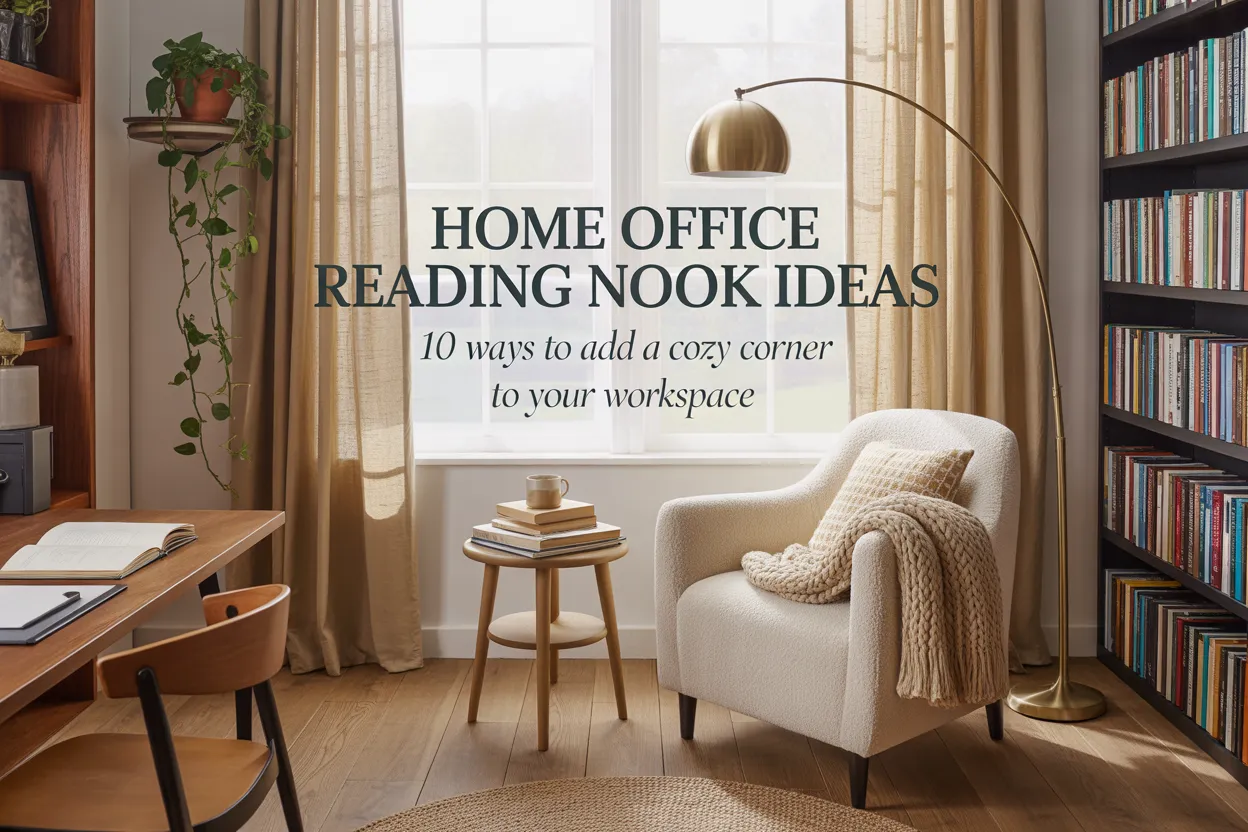
16. Add a Reading Chair a Few Feet From the Desk
Here’s what most small office lists skip: not all work belongs at the desk.
Reading a long report, sketching an idea, taking a call that doesn’t need a screen. Those go better in a second seat, even if it’s only three or four feet away. An armchair, a floor lamp with a warm bulb, and a throw that’s clearly been sat on. In the quiet after the laptop closes, you’ll notice how much softer a page sounds than a keyboard.
The desk is for screen work. The chair is for everything that doesn’t need one. Moving between them gives your eyes and your back a break without leaving the room.
Two seats, one corner. It’s the smallest change on this list that makes the space feel like more than a desk.

17. Soften the Echo Before Your Next Video Call
Tiny apartments echo. Hard floors, bare walls, and a desk pushed against drywall turn every keystroke into a clack and every call into a tin can.
Soft surfaces fix most of it, and all of them are renter-safe.
Test it with a call to a friend before and after the rug goes down. You’ll hear the difference in your own voice first.
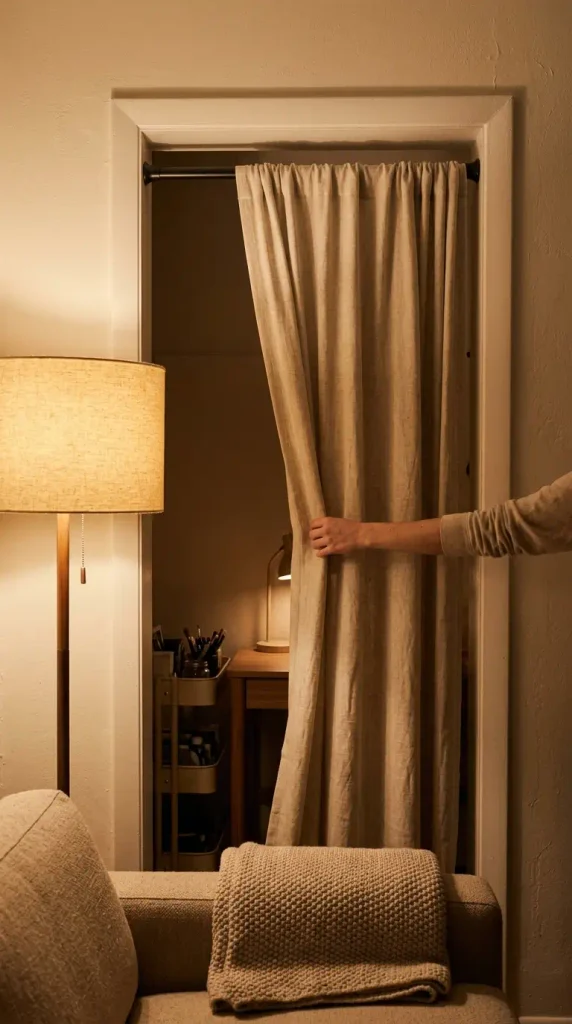
18. Hide the Whole Office Behind a Tension-Rod Curtain
At 6 p.m., the office should vanish.
A tension rod across an alcove or closet opening holds a linen curtain with no screws at all. Pull it across and the desk, the cart, the pinboard full of deadlines all drop out of sight. Your living room gets its evening back.
Laptop, cables, and a to-do list in full view from the couch all evening.
One pull of a linen curtain. The wall reads as soft fabric, and work waits until morning.
Choose a curtain a few inches wider than the opening so it overlaps the frame. Gaps at the edges show exactly what you’re trying to hide.
FAQ
What is the best desk for a small office?
The best desk is the one that fits your screen and your room. Room & Board notes that the most popular small desks are 30, 36, or 48 inches wide. Measure the spot, then check depth with the 20-Inch Screen Rule. If you work on a laptop only, a shallow console or wall-mounted desk works. With a monitor, choose a deeper desk so the screen and keyboard both fit.
How do I make a small office feel bigger?
Clear the floor first. Use vertical storage above the desk, an armless chair that tucks fully under, and lamps that mount on the wall instead of sitting on the desktop. Keep a few shelves partly empty so the wall doesn’t feel packed. Warm, even lighting from two sources also helps, because dark corners make a small room read smaller than it is.
Where should a desk go in a small room?
Put it at a right angle to the window, so daylight falls across the desk instead of onto your screen or into your eyes. In a bedroom, face away from the bed. Corners, closets, and the tall end of an under-stair space all work well, because nearby walls give you surfaces for storage and lighting without taking up more floor.
Can you put a home office in a bedroom?
Yes. Turn the desk perpendicular to the wall so the bed isn’t in your sightline, and use a low, open bookcase as a divider to separate the two zones visually. Keep work items off the nightstand. When work wraps up, close the laptop and put it on a shelf, or pull a curtain across the desk so the room feels like a bedroom again.
How do you hide cords in a small office?
Mount a power strip under the back edge of the desktop, then hang a cable tray or wire basket beneath it to hold chargers and extra cord length. Bundle the cables with reusable hook-and-loop ties, and run a single cord down one desk leg to the outlet. Keep the floor under the desk clear, since OSHA advises against storing items there that crowd your legs.
What light bulb is best for a home office?
Use two bulbs for two jobs. For the task lamp, an LED around 800 lumens matches an old 60-watt bulb, and a cooler white near 3500K suits work surfaces. For evening, a 2700K warm white lamp feels softer and more like home. Check the Lighting Facts label on the box, which lists brightness in lumens and light color in Kelvin.
Make the Corner Yours
A small office doesn’t need a spare room. It needs a corner you’ve measured, a screen at least 20 inches away, two lamps with two jobs, and a way to close it all off when the workday’s done.
Start with whichever idea solves the problem in front of you today. Maybe that’s taking the closet doors off this weekend. Maybe it’s just turning the desk sideways to the window tonight.
Save this list to your home office board so it’s there when you’re standing in the store with a tape measure. And when the desk is sorted, the reading chair from idea 16 is waiting.
Keep reading
More cozy nook ideas
 Home Office
Read →
Cozy Home Office Ideas: 10 Changes That Warm Up a Work Corner
Your desk is against a beige wall, under a ceiling light that makes everything look like a dentist’s waiting room, and you…
 By Room
Read →
One Corner, Two Lives: The Reading Nook Desk Combo That Fits a Small Bedroom
No bay window, no reno budget, no drill-friendly landlord required. You need one blank corner, about 5 feet of wall, and one…
 By Room
Read →
Home Office Reading Nook Ideas — 10 Ways to Add a Cozy Corner to Your Workspace
There is a very specific kind of tired that only comes from staring at a work screen for eight hours straight. Your…
One Comment