
Canopy Bed Ideas for a Romantic Cottagecore Bedroom

No four poster frame. No landlord permission. No renovation budget.
You need a rail, two panels, and one free afternoon.
Here is the part missing from every cottagecore canopy bed photo you have saved: a standard adhesive ceiling hook is rated for half a pound. A single linen panel weighs about a pound. Half the tutorials on your board end with fabric on your face at 2 a.m. and a gray adhesive scar on a ceiling you do not own.
So this covers nine looks, what each one really costs, where the rail goes down to the inch, and which versions survive drywall you are not allowed to touch.
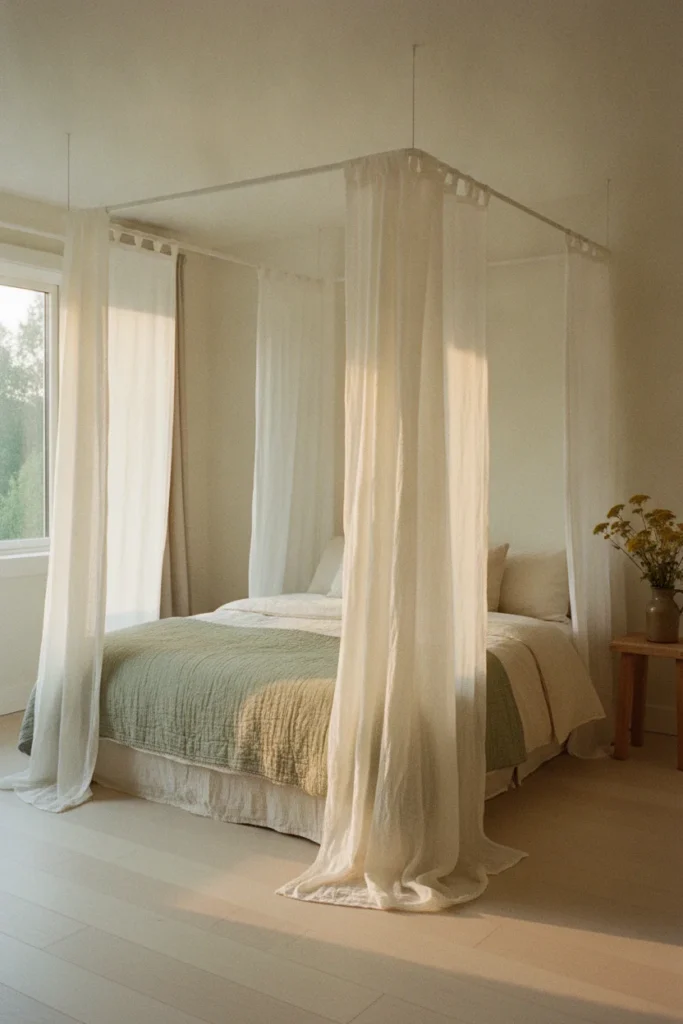
Nine Cottagecore Canopy Looks, Sorted by How Much You Have to Drill
Start here, because the ceiling decides everything else.
| # | The look | Holes in the ceiling? | Realistic cost | Best for |
|---|---|---|---|---|
| 1 | Two-hook wall swag | Zero | $15 to $35 | Renters, tiny rooms, first try |
| 2 | Tension rod half canopy | Zero | $25 to $50 | Alcoves, dormers, narrow walls |
| 3 | Wall-mounted corona | 2 to 4 in the wall | $45 to $110 | Low ceilings, headboard focus |
| 4 | Mosquito net dome | 1 in the ceiling | $30 to $70 | Fastest full enclosure |
| 5 | Ceiling rail rectangle | 9 or more | $210 to $290 | Owners, the full room-in-a-room |
| 6 | Existing four poster, draped | Zero | $20 to $60 | You already own the frame |
| 7 | Rope and branch swag | 2 in the ceiling | $35 to $80 | Rustic, cottage, wonky ceilings |
| 8 | Lace valance shelf | 2 in the wall | $30 to $65 | Vintage lace lovers, low budget |
| 9 | Four-rod square frame | 8 in the ceiling | $90 to $160 | Middle ground on cost |
Look 1 is first for a reason. It is the cheapest, the fastest, and the only one on this list you can undo in ninety seconds if you hate it.
What Makes a Canopy Bed Cottagecore Instead of Just Draped
A hotel drapes a bed. A cottagecore bed looks like fabric happened to it.
Four things separate the two, and none of them cost money.
Unlined, always. Cottagecore light passes through fabric. A lined panel blocks it and instantly reads formal. If you can see the window shape softly through the closed panel, you got it right.
Gathered, never tailored. Skip the pinch pleats and the tiebacks with tassels. Loose gathers, an uneven hem, one panel knotted halfway up. Wrinkles are the aesthetic, not a mistake.
Faded, not saturated. Ivory, oat, bone, unbleached muslin, palest sage. If a color is doing work in the room, it should be doing it in the quilt, not the drapes.
One pattern, maximum. A ditsy floral OR a lace edge OR a gingham tie. Two of the three and the bed starts arguing with itself.
If you are building the whole room and not just the bed, the same restraint governs everything else in it, and the five-rule version of that is laid out in these cottagecore aesthetic room rules.
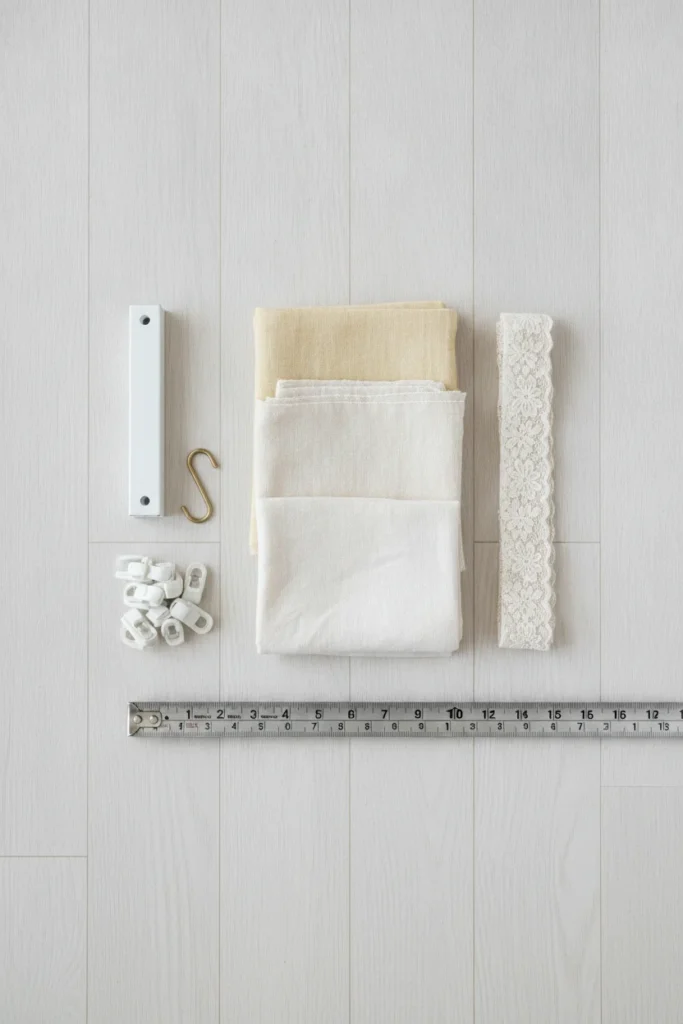
Look 1: The Two-Hook Wall Swag
The whole build is one long sheer panel and two wall hooks.
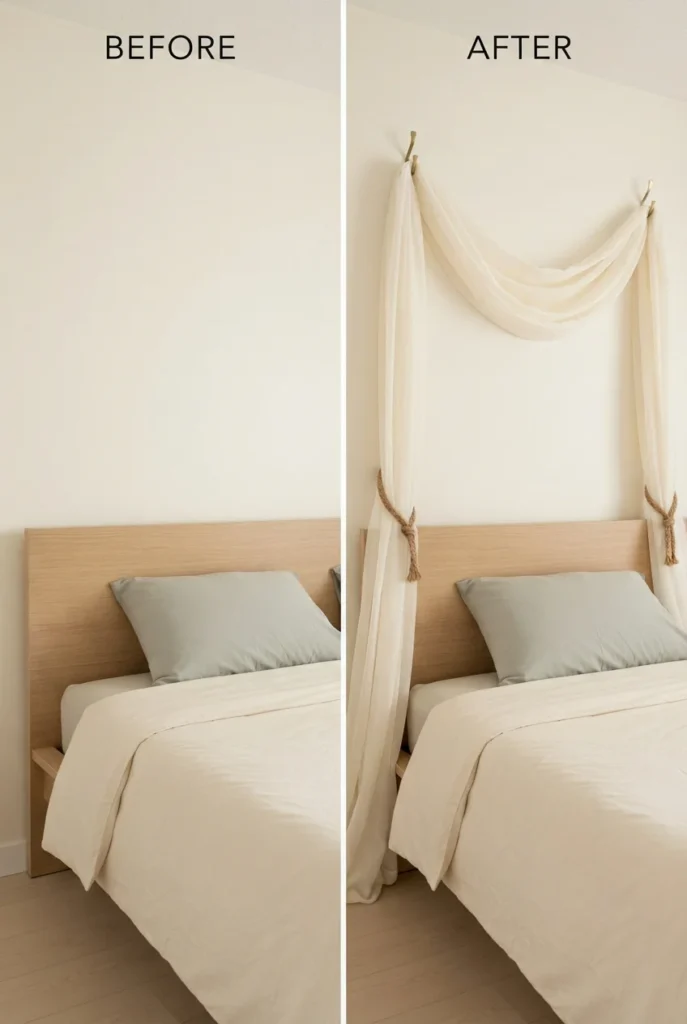
Place the hooks on the wall behind the bed, roughly 18 inches above the top of the headboard and about 12 inches wider than the bed on each side. Drape the panel’s center behind the headboard, run the two ends out to the hooks, and let the tails fall.
That is it. A queen setup takes one IKEA LILL sheer pair at $4.99 and two Command Large hooks rated at 5 lb each on the wall, where the rating is real.
What goes wrong: people hang the swag too low. If the fabric crosses below the top of the headboard, the bed reads shrunken instead of framed. Go higher than feels right, then step back to the doorway before you commit.
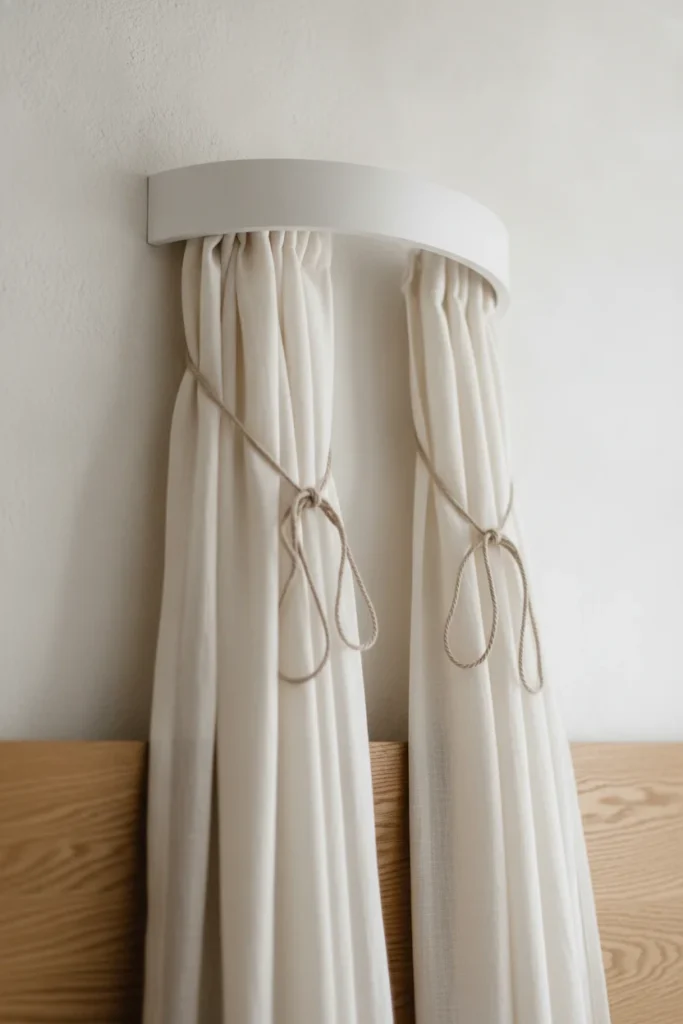
Look 2: The Corona, or Half Canopy, Over the Headboard
A corona is a small half-round or half-square bracket mounted on the wall above the headboard with panels falling from it to either side. It is the single best move for an 8 foot ceiling, because it never crosses the room horizontally, so it never lowers the visual ceiling.
It is also the most historically correct cottage option. Bed drapes existed for warmth and privacy long before they existed for a mood board, and a corona is closest to that original shape.
Panel math for a queen: two panels, each falling from about 84 inches down to the floor, held back with a soft linen tie at mattress height. Add a small-scale floral to the tieback only and you have grandmillennial territory, which layers pattern by scale rather than by quantity, exactly as these grandmillennial pattern layering rules set out.
What goes wrong: mounting the corona flat against the wall. It needs to project 8 to 12 inches out so the panels clear the headboard and fall in front of it, not behind.
Look 3: The Mosquito Net Dome, Out of Its Princess Era
A single-point net dome is the fastest full enclosure that exists: one hook, one net, done in ten minutes.
The reason it reads “eight-year-old’s birthday” by default is the trim. Factory domes ship with a glittery crown ring, satin ribbon, and often a fake rose garland. Cut all three off. Underneath is plain white mesh, which is genuinely lovely.
Then do the one upgrade that changes everything: hang a second layer of real fabric over the top third of the dome, so the crown of the net is opaque and the lower two thirds stay sheer. That single move takes it from costume to cottage.
What goes wrong: hanging the dome centered over the mattress. Center it over your pillow, about 20 inches in from the headboard, or the net closes across your face when you sit up.
Looks 4 Through 9, In Brief
Tension rod half canopy. One spring rod wedged across an alcove, dormer, or between two close walls, panels hung with clip rings. Zero holes. Test the rod with a hard downward tug before you trust it, because spring tension fails suddenly rather than gradually.
Ceiling rail rectangle. The full room-in-a-room. Costs and specs are in the build section below.
Existing four poster, draped. If you already own the frame, run panels at the two head-end posts only. Draping all four turns a queen into a closed box in a small room.
Rope and branch swag. A stripped birch or eucalyptus branch suspended horizontally on two lengths of natural jute rope, panels draped over it. Good for sloped attic ceilings where nothing square will fit.
Lace valance shelf. A narrow painted shelf above the headboard with vintage lace panels tacked to its front edge. Cheapest way to use real inherited lace without cutting it.
Four-rod square frame. Four standard curtain rods ceiling-mounted in a rectangle. Cheaper than a track system, but the corners never look as clean, so it suits a deliberately rustic room better than a crisp one.
The 12-Inch Halo Rule, and the Drape Length Nobody Gives You
Here is the rule the rest of the internet leaves out.
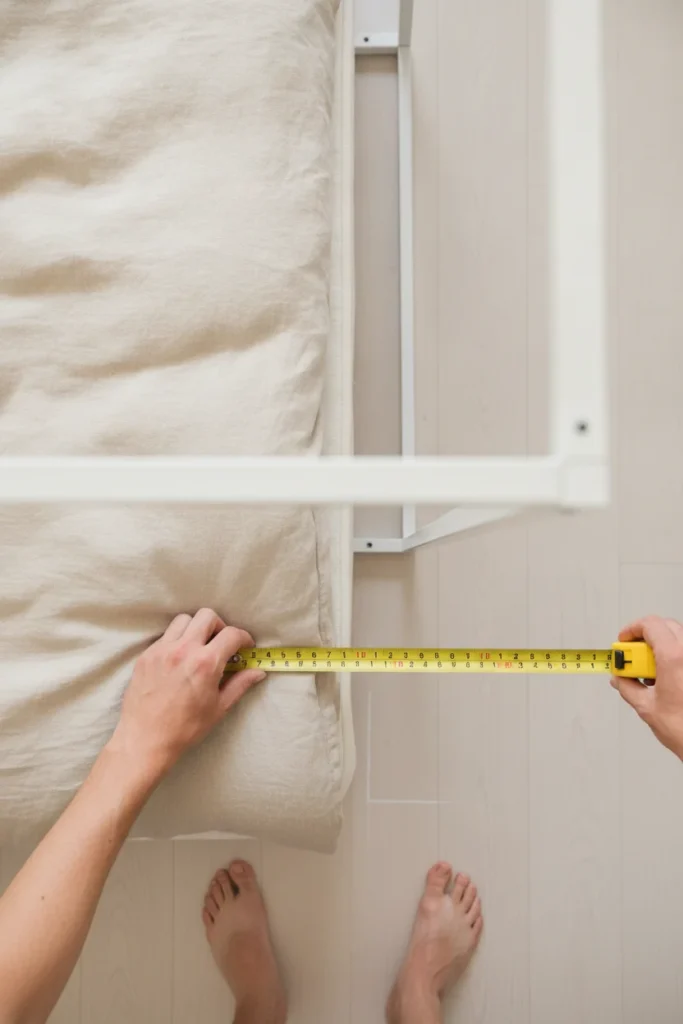
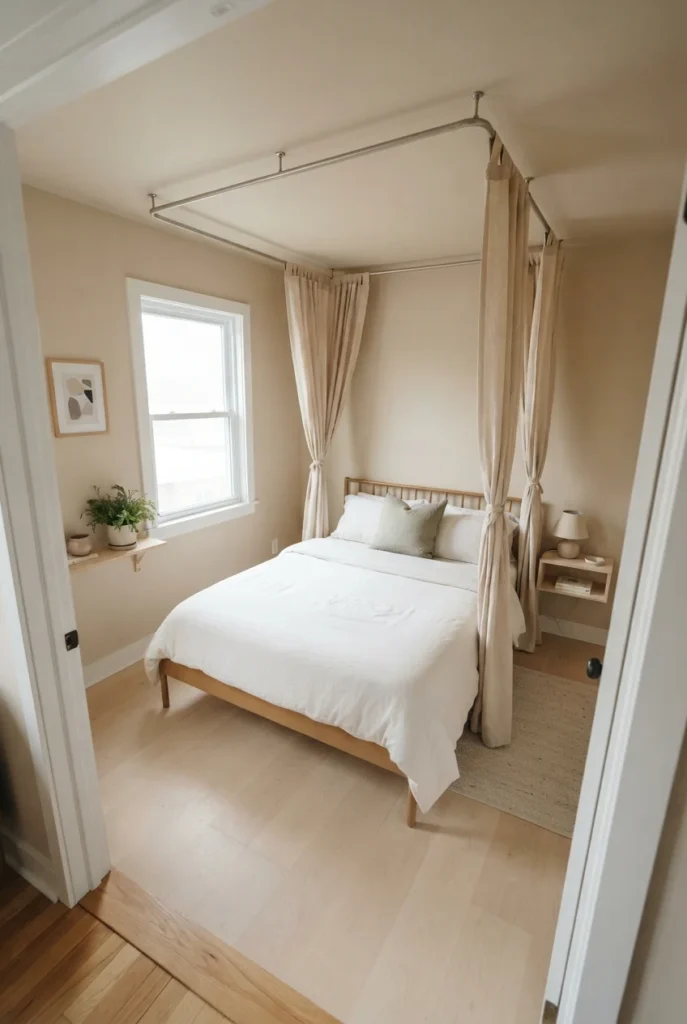
The 12-Inch Halo: the canopy rail sits 12 inches outside the mattress edge on all four sides. Not flush, not 24 inches. Twelve.
Flush to the mattress and the panels brush your arms all night. Much wider and the canopy stops framing the bed and starts being a tent that ate the room.
For a queen at 60 x 80 inches, the halo gives you a rail rectangle of 84 x 104 inches. That is your build footprint, and it also tells you whether the idea fits at all: you need 12 clear inches on every side, so a queen needs a 7 foot wide wall minimum before a full rectangle is realistic.
Now the drape length, keyed to your actual ceiling.
| Ceiling height | Rail height | Panel length for a floor pool | Panel length for the 6-inch float |
|---|---|---|---|
| 8 ft (96 in) | 94 in | 96 to 98 in | 88 in |
| 9 ft (108 in) | 106 in | 108 to 110 in | 100 in |
| 10 ft (120 in) | 118 in | 120 to 122 in | 112 in |
The 6-inch float is the second rule, and it is the one that matters in a rental. Hem the panels so they stop 6 inches off the floor. They stop wicking dust off the baseboard, they do not tangle in the vacuum, and nobody trips on them at 3 a.m. Floor-pooled panels photograph better. The 6-inch float lives better.
One useful accident of the math: the IKEA LILL sheer panel is 98 inches long, which lands exactly in the floor-pool range for a standard 8 foot US ceiling with no hemming at all.
Choose Your Fabric by Weight, Not by Vibe
Fabric weight is measured in GSM, grams per square meter, and it is printed on almost every listing if you scroll to specifications. It predicts drape better than any adjective in the product title.
| Fabric | Typical GSM | How it hangs | Cottagecore verdict |
|---|---|---|---|
| Polyester voile | 40 to 70 | Floats, catches every draft | Fine, but reads synthetic in daylight |
| Cotton muslin | 90 to 130 | Soft, slightly crinkled | Excellent, the sleeper pick |
| Lightweight linen | 120 to 160 | Falls in soft columns | The look you have been saving |
| Cotton lace | 100 to 180 | Stiff at the edges | Accents only, not full panels |
| Medium linen | 200 to 260 | Heavy, formal folds | Too grand, and too heavy to hang safely |
Aim for that 120 to 160 GSM band. Below it the fabric looks thin. Above it you get formal drapery, and the weight problem in the next section gets a lot worse.
Two non-obvious notes. Wash and line-dry linen panels before you hem them, because linen shrinks on first wash and a pre-hemmed panel will end up 3 inches short. And unbleached muslin at around $4 a yard is the closest cheap fabric to the expensive look, because it has the same matte, slightly irregular surface as washed linen.
There is also a sensory difference nobody photographs. Panels around a bed absorb high-frequency sound. A draped bed is measurably quieter than an open one, and if you live above a street or beside a shared wall, that muffling is half the reason the setup feels like a retreat.
The No-Drill Build That Holds More Than Half a Pound
This is the section that saves your security deposit.
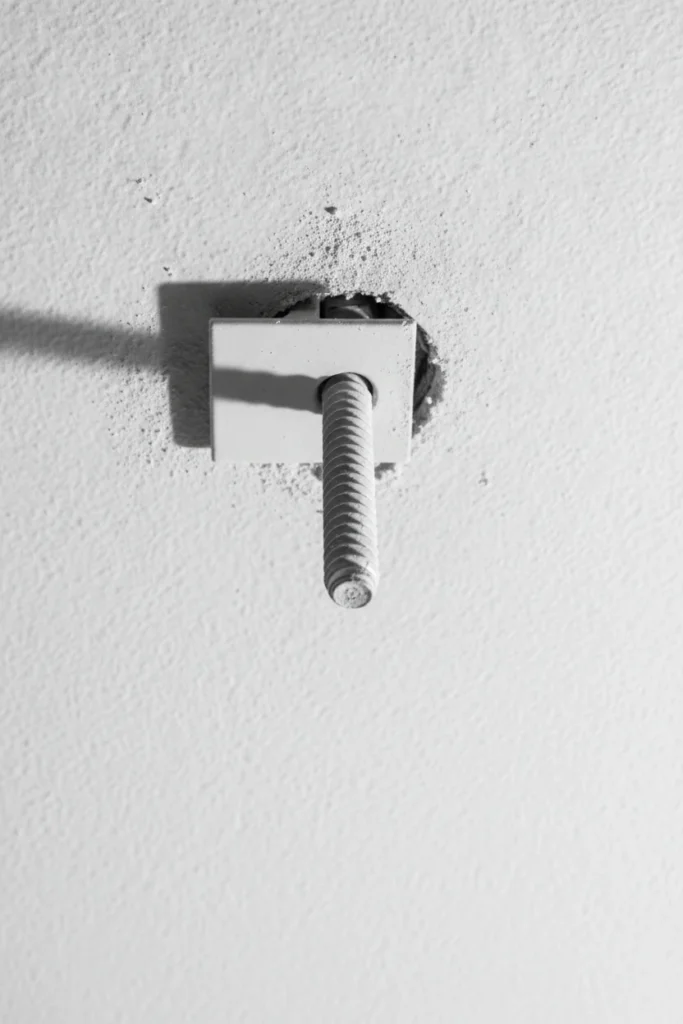
A standard Command Ceiling Hook is rated at 0.5 lb per hook. Half a pound. That is the manufacturer’s own number, not a cautious internet estimate.
Now weigh what you are asking it to hold. A 54 x 96 inch panel of 140 GSM linen covers 3.35 square meters, so it weighs roughly 469 grams, about 1.03 lb. One panel is already double the rating. Two panels on one hook is quadruple it.
So the hook does not fail on day one. It creeps, slowly, and lets go somewhere around 2 a.m. on night nine.
Three things actually work.
Move to the wall. Wall-mounted adhesive hooks are rated far higher than ceiling ones, ranging from 1 lb for a small hook up to 7.5 lb for a jumbo, and you can confirm any specific hook against the official Command product weight limits before you buy. Shear load on a wall is a completely different physics problem from dead load on a ceiling. Looks 1, 2, 3 and 8 all use walls, which is exactly why they are the renter picks.
Go lighter than linen. The IKEA LILL sheer pair weighs 14 oz for two panels, so each panel is about 7 oz, or 0.44 lb. That is the one common sheer that fits under a ceiling hook rating with any margin at all, and at $4.99 a pair it is also the cheapest.
Or drill properly, once. If you are allowed to make holes, do not use plastic wall plugs in a ceiling. A SNAPTOGGLE toggle bolt is rated up to 238 lb in half-inch drywall. Two of those hold a full rail system with an enormous margin, and they leave a single small hole that patches in five minutes with lightweight spackle.
For reference on the rail itself: an IKEA VIDGA single track rail runs $25.00, spans 55 1/8 inches, includes two ceiling fittings, and is rated to 11 lb. IKEA’s own queen-bed canopy spec calls for five rails plus two corner pieces, nine ceiling fittings, two glider packs, and two curtain pairs. Rails alone come to $125, and the full build realistically lands between $210 and $290 depending on which curtains you choose. (Prices verified on IKEA US listings August 13 2026 and subject to change.)
Small Room? A Canopy Can Add Height or Steal It
Straight answer to the question everyone asks: a canopy makes a small room look taller if the rail sits within 4 inches of the ceiling, and shorter if it hangs lower than that.
The eye reads the topmost horizontal line in a room as the ceiling. Put your rail at 94 inches under a 96 inch ceiling and the eye still reads 96. Drop that same rail to 84 inches and you have just given yourself a 7 foot ceiling.
Three more small-room rules that hold up.
Use the thinnest frame or rail you can find, because visual bulk costs more perceived space than the fabric does. Keep panels at the corners only rather than closing all four sides, which is the same advice working designers give for the current canopy revival. And match the panel color to your wall color, since contrast is what makes a canopy feel like an object taking up room.
If your bed genuinely cannot take a canopy, the room is too tight, or the ceiling is textured popcorn that adhesive will never hold, the cottage-retreat feeling is easier to build in a corner anyway. That build is covered start to finish in this dead corner reading nook build.
The Evening Layer, and Where the Candles Go
The canopy is a daytime object until you light it. After dark it becomes the reason you go to bed early.
Warm bulbs at 2700K, on a dimmer, from two sources at mattress height or lower. Never the ceiling fixture, which now has fabric hanging under it and will glow through the panels like a streetlight through a curtain.
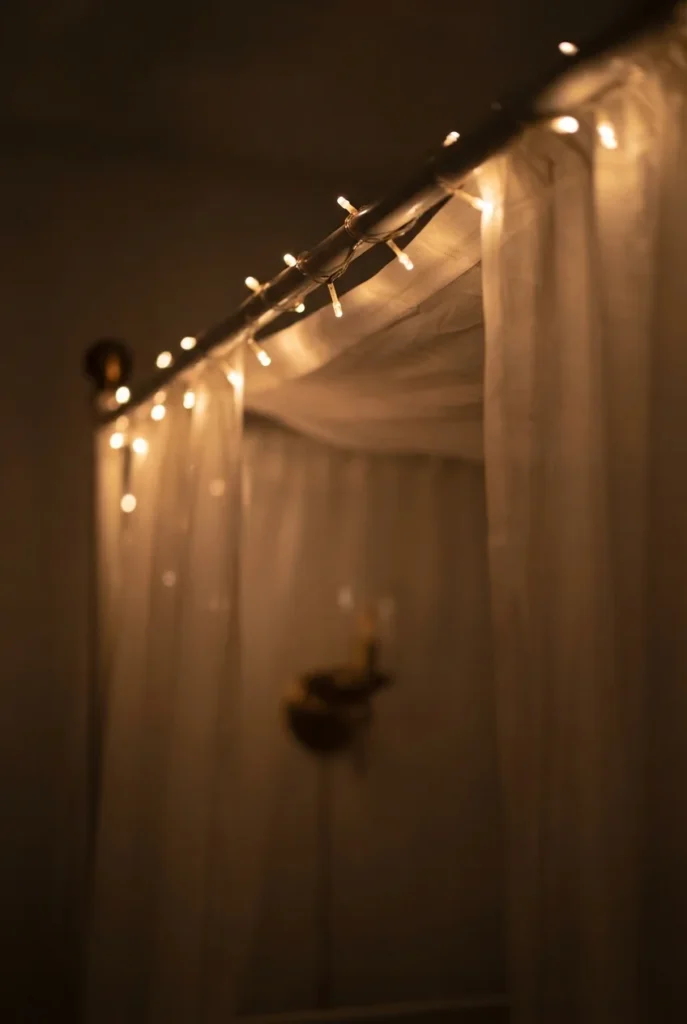
A plug-in sconce on the wall behind the panels is the best-looking option, because the panel diffuses the light and the whole bed turns into a lantern. A clip-on reading light on the rail is the practical one, since it points down at your book instead of at the fabric. Warm string lights woven along the top rail are the pin-worthy one, and they are safe because LED string lights run cool.
Candles are where this stops being a decor question.
The US Fire Administration’s guidance is direct: keep candles at least 12 inches from anything that can burn, and do not use lit candles in bedrooms or sleeping areas at all. An average of 20 home candle fires are reported every day in the US. You have just hung sheer fabric in a moving air current directly over your pillow, so the federal candle fire safety guidance is worth following exactly here. Battery-operated flameless candles on the nightstand get you the same flicker with none of the risk, and inside a draped bed they are the only version that makes sense.
If you want the smell without the flame, that job belongs to a beeswax melt on the dresser well outside the halo, or a linen spray on the panels themselves.
Dust, Washing, and the Fabric Above Your Face
Nobody warns you about this one, so here it is.
A horizontal canopy rail is a shelf. Within about three weeks a visible gray dust ridge forms along the top edge, directly above where you breathe for eight hours a night. If anyone in the bed has dust allergies, this is the deciding factor for the whole project, and it is a real argument for the corona and swag versions, which have no horizontal top surface at all.
The routine that keeps it manageable: run a microfiber duster along the rail top every two weeks, and wash the panels every eight to twelve weeks.
Washing rules that prevent the two common disasters. Cold wash on gentle, because hot water shrinks both linen and cotton muslin significantly on the first cycle. Line dry or tumble on the lowest heat for fifteen minutes only, then rehang them slightly damp so gravity presses the creases out, which saves you ironing 98 inches of fabric. Never bleach unbleached muslin, which sounds obvious and still happens constantly, because it turns the warm oat tone to a flat blue-white and the cottage quality disappears completely.
One trade-off worth naming plainly. A closed canopy reduces air circulation around the bed, so it sleeps roughly a degree or two warmer. In winter that is a genuine benefit and the original historical purpose of bed curtains. In an August bedroom without central air, it is the reason people take them down in July and forget to put them back up.

The Under-$40 Version, Start to Finish
If you want to test whether you even like sleeping under fabric before spending real money, build this one.
- One pair IKEA LILL sheer curtains, $4.99, 110 x 98 inches each
- Two Command Large wall hooks, 5 lb rated, roughly $6 to $9 for a pack
- One 3 yard length of natural jute twine, roughly $4
- Optional: one warm white LED string light set, $8 to $15
Mark your two hook points on the wall 18 inches above the headboard and 12 inches wider than the bed on each side. Press each hook for 30 seconds and then wait a full hour before hanging anything, which is the step everyone skips and the reason most adhesive failures happen. Drape the panel center behind the headboard, loop each end over a hook, tie off loosely with jute, and let the tails fall to the 6-inch float.
Total: about $16 without lights, about $30 with them. Two hours including the wait. Zero holes.
Sleep under it for a week. If you wake up and the room feels tucked-away instead of closed-in, then go build the rail version.
Cottagecore Canopy Bed FAQ
How do you make a bed canopy without drilling? Move the load from the ceiling to the wall. Two adhesive wall hooks rated at 5 lb each, one long sheer panel, and jute ties give you a full swag with zero holes. Ceiling-mounted adhesive hooks are rated at only 0.5 lb, which is less than a single linen panel weighs, so they are not a real option for anything heavier than a lightweight polyester sheer.
What is the best fabric for a cottagecore bed canopy? Lightweight linen in the 120 to 160 GSM range, unlined and unbleached. Cotton muslin at 90 to 130 GSM is the cheap alternative and looks nearly identical once washed. Skip lined drapery and anything shiny, because cottagecore depends on light passing through the fabric.
Does a canopy bed make a small room look smaller? Only if the rail hangs low. Mount it within 4 inches of the ceiling and the room still reads its full height. Hang it at 84 inches under a 96 inch ceiling and you have visually removed a foot. Use a thin rail, keep panels at the corners rather than closing all four sides, and match the panel color to the wall.
How much fabric do you need for a bed canopy? For a queen using the 12-Inch Halo Rule, your rail rectangle is 84 x 104 inches, giving a 376 inch perimeter. For gathered fullness, buy about 1.5 times that in total panel width, so roughly 560 inches, which is four to six standard panels. For a two-hook swag you need one panel of at least 110 inches wide.
Can you have a canopy bed without a canopy frame? Yes, and seven of the nine looks here do exactly that. The rail rectangle, corona, swag, net dome, rope and branch, lace valance, and tension rod versions all attach to the ceiling or wall rather than to the bed, so any bed frame works, including a plain platform or a floor mattress.
Are fairy lights safe on a bed canopy? Warm white LED string lights are, because LEDs run cool to the touch. Avoid older incandescent string lights near fabric entirely. Keep the plug and transformer outside the drapes, do not run lights under the panels where fabric can bunch against them, and switch them off before sleeping.
How do you wash canopy bed curtains? Cold water on gentle, then line dry or tumble on lowest heat for no more than fifteen minutes. Rehang while slightly damp so the weight pulls the wrinkles out. Wash linen and muslin before hemming, since both shrink noticeably on the first cycle. Plan on washing every eight to twelve weeks.

Start With the Rail Height
Before you buy anything, do one thing tonight.
Stand in your bedroom doorway and hold a tape measure up to the ceiling above your bed. If you have 94 usable inches, the full rail rectangle is on the table. If a ceiling fan, a sloped attic wall, or a landlord’s textured popcorn ceiling says otherwise, you are building a corona or a swag, and honestly, in a room under 120 square feet those often look better anyway.
Measure first. Buy second. The whole project either works or it does not at that one number.
Once the bed is done, the rest of the room has to earn its place beside it, and the five-rule version of that is the natural next read.
Keep reading
More cozy nook ideas
 Bedroom
Read →
Bedroom
Read →
English Cottage Bedroom Checklist: Everything to Decide Before You Start
You saved forty pins of floral quilts and sloped ceilings, then looked up at your own bedroom: beige walls, one window, a…
 Bedroom
Read →
Bedroom
Read →
21 Small Bedroom Ideas for Couples
Sixty-two and a quarter inches. That’s the width of a common IKEA queen storage frame, and in a 10 by 10 foot…
 Bedroom
Read →
Bedroom
Read →
Floral Bedding Ideas for a Cottagecore Bedroom That Still Looks Right in Daylight
No painting. No drilling. No conversation with your landlord. Floral Bedding Cottagecore is the one cottagecore move you can make in an…