
Cottagecore Christmas Decor: 12 Ideas You Can Actually Pull Off in a Rental

No mantel. No exposed beams. No landlord who’s delighted about you putting holes in the plaster.
Most cottagecore christmas decor you’ve saved to a board was shot in a farmhouse with a working hearth and 12-foot ceilings, which is exactly why it collapses when you try it in 700 square feet. The greenery has nowhere to drape. The candles have nowhere to sit.
So here’s the version that actually transfers. Twelve ideas built on three materials, one color rule you can apply in about four seconds, and a totaled budget that lands near $180. Every measurement below is a real one: oven temperature, slice thickness, bulb Kelvin, quarts of water per inch of trunk. You’ll finish this page knowing what to buy, what to skip, and what to do first.
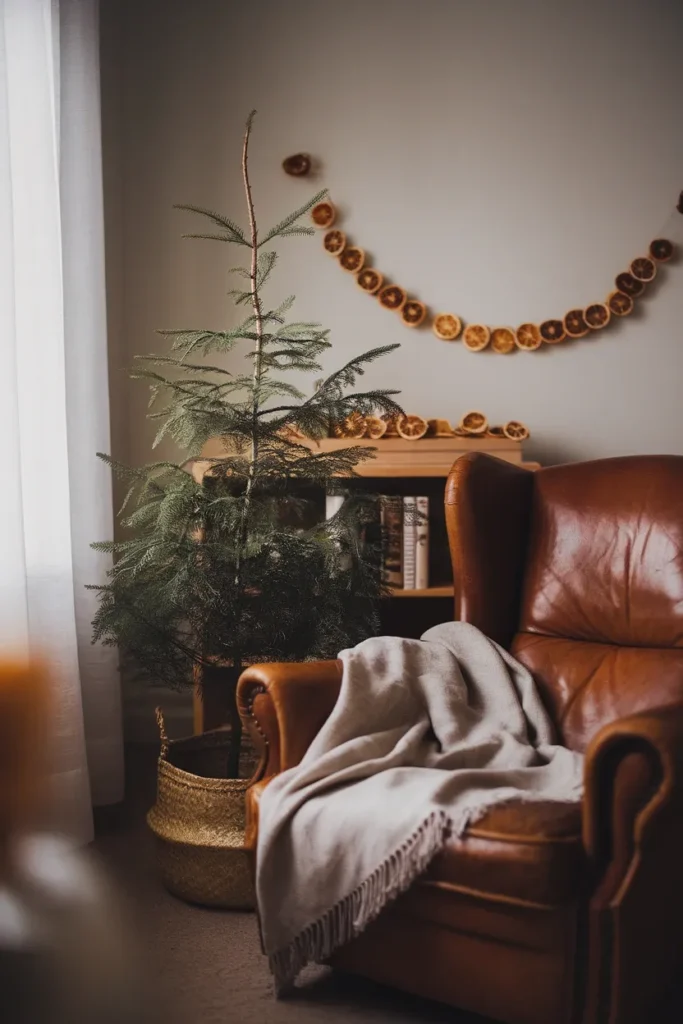
Start With Three Materials, Not Thirty
If you buy nothing else this season, buy these three. They carry the whole look, and they’re the reason cottagecore Christmas reads as collected rather than purchased.
- Dried citrus. Orange slices you dry yourself. Under $5 gets you an entire garland.
- Real or convincing greenery. Cedar, noble fir, or eucalyptus. One 6-foot garland is genuinely enough for a small space.
- Unbleached natural fiber. Jute twine, cotton lace, raw linen. This is the connective tissue that makes everything else look related.
Everything else is optional. Bottle brush trees, brass bells, wooden bead garland, paper village houses: all lovely, none load-bearing. Buy them after the three above are in place, not before.
The 60/30/10 Nature Rule
Here’s the thing that separates cottagecore Christmas from farmhouse Christmas and from traditional Christmas, and almost nobody names it out loud.
In every vignette you build, aim for roughly 60% plant matter, 30% textile, 10% shine.
Farmhouse flips it to textile-heavy. Traditional flips it to shine-heavy (glass, foil, metallic ribbon, tinsel). Cottagecore stays plant-dominant, which is why a cottagecore mantel photographs as though someone walked in from a garden and set an armful down.
Apply it as a sanity check. Stand back from any corner you’ve styled, squint, and ask whether plants are winning. If tinsel or glass is winning, pull something out.
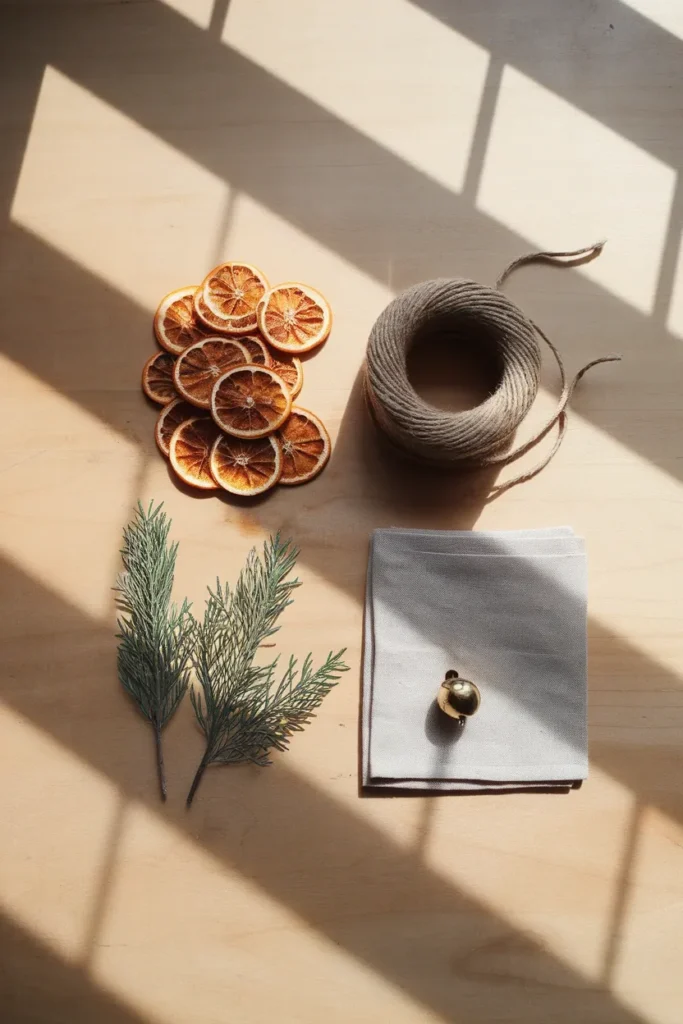
Dry Your Own Orange Garland (200°F, 1/4 Inch, About 3 Hours)
Store-bought dried citrus runs several dollars for a small bag. Your oven does it better and the house smells like mulled wine for two days, which is a real and underrated part of the payoff.
The specs that matter:
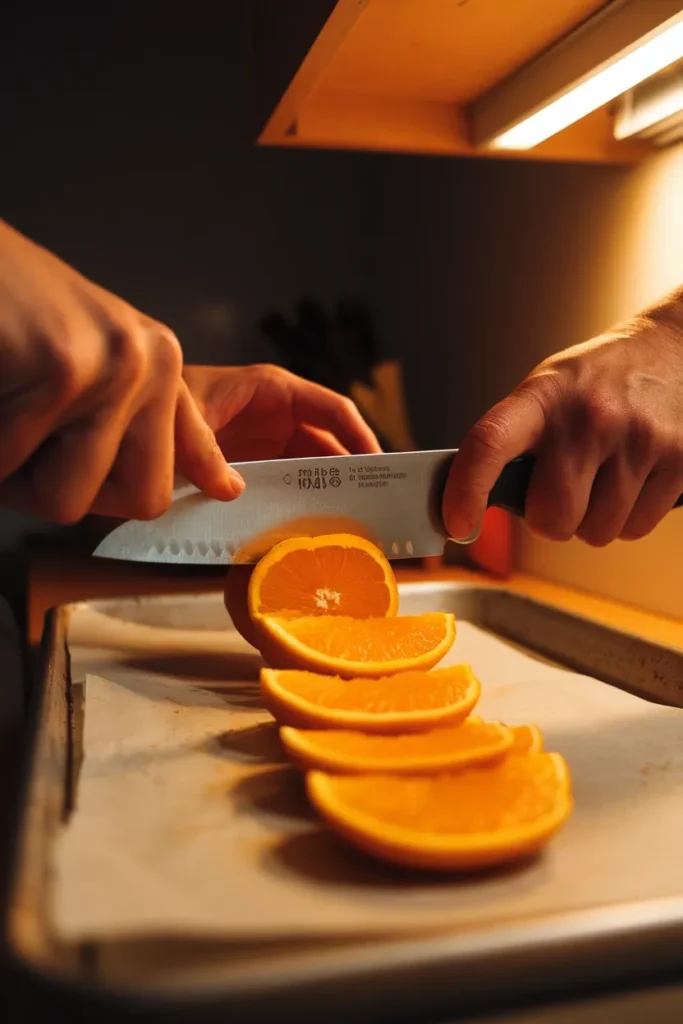
- Slice the oranges to 1/4 inch. Thinner ones scorch at the edges and go brittle. Thicker ones stay leathery in the middle and eventually mold on the string.
- Oven at 200°F, low and slow. Anything hotter caramelizes the sugars and you lose the translucency, which is the entire point.
- Total time is around three hours, flipping every 45 minutes. Blot the slices with a paper towel before they go in.
- Thread on jute twine with a large-eye needle, knotting between slices so they don’t slide into a clump at one end.
Navel oranges give you the cleanest sunburst pattern when backlit. Blood oranges dry to a deeper rust that reads gorgeous in a dark room and nearly black in a bright one, so save those for a lamp-lit corner rather than a window.
Failure mode: if you skip the blotting step or pull them while they’re still slightly tacky, they’ll bloom white mold along the pith within about two weeks. They must be completely dry and leathery-crisp before threading.
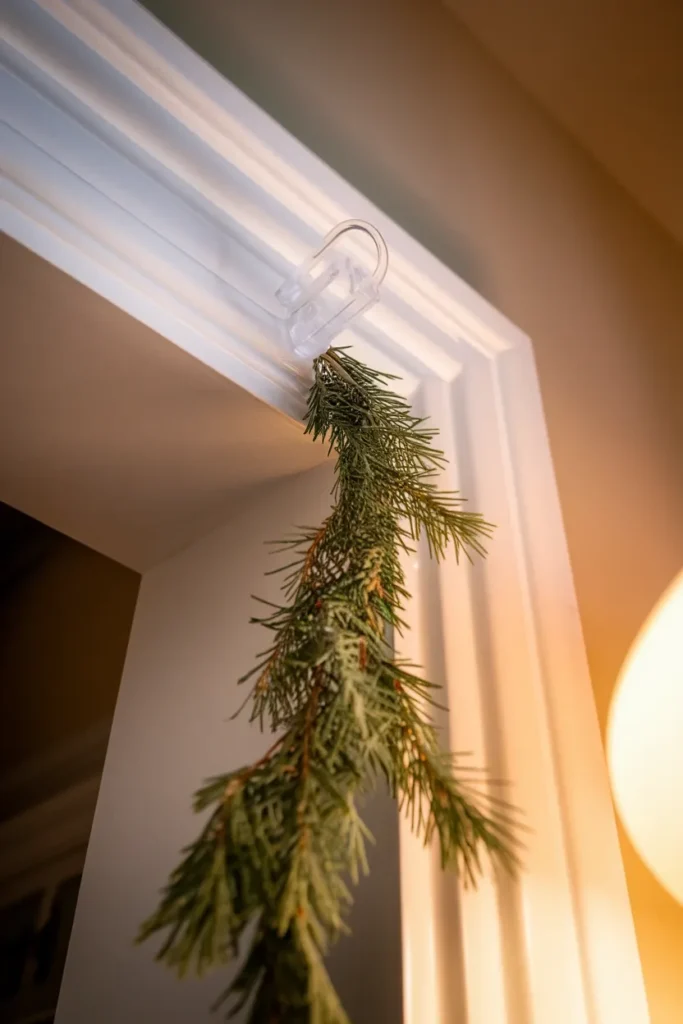
Hang Greenery Without a Single Nail
This is where the renter version diverges hard from every farmhouse tutorial, and it’s the section worth screenshotting.
Greenery needs an anchor, and you have four that leave nothing behind:
- Tension rod inside a window reveal. Drape a 6-foot cedar garland over it and let both ends fall unevenly. Uneven is correct. Symmetry reads as retail display.
- Adhesive hooks on the top edge of a door casing, not on painted drywall. Casing paint is almost always harder enamel and releases far more cleanly.
- Bookshelf lips. Loop the garland along the front edge of a bookcase and let it dip between shelves. Costs nothing, damages nothing.
- Existing curtain rod. A swag across the top of a sheer curtain gives you the dormer-window look with zero hardware.
Weight is the thing people get wrong. Fresh cedar and fir are heavy and get heavier as they dry unevenly, so anything adhesive should be rated well above what you think you need, and it should go up on a clean, dry, room-temperature surface. If your walls are that chalky matte paint landlords love, assume nothing adhesive is safe and work off the rods and shelves instead. Our full breakdown of no-damage rental decor strategies covers the surfaces worth testing first.
One more small thing: hang greenery slightly higher than feels right. Eye level makes a room feel shorter. A few inches above draws the ceiling up.
Where You Can Legally Cut Your Own Greenery
Every cottagecore Christmas article tells you to forage. Not one of them tells you where that’s actually allowed, which is a strange gap given how much of this aesthetic depends on it.
Cutting greenery or a tree on National Forest land requires a Forest Service permit first. The rules are specific and worth knowing before you drive out with clippers: the trunk must be six inches or less in diameter, cutting must happen at least 200 feet from main roads, recreation sites, and campgrounds, and it’s one tree per tag. Never top a tall tree for its crown. Most holiday permits are issued in November, so this is a plan-ahead item rather than a December-weekend impulse.
For boughs, cones, and decorative greenery specifically, the guidance is to call your local forest or grassland district office and ask what permit covers what you want. The rules vary by district, which is precisely why blanket “just go forage” advice is useless. The Forest Service tree cutting guidelines lay out the process for both trees and other forest products.
Two options that need no permit at all:
Your own yard, or a friend’s, with permission. Hollies, magnolias, boxwood, and cedars all take a light trim in December without harm.
The Christmas tree lot. Ask for the trimmings. Lots cut the bottom branches off nearly every tree they sell and pile them behind the stand. Most will hand you an armful for free or close to it, and it’s the same fir you’d have paid $30 a garland for.
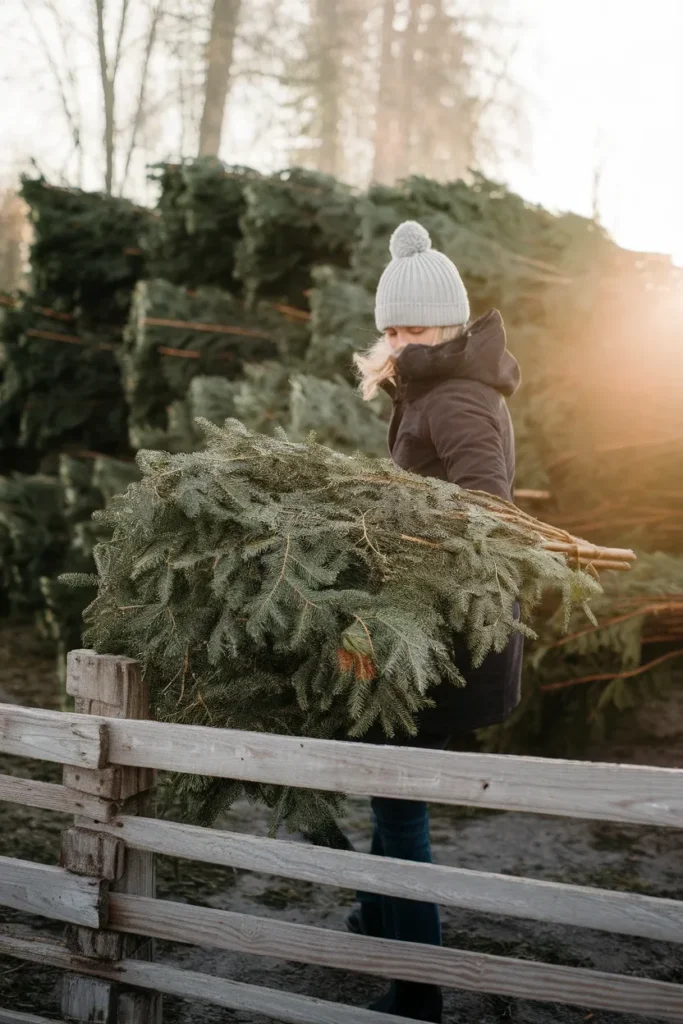
The Real Tree Math Nobody Puts in an Article
If you want the real fir, and the smell is a legitimate reason to want it, there’s arithmetic involved that gets left out of every inspiration post.
A tree drinks roughly one quart of water per inch of stem diameter, per the National Christmas Tree Association care guidelines. That’s not a suggestion about stand size, it’s a daily consumption rate. Run the numbers before you buy:
| Trunk diameter | Water it can drink per day | Minimum stand capacity you need |
|---|---|---|
| 3 inches | 3 quarts | 1 gallon |
| 4 inches | 4 quarts | 1 gallon, refilled daily |
| 5 inches | 5 quarts | 1.5 gallons |
| 6 inches (USFS permit cap) | 6 quarts | 2 gallons |
Typical stands hold one to two gallons, and a fresh tree can pull up to two gallons on a heavy day, which means a 6-inch trunk in a 1-gallon stand will run itself dry between your morning coffee and dinner. Check it daily and never let the water drop below the cut base.
Two more numbers that decide whether your tree makes it to New Year’s. Make a fresh cut removing about a half-inch disk from the bottom before it goes in the stand, since the original cut seals with sap. And get it into water fast: most species can sit six to eight hours after cutting and still take up water normally. Past that window, uptake drops off.
The honest trade-off: a potted living fir in a woven basket solves the watering panic, costs more up front, and weighs a great deal more than you expect when it’s time to move it. In a walk-up apartment that weight is the deciding factor, not the price.
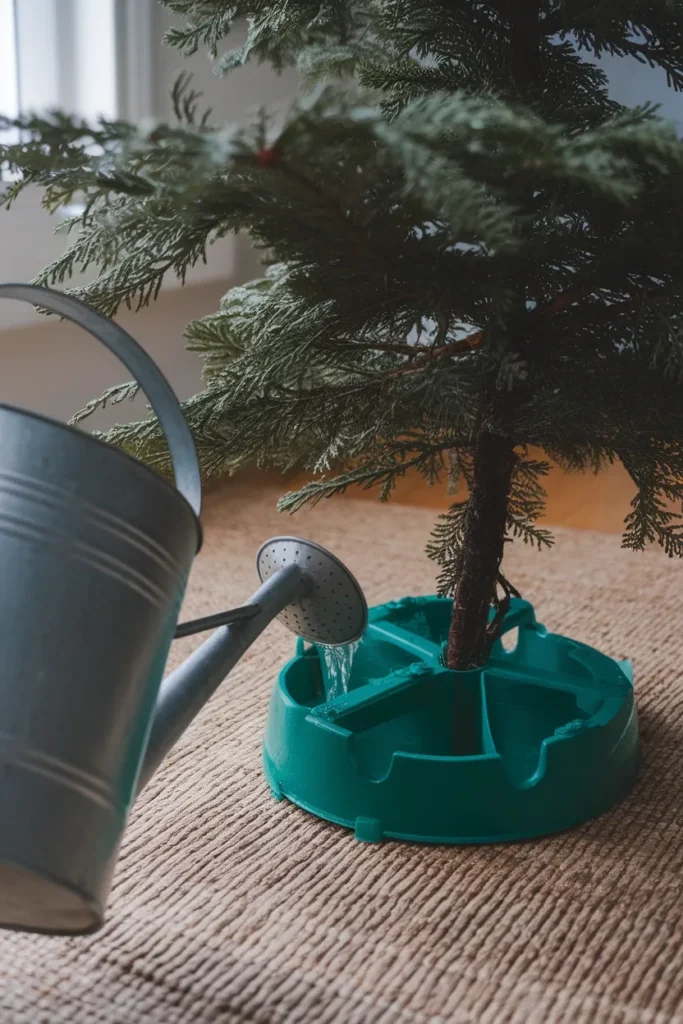
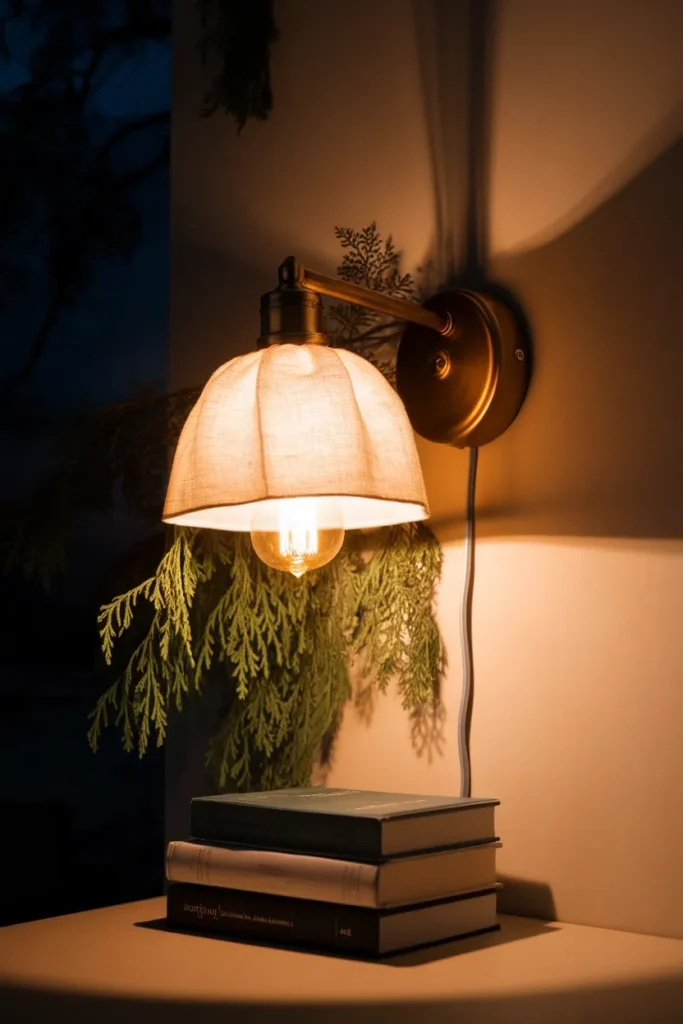
Set Every Bulb to 2700K and Stop There
Lighting is where most cottagecore Christmas attempts quietly fall apart, and it costs almost nothing to fix.
Warm white sits at 2700K. That’s the number printed on the box, usually in small type near the lumens. Anything at 3000K starts going clinical, and 4000K or above turns dried oranges a flat brown and makes linen look gray. String lights are the worst offenders because “warm white” on packaging is applied loosely, so check for the actual Kelvin figure rather than trusting the label.
Three placements that do the heavy lifting in a small room:
- A plug-in wall sconce beside the chair you’ll actually read in, which gives you the pool of light a ceiling fixture never will.
- A swing-arm floor lamp angled down onto a side table, not out into the room.
- Fairy lights buried inside greenery, not draped across it. Tucked into the depth of a garland they read as candlelight. Laid on top they read as a dorm room.
Kill the overhead entirely after dark. One overhead fixture flattens every texture you’ve spent the afternoon layering, and texture is the whole aesthetic. If you only own overhead lighting, a $15 dimmer switch or a couple of lamps will do more for these photos than another $50 of ornaments. We go deeper on building warm lighting layers in small rooms if your place is stuck with a single ceiling fixture.
Candle safety, plainly: keep any open flame at least a foot from greenery, and never leave a lit candle near dried citrus or dried florals, which catch far faster than fresh material. LED pillars in a hurricane glass are genuinely hard to distinguish from real ones at night, and they’re the right call in a small space with dried material everywhere.
Doilies, Tin Toys, and Why 2026 Is Their Year
Here’s an angle no article currently ranking for this keyword contains, because they were all written last season.
Pinterest’s own 2026 trend forecast names three shifts that land squarely on cottagecore Christmas. Laced Up covers lace and doily details, with searches for lace doily up 105%. Throwback Kid covers vintage toy nostalgia, with nostalgia toys up 225%. Wilderkind covers delicate animal motifs, the woodland creature accents this aesthetic has always used.
Practically, that means three specific things are about to be very visible:
Doilies as tree skirts and mantel runners. Not fussy, if you use one large crocheted piece rather than a scatter of small ones. Thrift stores have shelves of them for a couple of dollars.
Vintage tin toys and wind-up figures on the mantel instead of the ceramic village everyone already has.
Bottle brush trees in muted vintage colors, the sage and dusty rose and cream versions rather than bright green. Cluster them in odd numbers, and vary the heights by at least two inches so they read as a little forest rather than a row.
Buy these secondhand. Aggressively. A $2 crocheted doily and a $4 tin reindeer will out-photograph a $40 new “vintage-inspired” set every single time, because real age has irregularities that manufacturing can’t replicate convincingly.
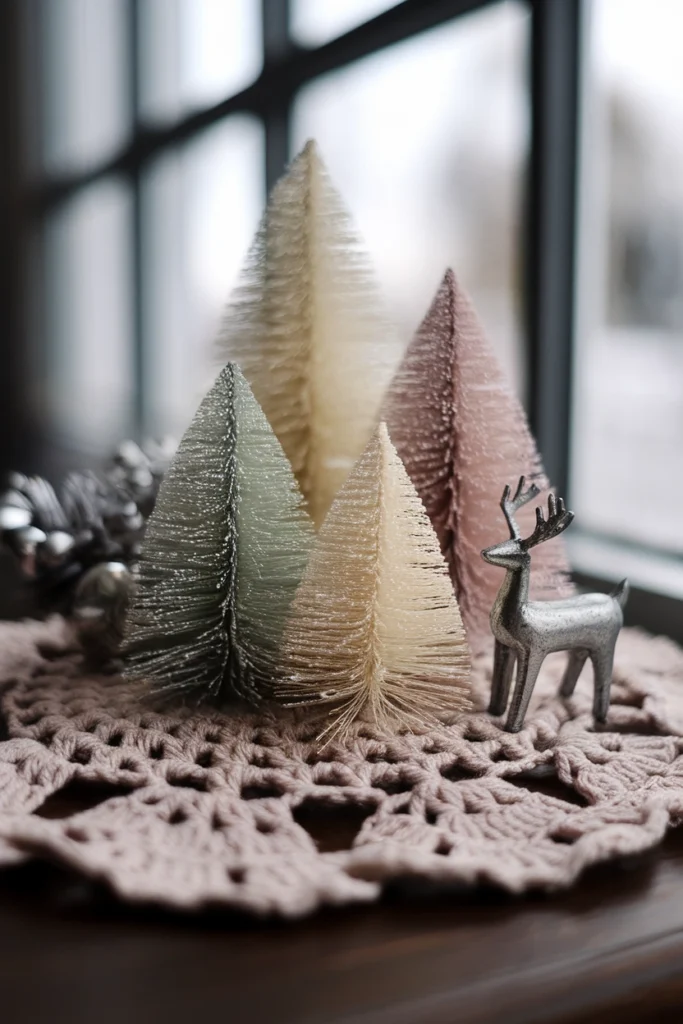
Layer Textiles Like You Inherited Them
The 30% textile slice of the rule has one governing principle: nothing should match.
A quilt that matches your throw pillows that match your tree skirt reads as a purchased set, and purchased sets are the opposite of this aesthetic. What you want is the look of things accumulated over decades by someone with consistent taste and no shopping plan.
How that works in practice:
- One patterned piece per sightline. A gingham cushion or a plaid throw, not both in the same view.
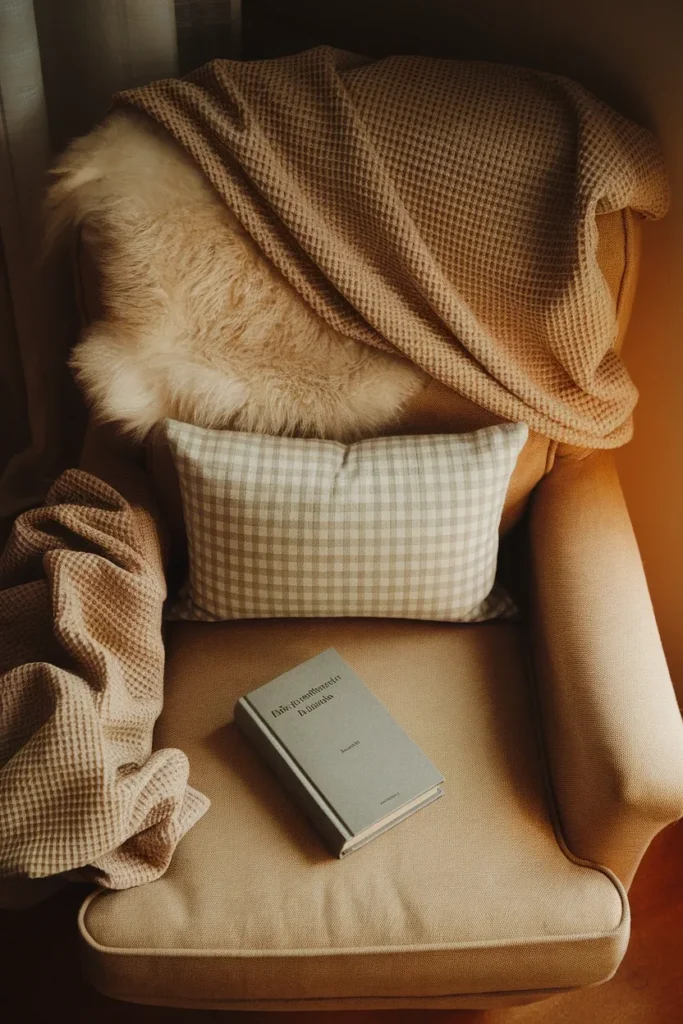
- Three textures minimum, no pattern required. A waffle linen throw, a sheepskin over the chair back, a wool runner underfoot. Texture layering does the heavy lifting that pattern gets credit for.
- Wash new linen twice before it goes out. Crisp linen reads as new. Rumpled linen reads as inherited, and rumpled is what you’re after.
- One thing should be slightly wrong. A throw half fallen off the chair arm. A cushion at an angle. Perfectly squared textiles look like a listing photo.
Colors that work: oatmeal, butter, faded sage, dusty rose, deep evergreen, and one rust or amber note. Colors that fight it: pure white, true red, anything metallic in a large field. If you already own red plaid, keep it small and let the greens and neutrals hold the room. Our guide to cottagecore fall decor layering uses the same texture stack, which means most of your autumn pieces carry straight through December without buying anything new.
Wrap Gifts So the Pile Becomes Decor
In a small space the gift pile is not a side note, it’s furniture. It’ll sit in the corner for three weeks and dominate every photo you take.
Kraft paper, jute twine, one dried orange slice or a cedar sprig tucked under the string. That’s the whole formula and it costs a fraction of printed wrap. Brown kraft is around $8 for a roll that handles a season, and it reads as intentional rather than cheap because it matches everything else in the room.
Skip gift bags entirely if you can. Glossy printed bags are the single fastest way to break a cottagecore vignette, since they introduce shine and saturated color in one move.
A small thing worth doing: write names directly on the kraft paper in pencil rather than using tags. Graphite on brown paper has a softness that printed tags don’t, and it removes the fussiest step in wrapping.
Make One Corner Carry the Whole Season
If your place is small, the strongest move is to stop distributing decor evenly and concentrate almost all of it in one spot.
Pick the corner you actually sit in. Then build in this order:
- Anchor with light. Lamp or sconce first, before a single ornament.
- Add the seat layer. Throw, cushion, sheepskin.
- Bring in the plant matter. Greenery on the shelf behind, a small potted fir, dried citrus strung along a bookcase edge.
- Finish with two small vintage objects. Not eight. Two.
A single fully realized corner beats decorations thinly scattered across four rooms, both in how the space feels and in how it photographs. It’s also dramatically less to take down in January, which matters more than anyone admits around the 28th.
If you have a window seat or an alcove, that’s your corner, no deliberation needed. If you don’t, an armchair with a bookcase behind it works just as well. The bookcase is doing the job the mantel does in all those farmhouse photos: giving the greenery a ledge to live on.

The Roughly $180 Version, Totaled
Competitors say “affordable” and never add anything up. Here’s a real allocation.
These are estimated US price bands, not quoted prices. Verify current costs before you shop, since seasonal pricing swings hard between early November and mid-December.
| Item | Estimated band | Notes |
|---|---|---|
| Oranges for garland (2 bags) | $8 to $12 | Makes 2 long garlands |
| Jute twine | $4 to $6 | One spool lasts years |
| Fresh greenery | $0 to $30 | Free if you ask a tree lot for trimmings |
| Small potted fir or slim tree | $35 to $60 | Living tree costs more, lasts longer |
| Plug-in wall sconce | $25 to $45 | The single highest-impact buy |
| 2700K string lights | $12 to $20 | Check the Kelvin figure, not the label |
| Secondhand doily, tin toys, bottle brush trees | $10 to $25 | Thrift, don’t buy new |
| Linen throw or textile layer | $25 to $40 | Wash twice before use |
| Kraft paper roll | $6 to $10 | Doubles as table runner |
| Estimated total | $125 to $248 | Midpoint lands near $180 |
Where to spend if the budget is tighter: the sconce and the greenery. Where to save: everything vintage, which should be secondhand anyway, and the tree, since a slim potted fir in a basket photographs better in a small room than a full-size tree that crowds it.
What Goes Wrong
The honest failure list, because inspiration posts never include one.
Dried oranges mold. Only when they went on the string slightly damp. Fully crisp or don’t thread them.
Adhesive hooks take paint with them. Chalky matte landlord paint is the usual culprit. Test one hook in a hidden spot and wait 48 hours before you trust the rest.
The tree dries out by week two. Almost always a stand-capacity problem rather than neglect. Run the quart-per-inch math before you buy, not after.
Everything looks brown under the wrong bulb. A single 4000K bulb somewhere in the room will undo the entire palette. Check every bulb in the sightline, including the one in the hallway behind you.
It reads as clutter instead of collected. Nearly always too much shine or too many small objects. Go back to the 60/30/10 rule, pull out anything metallic, and remove small items until each vignette has three or fewer.
Floor cushions look great and get uncomfortable fast. If you’re building a spot for actual reading rather than photographing, a real chair with a lumbar pillow beats a stack of floor cushions by a wide margin once you’re past the first half hour.
FAQ
What is cottagecore Christmas decor? It’s a holiday style built on natural, handmade, and vintage materials instead of manufactured ones. Dried citrus, real or realistic greenery, unbleached linen and lace, secondhand ornaments, and warm low lighting. The organizing idea is that a room should look accumulated over years rather than bought in one trip.
What colors work for a cottagecore Christmas? Oatmeal, butter cream, faded sage, dusty rose, deep evergreen, and a single rust or amber accent. Traditional bright red and metallic silver both fight the aesthetic. If you already own red, keep it in small doses and let neutrals and greens hold the room.
How do you dry orange slices for Christmas garland? Slice to 1/4 inch, blot dry, and bake at 200°F for about three hours, flipping every 45 minutes. They must be fully crisp before you thread them on twine or they’ll mold. Navel oranges give the clearest sunburst pattern when backlit.
What’s the difference between cottagecore and farmhouse Christmas? The material ratio. Farmhouse leans on textiles, shiplap, and black-and-white contrast. Cottagecore leans on plant matter, softer faded colors, and visible handmade irregularity. Roughly 60% plant matter is the cottagecore tell.
How do you do cottagecore Christmas in a rental? Work off tension rods, curtain rods, door casings, and bookshelf edges instead of walls. Concentrate the decor in one corner rather than spreading it thin. Use a potted or slim tree instead of a full-size one, and swap open flames for LED pillars around dried material.
How do you get the look on a small budget? Dry your own citrus, ask a Christmas tree lot for their cut trimmings (often free), and buy every vintage element secondhand. Spend real money on exactly two things: one good warm light source and your greenery.
How long do dried orange slices last? Expect one season reliably. Stored somewhere genuinely dry between years, many people get a second season out of them, though the color fades noticeably. Humidity is what kills them, so a basement box is a worse bet than a closet shelf.
Start With the Oranges
If this is a lot to take in at once, do one thing this weekend: slice two oranges, set the oven to 200°F, and string a garland while they cool. It’s about $4 and one afternoon, and it’s the single element that makes a room read as cottagecore rather than generically festive.
Once that’s up and you can see how the amber plays against your walls, the rest of the decisions get easier. The lighting fix comes next, and it’s the one that changes the most for the least money.
Working with an awkward corner rather than a whole room? Our small-space nook guides break down how to build the reading spot first and layer the season on top of it.
Keep reading
More cozy nook ideas
 Fall Decor
Read →
Fall Decor
Read →
Fall Door Decor on a Budget: Where to Spend and Where to Save
If your fall door every year is a wreath that sheds on the mat, two mums that are crispy by Halloween, and…
 Fall Decor
Read →
Fall Decor
Read →
12 Thanksgiving Tablescape Ideas for Small Spaces (That Still Leave Room for the Food)
Twenty-four inches. That’s how much table edge one person needs to eat without bumping elbows, and it’s the number most Thanksgiving tablescape…
 Fall Decor
Read →
Fall Decor
Read →
18 Fall Coffee Bar Ideas for Sweater-Weather Evenings
No counter space to spare, no espresso machine, no landlord permission needed. This fall coffee bar runs on three pieces: a slim…