
Cottagecore Fall Decor That Looks Collected, Not Bought

The tell is always the same. A cottagecore fall decor setup that was bought in one trip looks like it was bought in one trip, because every piece is the same age, the same finish, and the same three inches of orange.
Rooms that actually work look gathered over time. Some of it thrifted, some of it foraged off a sidewalk, one thing genuinely old.
Here’s the good news if you rent, if your place is 700 square feet, and if your budget is under $300. Collected is cheaper than bought. It just takes a different order of operations.
Three layers. One afternoon. No drilling required, and I’ll show you the version that survives a move-out inspection.
Start With Three Layers, and Everything Else Is Optional
Most fall decor advice hands you thirty ideas and no priority. So you buy a garland, put it somewhere, and the room still looks like the room.
Try this instead. I call it the Three-Layer Rule, and it’s the thing I’d hand a friend who has one afternoon and a $60 bill.
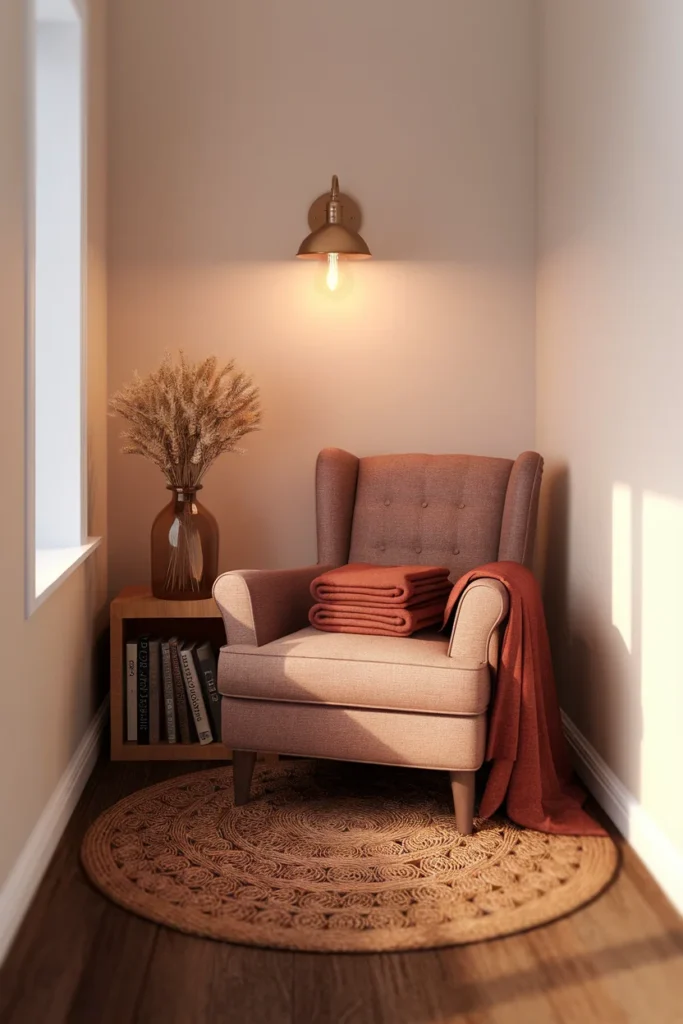
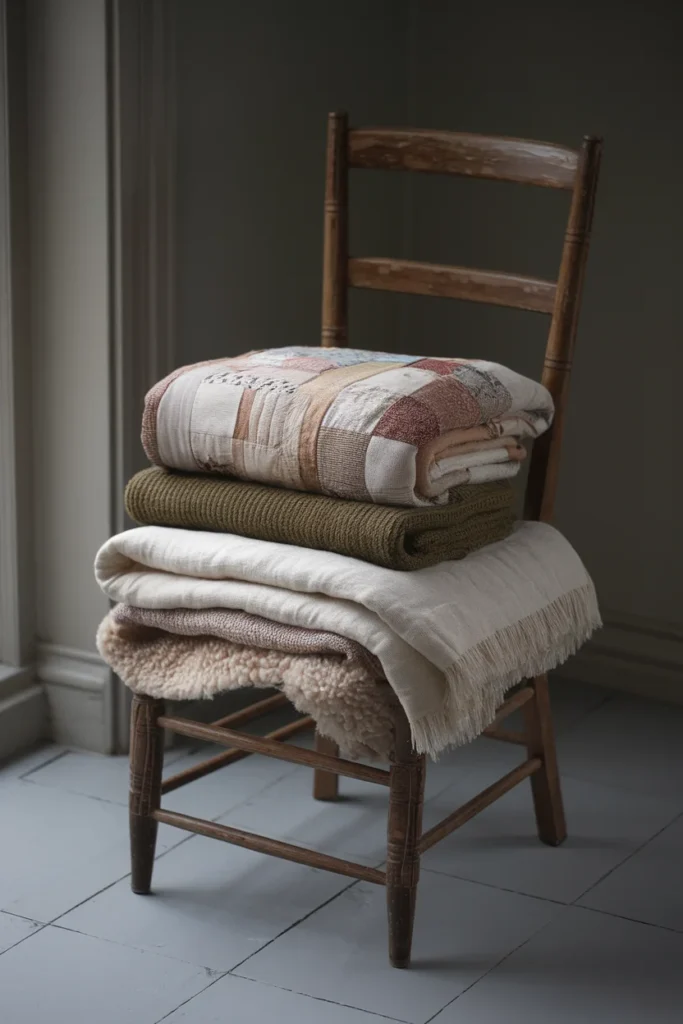
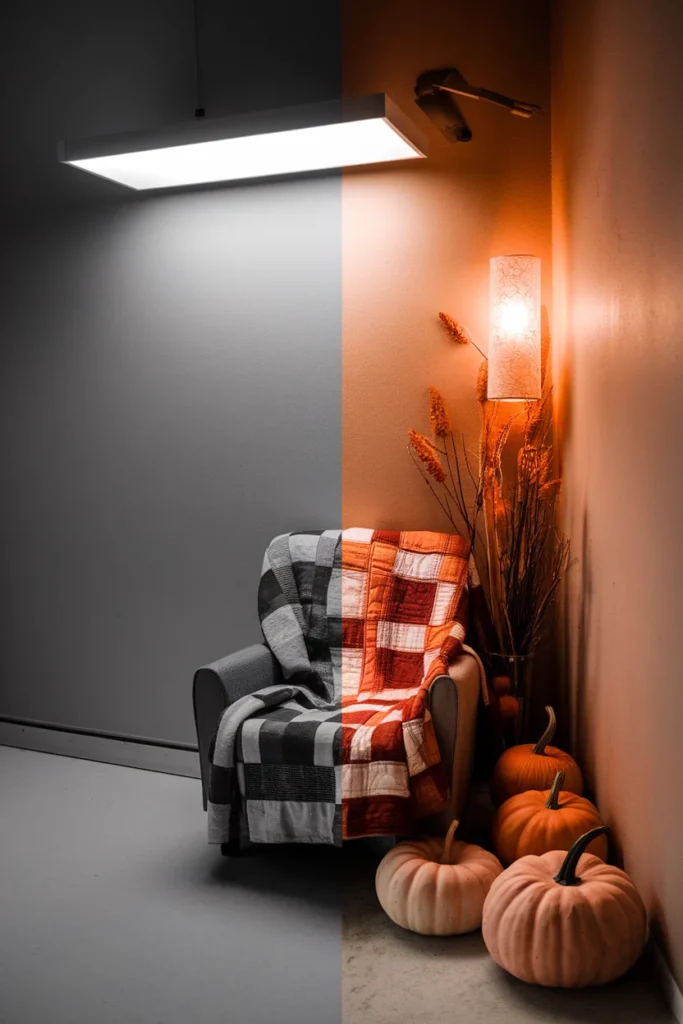
Layer 1: One textile that changes the temperature of the room. A wool throw over the arm of a chair. A quilt folded at the foot of the bed. Something you can touch that wasn’t there in July.
Layer 2: One dry, natural thing in a vessel. Wheat, bittersweet, dried hydrangea, oak branches you cut on a walk. In a pitcher, a crock, an amber bottle. Not a vase from the fall aisle.
Layer 3: One warm light source below eye level. A plug-in sconce, a small lamp on a stack of books, three tealights on a saucer. Below eye level is the whole trick, and I’ll get into why under the lighting section.
That’s it. Do those three and the room reads as autumn from the doorway.
Everything after this is refinement. If you stop here, you still have a room that works, which is more than most thirty-item lists can promise.
Failure mode: people skip Layer 3 because it feels like the least decorative one. Then they wonder why the corner photographs warm at 4 pm and looks flat and cold at 8 pm. Light is doing more work than the pumpkins.
The Fall 2026 Palette, and the One Color That Ruins It
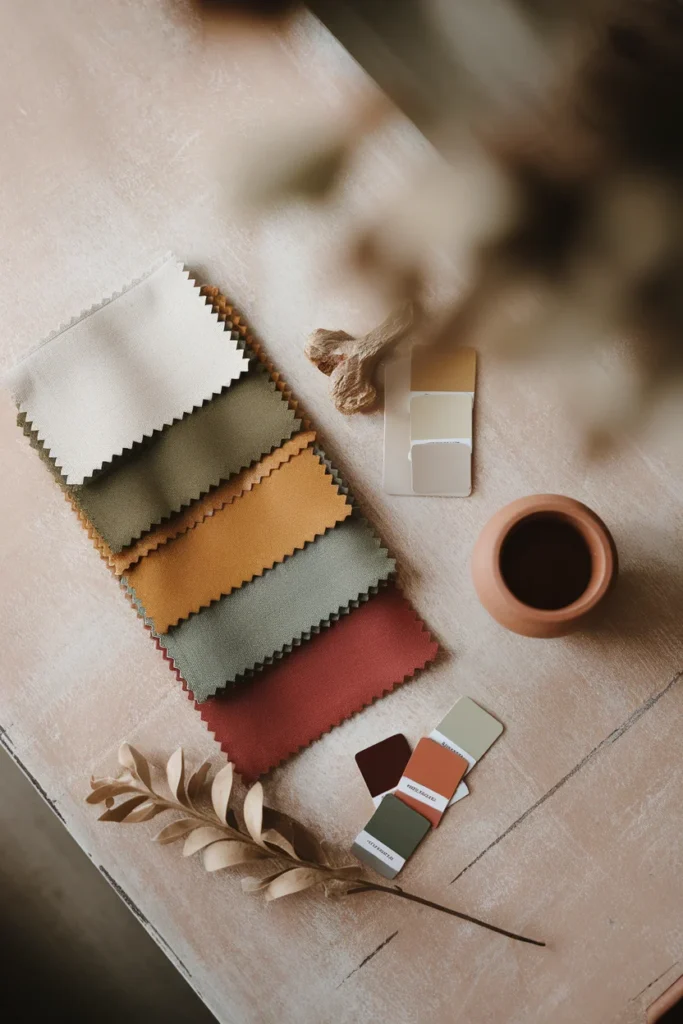
Cottagecore isn’t a color, it’s a color temperature. Everything leans warm and slightly dusty, like it faded a little in a window.
For fall 2026 specifically, designers are pushing away from the bright orange and toward burgundy, plum, chocolate, mustard, and oxblood, with creamy neutrals and caramelized beige carrying the background. Sage green and cream is up 410% as a Pinterest search. Benjamin Moore’s Barista and Glidden’s Warm Mahogany are both being named as signature colors for the season.
Here’s the working formula. Pick one from each row, and stop.
| Role | Pick one | What it does |
|---|---|---|
| Base (60%) | Oatmeal, unbleached linen, warm cream, caramelized beige | Everything else sits on this. Keep walls and big textiles here. |
| Depth (30%) | Olive, sage, chocolate brown, oxblood, plum | This is the layer that stops it looking like a bakery. |
| Spark (10%) | Mustard, rust, terracotta, dried-hydrangea pink | Small doses. A throw pillow, a candle, a bowl. |
The color that ruins it: cool bright orange. Traffic-cone orange, the kind on inflatable pumpkins and clearance-aisle foam. It fights every other warm tone in the room and reads as plastic even when it isn’t. If you already own it, tuck it behind something and use terracotta instead.
Olive green and mustard together is the pairing doing the heaviest lifting this year, and it works because both colors are dulled. Neither one is at full saturation. That’s the actual mechanism: cottagecore colors are always a step or two down from their brightest version.
Dark Cottagecore Is the Fall Version Nobody Told You About
If cottagecore in spring is a sunlit kitchen with a bowl of lemons, cottagecore in fall is the same cottage after dark. Same objects, less light, more depth.
This is the biggest shift happening right now and almost nobody writing about fall decor has caught up to it. On Pinterest, dark cottagecore kitchen is up 915%, which makes it the fastest-growing term in the entire home category. Aubergine is up 495%. Moody blue is up 325%.
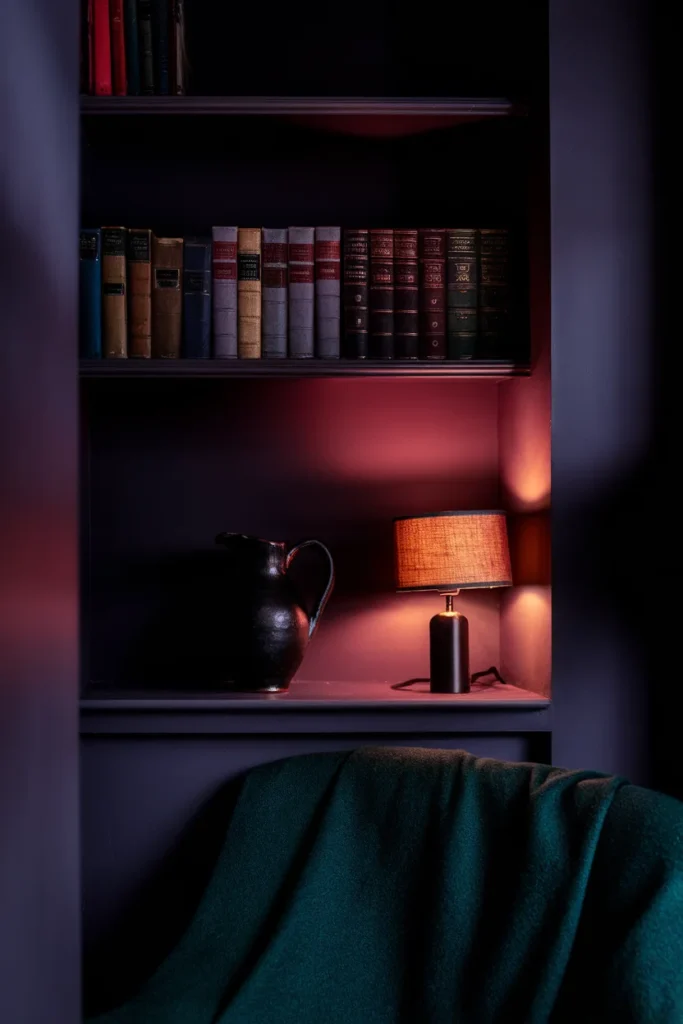
Dark cottagecore is not goth. It’s the same dried flowers and vintage crockery, just against a deeper background with less overhead light. Think a hallway lit by one lamp, a bookshelf painted plum, a black-brown chair instead of a birch one.
How to do it without painting anything:
- Swap the bulb before you swap the furniture. Go to 2700K and drop the total lumens in the room. Darkness is free.
- Add one genuinely dark object at eye level. A near-black ceramic pitcher, a stack of old cloth-bound books, a dark wood tray. One is enough to reset the whole corner.
- Use a fabric to darken a wall. A plum or forest wool blanket hung behind a chair does what paint does, and it comes down in ten seconds.
- Kill the ceiling light entirely. Not dim it. Off. This is the single change with the biggest effect and it costs nothing.
The honest trade-off: dark cottagecore photographs incredibly and lives less conveniently. You will not find a dropped earring. Keep one brighter task light you can reach without standing up, and accept that the room has a daytime mode and a nighttime mode.
Cottagecore also isn’t only an indoor style, and the outdoor version follows the same logic of layering rather than buying. If you’ve got even a balcony strip, the nine cottagecore garden layers use the same three-layer thinking applied to plants.
Pumpkins and Gourds: What Actually Lasts, and for How Long
Nobody in the top-ranking fall decor articles will tell you this, so here it is with real numbers.
According to University of Georgia pumpkin storage research, a properly cured pumpkin can last as long as three months. Curing needs a consistent 80°F for about two weeks, which is why the ones from a farm stand outlast the ones from a grocery bin. Their horticulturist also flags what to avoid buying: mushy handles or stems, and any cracks or pits in the rind.
Once you carve it, that clock resets to days. A damp towel over it when it’s not on display buys you a little more time. If you want cottagecore that lasts through November, don’t carve.
Dried gourds are a different process entirely. Iowa State University Extension describes washing them in soapy water, rinsing in a water and chlorine bleach solution, then drying them in a single layer on newspaper in a warm ventilated space, not touching each other, out of direct sun. That takes several weeks to months. You’ll know they’re done when they go light in the hand and the seeds rattle. Most lose their bright color along the way, which is exactly why cured gourds look more cottagecore than fresh ones do.
Here’s the practical version:
| What you’re using | Realistic indoor lifespan | Best for |
|---|---|---|
| Uncarved cured pumpkin | Up to ~3 months | The whole season, start to finish |
| Uncarved grocery-bin pumpkin | A few weeks, varies | Short runs, October only |
| Carved pumpkin | Days | One event, then compost it |
| Fully cured dried gourd | Years | Buy once, keep forever |
| Terracotta or ceramic pumpkin | Indefinite | The pieces you build the display around |
The move most people miss: build the permanent layer first. Terracotta pumpkins, cured gourds, wooden bowls. Then add two or three real ones on top. When the real ones go soft in November, the display doesn’t collapse, you just remove them.
Sensory note that no product page mentions: a pumpkin starting to turn smells faintly sweet and fermented before it looks like anything. If a corner of the room smells like cider you didn’t make, check the undersides.

Forage the Filler, Buy the Vessel
The single fastest way to make cottagecore fall decor look collected instead of bought: stop buying stems.
Sustainable and foraged is a named fall 2026 direction, with DIY dried arrangements from foraged flowers and branches showing up alongside thrifted and vintage pieces. It’s also just cheaper.
What to gather this month, free:
- Oak, maple, and beech branches with the leaves still attached
- Wheat, oat, and ornamental grass heads
- Hydrangea heads that have already gone papery on the bush, which is when they dry best
- Bittersweet, rose hips, and seed pods
- Acorns and small pinecones, which want a 200°F oven for 20 minutes to evict anything living in them
What to actually spend on: the vessel. A thrifted amber glass bottle, a stoneware crock, a chipped white pitcher, a small brass jug. This is where a couple of dollars does more work than a $30 faux-floral bundle.
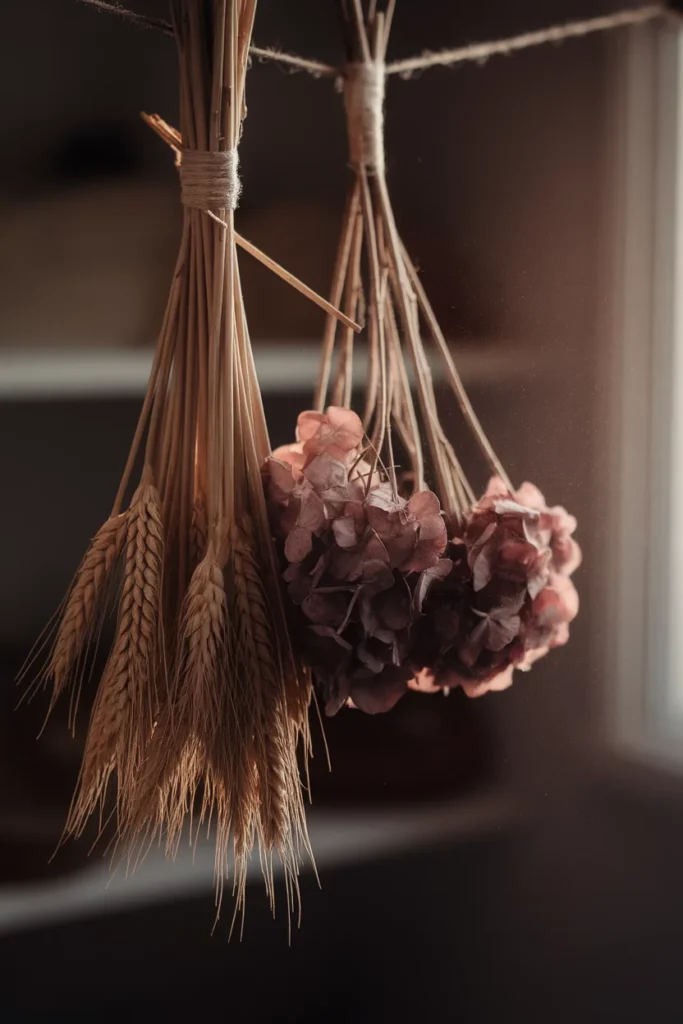
Drying is mostly waiting. Bundle stems loosely with twine, hang them upside down somewhere dark and dry, and leave them two to three weeks. Loosely is the key word: packed bundles mold in the middle.
The trade-off nobody says out loud: dried arrangements shed. Constantly. Wheat drops little husks on the shelf below it for as long as you own it. Put dried stems where a small mess is invisible, not over a sofa you just had cleaned.
Failure mode: foraging everything and buying nothing gives you a pile of brown sticks. The ratio that works is roughly two-thirds gathered material to one-third bought structure. The bought third is the vessel, a candle, and a ribbon.
Textiles Are Where the Season Actually Happens
Objects get noticed. Textiles get felt. If you only change one category between summer and fall, change this one.
The material list is short and consistent: wool, linen, cotton, boucle, sherpa, and sheepskin. What you’re avoiding is anything shiny. Polyester satin, sequins, and slick velvet all read wrong here, because cottagecore is a matte aesthetic top to bottom.
Where to put them, in order of visible impact:
- Over the arm of a chair. Folded in thirds, not draped artfully. Artful drape looks staged.
- At the foot of the bed. A quilt folded across the bottom third.
- On the floor. A jute rug or a small washable runner where your feet land.
- At the window. Cafe curtains or a linen sheer. Even a half-height panel changes the whole light quality.
Vintage quilts are the single best thrift find in this entire style. A real one has irregular hand quilting, faded and slightly mismatched fabrics, and usually a repair or two. That imperfection is the point. Reproduction quilts are uniform, and uniform is what makes a room look bought.
Price reality: thrifted quilts, wool blankets, and linen tablecloths swing enormously by region and by store type. Church-basement thrift is a different market than a curated vintage shop, and a quilt that’s $18 in one is $140 in the other. Check the estate sale listings in your area before you buy retail, and go on the second day when things get marked down.
Layering warmth without letting a small room feel crowded is its own skill, and the Scandinavian approach is a useful counterweight to cottagecore’s maximalism. These room-by-room hygge decor ideas show how to add texture while keeping surfaces clear.
Sensory beat: old cotton and wool sound different from new. A vintage quilt has almost no rustle to it when you fold it. Polyester fill crackles. You can hear the difference before you can see it.
Light It for 8 PM, Not for Noon
Every cottagecore photo you’ve saved was taken in daylight. Then you build the corner, and at night it looks like a storage area with a blanket in it.
The fix is layered light below eye level, and the specs matter.
Color temperature: 2700K. This is the warm white end of the Kelvin scale that the Department of Energy’s Lighting Facts label reports as “light appearance.” Anything at 4000K or above turns cream walls gray and makes wood look dead. One number, enormous difference.
Output: skip the wattage, read the lumens. The Department of Energy’s guide to lumens and the Lighting Facts label gives the conversions plainly: about 800 lumens replaces an old 60W bulb, 1100 replaces a 75W, and 1600 replaces a 100W. For a reading corner, an 800 lumen bulb in a shaded lamp about an arm’s length from your shoulder is the workhorse. For ambient glow in the rest of the room, go lower.
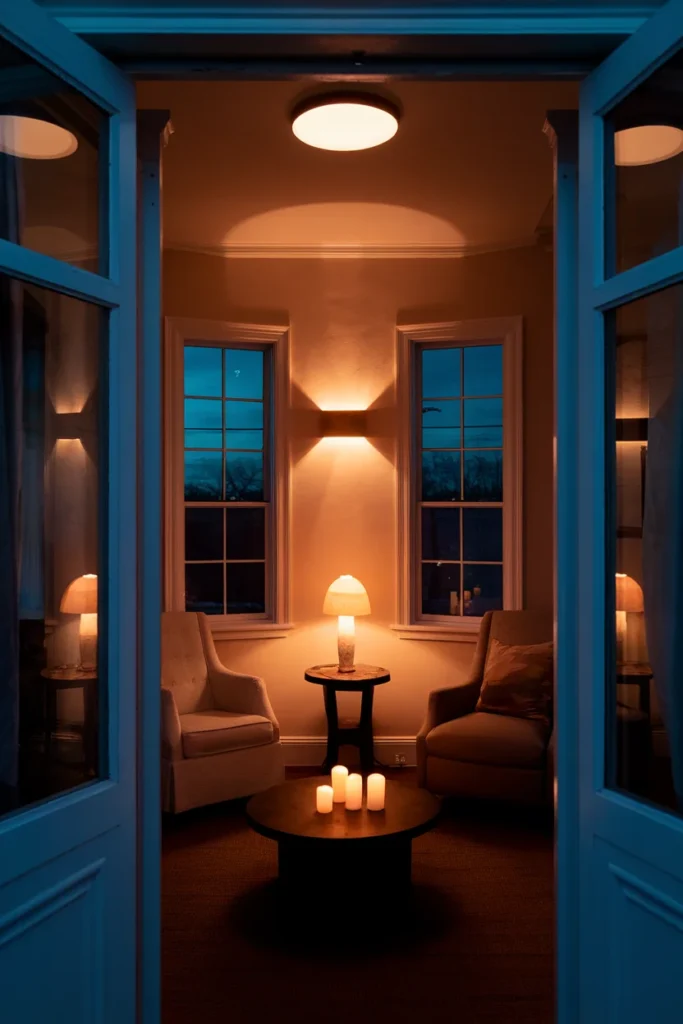
Three sources, three heights. A plug-in sconce at shoulder height, a lamp at table height, candles or a small LED puck at knee height. Three small pools of warm light beat one bright ceiling fixture every single time.
On candles: they’re the cheapest atmosphere available and the only element that engages smell. Beeswax and soy burn warmer in tone than paraffin. Cluster three at different heights on a plate rather than spacing them evenly, which looks arranged rather than gathered.
Failure mode: one bright overhead light left on. It flattens every texture you just spent an afternoon layering. If your ceiling fixture has no dimmer, a $12 plug-in lamp dimmer on the floor lamp does the same job.
Build One Real Reading Corner, Not Five Vignettes
Here’s where most fall decorating goes sideways. You end up with six styled surfaces and nowhere anybody wants to sit.
Pinterest data backs this up hard. Reading nook ideas is up 245%, and comfy reading chair small spaces is up 455%, which tells you people want a place to be in the room, not just a place to look at.
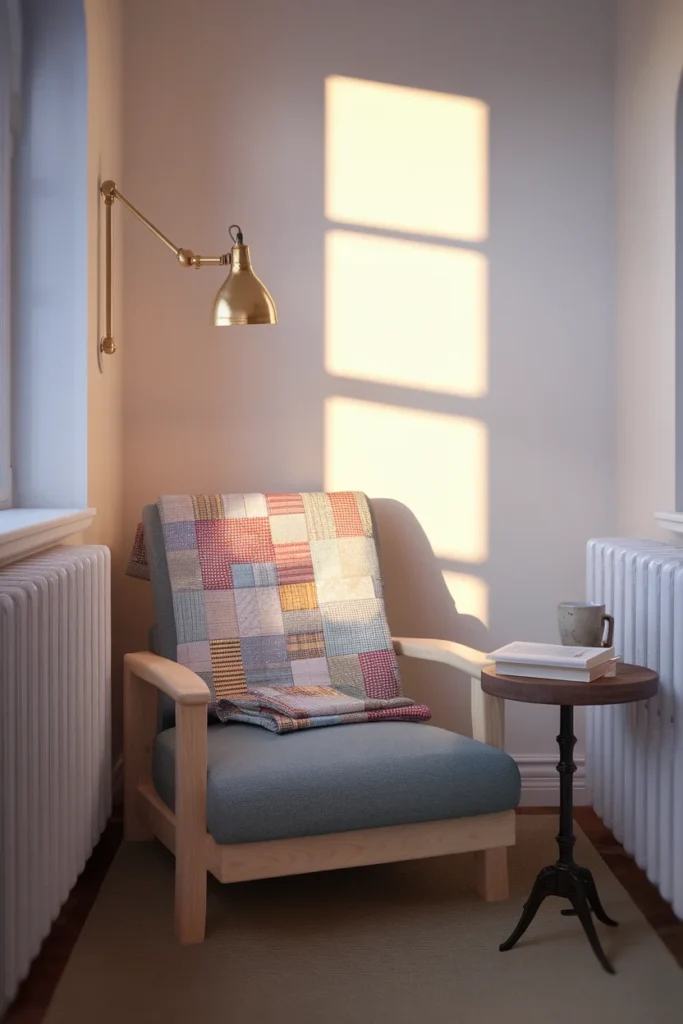
Pick your worst corner. Not your best one, your worst: the awkward one next to the radiator, the dead space beside the closet door. That’s where a nook belongs, because it converts unusable square footage into the most-used seat in the house.
The three pieces, and the measurements that make them work:
- A chair with a low seat. The IKEA POÄNG armchair is the archetype here and currently runs $249 at IKEA US, with a 16½ inch seat height and a 19⅝ inch seat depth. Low and deep is what you want, because upright dining-chair height doesn’t invite a two-hour read.
- A side table within reach. Roughly 18 inches from the chair, and level with the chair arm or an inch or two below it. Any 32-inch round side table is too big for most nooks. Aim for 16 to 20 inches across, just enough for a mug and a book face-down.
- A light you can turn on without standing up. See the section above. A plug-in swing-arm sconce is the small-space answer, since it takes zero floor space.
The trade-off: floor cushions and poufs photograph well and cost a fraction of a chair. After about 40 minutes your lower back will file a complaint. If a chair isn’t in the budget this season, put the cushion against a wall so you have something to lean on, and treat it as a temporary version.
Cottagecore layers go on top of that skeleton, not instead of it. The quilt, the dried stems on the windowsill, the amber bottle. Structure first, then the season.
The Renter’s Version: Zero Drilling, Zero Paint, Full Deposit
Every other cottagecore fall decor article assumes you own the walls. Most of the people reading this don’t.
So here’s the whole style rebuilt for a rental, with real published load limits instead of guesswork.
Weight limits, straight from 3M’s own Command product guide:
| Product | Holds |
|---|---|
| Small hook | 1 lb |
| Medium hook | 3 lb |
| Large hook | 5 lb |
| Jumbo hook | 7.5 lb |
| Medium picture strips | 3 lb per set |
| Large picture strips | 4 lb per set |
| Sticky Nail wire-back hanger | 8 lb |
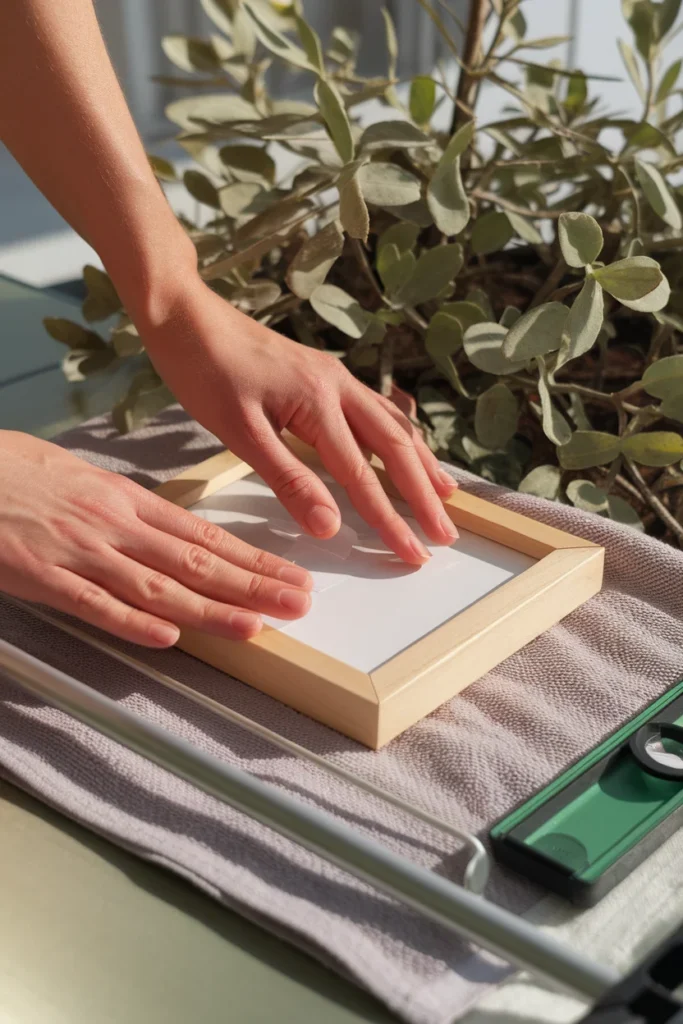
A dried wheat bundle weighs almost nothing, so a small hook handles a wall bunch easily. A framed botanical print in a wood frame is usually where people overload a medium strip. Weigh it on a kitchen scale first, then size up one bracket from what you think you need.
The rest of the renter kit:
- Tension rods for curtains, for a doorway of dried stems, for a half-height cafe curtain on a bathroom window. No hardware, no holes.
- Peel-and-stick anything stays in one small zone. One shelf back, one alcove, the risers on a stair. Full walls are where removable wallpaper stops being removable.
- Freestanding shelving instead of floating shelves. A leaning ladder shelf gives you five styling surfaces and rests against the wall under its own weight.
- Fabric as a wall treatment. A quilt or wool blanket hung from a tension rod covers more square footage than any decal and comes down intact.
- Plug-in sconces, never hardwired. Same look, cord tucked behind the furniture, zero electrical work.
Failure mode to avoid: adhesive strips on textured or freshly painted walls. Textured surfaces don’t give the adhesive enough contact area, and paint that’s cured less than about three weeks will lift with the strip. Test one in a closet before you commit to a gallery arrangement.
If you’re rebuilding a whole rental this way and not just a corner, these no-damage rental decor ideas go room by room through the same constraint.
What a Cottagecore Fall Corner Actually Costs
Nobody in the top five ranking articles mentions a single dollar figure. That’s not helpful when your budget is real.
Only one number below is a directly verified retail price. The rest are ranges, and they’re labeled as ranges, because thrift and estate pricing swings wildly by region and I’d rather give you an honest band than a fake precision.
| Piece | Typical range | Notes |
|---|---|---|
| Low armchair, new | $249 | Verified: IKEA POÄNG, US, at time of writing |
| Low armchair, secondhand | Wide range, often well under retail | Facebook Marketplace and estate sales |
| Vintage quilt | Varies hugely by venue | Thrift versus curated vintage is a different market entirely |
| Wool throw, secondhand | Low | Thrift stores are full of them |
| Small side table | Low to moderate | Thrift first, it’s the easiest piece to find used |
| Plug-in sconce | Moderate | The piece most worth buying new |
| 2700K LED bulb | A few dollars | Highest impact per dollar in this entire list |
| Dried stems | Free if foraged | Vessel is where you spend |
| Terracotta pumpkins | Low, and permanent | Buy once, use every year |
| Candles | Low, recurring | Beeswax and soy cost more, burn warmer in tone |
The honest summary: the bulb and the foraged stems cost almost nothing and do a disproportionate share of the work. The chair is the real expense, and it’s the one piece worth waiting to find secondhand.
If you’re starting from nothing, the order I’d spend in: bulb, then vessel, then textile, then light fixture, then chair.
Five Mistakes That Make It Look Bought
- Everything the same age. One genuinely old object rescues a whole shelf of new ones. It’s the fastest fix on this list.
- Symmetry. Cottagecore is gathered, not arranged. Odd numbers, uneven heights, nothing centered.
- Too much orange, all at one saturation. See the palette section. Dull it down, spread it out.
- Every surface styled. Leave two surfaces completely empty. The eye needs somewhere to rest, and empty space is what makes the styled parts read as intentional rather than cluttered.
- Decorating for a photo instead of a Tuesday. If the throw has to be re-draped every time you sit down, you’ll stop sitting down. Build it so normal use doesn’t wreck it.
Frequently Asked Questions
What is cottagecore fall decor? It’s autumn decorating built on natural materials, vintage and secondhand pieces, and warm dulled colors rather than bright seasonal plastic. The look leans on wool, linen, dried plants, worn wood, and old ceramics. The organizing idea is that everything looks gathered over time rather than bought in one trip.
What colors are cottagecore for fall? A warm cream or oatmeal base, a deeper middle layer of olive, sage, chocolate, oxblood, or plum, and small accents of mustard, rust, or terracotta. For fall 2026 specifically the trend has shifted toward burgundy, plum, and moody depth over bright orange. Sage green and cream is up 410% as a Pinterest search term.
How do you make your house look cottagecore for autumn? Start with three layers: one textile you can touch, one dried natural arrangement in a real vessel, and one warm light source below eye level. Those three alone change how a room reads from the doorway. Add vintage pieces, matte textures, and secondhand ceramics from there.
Is cottagecore still in style in 2026? Yes, and it’s evolving rather than fading. Dark cottagecore kitchen is up 915% on Pinterest, grandma core kitchen is up 545%, and cozy vintage kitchen is up 165%, all from Pinterest’s own 2026 trend reporting. The moody, darker version is where the growth is.
How do you do cottagecore fall decor on a budget? Forage the filler and buy the vessel. Dried branches, wheat, hydrangea heads, and seed pods cost nothing, and a thrifted amber bottle or stoneware crock does more visual work than an expensive faux arrangement. A 2700K bulb is the single cheapest high-impact change you can make.
Can renters do cottagecore fall decor without drilling? All of it. Tension rods for curtains and hanging stems, adhesive hooks rated to the real weight (3M publishes limits of 1 lb for small hooks up to 7.5 lb for jumbo), leaning ladder shelves instead of floating ones, fabric hung on a rod as a wall treatment, and plug-in sconces instead of hardwired fixtures. Test adhesive on textured or newly painted walls before committing.
How long do real pumpkins and gourds last as decor? A properly cured, uncarved pumpkin can last up to about three months, per University of Georgia Extension, though curing requires roughly two weeks at a consistent 80°F. Carved pumpkins last days. Fully cured dried gourds last years, but the curing process itself takes several weeks to months according to Iowa State University Extension.
Your Next Afternoon
You don’t need thirty ideas. You need three layers and one corner.
Pick the worst corner in your place, the awkward one you’ve been ignoring. Put a chair in it, throw a wool blanket over the arm, stand a bottle of foraged branches beside it, and swap the bulb to 2700K. That’s an afternoon and it’s most of the way there.
Then sit in it. That’s the whole test. If you actually want to sit there on a Tuesday night in November, the decorating worked.
Once the corner exists, the fun part is layering it through the season. Start with the light. Everything else follows.
Keep reading
More cozy nook ideas
 Fall Decor
Read →
Fall Decor
Read →
Fall Door Decor on a Budget: Where to Spend and Where to Save
If your fall door every year is a wreath that sheds on the mat, two mums that are crispy by Halloween, and…
 Fall Decor
Read →
Fall Decor
Read →
12 Thanksgiving Tablescape Ideas for Small Spaces (That Still Leave Room for the Food)
Twenty-four inches. That’s how much table edge one person needs to eat without bumping elbows, and it’s the number most Thanksgiving tablescape…
 Fall Decor
Read →
Fall Decor
Read →
18 Fall Coffee Bar Ideas for Sweater-Weather Evenings
No counter space to spare, no espresso machine, no landlord permission needed. This fall coffee bar runs on three pieces: a slim…