
25 Cottagecore Bedroom Ideas for a Dreamy, Storybook Retreat

Your bedroom probably has good bones and zero magic. White walls, a bed you’ve never really styled, one lamp that glows like an office. A cottagecore bedroom fixes that without a renovation, a drill, or a landlord’s blessing, and you don’t need a countryside cottage to pull it off. Below are 25 ideas that work in a rental, in a small room, and on a real budget, with actual measurements, honest price bands, and a $250 starter plan you can copy line for line in idea 22. Start at the bed. Everything else follows from there.
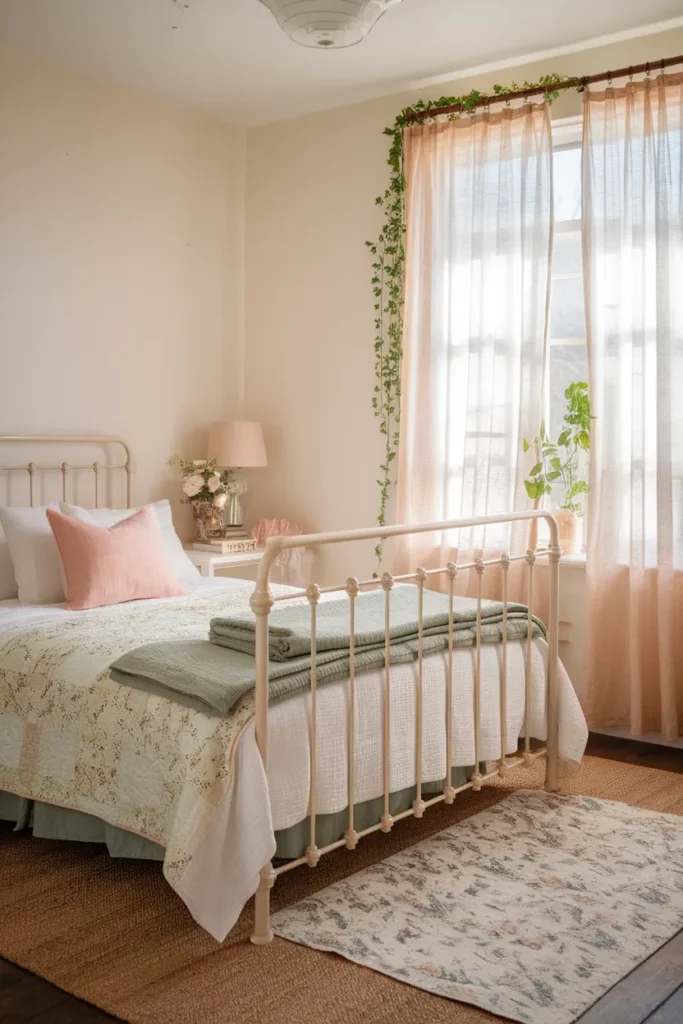
1. Layer the bed in three honest parts
The bed is 60 percent of what a camera, or a guest, sees, so it earns the first move. Build it in three parts: a washed linen or cotton percale base, a quilt in the middle, and a coverlet or knit throw folded at the foot. Most queen quilts run about 90 inches square, which gives you a 15 inch drop on each side of a standard 60 by 80 inch mattress, enough to look generous without puddling.
Big-box floral quilt and comforter sets start around $30, and a thrifted hand-stitched quilt often lands between $25 and $50. One failure mode ruins the whole effect: an all-polyester top layer with a plastic sheen. Natural fiber on top, always. The wash-softened weight of real cotton is half the point.
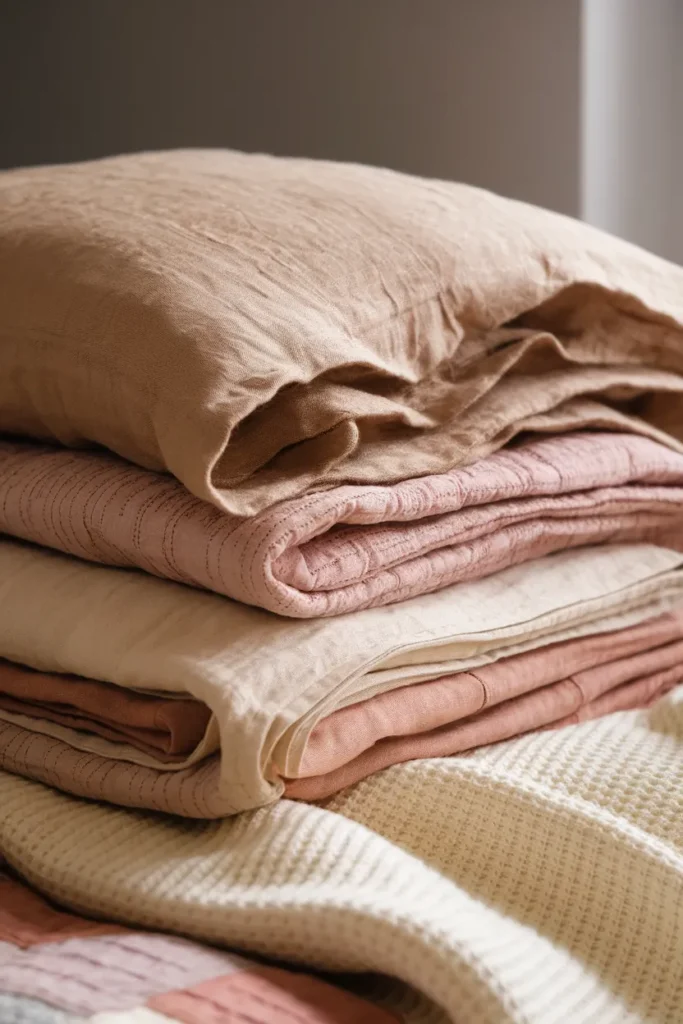
2. Paint it sage, blush, or butter yellow
Muted, warm, and slightly faded is the whole color story. Sage green reads calm at night and fresh in the morning, dusty blush warms a north-facing room, and butter yellow is the shade Pinterest’s 2026 forecast expects to move from accent pillows onto full walls. Designers who work in this style consistently warn against stark white, neons, and cool-toned grays, which flatten the lived-in feel into something clinical.
If you can paint, buy a $5 to $8 sample pot first and brush a 2 foot square near the window and another in the darkest corner, then watch both for a full day. If you can’t paint, run the same palette through bedding, curtains, and a rug instead. Color carried by textiles is completely deposit-safe.
3. Put floral wallpaper on the headboard wall
One papered wall behind the bed does more than four papered walls, and it costs a quarter as much. Choose a faded wildflower or trailing vine print, scaled medium to large so it reads from the doorway. A standard peel-and-stick roll covers about 28 to 30 square feet, so a typical 10 foot headboard wall in an 8 foot room needs two to three rolls, usually $25 to $45 each. Peel-and-stick has one honest enemy: texture.
On orange-peel walls or paint cured less than four weeks, corners lift within a month. Smooth wall, clean with a damp cloth, let it dry, then hang. Renters get the full look and a clean removal later.
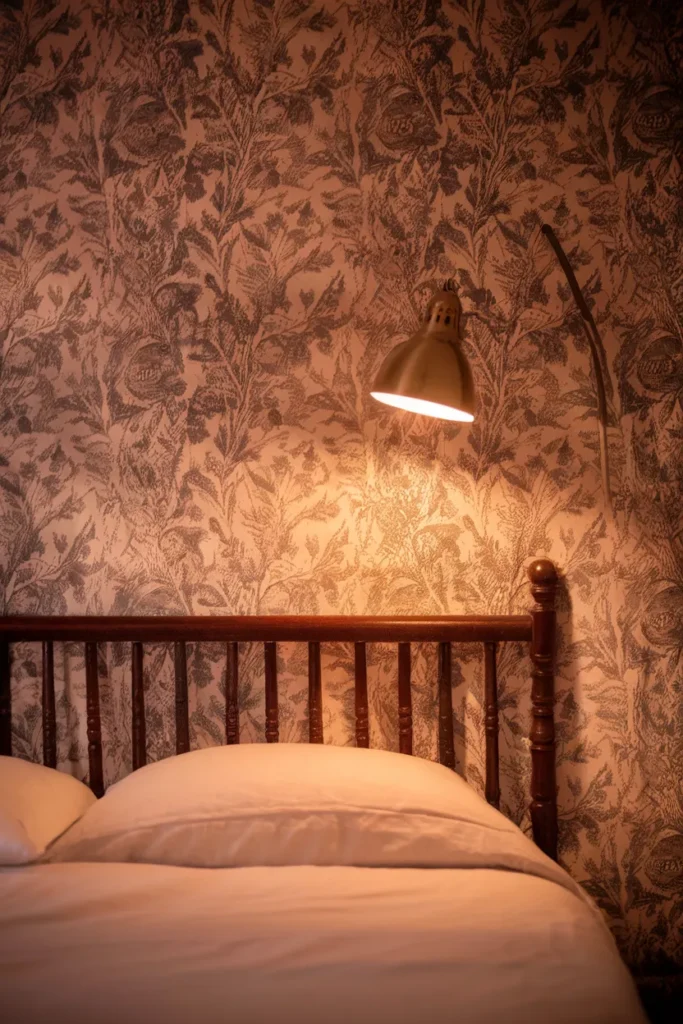
4. Hunt down a vintage metal or spindle bed
Nothing signals this aesthetic faster than an iron frame with a little honest wear or a turned-wood spindle headboard. Search Facebook Marketplace and estate sales for “iron bed,” “brass bed,” and “spindle bed”; full and queen frames typically run $50 to $200 secondhand, a fraction of reproduction prices.
Bring a tape measure and check two things before you pay: that the rails match your mattress size (a full is 54 by 75 inches, a queen 60 by 80), and that the frame has a center support rail. Old full-size frames often don’t, and a modern mattress will sag into the gap within a season. A $25 add-on center support solves it in ten minutes.
5. Mix three prints, then ground them with one solid
Here’s the rule of three prints: one floral, one gingham or ticking stripe, one small-scale block print, and not a pattern more. Vary the scale so they don’t argue, large floral, medium check, small block, and then anchor everything with one generous solid, a sage coverlet or an oat linen curtain panel.
Skip the grounding solid and the room tips from collected into chaotic; that’s the failure mode behind most “why does mine look busy” bedrooms. Pillow covers are the cheap way to run this experiment, usually $8 to $15 each, so you can audition combinations before committing a single larger purchase.
6. Fold a quilt at the foot of the bed
The folded extra quilt is grandma-chic shorthand, and it’s functional in a way staging never is. Fold it in thirds lengthwise so it spans the full width of the mattress and drops 10 to 12 inches over each side. A fringed or scalloped edge earns its keep here because the fold puts the edge on display.
Thrift stores price tired-looking quilts at $15 to $30, and a gentle cold wash with a cup of white vinegar revives most of them. The one to leave behind: any quilt with brittle, cracking fabric at the fold lines, because that damage spreads with every wash.
7. Add one lace or doily moment (2026’s quiet comeback)
Pinterest’s 2026 trend report clocked lace doily searches up 105 percent, which means the detail your great-aunt never retired is officially back. The trick is dosage. One lace cafe curtain, or one crocheted doily under a bud vase, or one lace-edged pillowcase, and stop.
Two pieces read intentional. Five read like a museum of someone else’s childhood. Thrifted doilies cost $2 to $6, and a lace curtain panel rarely tops $20. Backlit by a window, lace throws soft shadow patterns across the sill by late afternoon, decor that literally changes with the hour.
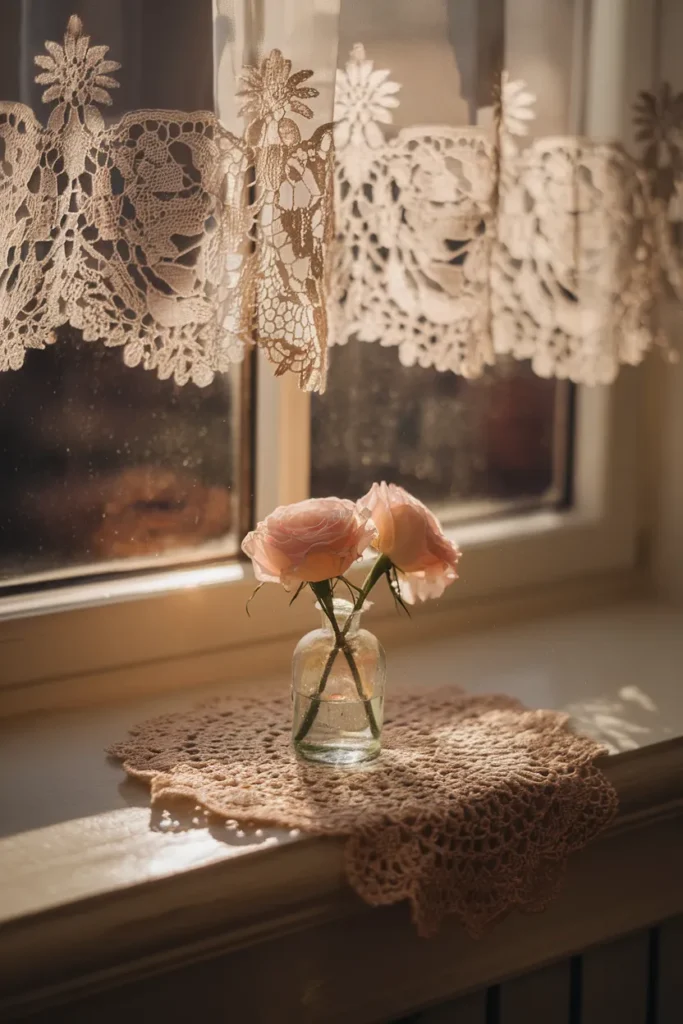
8. Hang sheer cafe curtains high and wide
Curtains are the fastest architecture you can fake. Mount the rod 4 to 6 inches above the window frame and extend it 6 to 10 inches past each side, and the window reads taller and wider while the panels stack off the glass.
Sheer cotton or muslin panels run $10 to $25 and let light through as a glow instead of a glare, which is exactly the sun-warmed effect this style trades on. In a rental, a $12 tension rod inside the frame carries a cafe curtain with zero holes. The failure mode is polyester sheers with a synthetic shine; hold the fabric up to your phone flashlight in the store, and if it sparkles, put it back.
9. Layer a washable floral rug over jute
Two rugs beat one. Start with a flat jute or sisal base sized so the bed sits on it with 18 to 24 inches showing on each side, then angle a smaller washable floral or faded-medallion rug where your feet land in the morning.
The texture contrast, rough natural fiber under soft pile, is what makes the layer look deliberate. Washable top rugs in 3 by 5 feet usually run $40 to $80. Skip the rug pad between layers and the top rug migrates toward the door within a week; a $10 gripper pad ends the slide permanently.
10. Thrift the nightstands instead of matching them
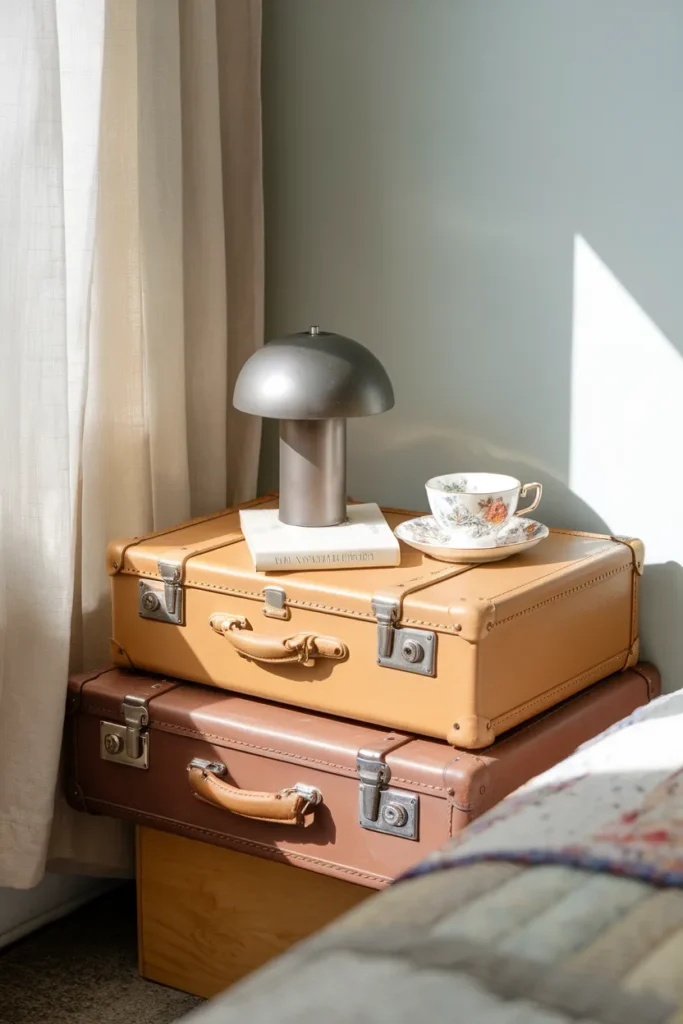
Matched nightstand sets are the fastest way to make a room look ordered from a single webpage. Mismatched vintage pieces, a painted chest on one side, a stack of two hard-shell suitcases on the other, give the collected-over-decades feel this whole style imitates. My rule at any flea market: buy the shape, ignore the finish.
Paint is an afternoon; good bones are forever. Expect $15 to $60 for small vintage tables and $10 to $25 per suitcase. If you stack suitcases, put the larger one down low and add self-adhesive felt pads between layers, because a wobbling tower holding a full teacup is a lesson you only need once.
11. Tuck a reading corner into the bedroom
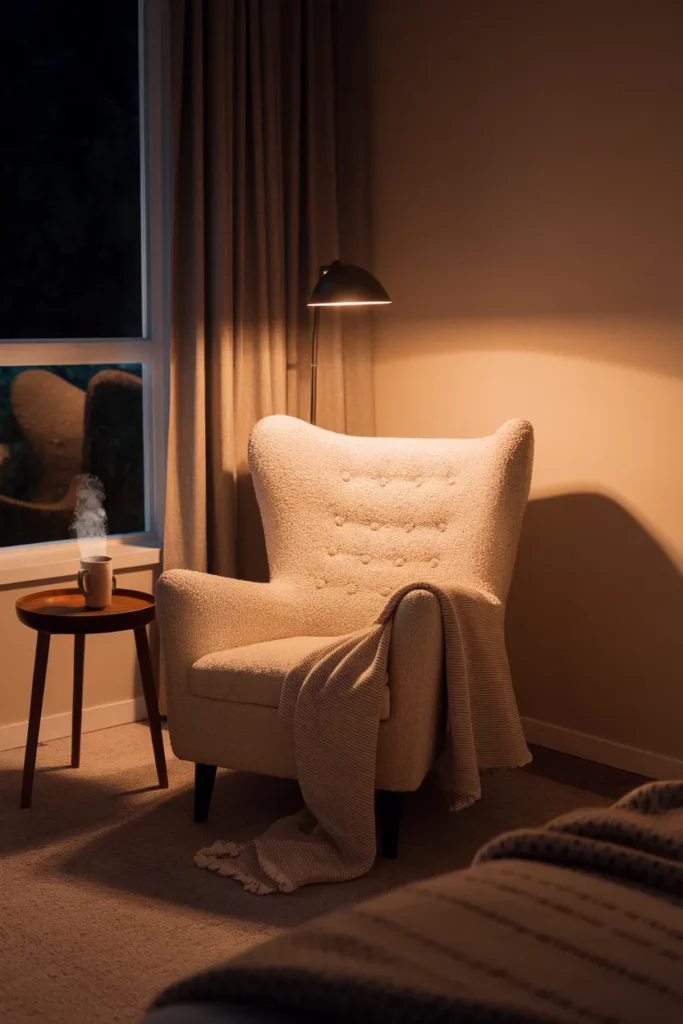
A cottagecore bedroom without a place to get lost in a book is a stage set. Claim the corner farthest from the door: one snug armchair (a thrifted boucle or wing chair, or an armchair in the IKEA Poang family with a floral seat cushion swapped in), one small side table, one dedicated light. Apply the 18-inch reach rule: the table surface lands within 18 inches of the chair arm, close enough that your mug never requires you to leave the cushion.
A floor cushion photographs like a dream, and your lower back files a complaint around minute forty, so give the corner a real chair and keep the cushion as a footrest. If you want to build this corner out properly, from chair angle to throw weight, our full guide to cottagecore reading nook ideas walks through 14 versions of it.
12. Switch every bulb to warm 2700K
I’d swap bulbs before I bought a single new pillow, because it’s the cheapest transformation on this list. Look for two numbers on the box: 2700K, the warm candle-adjacent color temperature, and at least 450 lumens for any lamp you read by.
Cool bulbs at 4000K and up are the invisible reason so many bedrooms feel like waiting rooms after dark; one 5000K “daylight” bulb can undo everything else on this page. LEDs also happen to be the frugal choice, and the Department of Energy’s home lighting guide puts average household savings from switching at about $225 a year. Add a $15 plug-in dimmer to your main lamp and the room gets a sunset on demand.
13. Mount a plug-in sconce beside the bed
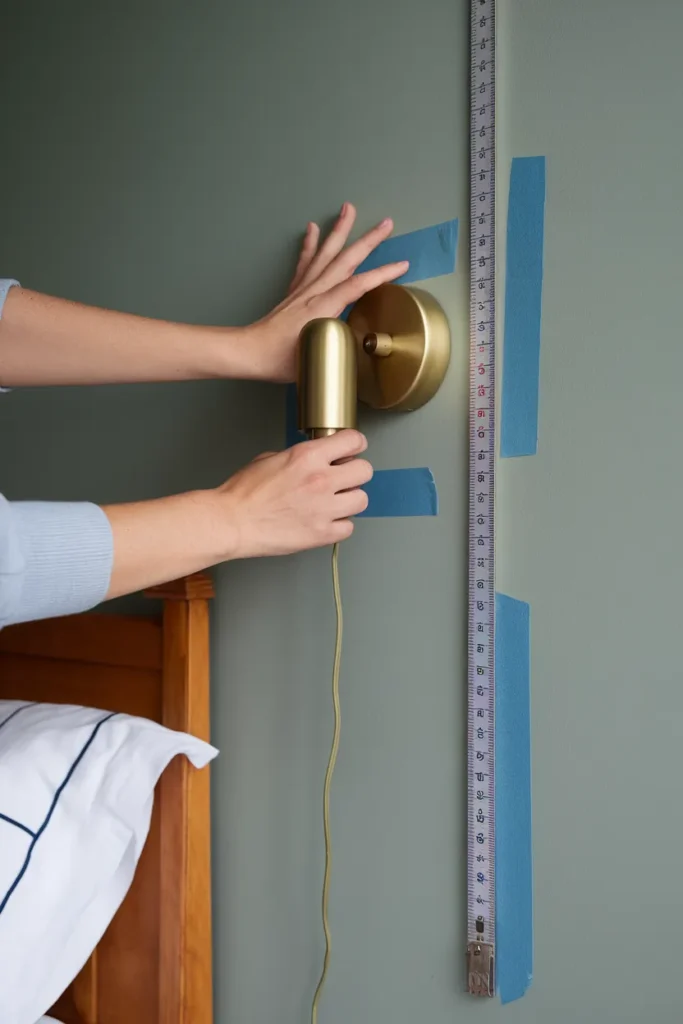
A wall sconce frees the entire nightstand for books and tea, and the plug-in kind installs without an electrician. Center the fixture roughly 55 to 60 inches from the floor, about shoulder height when you’re sitting up against the headboard, so light falls on the page instead of in your eyes.
A swing-arm version adds 8 to 12 inches of adjustable reach for under $60. Renters: heavy-duty adhesive hooks rated at 5 pounds carry most lightweight sconces, and a $10 paintable cord cover turns the dangling wire from eyesore into trim line. The classic mistake is mounting too high; light from above 65 inches pools on the floor, not the book.
14. String fairy lights in one zone only
Fairy lights work when they’re a detail and fail when they’re a system. Pick a single zone: woven through the headboard rails, draped along the top of one bookcase, or coiled inside a glass jar on the dresser. Warm white only, 2700K or lower, never the blue-white strands. A 10 foot battery strand with a timer costs $10 to $15 and switches itself off after you’re asleep. String them around the full perimeter of the ceiling and the room stops whispering countryside and starts shouting freshman dorm, which is the one association this style can’t survive.
15. Get candlelight without the open flame
Flicker is the fastest shortcut to hideaway atmosphere, and you can have it without a fire risk beside your bedding. Run one or two rechargeable flameless pillars with a realistic moving flame ($20 to $30 for a set with a remote) on the dresser or windowsill, and save one real beeswax candle for supervised evenings; real beeswax burns with a faint honey scent that no diffuser fakes. Keep any live flame at least 12 inches from curtains and never on the nightstand you reach across in the dark. Timer-enabled flameless sets that fade on at dusk make the room feel inhabited before you even walk in.
16. Bring in one easy trailing plant
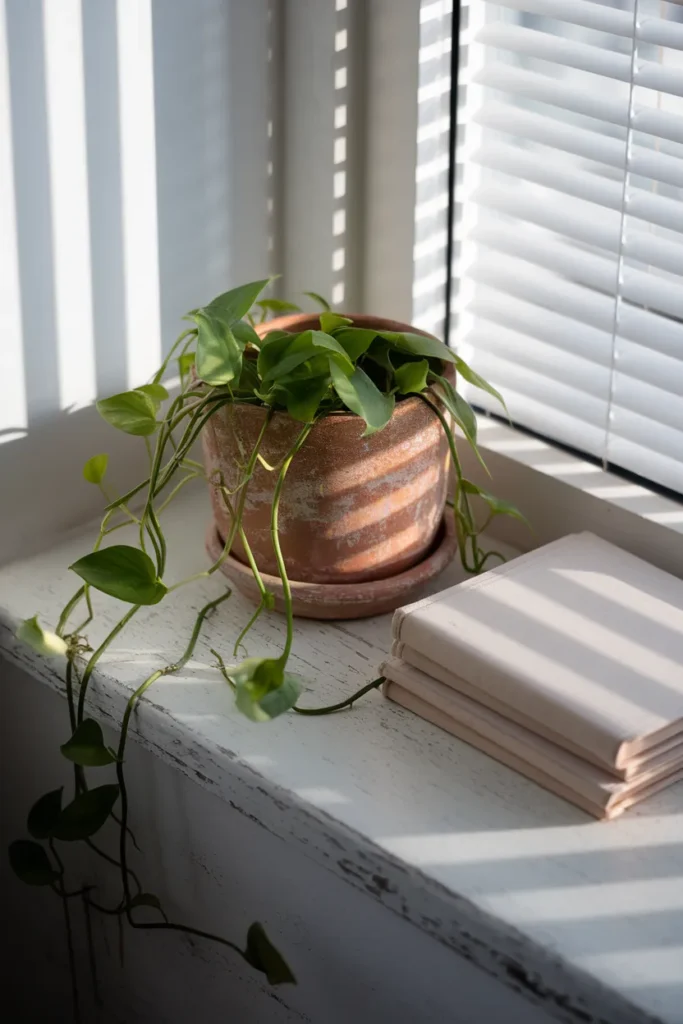
One live plant softens a room more than three shelves of decor, and the low-light champions make it nearly unkillable. A pothos or heartleaf philodendron in a terracotta pot tolerates the north-facing windows and shaded corners most bedrooms actually have, trailing 2 to 4 feet within a year. Terracotta matters beyond looks: the porous clay wicks excess moisture, which protects chronic overwaterers from themselves. Water only when the top inch of soil is dry; yellow leaves almost always mean too much love, not too little. For matching the right plant to your real light conditions, University of Minnesota Extension’s houseplant lighting guide is the reference worth bookmarking.
17. Dry flowers instead of buying decor
Dried stems are free or nearly free, they never wilt, and they carry more of the countryside than anything shipped in a box. Hang hydrangea heads, lavender bundles, or roadside grasses upside down in a closet for two to three weeks, then stand them in thrifted bottles and crocks. Lavender keeps releasing scent for months every time you brush past it. A $6 bunch of grocery-store eucalyptus dries beautifully right in the vase. The failure mode is direct sun, which bleaches dried stems to gray within a season, so park arrangements a few feet back from the window.
18. Build a collected gallery wall
Aim for the wall that looks assembled across ten years, not ordered in ten minutes. Mix thrifted landscape paintings, botanical prints, a small round mirror, and one pressed-flower frame, in mismatched wood and brass frames ($3 to $10 apiece secondhand; printed botanical sets start around $14 new). Hang the arrangement so its center sits 57 to 60 inches from the floor, the gallery standard that keeps art at eye level, and keep 2 to 3 inches between frames. Odd numbers hang easier than even. Lay the whole layout on the bed first and photograph it; rearranging on a mattress is free, and rearranging on a wall costs you a sunset of patching.
19. Let your books live in the open
Books are load-bearing decor in this style, so stop hiding them. A short ladder shelf or a low open bookcase keeps your TBR pile in reach of the bed, and horizontal stacks of three to five books make instant risers for a lamp or a plant on any surface. Arrange by nothing at all; color-coding reads like a showroom, and this aesthetic is allergic to showrooms. Old clothbound editions turn up at library sales for $1 to $3, and the faint vanilla smell of aging paper is a genuine part of the atmosphere. One caution: keep stacks off the floor near the bed’s walkway, because a 2 a.m. collision with a book tower ends the fantasy fast.
20. Add one piece of honest, worn wood
Every surface in the room shouldn’t be new, and one visibly aged wood piece is enough to anchor the rest. A weathered blanket chest at the foot of the bed, a chippy painted stool as a plant stand, or a reclaimed shelf above the dresser all do the job. You’re looking for wear that’s earned, softened edges, faded paint, tight old joints, not damage; wobbly legs and active cracks only get worse. Estate sales price small worn pieces at $20 to $80, well under boutique “vintage-style” reproductions. If a piece smells musty, a wipe-down with 1 part vinegar to 1 part water and a week airing out solves it in most cases.
21. The renter-safe route: zero drills, zero deductions
Everything above has a no-drill version, and this is the assembly manual. Walls: peel-and-stick paper and adhesive hooks (5 pound hooks for sconces and small frames, 16 pound picture-strip sets for mirrors and heavier art). Windows: tension rods inside the frame for cafe curtains. Lighting: plug-in sconces and lamps only, and I will always pick a plug-in sconce over hardwiring in a rental, because nothing about a security deposit is romantic. Furniture does the heavy lifting: a freestanding bookcase, a chest, a bed frame with presence, all of it moves out when you do. Test every adhesive product on a hidden patch for 48 hours first; fresh or cheap paint sometimes surrenders before the adhesive does. The same doctrine, applied to a full corner build, is in our no-drill reading nook setups for renters.
22. The $250 starter plan (copy this list)
Ideas are cheap and carts are honest, so here’s a real starter build, totaled. Prices are typical US bands as of mid-2026; thrift luck can push the total lower.
| Item | Source type | Typical price |
|---|---|---|
| Thrifted cotton quilt | Thrift or estate sale | $25 to $40 |
| 2 floral pillow covers + inserts | Big-box or online | $30 |
| Peel-and-stick wallpaper, 2 rolls | Online | $60 |
| Plug-in swing-arm sconce | Online | $35 |
| Two 2700K LED bulbs | Hardware store | $10 |
| Sheer cafe curtain + tension rod | Big-box | $25 |
| Small vintage nightstand | Marketplace | $20 |
| Pothos + terracotta pot | Nursery | $15 |
| Lavender sachet or dried bundle | Market or DIY | $8 |
| Total | $228 to $243 |
Sequence matters: bulbs and bedding first (biggest change per dollar), wallpaper second (biggest visual), everything else as you find it. Spending the same $250 on one showpiece item instead is the classic mistake; this style is a sum of small layers, not a single hero purchase.
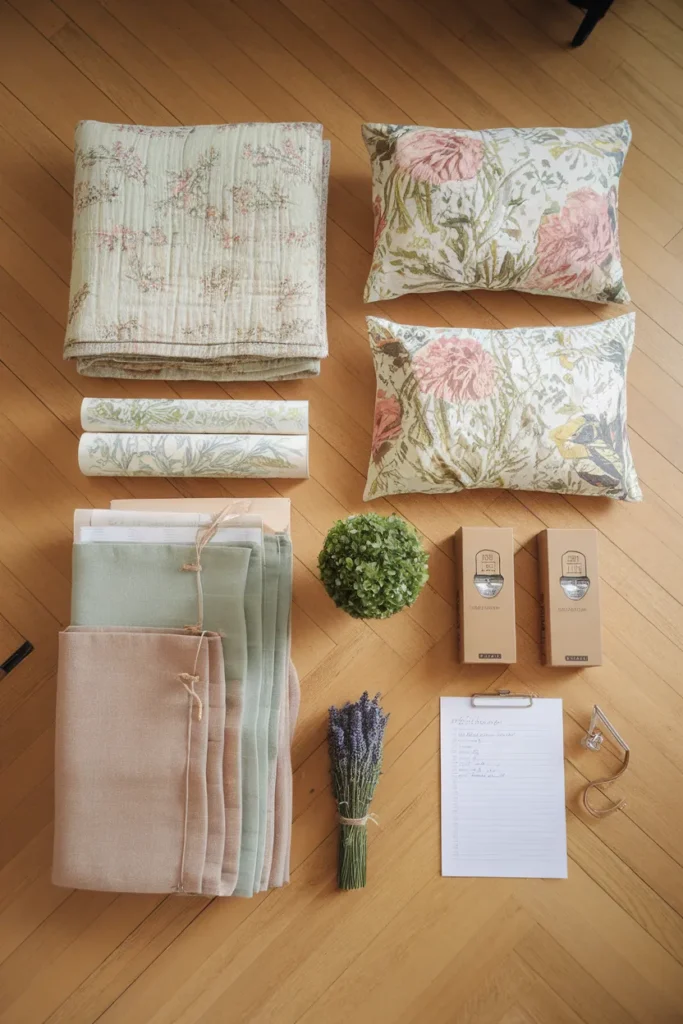
23. Go dark cottagecore if your room runs moody
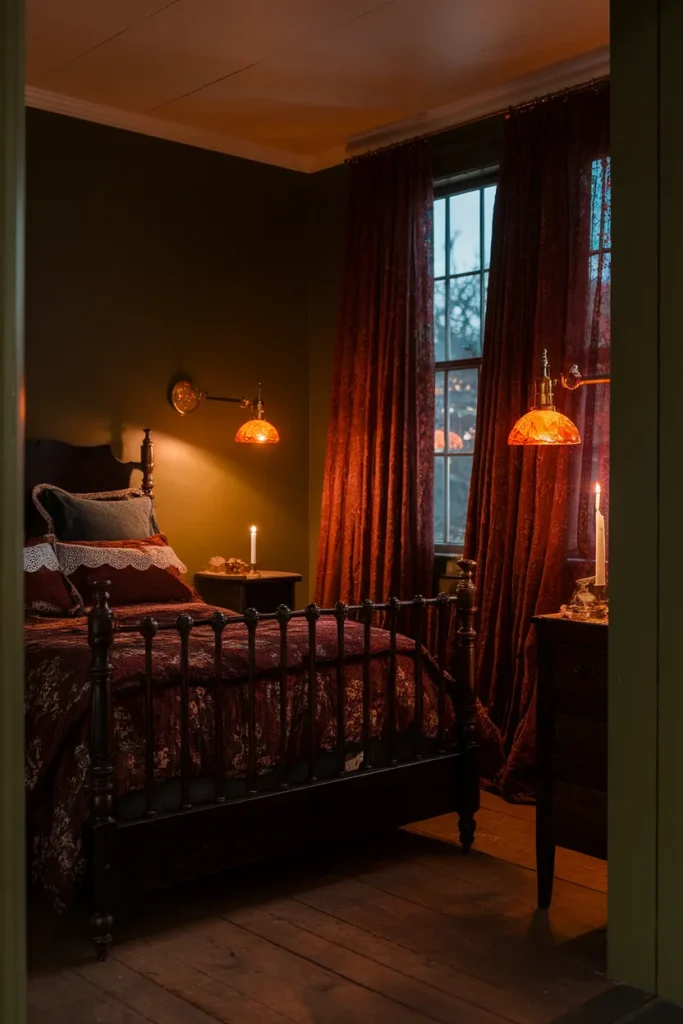
North-facing room, heavy tree cover, or just a taste for shadow: don’t fight it, feed it. Dark cottagecore trades pastels for olive, forest green, oxblood, and deep ochre while keeping every soft layer, and it sits squarely inside the moodier, history-heavy direction 2026 trend reports (Pinterest’s Vamp Romantic among them) keep pointing at.
Paint or paper one wall in olive, run a burgundy floral quilt, and double down on brass and amber lamp light. Dark walls absorb light, so budget roughly twice the lamp lumens you’d use against cream walls or the room slides from moody to murky. If the mossy, tucked-away-woods version calls to you, our forest reading nook guide translates the same palette into a corner you can copy.
24. Small cottagecore bedroom moves that keep air in the room
A small cottagecore bedroom fails when it’s furnished like a big one, not when it’s small. Keep walls light (cream, pale sage), choose one large-scale floral instead of five small prints, and hang a mirror opposite the window to bounce every hour of daylight twice. Guard your walkways: 24 inches of clear path beside the bed is the minimum that keeps a room usable, so in a 10 by 10 foot room a full bed usually serves the space better than a queen. Go vertical with a tall, narrow bookcase, and slide woven under-bed baskets into the dead zone below the frame. Clutter is the failure mode; this style loves objects, but a small room only forgives the ones you actually use.
25. Finish with scent and sound, not more stuff
The last layer costs almost nothing and does the most. A lavender sachet tucked into the pillowcase, a beeswax candle’s honey trace, the click of a kettle from down the hall, rain against the glass with the sheers drawn: these are the details that make a room feel inhabited instead of decorated. Keep one small tray by the bed for the evening ritual, tea, a paperback, the lamp dimmed to its lowest stop. Slow living is mostly just deciding the day is allowed to end. When the light is warm, the quilt has weight, and the air smells faintly of lavender, the room finally earns the word cozy. That’s the finish line, and no purchase gets you there faster than the ritual does.
FAQ: Cottagecore Bedroom Questions, Answered
What is a cottagecore bedroom?
It’s a bedroom styled around a romanticized version of countryside life: vintage and secondhand furniture, floral and gingham textiles, natural materials like linen, wood, and terracotta, and a muted, warm color palette. The defining quality is a collected-over-time feel rather than a matched set.
How do I create a cottagecore bedroom on a budget?
Thrift first: quilts, frames, nightstands, and small wood pieces cost a fraction secondhand. Put your new-purchase dollars into textiles and light (pillow covers, sheers, 2700K bulbs), and use paint sample pots and framed wallpaper samples for color. The $250 starter plan in idea 22 is a complete first pass.
What colors work in a cottagecore bedroom?
Sage green, dusty blush, cream, soft lavender, light blue, and butter yellow form the core palette, with olive and oxblood for the darker version. Avoid stark white, neon brights, and cool grays, which read modern and clinical against vintage textures.
Is cottagecore still in style in 2026?
Yes, and it’s maturing rather than fading. The 2026 direction is moodier and more historical: lace and doily details are climbing sharply in searches, butter yellow is expanding onto walls, and darker romantic palettes sit alongside the classic pastels.
What’s the difference between cottagecore and farmhouse style?
Farmhouse leans neutral and modern-rustic: whites, grays, black hardware, shiplap, and cleaner lines. Cottagecore leans romantic and collected: florals, color, lace, curved vintage furniture, and imperfect, softened finishes. Farmhouse tidies the country up; cottagecore lets it stay a little wild.
How do I make a small bedroom feel cottagecore without crowding it?
Light walls, one large-scale floral, a mirror opposite the window, and strict 24 inch walkways. Go vertical for book storage, use under-bed baskets, and limit yourself to objects with a job. Small rooms carry this style well because the aesthetic is built for snug spaces.
Bring It Home
You don’t need the cottage, the meadow, or the renovation. You need a bed layered in three parts, one warm bulb, and a corner that invites you to sit down with whatever you’re reading. Start tonight with idea 1, because restyling the bed costs nothing but fifteen minutes, then screenshot the $250 table and let the rest arrive one thrift trip at a time. If this gave you a plan, save it to your bedroom board so it’s there when the weekend is.
Keep reading
More cozy nook ideas
 Bedroom
Read →
Bedroom
Read →
English Cottage Bedroom Checklist: Everything to Decide Before You Start
You saved forty pins of floral quilts and sloped ceilings, then looked up at your own bedroom: beige walls, one window, a…
 Bedroom
Read →
Bedroom
Read →
21 Small Bedroom Ideas for Couples
Sixty-two and a quarter inches. That’s the width of a common IKEA queen storage frame, and in a 10 by 10 foot…
 Bedroom
Read →
Bedroom
Read →
Floral Bedding Ideas for a Cottagecore Bedroom That Still Looks Right in Daylight
No painting. No drilling. No conversation with your landlord. Floral Bedding Cottagecore is the one cottagecore move you can make in an…